Christ the Shepherd, Christ the Lamb
COMMENTARY: A good shepherd must be prepared to die for his sheep.

I once had an encounter with a hapless young cow that had gotten itself caught in a bush and, seeing that it was too stupid to figure out how to untangle itself, I simply went over and set the poor fellow free. He quickly rejoined his mother, who seemed grateful enough to get him back.
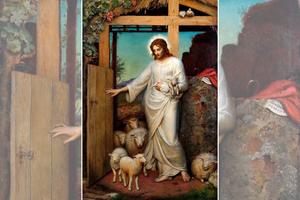
Too bad it wasn’t some poor sheep I’d rescued. Or, better still, a cute little lamb to remind me of Jesus, who seems to have had a special connection with such creatures. Isn’t that why we call him the Good Shepherd?
But why exactly? Is there some reason for the comparison besides the fact that shepherds and sheep abound in the Bible? So many, in fact, that they’ve quite cornered the market. Perhaps even more than the fish. I mean, who wasn’t a shepherd tending some flock or another? Why, in the Old Testament alone, nearly everyone has got a flock of some sort to look after. Between Abel and Abraham, there is no end of sheep.
Think of poor Jacob, for example, who spent 20 years looking after his Uncle Laban’s sheep, in order to win the hand of his two wives, Rachel and Leah. Or the sons of Jacob, who, when Joseph the youngest presents his brothers to Pharaoh, introduces them all as shepherds. Or Moses, who, before seeing the Angel of the Lord amid the flames of the burning bush, had been kept busy pasturing his father-in-law Jethro’s flock. Or young David, a man after God’s own heart, whom we first meet looking after his family’s sheep.
And let’s not forget those nameless shepherds who were the first to gaze upon the face of God himself, disguised as an infant on that magical first night of Christmas. Who, when fully grown himself, will become the most perfect shepherd, tending to the lost sheep of the house of Israel. Who will thereupon appoint no end of shepherds to continue the work he had begun. Which is to say, fulfilling the prophecy first set down by Isaiah seven centuries before: “He shall feed his flock like a shepherd: he shall gather the lambs with his arm, and carry them in his bosom, and shall gently lead those that are with young” (40:10-11).
So, what is it about sheep and the shepherds who look after them? Take the most apt and consoling example of all, that of Psalm 23, concerning which the psalmist reminds us that there is to be no fear among the sheep owing to the Good Shepherd who has come to comfort and look after them all. God is no ordinary shepherd, in other words, as the poet George Herbert makes clear in this lovely rendering of the text from King David:
The God of love my shepherd is,
And he that doth me feed:
While he is mine, and I am his,
What can I want or need?
He leads me to the tender grass,
Where I both feed and rest;
Then to the streams that gently pass:
In both I have the best.
Or if I stray, he doth convert
And bring my mind in frame:
And all this not for my desert,
But for his holy name.
Yea, in death’s shady black abode
Well may I walk, not fear:
For thou art with me; and thy rod
To guide, thy staff to bear.
Nay, thou dost make me sit and dine,
Even in my enemies’ sight:
My head with oil, my cup with wine
Runs over day and night.
Surely thy sweet and wondrous love
Shall measure all my days;
And as it never shall remove
So neither shall my praise.
The thing to keep in mind about sheep, and those who shepherd them, is that they belong together. They are constantly in each other’s company, so much so that the sheep know the voice of the shepherd so well that they will not listen to any other voice. And when lost or caught in some bush, it is the shepherd who goes in search of them. Who will not give up, will not stop looking, until he has found that one missing sheep. Doesn’t Jesus himself say, speaking of himself here, “What man of you, having a hundred sheep, if he has lost one of them, does not leave the ninety-nine in the wilderness, and go after the one which is lost, until he finds it” (Luke 15:4)?
And what does the shepherd then do, having at last found that errant sheep? He will lay it rejoicing upon his shoulders. And will, upon his return, summon all his friends and neighbors to celebrate its safe return.
Ensuring the safety of the sheep, then, is the job of the shepherd, the exercise of which is not an easy one owing to the helplessness of the sheep. Ask any shepherd and they will tell you how stupid and helpless they are, that without constant and unremitting care they will at once come to shipwreck, foolishly destroying themselves. The work of the shepherd is not a matter of a few hours a day dutifully spent in their company, but of an entire life burning in every moment, poured out in continuous sacrifice on their behalf. Less a holiday spent in the hill country amid the shrubs, than a bloody holocaust consumed in the crucible of self-giving love.
Not to put too fine a point on the matter, the shepherd must be willing to die for his sheep. There is no other way to account for calling Jesus the Good Shepherd than by referencing the fact that he becomes no less a lamb himself, who, by taking on the sins of the sheep, the whole weight of their travail, succeeds in atoning for every transgression ever committed.
- Keywords:
- good shepherd
- jesus christ
- lamb of god