How to Win the Battles in Spiritual Warfare
‘Take up the whole armor of God,’ says Ephesians 6:13, ‘so that you may be able to withstand on that evil day, and having done everything, to stand firm.’
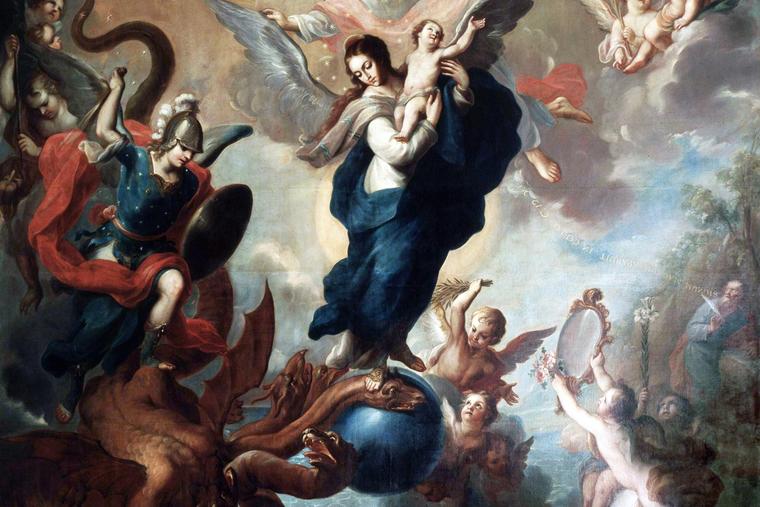
Spiritual warfare is a battle. It is no surprise that the Church on earth is known as the Church Militant. St. Paul knew it. Teaching the Ephesians, he compared the struggle to how Christians could adapt the example of a Roman military legion’s uniforms and weapons for battling against spiritual evil.
He did not let them go into this warfare unprepared and unarmed. Neither must Catholics. They can be constant victors in spiritual warfare if they know how to engage the enemy. Among those showing the winning way are two former military men — Dan Schneider, an adjunct theology professor at Franciscan University of Steubenville and a U.S. Army attack helicopter pilot and Gulf War veteran, and Jason “Hendo” Henderson, a retired U.S. Navy Seal Master Chief — whose perspective is backed by a Catholic priest.
Both men draw on the military approach with good reason. Schneider explains that Jesus delivers the Gerasene demoniac, whose name is Legion.
“So you’re up against a legion. At the time of Christ, the Roman legion would be 6,000 heavy infantry fighters. But we’re talking about spiritual combat, as St. Paul says, ‘not with flesh and blood, but with the powers and principalities’ of this earth.”
Marian Father Chris Alar, host of EWTN’s Living Divine Mercy, said this realization is vital.
“The best thing that we can do is know our enemy, how he acts and what he does,” Father Alar said. “Our enemy is not each other. It’s not the flesh and the blood; it’s powers and principalities that Paul tells us (Ephesians 6:12).”
Thus, the military approach.
Schneider cites Paul telling Timothy (2 Timothy 2:3), “‘Bear your share of the hardship of the gospel for me as a good soldier of Jesus Christ.’ Part of soldiering is bearing your share of the hardship. The word he uses in Greek is the word for interior goodness. So we soldier with purity, with virtue, with Christian values.”
“We’re in a battle greater than any world war,” Schneider continues. “Satan hates mankind because they were the reason for his fall. And throughout history, Satan has used our weaknesses. So next thing you have to do is not only be in a state of grace, but you’ve got to believe in the tenets of the faith.”
“God only puts levels of combat on us that we can handle,” Henderson stresses. “We just have to have faith that we will rise to the occasion. Our saints and exorcists have already done all the work. We just need to employ these tactics, techniques and procedures to our own lives.”
Father Alar also emphasizes, “The first thing we have to do is be in a state of grace. That is No. 1.”
Turning to fathers as one example, Henderson explains, “If we are not in a constant state of grace, then we leave our families vulnerable.”
Henderson links the battlefield analogy to vital questions: “What is the enemy thinking? And how can I counter and ensure that their agenda doesn’t get met?”
“Spiritual warfare is of great interest right now. People are recognizing that there’s been an increase of unexplainable evil in the world,” points out Schneider. “But this is not new to the Catholics.”
Citing the Catechism (409), he adds, “From the Garden, we see humanity at war, in conflict with an eternal enemy.”
Henderson, founder and CEO of The Northstar Group, a Catholic ministry working with combat veterans and first responders on spiritual and moral challenges, has seen both profound evil and great goodness under extreme conditions — experiences that “cultivated my interest in spiritual warfare and helped me to fully commit to the war,” as he puts it.
He adds that this spiritual war runs throughout history. “But we ignored it to focus on self-gratification. The world’s cultures celebrate evil and we are rapidly spiraling towards our own demise. We need to collectively resist.”
“It’s important for Catholics to recognize that there is a battle taking place,” Schneider notes. With combat inevitable, according to the Church’s teaching, “we have to learn: What are the rules of engagement, and how do we safely and effectively fight as Catholics with the tools and the weapons that the Church has given us?”
“This is why we need confession as we start to progress through those spiritual attacks,” Father Alar adds, underscoring the sacraments. “Confession is more powerful than an exorcism because confession is a sacrament. Exorcism is just a sacramental.”
Schneider, author of The Liber Christo Method: A Field Manual for Spiritual Combat, Sins of the Father, and Spiritual Warfare Q and A: For Priests and Laity, emphasizes that our strength comes from Christ — through the sacraments, virtue, and purity of thought, word and deed.
He stresses staying focused on Jesus Christ and living out our baptismal dignity.
“We have to be grounded in the truth, orthodoxy and orthopraxy, right thinking and right practice,” Schneider says. “We have to get our right understanding and right living of the Church’s teaching on sexual ethics. Important for spiritual combat is seeing, living and practicing what the Church teaches.”
That includes countering the seven deadly sins with the seven capital virtues, Henderson notes, citing how pride is countered by “being more of a servant instead of self-serving.”
Regular confession and a life ordered to prayer, penance and sacrifice are the ordinary means of our sanctification, Schneider says.
“Prayer and fasting are critical. We have to start engaging with our bodies. These are our spiritual armaments, our defensive weapons for combat. These are the ancient weapons. We fight an ancient enemy, and the ancient weapons are the best.”
Adds Father Alar, “The most important prayer is the Mass.” He also emphasizes fasting, which breaks the “control of the flesh over the spirit. Jesus says that fasting removes even the worst demons.”
Marian devotion also has a central place in the fray.
As Father Alar emphasizes, “Mary and Divine Mercy are the spiritual weapons of our time.”
Schneider calls Marian devotion and consecration to the Blessed Mother “absolutely critical in spiritual combat. She is our protective armor.”
Father Alar adds that devotion to Mary is essential because, as St. Louis de Montfort wrote in True Devotion to Mary, “Satan fears Mary more than God.”
“He knows God is God, he knows he’s a creature, and he knows that God has ultimate power and can whip him,” he says. “But to lose to this young Jewish girl who was chosen by God … her humility is more than his pride can handle. That’s why Satan, in his pride, fears Mary more than God. And he flees at the first sign of her presence. He does not take on Mary. Satan knows that he will be defeated by Mary’s humility.”
Henderson concurs, citing the necessity of consecration to Mary — and also to St. Joseph, pointing to Marian Father Donald Calloway’s Consecration to St. Joseph as especially helpful.
Continuing the military analogy, Schneider calls the brown scapular “the dog tag for the Christian soldier.”
Critical, too, is the Rosary. Schneider recalls how Padre Pio asked a young friar to “bring my weapon to me: Give me my rosary.” When the Blessed Mother gave the Rosary to St. Dominic, she called it a “battering ram.”
“So the Rosary is an offensive weapon,” he says. “Every Catholic should be praying at least one Rosary a day.”
“In spiritual warfare,” Father Alar adds, “every time you pray, ‘Hail Mary,’ it’s like shooting a bullet into the devil. Then that makes the Rosary a machine gun.”
There is no need to fear in this combat. Armed with heavenly weapons, the faithful can be victorious Christian soldiers.
As Schneider puts it, “We stand under a Queen who is a 12-star general, and St. Michael, her chief commander of the heavenly host.”
- Keywords:
- spiritual warfare