Pope Leo XIV: ‘A Son of St. Augustine’
COMMENTARY: The Pope has put forward Augustine as his great friend, father and companion on the Way of Christ.

God, Pope Francis reminded us, is a God of surprises — and that was the case not only with the election of Jorge Mario Bergoglio to the papacy but also with his successor Robert Francis Prevost. Once again, the pope brings to Rome a series of startling firsts: he is the first pope from the United States of America, the first pope from the Order of Saint Augustine, and — what is perhaps the bigger story in the grand scheme — the first pope with an active social-media account before his elevation to the chair of Peter.
There will be (and in fact already is) a deluge of analysis on who Robert Prevost is, what he’s said online, and the direction he’s likely to take the Church. And there will, of course, be a special focus on his striking selection of the name Leo XIV, after that trailblazer of modern Catholic social teaching revered by both traditional and progressive Catholics, Leo XIII. Truth be told, it seems that Prevost has generally held his cards rather close to the vest, and only time will tell what kind of pontificate his will be.
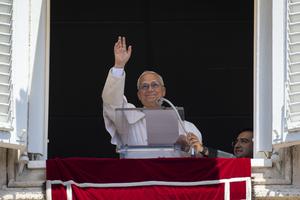
In the meantime, in these early days, I think it’s worth pausing to reflect on how Leo XIV — his papal name aside — chose to introduce himself on the loggia of St. Peter’s Basilica: “I am a son of St. Augustine, an Augustinian.” He then quoted the great saint and doctor of the Church: “With you I am a Christian and for you I am a bishop.”
Augustine of Hippo (354-430) is perhaps too easily overlooked in the history of Church precisely because of his prominence. He’s widely considered one of the greatest saints, theologians and writers of Christian tradition, not only among Catholics but also among Protestants. (The Reformers famously revered him.) And he’s wielded incalculable influence on Christian thought and life, especially through his two masterpieces: the Confessions and the City of God. (Even Thomas Aquinas, that other towering saint and thinker, famously cited Augustine in his Summa more than Aristotle.) Yet it would be a great mistake to relegate Augustine to the Christian past; as I’ve argued elsewhere, the Confessions is uniquely suited to the present age and its particular dysfunctions. In fact, with a few changes in language, time and place, it could easily read like a 21st-century conversion memoir.
With Prevost, the question is less where Augustine has shown up in his journey and more where he hasn’t. He completed high school at St. Augustine Seminary, a minor seminary in Michigan; he attended Villanova University, founded by the Augustinians; at the Pontifical University of St. Thomas Aquinas in Rome, his doctoral thesis was on “The Role of the Local Prior in the Order of Saint Augustine”; in 1977, he joined the Order of Saint Augustine as a novice, taking solemn vows in 1981 and joining the Augustinian mission in Peru four years later; in 1998, he was elected prior provincial of the order’s Province of Our Mother of Good Counsel in Chicago; then, in 2001, he was elected prior general of the entire Order of Saint Augustine, serving two six-year terms. Even his motto as bishop — In illo uno unum (“In the One, we are one” or “In the one Christ we are one”) — is taken from the “Doctor of Grace.”
Prevost’s long walk with Augustine also emerges on his personal Twitter feed, where he not only posted about the Order of Saint Augustine but also quoted the great saint no less a dozen times in three languages. And we find, among other things, an emphasis on those classic Augustinian themes: the restless heart, the grace of God, the “gravity” of one’s love.
- The measure of love is to love without measure. (Posted three times in Spanish/Italian.)
- Late have I loved you, O Beauty ever ancient and ever new! (English)
- The grace of God will not take you where the grace of God will not sustain you. (English)
- See what you believe in and become what you receive! (English — in reference to the Eucharist)
- He who has God has everything, and he who has not God has nothing. (English)
- If you want to know a person, don’t ask what he thinks but what he loves. (Spanish)
- Men are not saved by good works, nor by the free determination of their own will, but by the grace of God through faith. (English)
- You have made us for yourself and our hearts are restless till they rest in you. (Spanish)
- No one reaches the Kingdom of Heaven except by humility. (English)
- Don’t let your life give evidence against your tongue. (Spanish)
- True friendship ... is not to be judged by temporal advantages but is to be valued as gratuitous. (Spanish)
- Our thoughts in this present life should turn on the praise of God, because it is in praising God that we shall rejoice for ever in the life to come; and no one can be ready for the next life unless he trains himself for it now. (English — the first line of an Easter homily to which Prevost posted a link)
In a 2023 Catholic News Service video introducing the world to the then newly elected head of the Dicastery for Bishops, Cardinal Prevost talked about — what else — St. Augustine, the Confessions, and the deeply Augustinian theme of not finding our ultimate happiness in worldly goods or personal experience.
Then, in a 2024 presentation to St. Jude Catholic Church in Illinois, he opened by saying, “I’m an Augustinian. ... I have personally a great debt to the Order of Saint Augustine, to St. Augustine himself, [his] philosophy, theology, thought, humanity; that great love of Augustine for God’s Word, that infinite searching for truth, for himself, and for God in himself; and for everything that Augustine taught in terms of communion and community that marked my life.”
Now, as Pope Leo XIV, he’s once again put forward Augustine as his great friend, father and companion on the Way of Christ: “I am a son of St. Augustine.”
Perhaps a good way to begin to get to know Pope Leo XIV in the coming days is by getting to know his great model of the faith — maybe by watching Bishop Barron’s Pivotal Players episode on the saint (available for free on YouTube) or by reading the Confessions. How exactly the great saint’s spirituality will come into play in his pontificate remains to be seen. But one thing seems certain: It will.
Matthew Becklo is a husband and father, writer and editor, and the publishing director for Word on Fire Catholic Ministries. His first book, The Way of Heaven and Earth: From Either/Or to the Catholic Both/And, was released in 2025.
- Keywords:
- Pope Leo XIV
- st. augustine