Spy Wednesday: What the Church Fathers Say About Judas’ 30 Pieces of Silver
The Catena Aurea and other patristic sources reveal that the price of Christ’s betrayal was anything but arbitrary.
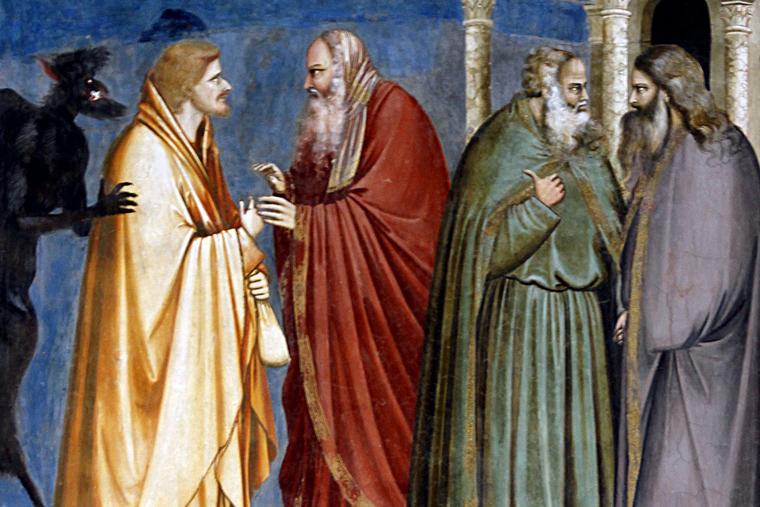
Judas Iscariot’s underhanded, “secret” arrangement with the chief priests to betray Jesus for 30 pieces of silver is the reason that this final day before the Sacred Triduum is known as “Spy Wednesday.”
Of course, to Our Lord, there was never anything secret about Judas’ plan. According to Old Testament prophets, as well as Fathers and Doctors of the Church, neither was there anything random about the evil agreement.
Knowing the chief priests sought to kill Jesus, Judas may have been motivated to seek money from them because Our Lord allowed a woman — by some accounts, St. Mary Magdalene — to pour a jar of costly ointment on his head (Matthew 26:6-13).
Since Judas controlled the money bag for Our Lord and the apostles, he may have sought to replace that money, which he states in John 12:5 was 300 denarii, according to St. Jerome, as recorded in the Catena Aurea, a commentary on the Gospels in the writings of Church Fathers compiled by St. Thomas Aquinas.
Judas’ downfall may have been covetousness, said St. John Chrysostom, which “makes men irreligious, and compels them to lose all knowledge of God, though they have received a thousand benefits from him, nay, even to injure him, as it follows.”
As a thief who seemed to know the value of things, it’s somewhat surprising that Judas lets the chief priests set the price for Christ’s betrayal. Thirty pieces, or shekels, of silver was enough to tempt Judas, but it wasn’t a great amount, according to an article on CatholicShare.com. It was equal to 120 denarii or four months’ wages, the price of a slave (Exodus 21:32).
Thirty shekels was also the amount the prophet Zechariah was paid for working as a shepherd — which he cast into the Temple treasury at the Lord’s command, unlike the chief priests whom Judas bargained with (Zechariah 11:12-13).
St. Jerome pointed out that Joseph of the Old Testament was probably sold by his brothers into slavery in Egypt for 20 shekels of silver (Genesis 37:28), “for it could not be that the servant should be more valuable than his Master.”
The amount shows the Jews’ unrighteousness, St. Augustine wrote. “Who, pursuing things carnal and temporal, which belong to the five bodily senses, refuse to have Christ; and forasmuch as they did this in the sixth age of the world, their receiving five times six as the price of the Lord is thus signified,” he wrote.
“The Lord’s words are silver,” he said. “but they understood even the Law carnally, they had, as it were, stamped on silver the image of that worldly dominion which they held to when they renounced the Lord.”
Scripture doesn’t reveal where the money offered to Judas came from. But St. Luke identifies the source as the “chief priests and captains.”
And Theophylact, an 11th-century Byzantine Archbishop of Ohrid (now including Bulgaria), wrote that some were magistrates “appointed to take care of the buildings of the Temple, or it may be those whom the Romans had set over the people to keep them from breaking forth into tumult.”
Maybe the 30 shekels of silver were quietly taken out of building-related funds. But when Judas, with regret, returned the money to the Temple, the perpetrators — now identifying it as “blood money” — decided it couldn’t go into the Temple treasury.
“Judas, when he saw that the Lord was condemned to death, returned the money to the priests, as though it had been in his power to change the minds of his persecutors,” St. Jerome wrote.
The decision not to put the money into the Temple treasury was “truly straining out the gnat, and swallowing the camel,” St. Jerome wrote, making an allusion to a Gospel saying. “For if they would not put the money into the treasury, because it was the price of blood, why did they shed the blood at all?”
Their purchase, instead, of a potter’s field for the burial of foreigners, coincides with the Lord’s command that the prophet Jeremiah purchase a field for 17 shekels (Jeremiah 32:7-9; 25).
Burial of foreigners in the potter’s field could represent those who are alienated from God. They are buried in the “field of blood,” wrote Origen, while the righteous are buried with Christ in a new tomb.
But it may be God’s Providence that the field was purchased by the price of the Lord’s blood, wrote St. Augustine, “thence Christ might both redeem the living by the shedding of his blood, and harbor the dead by the price of his passion.”
He continued: “We read in Scripture that the salvation of the whole human race has been purchased by the Savior’s blood. This field, then, is the whole world. The potter who is the Lord of the soil, is he who has formed of clay the vessels of our bodies … for the burial of Christ is nothing but the repose of a Christian; for as the Apostle (St. Paul) says, ‘We are buried with him by baptism into death’ (Romans 6:4). We are in this life then as foreigners.”
In the end, Judas’ terrible Spy Wednesday “deal” led to his demise and Our Lord’s suffering and death, but we are the beneficiaries of it, according to a text attributed to St. Augustine.
“Exult, Christian, you have gained by this bargain of your enemies; what Judas sold, and what the Jews bought, belongs to you.”
- Keywords:
- judas
- spy wednesday