5 Ways the 2025 Solemnity of Sts. Peter and Paul Speaks to US Catholics
A new Pope, a revived tradition, and nine American archbishops in Rome mark this year’s solemnity.

The Solemnity of St. Peter and St. Paul — the princes of the apostles and the patrons of the city of Rome — will take on a special character this year, especially for American Catholics.
The feast falls on Sunday, so while it is always observed with a papal Mass in Rome, every parish will also keep the feast, as it outranks a Sunday in Ordinary Time. In fact, it caps off four consecutive Sunday “solemnities” this June: Pentecost, Most Holy Trinity, Corpus Christi and Peter and Paul.
Here are five things to note about the Solemnity of Sts. Peter and Paul in 2025.
A New Pope
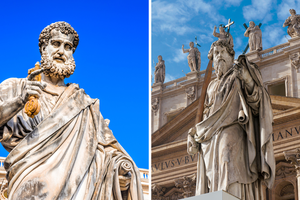
It will be Pope Leo XIV’s first opportunity to preach on the patronal feast of his city and on the figure of Peter, which animates the iconography of St. Peter’s Basilica. What will he emphasize? Already this year, he has had several occasions to hear John 21 — “Simon, do you love me?” — proclaimed, at the funeral of Pope Francis, at Sunday Mass before the conclave, at his inaugural Mass as Pope.
The Gospel passage for Peter and Paul is Matthew 16: “You are Peter and upon this rock I will build my Church.” Leo XIV began his first homily the day after his election by quoting Peter’s confession of faith from the same passage: “You are the Christ, the Son of the living God.”
While Matthew 16 is the principal text for the Petrine office, different popes choose to emphasize different biblical verses. Benedict XVI tended toward John 21, while St. John Paul the Great often cast his office in light of Luke 22:32, where Jesus speaks of Peter’s denials: “I have prayed for you, that your faith may not fail; and when you have turned again, strengthen your brethren.”
Biblical Inscriptions
Given the Gospel reading for the feast, pilgrims in St. Peter’s will be especially attentive to the biblical verse inscribed with giant letters inside the base of the cupola, Matthew 16:18 — “Tu es Petrus …” (“You are Peter …”).
What is less noticed is that along the vast nave and transepts of St. Peter’s are the other verses associated with the Petrine office — John 21 and Luke 22. The basilica is encircled, as it were, by the biblical mission given to Peter.
Americans may know that there is a St. Peter’s parish near Capitol Hill in Washington. Along the nave is inscribed “Tu es Petrus …” in Latin. But in the sanctuary, it prominently has the words of Peter to Jesus, his confession of faith: “Tu es Christus Filius Dei Vivi” (“You are the Christ, Son of the living God”).
Somehow, the Washington option seems better in following the biblical order — first the confession of Christ as Son of God, then the constitution of Peter as the rock upon which the Church will be built.
At St. Peter’s Basilica in Rome, there is a ready explanation for its design choice: The cupola is directly above the tomb of Peter itself. The basilica is, quite literally, built upon the rock of Peter.
Some years ago, a memoir from the late Gregory Baum, an influential but heterodox Canadian theologian, recalled a conversation he had with a young Father Joseph Ratzinger at Vatican II. They were looking up at the cupola. Baum remembers Ratzinger saying that to be complete, it should also include the later verses of Matthew 16: “Vade retro Satana” (“Get behind me, Satan”).
I don’t know if Ratzinger said that, but there is truth to it. The primacy of Peter is willed by Christ, but he remains very much an “earthen vessel,” as St. Paul himself expressed the human weakness of apostolic instruments.
A New Tradition
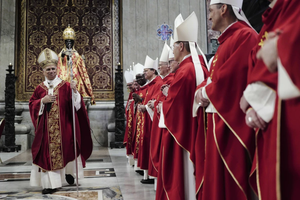
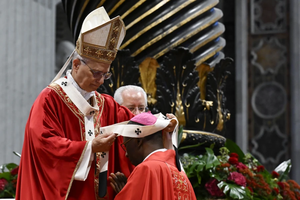
John Paul started a new “tradition” on Peter and Paul’s feast in 1983, the Extraordinary Jubilee Year of the Redemption. He would bless the pallia that new metropolitan archbishops wear and place it upon their shoulders. Each year, all the new archbishops appointed since the last feast of Peter and Paul would come to Rome for the feast-day Mass and have the pallium imposed upon them by the Holy Father.
The pallium symbolizes the good shepherd who carries the sheep on his shoulders. It is a woolen band that archbishops wear over their chasubles when celebrating Mass in their own “provinces.”
For example, Cardinal Timothy Dolan would wear the pallium anywhere in the ecclesiastical province of New York, which includes all the dioceses in the state of New York. Given that there can only ever be one archbishop present in his own province, the Peter and Paul Mass is the rare occasion where pallia are worn by multiple archbishops at the same Mass.
Pope Benedict XVI kept the new tradition, but Pope Francis modified it, only blessing the pallia and then sending them home to be imposed by the local nuncio in the new archbishop’s cathedral. Pope Leo has decided to resume the tradition, which is 42 years old.
An Early Fourth?
There will be nine new American archbishops in Rome to receive the pallium this Peter and Paul feast day; it’s an unusually high number. They include the new archbishops of Boston, Cincinnati, Detroit, Galveston-Houston, Kansas City in Kansas, Milwaukee, Omaha and Washington, as well as Guam, a U.S. territory. Given that there are 33 American archbishops, fully a quarter were appointed in the last 12 months.
With a pope from Chicago, this Solemnity of Sts. Peter and Paul can lay claim to being the most American in history. Perhaps on Sunday afternoon, the Holy Father might invite the American archbishops for an early Fourth of July barbecue, Italian style, meaning wine instead of beer.
Religious Freedom Week Concludes
Peter and Paul marks the conclusion of the United States bishops’ Religious Freedom Week. It begins on June 22, the feast of St. John Fisher and St. Thomas More. St. Peter was very much on St. Thomas More’s mind as he went to his death.
St. John Fisher was executed on June 22, 1535. The “trial” of Thomas More was set for July 1; after what had happened to Bishop Fisher, More would have had little doubt of what lay ahead for him. More lived a deeply liturgical life, and so he would have been thinking about Peter and Paul as he was put on trial just two days after their joint feast.
More would be executed on July 6, 1535, within the octave of Peter and Paul, which was observed liturgically at that time. He noted as much in his last letter, written with a piece of charcoal to his daughter Margaret. Earlier, he had also written a letter from prison to his daughter, which is now included in the Divine Office for his feast day.
“I will not mistrust [God], Meg, though I shall feel myself weakening and on the verge of being overcome with fear,” More wrote. “I shall remember how St. Peter at a blast of wind began to sink because of his lack of faith, and I shall do as he did: Call upon Christ and pray to him for help. And then I trust he shall place his holy hand on me and in the stormy seas hold me up from drowning.”
The Petrine theme continued as More contemplated his martyrdom, revisiting the scenes of Luke 22: “And if he permits me to play St. Peter further and to fall to the ground and to swear and forswear, may God our Lord in his tender mercy keep me from this, and let me lose if it so happen, and never win thereby! Still, if this should happen, afterward I trust that in his goodness he will look on me with pity as he did upon St. Peter, and make me stand up again and confess the truth of my conscience afresh and endure here the shame and harm of my own fault.”
A new Pope, a new tradition, Petrine inscriptions, an American day in Rome, and a martyr inspired by Peter — Peter and Paul Day 2025 has an abundance of spiritual riches.