The Jubilee of Migrants Mirrors the Catholic Church’s Own Journey of Hope
COMMENTARY: The commemoration offers us an important opportunity to reflect on the challenges but also the opportunities brought about by migration.
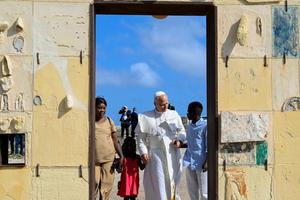
On Oct. 4-5, the Catholic Church will celebrate the 111th World Day of Migrants and Refugees as part of the Jubilees of Migrants and the Missions. This commemoration recalls a harsh reality that is not itself cause for celebration: the difficult situation of countless millions of people who have been forcibly displaced from their homes and who struggle to find a new place to live. The number of such persons has reached record levels in recent years.
The World Day is dedicated to both refugees, who are forced to flee their country, as well as migrants, who move to a new country — at least in the case of “international migrants” — in search of a better livelihood. The latter group has come to encompass some 280 million people, and is a special focus of the Church’s attention for the myriad challenges they face in adjusting to their new home.
Pope Leo XIV, in his message for the occasion, notes the sad circumstances of “wars, violence, injustice and extreme weather events, which force millions of people to leave their homelands in search of refuge elsewhere.” He further describes the various serious challenges faced by displaced persons in finding welcome, along with the broader world problems — military buildup, the climate crisis and economic inequalities — that complicate this picture.
Nonetheless, in the face of these trying circumstances, the Holy Father invites us to renew our hope in the future peace which was announced by the prophets and has already become a reality in Jesus Christ (see Mark 1:15; Luke 17:21), even as we still “believe and hope in its full realization.”
Such an attitude of hope draws strength from the awareness that migration, for all the hardships it entails, has historically been a source of cultural, economic and spiritual enrichment for our country and others.
In the face of various humanitarian crises, the welcome of refugees has been an important means of expressing solidarity and welcome. Along with many examples from U.S. history, we can think of the welcome offered in Poland to more than 2 million refugees from the war in Ukraine, mostly in private homes. Refugees make up about a quarter of Lebanon’s population, and this small country has made notable efforts to provide for the education and health of many persons fleeing the recent war in Syria.
At the same time, such movements of persons have created significant dilemmas, and not just in contemporary times. The Second World War created an unprecedented refugee crisis, with as many as 65 million people forced to leave their homes.
The international community, including the U.S., reacted with the landmark 1951 Refugee Convention, the first comprehensive document aimed at defining and protecting the basic human rights of refugees. Such protections include the right not to be returned to the country where they had experienced persecution, a need that had become particularly evident in the tragic situations of groups of Jews and others fleeing Nazi Germany. The text applies to Europeans who were displaced after World War II. In 1967, these principles became applicable to all refugees and over the years have served to protect millions of persons in dire humanitarian situations.
The 1960s also witnessed a significant change in immigration law in the United States. The Immigration and Nationality Act of 1965, based on a draft bill sent to Congress by President John F. Kennedy in 1963 and signed into law by President Lyndon B. Johnson, gave immigration status to a far more universal range of persons than before, when preference had been given to those from northern Europe and the British Isles. The law led to a new global wave of immigration, mostly from Latin America and Asia, following previous waves of migration from Europe. The act led to a vast number of new people in the U.S. who would become a vital part of the country’s economy and culture. At the same time, the law for the first time put limits on immigration from the Americas, far below the needs of the U.S. economy, and led to a surge in undocumented immigrants from Latin America.
Hence, while laws have opened the door to a more global migration and brought about a better livelihood for countless people, they have not always kept pace with reality. The result is that a vast number of migrants, in the United States and many other countries, lack legal status in their new places of residence and, as a result, live in particularly precarious circumstances from an economic and humanitarian point of view.
Christians, like their fellow citizens, should be committed to the rule of law. How, then, to approach the irregular legal situation of so many millions of persons in the U.S. and elsewhere?
Without neglecting due respect for the law, we are nonetheless called to look beyond the legal dimension and recognize each migrant and refugee as a person who deserves respect and charity.
As the U.S. Catholic bishops affirmed in a statement from the year 2000:
“Without condoning undocumented migration, the Church supports the human rights of all people and offers them pastoral care, education, and social services, no matter what the circumstances of entry into this country, and it works for the respect of the human dignity of all.”
Such an attitude, as the bishops note, is deeply rooted in Sacred Scripture and in the Church’s perennial teaching. The Chosen People of God were themselves once a migrant people, and were taught by God to have compassion on those in this condition (Exodus 23:9).
Christ would bring this cross-ethnic charity to a new level, as seen, for example, in his dialogue with the Samaritan woman (John 4). The Church, seeking to follow this example, strives to address the human and supernatural needs of migrants and refugees, including the issue of their legal status.
Thus, without ignoring the significant challenges that displacement can bring for both migrants and their host countries, we can see migration not simply as a problem but also as an important opportunity for growth for all those involved. Pope Leo XIV, in his message for the World Day of Migrants, asserts that migrants and refugees “stand as messengers of hope,” who furthermore “remind the Church of her pilgrim dimension.”
Such a role is underscored by the decision, made by Pope Francis, to hold a commemoration for migrants at the same time as the Jubilee for Missions. With “their spiritual enthusiasm and vitality,” Leo suggests, displaced persons can “help revitalize ecclesial communities” in a time of growing secularization. They provide an occasion for host communities to exercise justice, charity and solidarity — virtues that redound to the benefit of society.
The Jubilee of Migrants, then, is indeed a cause for celebration as well as constructive reflection. The occasion is an opportunity to go beyond the fears and anxieties we may feel in the face of displacement, and to look with hope to that future peace, announced by the prophets, which already in a certain way can become a reality in our society today.
In this way, our communities can be, as the Holy Father states, “a living witness to hope, one that is understood as the promise of a present and a future where the dignity of all as children of God is recognized.”
- Keywords:
- jubilee of migrants
- migrants
- immigration
- refugees

Father Joseph Thomas Opus Dei Father Joseph Thomas, based in Princeton, New Jersey, is dedicated to ministry that focuses on college students. He writes regularly on theological topics and is the author of The Theology of Divine Grace (Scepter, 2023). He also serves as the U.S. representative for the Pontifical University of the Holy Cross in Rome.