Ex Corde Ecclesiae at 35: Why Catholic Universities Must Stay Catholic
COMMENTARY: The Church’s vision for higher education is not compromise but transformation — universities that are ordered to truth, love and worship.

The message of Ex Corde Ecclesiae (From the Heart of the Church), promulgated 35 years ago by Pope St. John Paul II, is as relevant today as it was when it was first published. There is a single, fundamental through-line in Ex Corde, one that is at the very heart of Christianity: The Gospel has the power to assimilate to itself all that is authentically human, and in this assimilation, it perfects and transforms what it assimilates and does not harm or diminish it.
This point is worth a deeper look, as it applies to higher education, but it has its foundation in the Incarnation. And in the end, when Catholic universities bracket or eschew their Catholic identity in order to be a “real university,” they deny one of the fundamental truths of Christianity itself.
We can see the assimilative power of the Gospel above all in the Incarnation. Over many centuries of struggle and reflection, the Church has refined her understanding of the mystery that stands at the heart of our faith.
The Son of God, eternally with the Father and the Holy Spirit, made his own a human mind and a human body. This mind and body are genuinely his, and so they express his person, his identity as the Son of the Father, thus making known to us the inner life of God.
But their union with the Son of God does not make them less human — the humanity of Jesus is not abridged, truncated, dissolved, overwhelmed or diminished because of its union with his divinity. Jesus is divine but not thereby less human.
The Incarnation thus shows us the dignity and power of human nature. We would never have imagined God himself could truly make his own a human mind and body, and that while remaining what they are, they nonetheless take on a higher purpose and dignity, showing us the heights of divine and human love. Christianity thus revolutionized our understanding of God (whom we now know to be a communion of persons), of man (whom we now know to be capable of insertion into the very inner life of God), and of physical creation (which we now know was made to be enlisted into the service of manifesting the highest of spiritual mysteries).
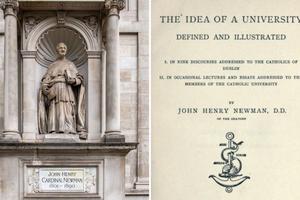
The Christian revolution extends to all things human, including education. Most universities today have a broad, two-fold mission: They seek to form students liberally — to enlarge their minds, as St. John Henry Newman put it — and they seek to form them in knowledge that is useful. Both of these, acknowledged in Ex Corde Ecclesiae, are important. The former speaks to the dignity of the person as an end in himself; the latter, to the great power that we have to make a difference in the lives of others.
While it is vitally important for us to recognize the goodness of the cultivation of the person for his or her own sake and not just for some useful end, it is also important for us to be useful. To be useful is not beneath us. To work with our hands, to farm, to build, to create and run a business, to meet the material and spiritual needs of others — all of this is very important to the mission of universities, Christian and not.
Christian faith takes this further. A Christian university certainly aspires to enlarge the mind, to discover the truth through research of all kinds, and to be useful in all manner of ways. But the Christian university aims also for wisdom, to impart the likeness to God and to enable men to see him, the world and themselves as he does.
For the Catholic, the whole point of every human life is to live in such a way as to become more and more like God and more and more like the Son of God. He made us in his image and saved us so that, through countless acts of love, we might gradually, act by act, take on the likeness to him.
Our common calling, then, is not merely to flourish. It is not just health in body and “enlargement” of mind. Our common vocation is to become like God, to see the truth about the world as he sees it, to see the truth about ourselves as he sees us, to will the good as he wills it, to love each other as he loves us, to delight in the beautiful as he does. In a few words, a Catholic university seeks to impart to its students the beginning of wisdom, the ability to see relationships and connections, and to bring disparate fields of knowledge to unity.
At a Catholic university, truth must be ordered to love and to worship of God. And useful knowledge ordered to the authentic love of men and women. As St. Bonaventure says, “Knowledge puffs up; but charity builds up.” We don’t stop at learning the truth about the world and ourselves; we make this learning the occasion to praise, worship and love God and the opportunity to serve and love our fellow man.
Our highest act at a Catholic university is not the act of understanding but the act of worship, the act of liturgical love, which itself does not exclude our intellect but takes it up. The act of understanding the truth, which is in itself a good thing, is brought to fulfillment when it issues in love and devotion.
Just as Jesus’ humanity is fully authentic and active while at the same time ordered to his divine person and mission, so, too, at a Catholic university, the various disciplines that have their own integrity and methods take on a supernatural end and are fitted into a broader, sapiential vision of reality without any loss of what is rightly their own.
Jesus does not need to be merely human in order to be authentically human; Catholic universities do not need to be secular in order to be universities. The conviction of Ex Corde, rooted in the core teaching of Christianity, is that Catholic identity enhances, deepens and broadens the intellectual life of a university — it does not harm it. Universities are quintessentially human institutions. The idea that such institutions compromise their very identities as universities — and so compromise their humanity — when they admit Christian faith is a betrayal of Christianity itself.
Ex Corde Ecclesiae stands for the fully human, fully authentic, faithfully Catholic university and so stands for the Gospel and for humanity.
Stephen Hildebrand is a professor of theology and provost at Franciscan University of Steubenville.
- Keywords:
- ex corde ecclesiae
- catholic higher education