To Hearts That Seek, Our Lady of Fatima Offers Peace
COMMENTARY: During a side trip to Portugal, the author encountered the antidote to the evil and suffering he’d seen working as an aid worker in Ukraine: genuine peace.

When I stepped onto the cobblestones of the Sanctuary of Our Lady of Fatima in Portugal, the truth came to me in a moment of gentle but convincing persuasion. Yes, it happened here. I felt it. She appeared, like she had at Guadalupe and Lourdes and so many other places, to guide us humans to a path for peace through faith.
This moment of certainty came like a faint breath on the neck, a gentle whisper in the ear, the coo of a dove, or that of a mother to a baby falling to sleep, indiscernible and easily missed if your heart wasn’t open to it.
Mine was. My mother died 11 months earlier, nine days before her 100th birthday, with rosary beads in her still hands. She began praying the Rosary as a teenager, when her brother went off to World War II, and continued until the “hour of her death,” which she accepted with grace knowing Jesus awaited her.
I came to Fatima this past February, in part, because my mother never had. Maybe she was now, with me, and she sent this whisp of a message to let me know.
“Did you feel that?” I asked a man nearby, but he spoke no English. I wanted to know if this sensation came only to me from my mother, or from our Mother of Mothers, meant for everyone.
A second moment of clarity then came. My mother’s devotion to the Rosary now made sense to me, and I understood it — and her — more than I ever did while she was on earth. Through the deaths of two sons, her husband of 74 years, all of her siblings, her in-laws, and their spouses, my mother found strength in those beads. She endured. She stayed committed to her faith and the Rosary through those deaths and her own pain and frailty.
“Now I get it,” I said to her. I think I said it out loud.
Then came yet another sign. At the far end of the concourse near the statue of Pope John Paul II is a spare, modern Crucifix made of rust-colored steel girders. I took pictures of both.
The angle from the foot of the Crucifix put it against a blue sky, clear except for a few thin, cirrus clouds, and for the first time in my life, I realized the color of the clear, blue sky is the same shade worn by Mary in most depictions. I have thought of that every sunny day since.
I walked down the concourse, where a priest led the Rosary in Portuguese at the open-air chapel, but the rhythm of the prayers translated to any language:
Ave Maria, cheia de graça, o Senhor é convosco ...
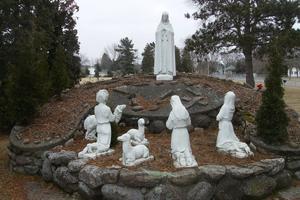
In the faces of those praying, I saw hope and devotion and belief in all the miracles and mysteries of Catholicism, from the Resurrection to the day on May 13, 1917, when the Virgin Mary appeared to three children tending sheep in the pastures of Cova de Iria on the outskirts of the town of Fatima.
I listened for a while, then climbed the steps of the pavilion and the outdoor altar leading to the Basilica of Our Lady of Fatima, which has a gold crown atop its soaring belltower, and it reminded me of the gold church domes I had seen in Ukraine.
My trip to Fatima came while returning home from the war for my eighth time, mostly to deliver humanitarian aid to civilian bombing but also gear to the military. On an extended trip last summer, I taught proper tourniquet at a Ukrainian army training camp and delivered supplies near the front.
I saw the destruction of cities and villages. I witnessed grief at funerals for both soldiers and civilians, and the hollow loneliness of orphaned children. In every war-torn place I went, the church was either damaged or destroyed. Russia’s attack on Ukraine is not only for land but to destroy the spirit, culture and religion of its people. Almost 700 Christian churches have been ransacked, raked with gunfire or blown up by artillery.
All of that Mary predicted in the third part of the Secret of Fatima, I saw firsthand, yet another piece of evidence for me to believe she appeared there.
“If people attend to my requests (of prayer and repentance), Russia will be converted, and the world will have peace. If not, (Russia) will scatter her errors throughout the world, provoking wars and persecutions of the Church. The good will be martyred … and various nations will be destroyed. In the end, my Immaculate Heart will triumph.”
I believe this to be true. So do the Ukrainian people. They love their freedom and faith too much to ever capitulate to the godless oppressor to their east.
When I entered the Basilica of Our Lady of Fatima, I thought of all the great cathedrals I’ve been privileged to see. The Sistine Chapel, Notre Dame, the Duomo of Florence and St. Sophia of Kyoiv, among others. Each place overwhelmed me with reverential awe and affirmed the certainty I had in my faith as a Catholic school child, drifted from as an adult, and was now returning with greater conviction. What else but the truth of the Catholic story could inspire such passionate art and the towering monuments that house it?
My sensation entering the Basilica of Our Lady of Fatima was equally affirming but different. A feeling of peace and comfort came over me, as if enveloped by two loving arms. I was back from the war, again. Safe. I sat in the first row and studied the painting over the altar of the ethereal Blessed Mother, dressed in white hovering over the children.
The image made me think of the universal plea for Mary to “pray for us sinners now and at the hour of our death,” and how it assures us her presence, and our faith, will help us triumph over the thing we fear most.
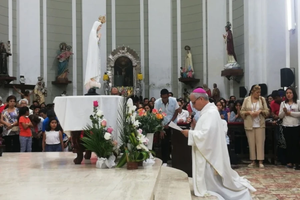
Outside a procession was forming with a statue of Mary, with a bed of roses at her feet, carried above the crowd by six men in white robes. As they made their way up the concourse, hundreds of people joined the line, most respectfully solemn, some with rosary beads in hand, mouthing the words of prayer. I joined. We entered the massive Basilica of the Holy Trinity, which seats 9,000. It was dedicated in 2007 to accommodate the growing number of Fatima pilgrimages. Inside, Mass was celebrated, and I took Communion with hundreds of others, in a remarkable experience of community.
After Mass, I crossed the concourse and returned to the other basilica, which is said to be built on the spot where she appeared. I sat there for more than an hour to absorb as much peace as I could, as if I could bank it for the future.
Flanking the altar at the basilica are the tombs of Francisco and Jacinta de Jesus Marto, the brother and sister who witnessed the apparitions with their cousin, Lucia dos Santos. The siblings died within three years of Mary’s visit, Francisco at 10 and Jacinta at 9, in the Spanish flu epidemic.
By all accounts, they went prayerfully and peacefully, knowing heaven awaited them through the Rosary as Mary promised. As she promises us all.
- Keywords:
- fatima
- our lady of fatima

Mark Di Ionno Author and journalist Mark Di Ionno is a 2013 Pulitzer Prize finalist in news commentary and a Pulitzer Prize winner as an editor in 2002. He is the author of five award-winning books and has made seven extended trips to Ukraine to deliver humanitarian aid, provide military supplies, and teach tourniquet training to Ukrainian soldiers.