The Terrible Abyss: Lincoln, Stern and Judas
COMMENTARY: On Good Friday, the ‘terrible abyss’ comes into focus: the freedom that leads some to grace and others to betrayal.
Canadian-German psychiatrist Karl Stern recounts, in his conversion story, The Pillar of Fire, a chance meeting he had with a dear friend he had not seen in 14 years. They had much to say to each other.
While she was bringing him up to date about her marriage, her child, and her medical practice, Stern was asking himself, “Shall I tell or shall I not tell?” He decided to tell her about the most decisive event of his life since they last met: “I have become a Catholic.” She paused for a moment and said simply and shortly, “Oh!”
“Her polite exclamation,” Stern recalls, “contained a cosmic abyss.” It was about this terrible abyss that Karl Stern told the story of his journey to Catholicism. How can there be such a divide between two people who had been so close to each other? A dark solitude had come over him. The abyss can be heartbreaking, but it can also be perilous.
On March 4, 1865, Abraham Lincoln delivered his second inaugural address. It is considered to be one of his greatest speeches. Lincoln used this moment to urge people to be reconciled with each other, to move past vengeance and focus on peace and healing.
Lincoln was well prepared for the occasion and his concluding words have become a permanent part of American lore:
With malice toward none, with charity for all, with firmness in the right as God gives us to see the right, let us strive on to finish the work we are in to bind up the nation’s wounds, to care for him who shall have borne the battle and for his widow and his orphan — to do all which may achieve and cherish a just and lasting peace among ourselves and with all nations.
The full text of his speech is inscribed on the north wall of the Lincoln Memorial.
Present at the address and standing near the platform in the crowd was the distinguished actor, John Wilkes Booth.
There was a terrible abyss that separated him from President Lincoln. He had obtained his ticket from his fiancée, Lucy Hale, daughter of a New Hampshire senator. Booth later boasted to a friend that he was close enough to the president that he could have shot him during the ceremony. He was enraged by Lincoln’s message of reconciliation. A little over a month later, on April 14, Booth assassinated America’s 16th president.
The greatest of all American presidents delivering an address on reconciliation on a most auspicious occasion was not sufficient to dissuade John Wilkes Booth from murdering that very man who was presenting a message of peace. Booth’s life ended 12 days later. How far apart can we human beings be from each other! How broad the communication gap can be! How can the abyss be overcome?
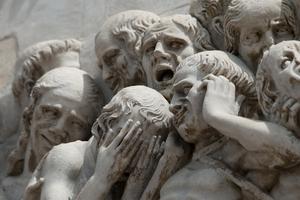
That “terrible abyss” is even more profound on Good Friday.
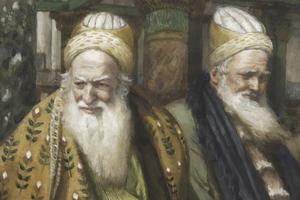
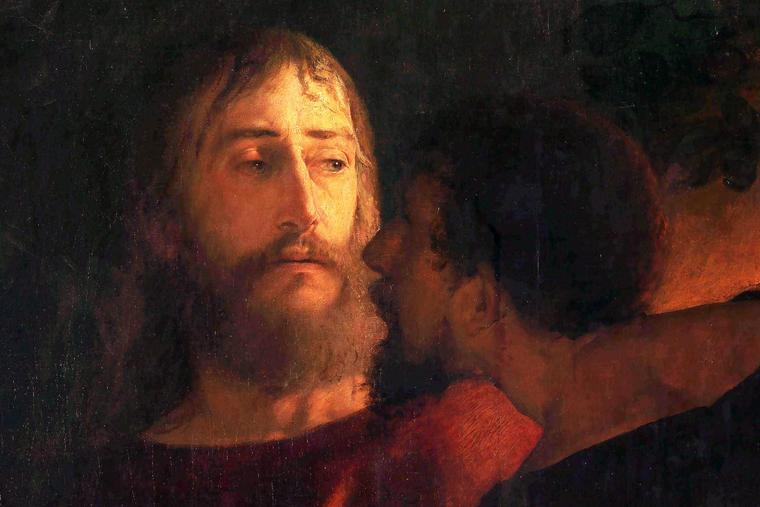
Judas Iscariot was present during Christ’s Sermon on the Mount. The greatest sermon delivered by the greatest man had little impact on him. He had often been warned about a love for money. Nonetheless, he went ahead and betrayed his Master.
His regret came too late. Thirty pieces of silver meant everything to him at one time, and then, just before he took his own life, it meant nothing to him. Hearing the Word does not necessarily translate into accepting it. The abyss must be overcome.
A teacher cannot be blamed for the waywardness of one of his students. Neither Lincoln nor Christ can be accused of not being sufficiently clear in the message they were presenting. There is a mysterious solitude that can exist in the human being, a region where he is entirely alone and is able to inure himself against any form of help. It is tantamount to being in hell while still on earth.
The abyss that can exist between people means that no matter how beneficial a message is, it can fail to reach its target. Here is the gap between paradise and the inferno. It is what Dante presented in poetic form in his Divine Comedy. Human beings are free to accept truth or reject it. That is simply the nature of freedom. It is a gift, but one that can be horribly misused.
In his autobiography, Karl Stern points out, “The dark abyss of freedom is the freedom to choose negation.” St. Thomas explains that because man “originates from nothingness,” he has “the power to turn to nothingness.”
It is important to note that Stern’s book was well received. The Chicago Daily News called it “one of the most absorbing personal histories of the day.” It was “the best,” according to Commonweal, “of the modern spiritual autobiographies.”
Christ was crucified, but he resurrected. His work has inspired millions throughout the world. Lincoln’s words given at his second inaugural address live on and continue to be a source of inspiration for many. Evil does not have the last word.
Socrates did not fare well in his student evaluation. Despite being executed, he is known as the Father of Moral Philosophy. Cicero, Boethius, Gandhi, Martin Luther King, Jr., and more recently, Charlie Kirk, all paid a heavy price for preaching justice. But their message lives on while their assassins have either been consigned to oblivion or held in stern disrepute.
How do we avoid being on the wrong end of the terrible abyss? Is there a John Wilkes Booth or Judas Iscariot hiding deep within us? Christ spoke of the “narrow gate” (Matthew 7:13-14): “Enter through the narrow gate. For wide is the gate and broad is the road that leads to destruction ...”
This means that there are more ways to fall than to remain upright. Therefore, we must be vigilant, prayerful and humble. We must shun egoism and, for the Christian, follow Christ.
We cannot communicate successfully with everyone. At the same time, we should cherish our relationships with those with whom we share the same truth.
- Keywords:
- judas iscariot
- sin
- good friday
- karl stern
- abraham lincoln