Your Vocation Is Christ’s Call to Your Heart
COMMENTARY: Every vocation is ultimately a summons into communion with Christ.

When we hear the word “vocation,” our minds often move quickly to one concern: the need for more priests. Important as that is, such a focus can unintentionally narrow our vision. For vocation is not first about filling roles within the Church, but about responding to a call that precedes every role.
At its deepest level, a vocation is not simply a task to be accomplished or a position to be occupied. It is a summons issued by God himself, inviting each person into a living, personal communion with him. The word comes from the Latin vocare (“to call”) and this divine call is never abstract. God calls each one by name, drawing the human heart into communion with himself through Jesus Christ, who reveals both the face of the Father and the fullness of what it means to be human.
From this perspective, vocations are not primarily about external activity but about interior communion. Whether one is called to marriage, to the priesthood, to the diaconate, to consecrated religious life or to the generous fidelity of the single life in the world, each vocation is ordered toward a single end: deep and intimate union with Christ. The diversity of vocations reflects the richness of the Church, which, as the Body of Christ, lives out its mission through a multiplicity of states of life. Yet this diversity is not fragmentation. It is a harmony, like many voices joined in a single hymn of praise, each distinct yet united in the love of Christ.
At times, however, we risk understanding vocation in a narrow, one-dimensional way, reducing its depth and obscuring its true meaning. This reduction often occurs in three significant respects.
The Foundation of Vocation Is Love
First, we often fail to recognize what Pope St. John Paul II taught with striking clarity: The most fundamental and innate vocation of every human person is the call to love (Redemptor Hominis, 10). As he writes:
Man cannot live without love. He remains a being that is incomprehensible for himself … if he does not encounter love, if he does not experience it and make it his own, if he does not participate intimately in it.
This is the universal vocation, rooted in our creation in the image and likeness of God. Before any particular vocation is discerned, by virtue of baptism, each person is already summoned to a life of self-gift, a love that is faithful, sacrificial and life-giving, a participation in the very love of Christ. This universal call is not an added dimension of human existence; it is inscribed in the very structure of the person and finds its fulfillment only in communion with God.
At the same time, this universal vocation unfolds concretely through a particular call. One is called to marriage, where the love of Christ is made visible in the covenant between husband and wife; another to the priesthood, configured sacramentally to Christ the Head and Shepherd; another to the diaconate, embodying Christ the Servant; another to consecrated life, witnessing to the eschatological Kingdom; and still another to a dedicated single life offered in service.
These particular vocations are not alternatives to the call to love, but its specific realizations. When lived faithfully, sustained by grace and nourished by prayer, they become the path by which the universal vocation reaches its fulfillment, namely, eternal communion with God in heaven.
Vocations Are Born in Families
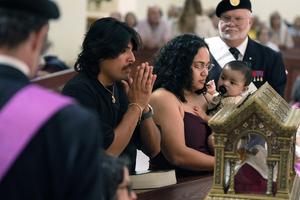
Second, we often overlook the profound interrelationship among vocations. No vocation exists in isolation. The priest does not emerge from nowhere, nor does the religious simply appear detached from human history. Vocations are born within the life of the family, the “domestic church.” It is within the family that faith is first received, that love is first learned, and that the seeds of a vocation are first planted.
Seen in this light, the present struggle with priestly and religious vocations cannot be understood merely as a failure of recruitment or promotion. It is, more deeply, symptomatic of a prior weakening of the family itself. When the stability of marriage is undermined, when the witness of faithful, sacrificial love is obscured, when prayer is no longer central to family life, the soil in which vocations grow becomes thin and fragile. A culture that no longer understands commitment will inevitably struggle to produce vocations that require lifelong fidelity.
Conversely, where families are rooted in Christ, where the Eucharist is central, where forgiveness is practiced and love is lived concretely, vocations arise almost naturally. Children formed in such an environment learn, often without being told, that life is a gift meant to be given. From this soil, the call to priesthood or religious life can be heard not as something strange or burdensome, but as a beautiful and coherent extension of what has already been lived within the home.
Holiness Is the Heart of Vocations
Third, our prayer for vocations can itself become narrow. We rightly pray for an increase in vocations, and this remains a necessary and urgent intention (Matthew 9:38). Yet if our prayer is limited to numbers alone, we risk overlooking something more fundamental: the call to fidelity within every vocation. The Church does not simply need more vocations; she needs holy vocations, men and women who live their call with integrity, perseverance and love.
To pray for vocations, therefore, is to pray that husbands and wives remain faithful to their vows, that priests serve with pastoral charity, that deacons embody Christ the Servant, that religious live their consecration with joy, and that all the baptized respond generously to grace. Fidelity is itself a powerful witness. A faithful marriage, a joyful priesthood, a humble diaconal ministry or a radiant consecrated life becomes a living invitation, drawing others to ask what makes such a life possible.
Renewing the Culture of Vocation
Given these considerations, how can the Church more effectively help the faithful discover and live their vocations?
First, there must be a renewed emphasis on the interior life. Vocation is discerned not primarily through external activity, but through prayer.
Second, the Church must strengthen the family as the primary seedbed of vocations. This includes supporting marriages, offering formation for parents, and fostering a culture in which children see love lived faithfully. The renewal of vocations will follow the renewal of the family.
Third, there must be intentional accompaniment. Vocations are rarely discovered in isolation. Spiritual directors, mentors and pastors play a crucial role in helping individuals recognize and respond to God’s call. A culture of accompaniment allows the question of vocation to be asked openly and without fear.
Fourth, the witness of joyful fidelity must be made visible. When vocations are lived well, they become attractive. The young, in particular, are drawn not by abstract arguments but by the beauty of a life fully given.
In the end, vocation is not about choosing a path among many. It is about responding to a Person who calls. And in that response, the human heart discovers its deepest identity and its ultimate destiny: to live in the love of Christ, now and forever.
- Keywords:
- vocations