Catholic Renewal Is Rising in Surprising Places
COMMENTARY: From campus chapels to parish halls, a quiet Catholic renewal is taking root beyond the Church’s usual centers of visibility.
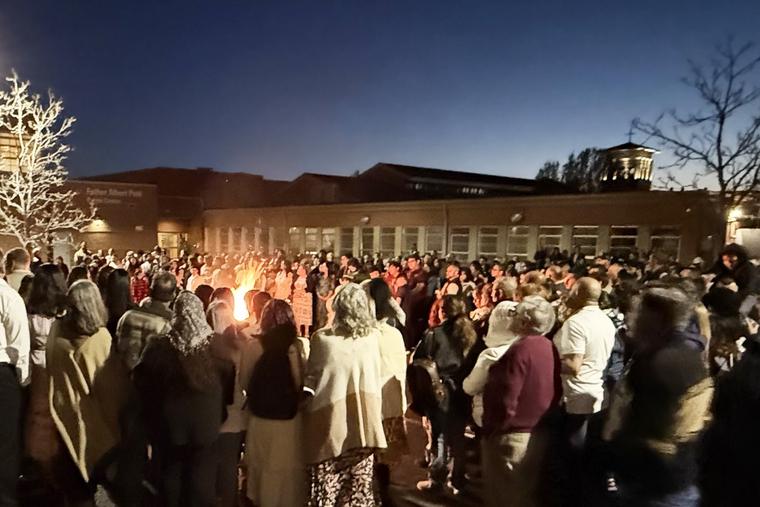
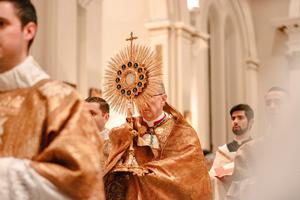
Despite widespread assumptions of decline — especially among young people — a Catholic renewal is quietly taking root in surprising places. In the places where Catholics actually gather — campus Newman centers, Eucharistic adoration chapels and parish halls — the reality is unmistakable: Renewal is alive and growing.
In South Boston, a young adult group attracts several hundred participants each Wednesday evening for confession, talks on faith, pilgrimages and retreats. They also offer weekly adoration. At my home parish, St. Paul’s in Hamilton, Massachusetts, a simple Friday night Stations of the Cross followed by soup and bread regularly draws 75 to 100 people of all ages.
Across the U.S., Catholics of all ages are attending adoration, confession and parish events in surprising numbers. In many areas, people stay long past the end of the formal program, expressing the psalmist’s desire: “My soul thirsts for the living God” (Psalm 42:2).
Digital apostolates like EWTN, Word on Fire, Hallow, Ascension and MagisAI, along with many independent creators, now reach millions with distinctly Catholic content. The number of new members entering the Church reflects this momentum: 8,500 in Los Angeles, 2,500 in Atlanta, 1,700 in Washington, and 680 in Boston. College campuses show the same trend: At Harvard, 88 new members will come into the Church this Easter, including 49 from the university community. At Rutgers, 44 new members will join — about four times the recent average.
It doesn’t depend on bishops and diocesan leaders to spearhead the renewal. It is important, however, for them to offer support — public, personal, canonical and financial — where needed.
Church leaders acknowledge the phenomenon but often struggle to account for its rapid and unexpected growth. Some in the secular press either dismiss or misunderstand it. The New York Times recently suggested causes such as “the desire for community, social and political instability, outreach to young people, and technological changes.” While these ideas may seem valid, such conditions have existed for decades.
So, what is driving this renewal?
Renewal often starts at the edges of large systems, where openness to change is greatest and existing structures are fewest. The Church's institutional center — including the chancery, diocesan offices and the USCCB — is set up to guarantee consistency. Its main tasks include protecting the sacraments, preserving continuity and upholding order.
However, stability does not ensure vitality. In the business world, established organizations often struggle because they prioritize processes and reliability over innovation and change. Renewal rarely begins at the institutional center. Innovations like Gmail, Uber, Airbnb and the iPhone emerged from small teams that recognized unmet needs long before larger organizations did.
The Church reflects this pattern. Renewal tends to take place at the margins, where bureaucracy is lighter and people are motivated to try new approaches. It begins where the Gospel is actively practiced and encountered, rather than managed.
Today, individuals are pursuing deeper meaning and finding it, just as the Lord promised: “You will seek me and find me when you seek me with all your heart” (Jeremiah 29:13). This spiritual desire is real and goes beyond what any program or initiative could create. The current phenomenon is not simply a positive trend; it illustrates a spiritual instinct coming to life.
The question remains: How will the Church respond to this moment?
A key reality is that renewal is happening outside the systems the hierarchy often uses to understand the Church. Bishops regularly rely on sacramental statistics, parish budgets, school enrollments and demographic trends. While these measurements are important, they focus on outcomes rather than underlying causes.
This helps explain why some Church leaders — and those in the secular world — seemingly find it hard to grasp the renewal. The signs are evident and convincing, but they remain hidden within administrative structures. Meanwhile, the Holy Spirit’s influence is both boundless and timeless.
In reality, renewal shows synodality in its truest sense: the Holy Spirit speaking through the lived experiences of faithful Catholics long before their stories are shared in reports or consultations.
This isn't a failure of leadership; rather, it reflects the Holy Spirit’s ways of renewal. Understanding this pattern challenges current assumptions and reshapes our view of where real renewal in the Church begins.
The people leading this renewal are not indifferent. They are not cultural Catholics going through the motions. They are seeking truth rather than trends. These Catholics do not wait for guidance from bishops or priests; they are enthusiastically engaging their faith, and that passion spreads to others.
The margins often sense cultural changes before the institutional center does. The digital evangelization movement didn't start in diocesan offices; it began with individuals — including priests, laypeople and small groups — who recognized the mission field earlier than the institution. Likewise, the rediscovery of tradition, the renewed desire for reverence, the return to confession and the growth of young adult communities all began at the margins. The center typically responds after these changes take hold.
Why is this occurring now?
Our culture feels increasingly unstable and spiritually unmoored. The isolating effects of COVID persist. Yet the Church's greatest treasures — the sacraments, Tradition, community and mission — remain accessible, as they have for 2,000 years.
Catholicism has always been radical and self-renewing, even if many have forgotten this aspect.
The role of the institutional center is not to create renewal but to recognize and support it. As current developments show, evangelization works. However, it does not thrive or take root when it's centralized, manufactured or strictly programmatic. The Church needs its hierarchy to bless, protect, guide and allow space for renewal. When bishops acknowledge and support the spiritual vitality coming from the edges, renewal moves from the periphery to the heart of the Church.
The occurrence of renewal without full understanding by the hierarchy does not signal dysfunction. Instead, it reveals authenticity. Jesus told Nicodemus, “The wind blows where it wills … so it is with everyone born of the Spirit” (John 3:8). This is the established pattern of renewal.
The underlying message offers hope: A grassroots resurgence, driven by true faith, continues to arise at the Church's margins and cross boundaries. This ongoing pattern suggests that renewal arises wherever God is at work, regardless of assumptions about decline.
The same Spirit who inspired the early Church in hidden rooms and ordinary homes is once again active in places not managed by the institutional center, reminding us that God still delights in beginning great things in quiet places.
John Corcoran is the founder of Trinity Life Sciences and serves as chairman of the board of iCatholic Media, the parent company of CatholicTV in the Archdiocese of Boston.