Religious Expression in Public Life on the Rise
COMMENTARY: The reengagement of religious Americans deserves more serious attention than it often receives.
Something is happening in the country that is being misread as politics. People of faith are reasserting their place in American public life, the law is increasingly vindicating them and the secular establishment has not figured out what to do about it.
While the number of Americans who identify as religious may be shrinking numerically, those who do are more intentional, more orthodox and more willing to defend the place faith holds in public life. Efforts to sideline traditional views on life, sexuality and education have clarified rather than diminished conviction. Recent court decisions underscore that people of faith are not second-class citizens whose faith must be confined to private life.
This reengagement of religious Americans deserves more serious attention than it often receives.
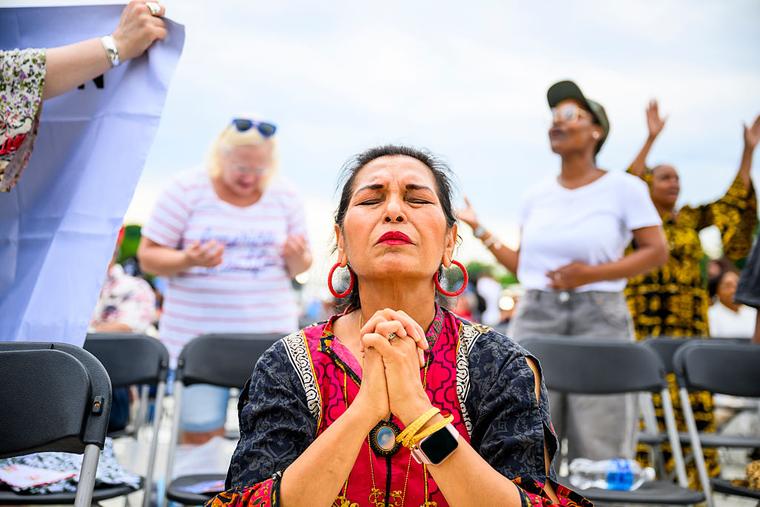
Consider what happened on the National Mall on May 17. Thousands of Americans of many faiths gathered for Rededicate 250: A National Jubilee of Prayer, Praise and Thanksgiving — a day of Scripture, testimony and prayer asking for God's guidance for the next 250 years — part of the commemoration of America’s 250th birthday. Americans in red, white and blue, hands raised, asked God to bless their country. Prayer for the nation is one of the oldest expressions of American civic life. Congress opens with it. Presidents are inaugurated with it. Mocking that devotion is not a defense of pluralism. It is its own kind of intolerance.
Similarly, critics of President Trump’s Religious Liberty Commission miss how its hearings have featured Americans of minority faiths, including Muslims, and dedicated a session on the alarming rise of antisemitism in American life.
Notably absent from these critiques is a serious reckoning with a 200-page report from the Department of Justice’s Task Force to Eradicate Anti-Christian Bias that details the appalling track record of the prior administration. Fortunately, steps like the recent restoration of the HHS Conscience and Religious Freedom Division reflect the broad recognition from within the current administration that religious liberty claims remain central concerns, not historical artifacts.
The judiciary is increasingly reflecting the same concern.
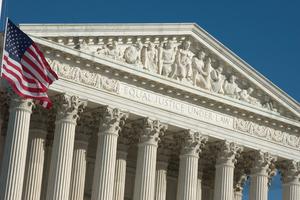
On April 21, a 9-8 majority of the Fifth Circuit sitting en banc (as a full bench) upheld Texas Senate Bill 10, requiring public school classrooms to display the Ten Commandments. The majority declared that the Supreme Court’s 1980 ruling in Stone v. Graham is no longer controlling. The court was clear: No Texas child is being catechized, no teacher is assigned to proselytize, no student is penalized for disagreement. Hanging a poster is not establishing a church.
That case will most likely be headed to the Supreme Court, which is also set to review St. Mary Catholic Parish v. Roy in its next term. The court will hear how Colorado created a universal preschool program promising every family in the state up to 15 hours of free preschool weekly, at the public or private school of their choosing but effectively excludes Catholic preschools because those schools ask families to support Catholic teaching on sexuality and gender.
Colorado permits schools that admit only children of color and gender-nonconforming children into the same program. The logic is that some identities warrant accommodation and others disqualification.
The Supreme Court has already corrected Colorado three times when it trampled on the First Amendment. St. Mary could make it four.
The court’s recent religion-clause decisions reflect a broader reconsideration of late-20th-century jurisprudence that often treated religious expression in public life with pronounced suspicion.
Going back to what the founding generation actually believed about faith and self-government provides an answer.
Thomas Jefferson wrote to the Danbury (Connecticut) Baptist Association, suggesting that the First Amendment created a “wall of separation between Church & State.” As familiar as the wall metaphor is to contemporary minds, it was not an attempt to establish a constitutional axiom that constrains religious sentiment. Instead, the founding generation understood that a republic requires something to hold it together from the inside.
Consider George Washington, who in his Farewell Address called religion and morality “indispensable supports” to political prosperity and warned that no one who undermined them could “claim the tribute of patriotism.” John Adams was blunter:
“Our Constitution was made only for a moral and religious People. It is wholly inadequate to the government of any other.”
Alexis de Tocqueville, arriving from France in the 1830s to figure out why American democracy actually worked, reached the same conclusion. He regarded religion as “the foremost of America’s political institutions” — not because it was established by law, but because it was woven into the habits and dispositions of the people who made self-government possible. “Despotism may govern without faith,” he added, “but liberty cannot.”
This is the context that most coverage of Rededicate 250, the Religious Liberty Commission, the Ten Commandments case, and St. Mary is missing entirely. The debate is not simply about whether “separation of church and state” appears in the Constitution (it doesn’t), if a poster violates the religion clauses of the First Amendment (again, it doesn’t), or if preschools should embrace the fiction of gender ideology before they too can offer families a state-issued subsidy (they shouldn’t).
A secular assumption has been that religion in America would steadily recede from public significance. Recent legal and cultural developments suggest something more complicated is happening instead. Faith in America is reorganizing rather than disappearing.
In the Gospel of Matthew, Jesus describes seed falling on rocky ground and among thorns, unable to endure when tested. Only what falls on good soil takes root and bears lasting fruit. The question facing American religious life is whether this renewed public confidence is merely reactive and temporary, or whether it reflects something deeper and more durable. Courts can resolve constitutional disputes. They cannot answer that question. History will.
- Keywords:
- religious expression