Vatican Newspaper Gets Edgy
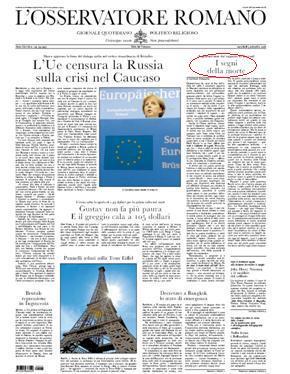
The Vatican newspaper L’Osservatore Romano has received a facelift in the year since current editor Giovanni Maria Vian took over.
The new look is ruffling some feathers in the Vatican, according to Sandro Magister of the Chiesa website.
In a commentary posted yesterday, Magister notes that L’Osservatore Romano waded into the debate over whether “brain death” is a legitimate end-of-life criterion by publishing an article in its Sept. 3 issue that argued it wasn’t.
After the article was published, Vatican spokesman Jesuit Father Federico Lombardi quickly disassociated the Church from its conclusions. However, Magister points out that Pope Benedict XVI did not speak of brain death as a settled matter in remarks this month to a conference in Rome on organ transplants.
“But the issue of brain death is only one of the many disputes ‘of ideas’ recently ignited by L’Osservatore Romano,” Magister said.
Another potentially controversial article cited by Magister was a Nov. 19 commentary that criticizes the World Health Organization’s definition of health as “a state of complete physical, mental and social well-being.”
That definition, according to the L’Osservatore Romano commentary, gives rise to “the ‘medicalization of desire’ that goes so far as to maintain that life itself is a pathology to be ended whenever one wishes, even by people not affected by terminal illness.”
In a recent interview with The Wall Street Journal, Vian attributed L’Osservatore Romano’s new approach to Pope Benedict XVI.
“There was a really precise request from the paper’s publisher,” Vian said. “In this case, the publisher just happened to be the Pope.”
Tomorrow, in another example of the change of direction under Vian, L’Osservatore Romano will publish a tribute to the Beatles on the occasion of the 40th anniversary of the release of the group’s “White Album.”
Comments Magister about Vian’s leadership, “A ‘newspaper of ideas’: this is what L’Osservatore Romano was supposed to become when Professor Giovanni Maria Vian took command of it thirteen months ago.
“A ‘newspaper of ideas’ is how Giovanni Battista Montini had described it many years before, while he was still archbishop of Milan, before he became pope under the name of Paul VI. This means a newspaper that ‘does not seek only to furnish news; it intends to influence thought. It is not enough for it to report events as they happen: it intends to comment on them in order to indicate how they should have happened, or not happened. It does not only conduct a conversation with its readers; it conducts one with the world: it comments, discusses, polemicizes.’”
Assesses Magister, “Today it can be seen that the promise has been kept. L’Osservatore Romano acts as an official bulletin only for a few things: those contained each day in the feature ‘Our information,’ reporting the audiences that the Pope has held and the appointments he has made, which become official once they are published in the newspaper. But other than this, it is a newspaper of documents, of news, of commentary, and even of polemics, under the autonomous responsibility of those who write for it and direct it. With the entire world as its horizon, and on questions without boundaries.”
— Tom McFeely