What Does the Church Teach About the Devil?
News Analysis
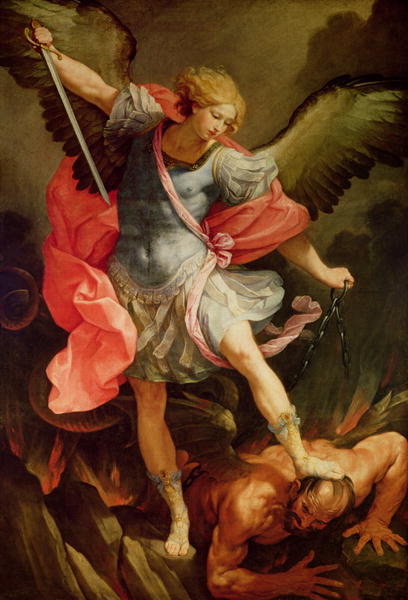
CAMBRIDGE, Mass. — Last spring, Father Michael Drea, the senior Catholic chaplain at Harvard University, read a text message from a student, who reported that a Satanic “black mass” would be held on the Cambridge campus in early May.
The chaplain and his flock quickly launched a campaign to stop the event that gained national attention and ultimately resulted in the cancellation of the black mass at Harvard, while a Holy Hour scheduled for the same evening drew thousands.
“We wanted to promote an understanding of the power of evil in the world, but we also wanted to promote the Eucharist and explain how this is so central to who we are,” Father Drea told the Register.
The controversy that erupted over the black mass at Harvard pitted two millennia of Church teaching that repudiates the devil as the “Father of Lies” against an Ivy League culture that nurtures skepticism regarding the existence of God and thus often dismisses the danger posed by “Satan ... and all his evil works.”
While some Catholics know little about what the Church has to say about Satan, they have seen popular movies like William Peter Blatty’s The Exorcist, which vividly portrays Satan as a powerful intelligence that is utterly opposed to the Church and the good of human persons.
Yet there is much more to the Church’s teaching on Satan than the spectacle of demonic possession.
Indeed, now, as a Satanic group successfully sponsored its own black mass — without a consecrated Host — at Oklahoma City’s Civic Center, Church experts say it is more important than ever for Catholics and other people of goodwill to understand what the Church teaches about the devil and why Catholic leaders continue to strongly oppose any rituals designed to evoke the power of Satan.
The Satanic Mass in Oklahoma City took place on Sept. 21, and The Oklahoman newspaper reported that the 40 to 50 attendees at the ritual were far outnumbered by the 1,200 Catholics who joined Archbishop Paul Coakley at St. Francis of Assisi Church for a Holy Hour prayer service, with hundreds more following the service in adjacent buildings. The archbishop also led a procession to the Civic Center, where opponents of the black mass came together to denounce the ritual.
In his homily, the archbishop acknowledged that “dark forces” had been evoked by the ritual. But he also reminded his flock, “Christ conquered Satan. The war has been won; Christ has conquered, though skirmishes will continue until Christ comes to reign forever.”
Catechism Teaching
The Catechism of the Catholic Church states that Satan “acts in the world out of hatred for God and his kingdom in Christ Jesus, and … his action causes grave injuries” (395).
Bishop James Conley of Lincoln, Neb., told the Register that Church teaching identifies Satan as “a fallen angel, ‘a seductive voice opposed to God.’”
Bishop Conley warned, “Because Satan would like to destroy our relationship with God and ensnare us with lies, we must be on vigilant guard against his temptations. If we don’t believe in Satan, we won’t recognize his efforts to confuse us, to bind us and to tempt us away from God’s will.”
Strikingly, the news of the black mass at Harvard, followed by the similar event that took place in Oklahoma City, surfaced as Pope Francis has repeatedly addressed the reality of the devil and his battle to undermine the dignity of the human person.
“We are all tempted because the law of our spiritual life, our Christian life, is a struggle. … That’s because the prince of this world, Satan, doesn’t want our holiness; he doesn’t want us to follow Christ,” said Pope Francis during an April 2014 homily.
“Maybe some of you might say: ‘But Father, how old-fashioned you are to speak about the devil in the 21st century.’ But look out, because the devil is present! The devil is here … even in the 21st century. And we mustn’t be naïve, right? We must learn from the Gospel how to fight against Satan.”
Domestic Church
A few months later, in June, before a Catholic Charismatic Renewal gathering that attracted tens of thousands of people, the Pope said the devil sought to undermine the family to destroy the domestic church.
“Let us pray to the Lord and ask him to protect the family in the crisis with which the devil wants to destroy it,” he said.
Ralph Martin, the president of Renewal Ministries, an organization devoted to Catholic renewal and evangelization, applauded the Pope’s willingness to speak plainly about Satan.
“The practical wisdom about safeguarding ourselves against the ‘fiery darts’ of the devil — which fly at us every day in the disordered desires of our own flesh, in the lies of the culture, undoubtedly some of which are demonically inspired, and the personal temptation we are subjected to, which we find in Ephesians 6 — is really essential,” said Martin.
But Martin also noted that such teaching must strike a careful balance.
“The Church has always been careful not to foster a prurient interest in the devil or Satanic possession,” he said.
“In talking about the devil, we should try to attain the balance with which we find Jesus and the apostles and the Catechism of the Catholic Church” addressing this subject. They present the devil as “real, relevant, important, but not the central focus,” said Martin.
“The essence of Satan’s malice derives from his pride. He knows that he can never be God, though that is ultimately what his great revolt was about,” said Michael O’Brien, the author of Father Elijah: An Apocalypse — a bestselling novel that traces the rise of the Antichrist.
Satan strikes at God by “corrupting his most beloved creature, made in his image and likeness,” explained O’Brien. And as a Catholic novelist, he seeks to “tell stories which … shed light on how the adversary deceives us and prompts us to deceive ourselves.”
However, an increasing number of Americans, including some Catholics, no longer see the risks of experimenting with the occult or even Satanism. How else to explain the scheduling of two public black masses over the past six months, along with a reported rise in demonic possession?
These disturbing developments have prompted an increasing number of dioceses to appoint exorcists and launch “deliverance ministries” that help identify and heal destructive spiritual attachments.
Exorcism
“In the past year, the Pope has given encouragement to the ministry of exorcism. It is proper that we recover an important part of our spiritual tradition, which was significantly lost, especially here in America, in the past 40 years,” Msgr. Charles Pope, pastor of Holy Comforter-St. Cyprian Parish in the Archdiocese of Washington, told the Register.
“Demons are real and should be taken seriously. And when it can be determined that demons are a source of suffering, the Church can and should use her given powers to deliver and free souls who are in the grip of the demons, either by obsession or possession.”
Father Gary Thomas, the pastor of Sacred Heart Church in Saratoga, Calif., and the mandated exorcist in the Diocese of San Jose, Calif., has witnessed the rise in demonic attachments firsthand, and he believes that ignorance of the devil’s powers, even among Catholics, has fostered this development.
“People [think they] can reconcile praying to Satan, dabbling in paganism and going to Mass at the same time. It is largely from a lack of catechesis,” he said, noting that such contradictory practices have become more common in Mexico.
When people struggle with demonic attachments, Father Thomas noted, “The first step is to deal with the symptoms. And then, in the course of time, catechesis is done. We need to affirm the fact that the death and resurrection of Christ defeated Satan.
“But I also make clear that the invocation of evil forces and powers that are antithetical to faith, God and Christ cannot stand.”
Accordingly, Father Thomas said that black masses must be strongly opposed. Any attempt to “invoke personified evil in the public square, will unleash unimaginable and incalculable dangers to the country and will establish a dangerous precedent,” said the priest.
Indeed, said Father Drea of Harvard, “We have to acknowledge the fact that evil exists in the world and the presence of the devil is a reality. We should not wait for a black mass before we speak about such matters.”
- Keywords:
- Oct. 5-18, 2014