Holy Week With the Suffering Pope
VATICAN CITY — Il Papa sofferente. The suffering Pope.
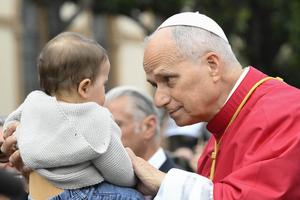
During a Holy Week charged with the compelling image of a determined Pope John Paul II hobbled by pain, John Paul became known simply as the suffering pope.
“Il Papa sofferente” was how he was referred to in newspapers and on television. And while his increasing incapacity did set off a new round of chatter regarding the possibility of a papal resignation, the overwhelming reaction was one of compassion and respect for a man so clearly walking his own way of the cross.
Arthritis in his right knee has made walking and prolonged standing extremely painful for the Holy Father and, combined with an increasing unsteadiness on his feet in recent months, rendered him incapable of presiding over the Holy Week liturgies in his usual way.
Front-page stories in the Italian press on Easter Sunday reported that the Pope would have knee surgery in the near future, though they were unconfirmed by the Vatican press office.
On Palm Sunday, he was unable to join the procession of the palms, even in his popemobile, and while he presided over the blessing of the palms and the Liturgy of the Word, he did not go to the altar for the Liturgy of the Eucharist. He remained kneeling and received Communion with the faithful.
On Holy Thursday, he was not able to ascend the steps to the papal altar, so remained at his chair on the floor, from which he led the Eucharistic Prayer. He was also unable to perform the Washing of the Feet. At the Good Friday Way of the Cross at the Colosseum, he did not follow the procession from station to station, but remained seated in his chair throughout.
It appeared that his days as principal celebrant at Mass might be over, as it seemed impossible for him to get to the altar.
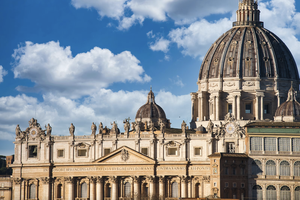
A solution was found, though, for the Easter Vigil. Another altar was built for John Paul on the floor of St. Peter's Basilica, with just one step to mount. He was able to celebrate the three-hour Easter Vigil, presiding over the Blessing of the Fire and the procession of the Paschal Candle from the moving platform which he has used since December 1999.
On Easter Sunday morning, John Paul was able to celebrate Mass in St. Peter's Square, being dropped off and picked up at the altar in the white jeep used for ceremonies in the square. Another innovation was the introduction of a podium brought before the Holy Father when he must stand — he uses it to balance and support himself.
The physical frailty of the Holy Father has elicited sympathy from around the world. Responding to speculation that the Pope might have to use a wheelchair, the Vatican press office reported that he had already received 15 wheelchairs as gifts from the faithful, and over 100 walking canes.
The suffering of the Holy Father was not only physical.
Not Just Physical Pain
On Holy Thursday it was announced the Archbishop of Poznan, Poland, Juliusz Paetz, had resigned after being accused of making repeated homosexual advances to seminarians in his archdiocese. Archbishop Paetz, who announced his resignation at the Chrism Mass in Poznan, continued to maintain his innocence, but his resignation comes after the Holy Father appointed a commission to investigate. While the commission did not report publicly, it is clear that John Paul forced Archbishop Paetz to resign — a particularly painful episode, as Archbishop Paetz worked in the papal household of Paul VI and John Paul in the 1970s and early 1980s.
“We pray for those of our brothers who have abandoned the duties which they assumed at their priestly ordination or who are going through a period of difficulty or crisis,” said John Paul is his own Chrism Mass homily. It is a customary phrase, always included, but it was particularly poignant this year.
The Pope's suffering was most clear at the nighttime Via Crucis celebrated on Good Friday at the Colosseum. One longtime Vatican observer likened the image of the Holy Father, literally bent around the cross at the 14th station, holding it in a shaking right hand, while his left hand balanced himself on a nearby railing, as seeming “like a Michelangelo figure of torment and prayer.”
“One way [that Christ draws all to himself] is human suffering,” said Father Raniero Cantalamessa, the preacher of the papal household, who, according to tradition, gave the Good Friday homily in St. Peter's. “Once Christ has taken it upon himself and redeemed it, suffering becomes, in its own special way, a universal sacrament of salvation. Universal, because it knows no distinctions, whether between the First and Third World, Northern Hemisphere or Southern; we find suffering at every spot of the globe.”
After the conclusion of the Via Crucis, John Paul addressed the crowd extemporaneously in Italian and Latin, leaving aside his prepared text. Speaking as if leading a meditation, with long pauses, it was one of his most dramatic recent addresses.
“Today the Church sings, Ecce lignum crucis in quo salus mundi pependit. Venite adoramus. Adoramus te, Christe. (Behold the wood of the cross on which hung the Savior of the world. Come let us adore. We adore you, O Christ),” he said. “Per sanctam crucem tuam redemisti mundum … redemisti mundum (By your holy cross you have redeemed the world … you have redeemed the world).”
Redemisti mundum … redemisti mundum. In the long pause in between the repetitions of the key text of Good Friday, the immense crowd was silent, beholding a man deep in prayer, quoting from his memory and his heart the liturgy of Holy Week.
“Mors et vita duello conflixere mirando: dux vitae mortuus, regnat vivus,” he repeated twice, recalling the Sequence sung before the Gospel on Easter Sunday (Death and life have battled in a stupendous combat, The Lord of life is dead; yet living he reigns).
During the week, many commentators and senior prelates were questioned about the future of the pontificate. One cardinal, Jorge Medina, prefect of the Congregation for Divine Worship, said in an interview that he already had John Paul's response.
“Not long ago, someone asked [the Pope] why, in view of his declining health, he continued in his mission, and the Pope responded, ‘Because Jesus did not come down from the cross,’” said Medina.
Plans are still proceeding for papal trips to Bulgaria in May, Toronto, Mexico and Guatemala in July for charity, and Poland in August, though obviously new measures will have to be adopted to facilitate the Pope's movements.
- Keywords:
- April 7-13, 2002