Leaders of Finland’s Christian Minorities Follow Pope Leo’s Call to Foster Ecumenism
During the Week of Prayer for Christian Unity, Finnish Catholic, Orthodox and Lutheran shepherds gathered in Rome to meet Leo and share their common Christian witness.
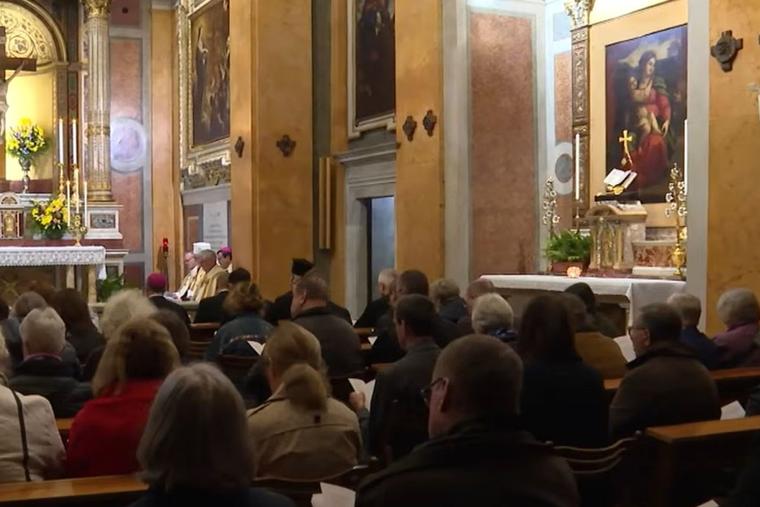
In the Nordic country of Finland, where Christianity is a minority faith besieged by aggressive secularism, Catholic, Orthodox and Lutheran leaders share churches and prayers — both out of necessity for survival and from a shared conviction that, as minorities, they are stronger together in spreading the message of Christ.
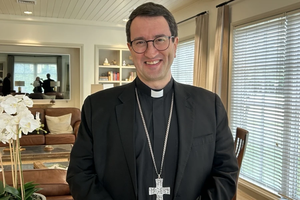
“In Finland, we are very united with the Orthodox Lutherans and also with the Orthodox Church,” Catholic Bishop Raimo Goyarrola of Helsinki told the Register. “It’s easy to talk and to listen to each other.”
Despite being among the largest countries in Europe, Finland only has one Catholic diocese, eight parishes and 25 priests.
For this reason, the unity of the Christian minorities is crucial.
Meeting the Pope: A Tradition of 41 Years
One of the ways this particular unity is expressed is through Christian leaders’ annual joint pilgrimage to Rome — “a very beautiful sign for the unity in the Nordic countries and a good sign also for … the unity in all the church,” Cardinal Kurt Koch, prefect of the Dicastery for Promoting Christian Unity, told the Register.
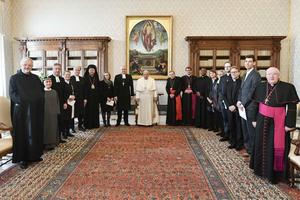
On the second day of the Week of Prayer for Christian Unity, Pope Leo XIV met with a Finnish ecumenical delegation and praised the long-standing cooperation between Lutheran, Orthodox and Catholic communities in Finland, referencing how it is held up as a “model country for ecumenism.”
Leo added: “At a time when people are often tempted by a sense of hopelessness, we have the essential mission, as Christian messengers of hope, to bring the Lord’s light into the darkest corners of our world. Although the Jubilee of Hope has now concluded with the recent closing of the Holy Door of Saint Peter’s Basilica, our Christian hope knows no end and no limit. Thus, encouraged and strengthened by the grace of Jesus Christ, who is the very incarnation of hope for all, we are called and sent out to bear witness to this saving truth with edifying words and charitable deeds.”
“Our encounter with the Pope was one in the series which has lasted now 41 years,” explained Archbishop Tapio Luoma, primate of the Evangelical Lutheran Church of Finland.
Together in Christ
Gathering representatives from the Evangelical Lutheran Church, Catholic Church and the Orthodox Church of Finland, the meeting, Archbishop Luoma shared, is an opportunity to better “understand better [their] roots in Catholic Christianity.”
As “the 55th bishop in the seat of St. Henry, who came to Finland in the 12th century,” the Lutheran archbishop emphasized, “we appreciate our Catholic roots, and now we are trying to find out how we can come closer together.”
Reflecting on the “wonderful meeting,” Archbishop Elia of the Orthodox Church of Finland and head of the Ecumenical Council of Finland also stressed: “We are not against each other in any way. We work together. We pray for each other. We talk with each other; we discuss; we become friends.”
“As it says in the letter written by Paul, we are not from different churches. We are one body,” Archbishop Elia explained, adding that St. Paul “said, ‘we are one body in Christ.’ This is the meaning of ecumenism.”
Archbishop Elia emphasized that since “Christ unites us in baptism, we are brothers and sisters in Christ.”
Especially “in this world, which is so polarized, we should work together,” he added. “The Christian message has to go through, and what is better than working together as Christians?”
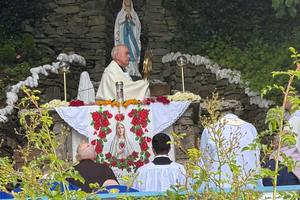
Reflecting on the recent initiative of making “a common pilgrimage in honor to our mother, the Virgin Mary,” during which they walk from the Catholic “cathedral to the Orthodox cathedral together, singing together, praying together,” Bishop Goyarrola commented: “It’s amazing. We are reunited. It’s a blessing; it’s a grace.”
Because of the small number of Catholics and even smaller number of Catholic churches, Archbishop Luoma, explained the country’s special ecumenical arrangement to the Register:
“They don’t have very many places where they can celebrate Mass. But our Lutheran churches and even some Orthodox churches [lend] our churches for their use and vice versa. So, whenever there is possibility and need, we turn to each other.”
In total, the Diocese of Helsinki rents space from 20 Lutheran churches and five Orthodox churches in 25 of the 33 cities.
Working so closely together, and giving each other the needed support, Archbishop Luoma shared, means that “there is a very deep friendship and understanding that [they] are giving a common witness of our Risen Christ” together in one of the world’s most secular countries.
“This common witness,” he added, “not only needs friendship and understanding, but also the will to see the other person, the other tradition, in a bright way, in an evangelical way, and that the Holy Spirit works also in other churches, not only in mine.”
‘Christian Unity Is the Will of God’
The foundation of this close relationship between the small Christian minorities can be found in the Gospel of John, Cardinal Koch explained.
“Jesus prays with his disciples that all may be one,” Cardinal Koch highlighted. “It is very touching for me. Christ has not ordered unity. He has prayed for unity. And when Jesus has prayed for unity, what can we do better than praying for unity?”
This unity, the cardinal explained, is not only willed by God, but comes from God himself. Indeed, the Swiss cardinal continued, “when we pray for unity, we confess that we humans cannot make unity. We humans can make divisions, as we see in history and also in the present. The unity is always a gift of the Holy Spirit, and the best way for receiving this gift is prayer.”
While stressing that praying for Christian unity is “very important because it’s the will of Christ,” Cardinal Koch added that in the Nordic countries, where Christians are a minority, “it is more important, because they must confess the faith together in difficult situations.”
The statistics might appear gloomy. Only around 1% of the population is Orthodox, and approximately 0.3% is Catholic. Although 65% of the population is nominally Lutheran, Finland remains deeply secular, with only about 2% of Lutherans considered practising.
As secularism continues to erode Lutheranism — seen in the surge of church tax opt-outs — Catholic life persists through sacramental practice and enduring bonds with Rome.
“It is very important to pray and to dream with our Lord Jesus Christ because there is hope,” Catholic Bishop Goyarrola shared. “It is Jesus’ will that we have to be one, as Jesus Christ is one with the Father.”
And there is hope, he added, because Christian unity “is the mission of the Holy Spirit”: “For this reason, there is hope, because it’s in God’s hands.”
Today, Christian unity is more important than ever, Bishop Goyarrola stressed. “Our world is so sick: confusion, war, injustice, persecutions,” he said, adding that this is the moment for all Christians to come together, “because the world needs us.”
“The world needs our unity. God needs us to be faithful to him.”
The Pope stressed this during the close of the Week of Prayer for Christian Unity, urging Christians to commit themselves “to further developing ecumenical synodal practices and to sharing with one another who we are, what we do and what we teach.”
WATCH ON EWTN
Amid Pope Leo’s Push for Unity, Christians Observe Week of Prayer | EWTN News Nightly