Gender Can’t Be Changed, But Hearts Can Change, Ohio Bishop Says
Toledo Bishop Daniel Thomas’ new document ‘The Body Reveals the Person’ rejects gender transitioning, but not the gender transitioner.
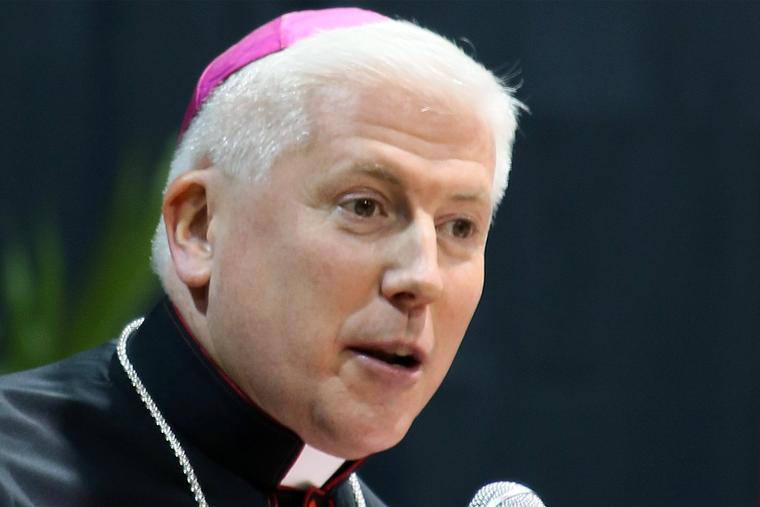
Attempting to change gender is “medically assisted self-harm” and should be rejected, but people experiencing pain over gender identity should know that God loves them and wants to bring them to himself through their sufferings, an Ohio bishop says in a new document.
At 7,700 words, The Body Reveals the Person: A Catholic Response to the Challenges of Gender Ideology, published by Toledo Bishop Daniel Thomas in August, is the longest statement on gender identity yet from a U.S. bishop, drawing on Scripture, theology, philosophy and social sciences to present Church teaching in a form the bishop said he hopes is “readable, digestible, accessible, and charitable.”
He acknowledges in the document that opposing gender transitioning is a message that many don’t want to hear, especially those who see social, chemical and surgical changes as a way to end their distress.
“When people hear teachings that conflict with their own understanding of who they are and what they need to be happy, it can seem to them that no explanation could possibly justify such teachings and that they must be rejected out of hand,” Bishop Thomas writes.
“How can we respond to such a seemingly impossible situation?” he says. “The answer is surely not to water down Catholic teachings, which are meant to clarify and defend, in the light of faith, the truth about our engendered bodily life.”
Big Numbers
Gender identity has caught the attention of U.S. bishops in recent years.
Previous U.S. Catholic documents on gender identity include Bishop Michael Burbidge’s August 2021 pastoral letter to his Diocese of Arlington, Virginia, titled “A Catechesis on the Human Person and Gender Ideology”; Oklahoma City Archbishop Paul Coakley’s April 2023 pastoral letter “On the Unity of the Body and Soul: Accompanying Those Experiencing Gender Dysphoria”; and a September 2023 joint letter (“The Body-Soul Unity of the Human Person”) from San Francisco Archbishop Salvatore Cordileone and Oakland Bishop Michael Barber.
In March 2023, the U.S. Conference of Catholic Bishops issued a Doctrinal Note on gender identity stating that modern medicine, particularly at Catholic hospitals, should “truly promote the flourishing of the human person in his or her bodily integrity.”
Bishop Thomas said the Church needs a detailed and well-thought-out pastoral approach to people who identify with a gender other than the one that corresponds to their sex in part because of how common such cases are nowadays.
Transgender-identifying people once formed a “tiny” group, the bishop notes in the document. But their numbers have increased sharply in recent years — about 1% of Americans 13 and older now identify as transgender, including about 3.3% of adolescents between the ages of 13 and 17, according to an August 2025 report from the Williams Institute at the University of California at Los Angeles.
Discussions of the topic can quickly turn personal.
Bishop Thomas told the Register that a father he spoke with before the document came out last month broke down in tears when he learned what the bishop was working on, explaining that his son was thinking about transitioning.
Shortly after the document came out, the bishop said, a woman told him she sent it to her son and that it led to “a very lengthy conversation of the content,” and that her son was “very touched by it” and “was moved by some of the arguments,” though it remained unclear what he would do in the future.
“This has become so painful,” Bishop Thomas said, referring to gender identity. “It's my ultimate hope that this will be able to speak to hearts, minds, and souls.”
The document is enhanced by carefully chosen art, including paintings of Adam and Eve in the Garden of Eden, Jesus at the Transfiguration, and Jesus on the cross.
Another painting depicts Jesus with a Samaritan woman at Jacob’s Well (John 4:4-42). In the Gospel story, Jesus goes out of his way to engage with her. He tells her that “eternal life” will come from “the water I shall give” — a reference to baptism — while also noting, prophetically, that the woman has had five husbands, “and the one you have now is not your husband.”
It’s an example of telling the truth about a person’s situation without rejecting the person — an approach Bishop Thomas says also fits cases of gender discomfort.
“Jesus reveals her to herself, and at the same time loves her with this great compassion,” Bishop Thomas told the Register.
Mind and Body, Not Mind or Body
Bishop Thomas spoke with the Register and also with Register Radio late last week.
He told the Register that he first got the idea for the document a few years ago, and that creating it took many months and included assistance from experts in various fields. He said he hopes the document helps practicing Catholics develop an effective pastoral approach to gender identity.
“I'm also hopeful that others and even perhaps estranged Catholics, perhaps non-Catholics, would be able to see in this captured, really, what’s at the heart of this issue and why we teach what we teach and how we can be of better assistance in a culture that really has collapsed around us,” Bishop Thomas said.
The title of the new document — “The Body Reveals the Person” — comes from Pope St. John Paul II’s theology of the body, including a talk in January 1980 in which the Pope said that the way God created male and female in Genesis 2 shows that the body “expresses the person” and “reveals the ‘living soul.”
Bishop Thomas, in his new document, says the body has “inherent meaning” because the body is “the tangible revelation of the whole human person.”
“Indeed, because body and soul are not two natures but form a single human nature, the body necessarily reveals the person as a boy or a girl, a man or a woman,” Bishop Thomas writes (original emphasis). “God did not add the body after creating the soul …”
An opposing view, he says, comes from dualism, a philosophical idea that the mind and the body are not only fundamentally different but also separable. This idea, the bishop says, can lead to the conclusion that the body is merely material that can be altered or disposed of at will — which can help justify abortion and euthanasia in addition to gender transitioning.
This sort of mind-body dualism not only contradicts Church teaching on moral matters, the bishop argues, but also contradicts Christian teaching on the resurrection, since the logic of dualism suggests reuniting body and soul after the body has died “can only be regarded as a burden.”
That in turn is a direct attack on Christianity, which says Jesus Christ, who is the Second Person of the Holy Trinity (and thus God), became a human person with a human body, and that he lived, suffered, died and rose from the dead, with a glorified body that then ascended into heaven.
That Jesus took on a human body shows that God loves the human body, the bishop said.
“So, you know, a person may, quote, ‘hate their body,’ but the effort is to try to help them understand that God, who created that body, loves their body and their person, and you can't separate the body and the soul,” Bishop Thomas said.
‘Important Teaching Document’
The new document is primarily meant for the Diocese of Toledo but is drawing attention elsewhere.
Fran Maier, senior fellow in Catholic Studies at the Ethics and Public Policy Center in Washington, D.C. (and a former editor-in-chief of the Register), called Bishop Thomas’ document on gender identity “a skillful blend of compassion, scientific fact backed up by data, and the sanity of Christian teaching,” in an article in First Things published Aug. 29.
Father Tadeusz Pacholczyk, senior ethicist at The National Catholic Bioethics Center in Broomall, Pennsylvania, called Bishop Thomas’ The Body Reveals The Person an “important teaching document.”
He said the bishop makes a compelling case that the sex of a human body — its maleness and femaleness — “constitutes a non-negotiable aspect of our personal being and humanity,” while also welcoming them to reconsider gender transitioning.
“Throughout the document, Bishop Thomas stresses the need to compassionately assist confused individuals — especially youth — to step back from the temptation of thinking that feelings and desires dictate the reality of their human identity,” Father Pacholczyk told the Register by email.
He said the bishop’s document effectively presents the Catholic perspective on anthropology, which is the scientific study of mankind and its development.
“He shares the beautiful teachings of the Church on human anthropology, emphasizing how the body is revelatory of the person, and how a person's identity cannot spring from feelings nor from any sense of inadequacy they may be struggling with. Instead, their identity needs to be recognized through the body, which is a gift of central importance that is truly constitutive of the human person,” Father Pacholczyk said.
The right approach, Bishop Thomas told the Register, involves neither rejecting people who feel disconnected from their body nor affirming their disconnection. Instead, he said, Catholics should encourage people in this situation to frequent the Church’s sacraments and unite their sufferings to the sufferings of Christ.
“To those who struggle with gender confusion, I want you to know that you are not alone,” he writes in the document. “Christ loves you. The Church loves you. And I love you.”