ACLU Sues City to Block Statues of Saints on Public Safety Building
Former Catholics comprise the largest group of residents challenging the statues of the patron saints of police officers and firefighters in Quincy, Massachusetts.

Local residents backed by the American Civil Liberties Union are asking a judge to stop a Massachusetts mayor from erecting statues of two Catholic saints on a city’s new public safety building, claiming that doing so would violate the separation of church and state.
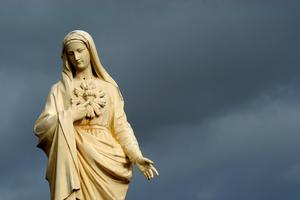
The 10-foot-high bronze statues of St. Michael the Archangel (the patron saint of police officers) and St. Florian (the patron saint of firefighters), which the complaint says are being made in Italy, would cost an estimated $850,000. They are supposed to be erected on the façade of the $175-million, 120,000-square-foot, multistory building, which is scheduled to open in October 2025.
The plaintiffs in the case are 17 residents of Quincy, a city of about 100,000 just south of Boston. One identifies as a churchgoing Catholic. Eight others identify as former Catholics.
“They bring this suit to protect their rights under the Massachusetts Constitution and to ensure that their government respects their community’s rich religious pluralism,” states their complaint, filed Tuesday in Norfolk Superior Court in Dedham by lawyers representing the American Civil Liberties Union Foundation of Massachusetts, the Freedom From Religion Foundation, and Americans United for the Separation of Church and State.
“Affixing religious icons of one particular faith to a government facility — the City’s public safety building, no less — sends an alarming message that those who do not subscribe to the City’s preferred religious beliefs are second-class residents who should not feel safe, welcomed, or equally respected by their government,” the complaint states.
The ACLU of Massachusetts first contacted Quincy Mayor Thomas Koch about the statues in February, as the Register reported earlier this year.
Koch, a pro-life Catholic, added the statues to the project on his own authority sometime after the City Council approved funding for it a few years ago, an aide told the Quincy City Council on Feb. 24. The planned statues became public knowledge when The Patriot Ledger, a local daily newspaper, reported their existence in February.
Koch could not be reached for comment Thursday.
But in late February, he dismissed the concerns raised by the ACLU of Massachusetts.
“I don’t hold ACLU in much regard, in high regard. So I think it’s just a crazy letter sent without understanding the whole situation,” Koch told an interviewer on Quincy Access Television, the local cable-access station, on Feb. 25. “This city is diverse, been diverse a long time. And I’m proud of our city, and we do great work in so many different areas. We’re at the top of the heap of services provided to everybody in this city, whatever their background is. So I think that’s a lot of malarkey.”
City Council members were deadlocked over whether the statues are appropriate during a public meeting Feb. 24.
Supporters say they see the statues as more cultural than religious and as a statement of support for police officers and firefighters. Opponents depict the statues as specifically Catholic for a building meant to serve everyone, and some also decry what they consider the violent imagery of St. Michael putting his foot on the neck of Satan, as Michael is commonly depicted in art.
Plaintiffs say in the complaint that the city has already paid at least $761,378.75 to make the statues, but they’re asking a judge to issue an injunction preventing the city from spending any more public funds on them and from erecting them on the building.
The complaint cites the Massachusetts Constitution, which states: “… all religious sects and denominations, demeaning themselves peaceably, and as good citizens of the commonwealth, shall be equally under the protection of the law; and no subordination of any one sect or denomination to another shall ever be established by law."
The complaint doesn’t cite the U.S. Constitution. The First Amendment of the federal Constitution guarantees the “free exercise” of religion (known as the Free Exercise Clause) and also prohibits Congress from passing a law resulting in “establishment of religion” (known as the Establishment Clause). Since 1947, in a case called Everson v. Board of Education, the U.S. Supreme Court has also applied the Establishment Clause to state and local governments.
Dwight Duncan, a constitutional law professor at the University of Massachusetts School of Law, told the Register that omitting a reference to the U.S. Constitution suggests that lawyers for the plaintiffs see the state Constitution as a surer vehicle to prevail.
“Why didn’t they sue under the First Amendment Establishment Clause — or Free Exercise Clause, for that matter? They could have. But then that opens them up to U.S. Supreme Court review. By focusing solely on the state Constitution, I think they’re avoiding the fact that the current U.S. Supreme Court has a religious-freedom majority, and they don’t want to deal with the uncertainty of that,” Duncan told the Register by telephone. “They think they have an open-and-shut case under the Massachusetts Constitution.”
Patrick Brennan, a law professor at Villanova University’s Charles Widger School of Law, told the Register that courts typically decide public art cases based on the details of each situation.
"The Supreme Court has not interpreted the Establishment Clause as preventing government from displaying symbols associated with Christianity, Judaism or any other particular religion. Government displays that include religious symbols are reviewed on a case-by-case basis,” Brennan said by email.
“Here, if a reasonable observer might conclude that the government was installing these two statues to promote Catholicism over other faiths, that would count against the display, but the court would also need to take into account the historical, cultural associations between police officers and St. Michael and between firefighters and St. Florian,” he said.
A court hearing in the case had not been scheduled as of Thursday afternoon, according to an online docket.
- Keywords:
- aclu
- catholic saints
- quincy mass