An Extraordinary Lady Formed by Faith and Fire
COMMENTARY: From war-torn Russia to the quiet strength of family life in America, Aunt Rose’s courage was forged in suffering and sustained by faith and humility.
I was blessed to have two loving parents who were the nucleus of an extended family that included my brother, sister, aunt, two cousins, uncle and a part-time housekeeper who joyfully filled the role of my midwife grandmother, who had died before I was born.
One of the most extraordinary people in my family was Aunt Rose, who, along with my two cousins, Eleanore and Dolores, came to live with us for several years. “Dolly,” the younger of my two cousins, became my best friend for many years.
Aunt Rose came into our family by a remarkably circuitous route that began in Russian-occupied Poland and was dramatically changed by the end of World War I. By then, the Bolshevik seizure of power in Russia in late 1917 had been followed by the Russian Civil War and a war with the reborn state of Poland.
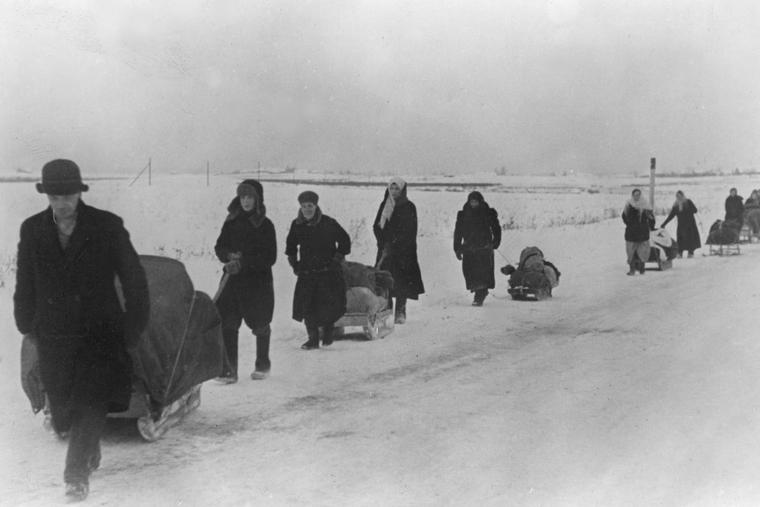
Aunt Rose, whose mother had died, accompanied her father, a classically trained organist, eastward across the Russian steppe and Siberia. They were part of a hejira of refugees hoping to find passage from Vladivostok to the United States, the new “Promised Land.”
During their long, arduous trek, my aunt somehow got separated from her father. Forced to seek out family members and friends for help, she — a determined and courageous young lady — continued her journey of suffering and deprivation for weeks across what had once been the Russian Empire.
The country was in chaos until the Bolsheviks consolidated power in Moscow. Warring armies and guerrilla bands were everywhere, stealing, raping and killing countless men, women and children.
I recall asking my aunt about her experiences when I was in the fifth or sixth grade.
“Dicky,” she replied tearfully, “I really can’t talk about those terrible months. I can’t do it.”
The last thing I wanted was to hurt Aunt Rose, whom I loved and who was like a second mother to me.
Years later, when I was a student pursuing graduate studies, I brought up the subject again. This time, she was more responsive.
“It was one of the worst experiences of my life. Remember, I was a young girl,” she said. “What got me through it was faith in God. I constantly prayed and hoped to rejoin my father.”
One day, the group with whom she was traveling stopped to make camp. Someone handed her two wooden pails to fetch water from a stream below the ridge where the camp was located.
No sooner had she reached the stream than she heard the thunderous noise of a huge number of horses, followed by yells, agonizing screams and gunshots. A motley band of guerrillas had attacked the camp.
Terrified, my aunt saw a dead oak tree that had fallen partially into the stream. She ran beneath it, hoping it would provide sufficient protection until the marauders left the area.
“I waited a long time,” she said in a whisper. “It seemed like an eternity. I was in a state of shock, forgetting prayers I had learned as a little girl in parochial school. All I could repeat was the phrase, ‘God, please help me.’”
When she returned to the camp above the stream, she saw the grim scene of a massacre.
“I never cried so much in my life,” she told me. “I had no choice but to keep going east.” Since the band of thugs and murderers had stolen everything of value, including horses and wagons, my aunt resumed her journey on foot until she teamed up with relatives and friends who escorted her to Vladivostok, Russia’s major port on the Pacific Ocean.
Incredibly, her father, frantic with worry, managed to find his daughter, and they were happily reunited in Vladivostok. He booked passage for the two of them on a ship that took them to Japan. They remained there long enough for her to develop a working knowledge of Japanese.
When they arrived in the United States, my aunt knew three languages — Polish, Russian and Japanese. English proved to be her greatest challenge, she later confided. I loved to hear the sweet lilt of her voice when she spoke it.
My aunt and her father eventually found their way to the Polish American enclave of West Lynn, Massachusetts. The nucleus of the community revolved around St. Michael’s Catholic Church, where her father played the organ. According to my mother, when he wasn’t playing Latin hymns at Mass, customary in those days, one could often hear him play the beautiful music of Bach.
Their arrival in Lynn was significant in my family’s history because my aunt’s father married my widowed grandmother, who had two children — my mother and uncle — from previous marriages. Now my mother and uncle had a stepsister, whom they heartily and lovingly embraced.
“She was my best friend,” my mother said many times. “I never met anyone like her. She was one of a kind.”
My aunt’s journey through life had more pain and suffering in store for her. She married and had two daughters. But the effects of the Great Depression wreaked havoc on the family’s financial security and especially on my uncle’s emotional stability. He became an alcoholic.
Seeking some semblance of normality in her life, Aunt Rose and my cousins came to live with my family. “To say that I was ‘grateful’ when your mother and father opened the door of their home to us doesn’t adequately express how I felt,” she told me many years later when I visited her in New York, where she and my cousins lived.
One of my fond memories of Aunt Rose was her unfailing kindness. I recall the deep concern she shared with my mother about my poor appetite when I was a young boy. I was a thin, scrawny kid who only liked one food — lobster.
“You can’t eat lobster three times a day!” my mother declared in despair one day.
“But I don’t like anything else!” I replied.
Aunt Rose, who had a keen understanding of people, discovered that if she generously buttered vegetables, I’d eat them. I even ate spinach, provided it swam in a pool of warm butter.
I immediately began to gain weight.
Stunned by my aunt’s discovery, my mother confessed, “Rose, you did the impossible! You did what I couldn’t do.”
When I was in her presence, I witnessed her reaction to times of stress and even anger, which sometimes occurred in a large family. She always applied the healing balm of kindness in those situations.
As I grew older, I increasingly reflected on my aunt’s remarkable life. What I learned was that her ability to cope with hardship and pain forged in her an uncommon courage, patience and understanding of other people. These attributes produced a mature spiritual growth that eludes so many of us. Predictably, she was a very humble person who held her religion in her heart and soul, not in ostentatious display.
“I always tried more to listen than to talk,” she once told me. Her comment was the key to the gift of wisdom she possessed.
When I tried to liken the hardships of her life to what some of the prophets of Holy Scripture experienced, she took my arm and gently chided me: “Surely, you’re not comparing me to those very holy people!”
“You radiate holiness,” I told her during our last conversation.
She shrugged. “God will eventually decide that, won’t he?”
Not long after my last visit with my Aunt Rose, I heard the sad news of her death. I was immediately reminded of some of the verses of a poem, written by Shiphrah Lakka and inspired by Proverbs 31:
She was clothed in grace and dignity,
A woman of worth, with selfless humility.
Her beauty comes from deep inside.
Her heart is pure, not a hint of pride.
So, I ask Him for His strength and grace,
To do my best and run the race,
To be the woman I’m meant to be,
And take hold of the prize set before me.
- Keywords:
- faith
- refugees
- immigrants