Christ Offers More Than John Lennon Could Ever Imagine
COMMENTARY: Our problems cannot be solved without Jesus Christ and a people willing to live prophetic lives of Christian counter-witness.
I want to make one very simple claim, so simple it can appear naïve and even childish: We cannot solve our problems without God. More specifically, we cannot solve them without Jesus Christ, God incarnate. Which is to say, we cannot solve them without Christians willing to live prophetic lives of counter-witness.
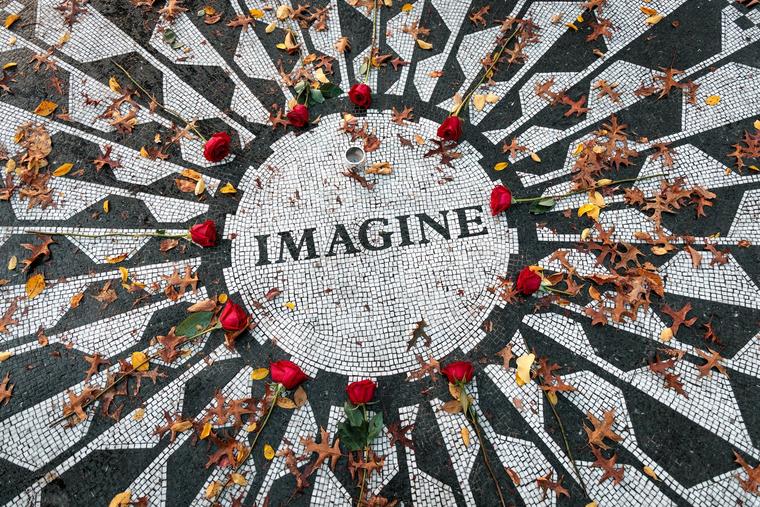
This was brought home to me while watching news coverage of our nation’s ongoing, fractious unraveling over the issue of immigration. I was reminded of John Lennon’s song Imagine — so popular, apparently, with people of a secular nature. It is, in my view, one of the worst songs ever written in terms of its message. The song’s lyrics call for us to imagine a world in which there is no heaven or religion or countries:
Imagine there’s no heaven It’s easy if you try No hell below us Above us only sky Imagine all the people Living for today
Imagine there’s no countries It isn’t hard to do Nothing to kill or die for And no religion, too
The vision, therefore, is rather clear: Only a world in which there is no heaven or hell, no God, no religion, no countries, no possessions — and with our focus only on this world — can bring us peace. And that is because, allegedly, once those things are eliminated, there will be “nothing to kill or die for.”
John Lennon could not have been more wrong. As we watch the carnage in our streets play out on our TV screens, we need to remind ourselves that this is what reality looks like when Lennon’s vision comes to fruition. It is precisely when we lose our sense of divine transcendence, when we cease to believe that there is a heaven above our sky and that there is a singular God — one who is love and who binds us all together into one human family — that violence becomes inevitable.
It is not religion or love of country as such that causes our tribal violence. To love our heavenly Father and to show that love via ritual and formal worship is not something to be feared any more than it is to love my earthly father and mother. To love my family. To love my siblings and spouse and friends and neighbors.
Loving my country means embracing with deep gratitude my homeland, which, after all, gave me my language and my culture. That is to say, it gave me, ironically, my imagination — the very imagination Lennon thinks can be concocted in an ersatz fashion out of whole cloth, in an abstract vacuum where all those things that made me who I am are airbrushed out and the space created is sanitized with secular sterilants.
The human being thus created is exactly as C.S. Lewis described in his prescient book The Abolition of Man, to wit, that modern people are like “men without chests.”
What Lewis is appealing to here is the idea, as he puts it, that “the mind rules the belly through the chest.” By that he meant that our lower and more animal nature, mainly concerned with food and procreation and survival (the “belly”), cannot be tamed by the mind alone (reason). Instead, the mind needs the moral virtues of the free will, symbolically located in our “heart” (the “chest”). These moral habits can harness the passions in fruitful ways, energizing our lives and directing our eros — an ecstatic “going out” of the self — toward the Good and onward to God.
What Lennon did not understand, apparently, is the moral entropy of this thing within us we call sin. Devoid of God, who alone can direct our will “upwards” and out of ourselves into the moral Good, we will not remain in a kind of stasis but will instead have our moral orbit decay as we flame out in the heat of our passions. If we are not trending upward toward God, we will be trending downward toward our gut or our crotch or our veins.
Therefore, we need our loyalties. We need the moral ties that bind. And the purely intramundane and secular vision of a rootless cosmopolitanism of “Starbucks unity” cannot generate such ties. We are not defined by appeal to some abstraction called “humankind.” We are defined by that to which we bind ourselves morally. We are defined by that to which we vow our souls.
Nor am I speaking only of liberals and overt secularists. The wonderful moral theologian David Deane, author of the criminally underrated book The Tyranny of the Banal, once said to me on a podcast that if we think the post-Christian political left is dangerous and scary, just wait until we see the post-Christian political right.
I agree with Deane. Lennon may have envisioned a leftist globalist utopia where we can all live in a million-dollar brownstone on New York’s Upper East Side. But there are also the truly frightening right wing post-Christian billionaires whose technocratic vision of a post-human, eschatological inbreaking of the “singularity” is even worse. And this is in addition to all of the “don’t tread on me” sovereign-nation types who range from the silly to the grotesque.
And then there are the post-Christian “Christians” like the Nick Fuentes “groypers,” some of whom have created a bizarre amalgam of traditional Catholicism and rank racist vulgarisms.
What was it that Chesterton said? “When people stop believing in God it is not that they now believe in nothing. Rather, it is that now they will believe anything.”
I am reminded as well of the following quote from Joseph Ratzinger, taken from his book Introduction to Christianity:
The profession ‘There is only one God’ is, precisely because it has itself no political aims, a program of decisive political importance; through the absoluteness that it lends the individual from his God, and through the relativization to which it relegates all political communities … it forms the only definitive protection against the power of the collective and at the same time implies the complete abolition of any idea of exclusiveness in humanity as a whole.
This is not to say that politics is unnecessary. But it is to say that it is a penultimate and not an ultimate reality — and that when we eliminate God, as in Lennon’s vision, we reduce everything to the political and make it a slave of the same.
Love of country can indeed devolve into a hateful nationalism that leads to violence. Love of family and neighborhood can devolve into racism and xenophobia. And love of God can devolve into the weaponization of religion against other religions.
But these various “devolutions” are just that — devolutions, not laudatory evolutions. They occur when that which is truly “above” politics — “prepolitical” in an ontological sense — is coopted by politics. In other words, they occur when God ceases to be God and is no longer believed in precisely as he who transcends, and is instead reduced to a cipher for our pettiness and hatreds. God then becomes a mere extension of, and projection from, my worldly politics.
I would like to Imagine a different world: Imagine our nation filled with old-fashioned, medieval-styled Benedictine monasteries. You can imagine it if you try. It’s not hard to do. And as millions of undocumented immigrants came into our country, they found refuge in the hospitality of our monasteries — places where the corporal and spiritual works of mercy were performed.
Imagine that most Americans believed passionately in heaven, and that we have a moral duty, commanded by the God of that heaven, to care for the least among us — and therefore donated generously to those monasteries, offering their skills and services to help in any way they could.
This is a fantastical vision, of course, but it has historical precedent. Before the Reformation, there were hundreds of Benedictine monasteries across England. They served as hospices, hospitals, aid stations for pilgrims, and places to seek material help if one was poor. But after Henry VIII dissolved the monasteries and confiscated their land and wealth, he destroyed this system of social aid to the needy. Consequently, England developed a “poverty problem,” necessitating the creation of squalid poorhouses, debtors’ prisons and similar institutions.
I do not know the answer to the politics of our immigration issue. But I do know that I prefer the vision of St. Benedict to that of John Lennon. A world without God will be, ironically, a balkanized world of self-interest seeking power. A world with Benedict’s God — and Catholics willing to live the vision of the Sermon on the Mount — will be a world where ICE is something I put in a glass of chilled tea.
And that is not at all hard to imagine.
- Keywords:
- Jesus Christ
- John Lennon
- religion
- st. benedict
- benedictines