What Should We Make of the Supreme Court’s St. Isidore of Seville Virtual School Decision?
COMMENTARY: It’s only a matter of time before a case questioning the constitutionality of excluding religious schools from charter-school programs is before the high court once again.

After Oklahoma’s Charter School Board certified St. Isidore of Seville Virtual School — an online school created jointly by the two Catholic dioceses in the state — Attorney General Gentner Drummond objected. He successfully petitioned the state’s highest court to order the charter school board to withdraw certification.
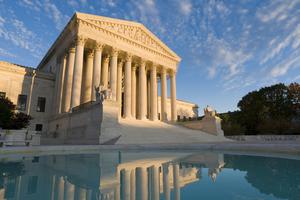
Unwilling to accept such blatant religious discrimination, both St. Isidore’s and the Oklahoma Charter School Board asked the Supreme Court to review the matter. On Thursday, the Supreme Court deadlocked — a result that allows Drummond to keep St. Isidore’s from opening as a charter school. For now.
The Court’s per curiam opinion stated simply that the judgment of the Oklahoma Supreme Court was affirmed by an “equally divided Court.” The order did not include a vote count.
This sort of unusual occurrence — a 4-4 split — came about because one of the justices, Amy Coney Barrett, recused herself from participating in the Court’s review of the matter. Barrett did not explain her reasons for her recusal, but likely considerations were her close ties to Notre Dame’s Religious Liberty Clinic, which represented St. Isidore’s, as well as her longtime friendship with a chief adviser to the school, Notre Dame Law professor Nicole Garnett.
The Code of Conduct for Justices of the Supreme Court of the United States observes that “the absence of one Justice risks the affirmance of a lower court decision by an evenly divided Court —potentially preventing the Court from providing a uniform national rule of decision on an important issue.” Consequently, the Code outlines considerations to guarantee that a justice performs his or her “duties of office fairly, impartially, and diligently.” A justice is “presumed impartial” and “has an obligation to sit unless disqualified.” Grounds for a justice to disqualify himself or herself involve proceedings “in which the Justice’s impartiality might reasonably be questioned, that is, where an unbiased and reasonable person who is aware of all relevant circumstances would doubt that the Justice could fairly discharge his or her duties.”
After Thursday’s decision, Supreme Court commentator Carrie Campbell Severino observed, “Recusal because a friend has had some connection to the case — but is not a party — has never been the practice.” Severino lamented, “An enormous amount of time, money, and effort were spent on this case, only to have it end without resolution.” Justice Barrett’s recusal kept a keen jurist off the bench in an important case. Fortunately, her recusal is not binding for future cases.
Similarly, evenly split decisions like this one do not constitute binding legal precedent. As Garnett told The Washington Post, “there is no precedential value to this order so the issue remains a live one.”
So what should we make of Thursday’s decision?
As I wrote for the Register after the Court held oral argument in April, four of the Court’s originalists — Justices Clarence Thomas, Samuel Alito, Neil Gorsuch and Brett Kavanaugh — appeared to support St. Isidore’s certification as a charter school. They appreciate that because charter schools are privately created and privately controlled, they are not the government, and nor are they engaged in state action. They also appreciate that excluding religious schools like St. Isidore’s from participating in the state’s charter-school program is a form of religious discrimination. It’s likely that Justice Barrett would agree. By contrast, the Court’s three progressives — Justices Elena Kagan, Sonia Sotomayor and Ketanji Brown Jackson — were more than satisfied with excluding St. Isidore’s.
And Chief Justice John Roberts?
Several legal commentators speculate that Roberts joined his three progressive colleagues, pointing to his questioning during oral argument. They may be right. During argument, he opined that, unlike privately run foster-care agencies that contract with the government, charter schools involve “a much more comprehensive involvement.”
If Roberts did vote against St. Isidore’s request for fair treatment, that is a great disappointment, particularly because he was the author of two recent school-choice cases in which the Court held that excluding religious schools was deemed unconstitutional. In Espinoza v. Montana Department of Revenue, for example, the Court struck down the “No-Aid” provision in the Montana Constitution that excluded religious schools and families from a publicly funded scholarship program for students attending private schools.
“A state need not subsidize private education,” observed Roberts. “But once a State decides to do so, it cannot disqualify some private schools solely because they are religious.” Two years later, in Carson v. Makin, the Court found that Maine violated the Constitution when it excluded religious schools from participating in a voucher program for rural students. “The State pays tuition for certain students at private schools — so long as the schools are not religious. That is discrimination against religion,” Roberts wrote.
It’s only a matter of time before a case questioning the constitutionality of excluding religious schools from charter-school programs is before the high court once again. When that time comes, let’s hope that Justice Barrett is on the bench and Chief Justice Roberts allows fairness and religious freedom to win the day.