1,700 Years After Nicaea: A Maronite Bishop’s Call for Christian Unity
COMMENTARY: The Jubilee and Nicaea anniversary summon Christians to reconciliation.

Editor’s Note: The Maronite Catholic Church is one of 23 Eastern Catholic Churches in full communion with the pope in Rome. The Church’s approximately 3.5 million members worldwide are primarily concentrated in Lebanon. Bishop Gregory Mansour leads the Eparchy of Saint Maron of Brooklyn, New York, one of the two Maronite eparchies (dioceses) in the U.S. His commentary below originally appeared on the eparchy's website and is reprinted here with permission, in conjunction with Pope Leo XIV’s apostolic journey to Turkey and Lebanon Nov. 27-Dec. 2.
The year 2025 has brought with it two occasions of grace and challenge: the Jubilee Year proclaimed by the Catholic Church and the 1,700th anniversary of the Council of Nicaea. Each summons us to repentance and renewal, to fidelity and hope. The Jubilee invites us to turn again to God, to seek reconciliation with one another, and to embrace mercy as the path of renewal.
The commemoration of Nicaea recalls the first of the Ecumenical Councils, convened in 325, when the Church, under the authority of an emperor but guided by the Spirit, confessed with clarity that the Son of God is homoousios with the Father — true God from true God, begotten not made, consubstantial with the Father.
For me as a Maronite Catholic, these two anniversaries converge in a single summons: to reflect deeply on the unity of Christians. My own life bears witness to both unity and division. I was baptized in a Latin parish in Flint, Michigan, for no Maronite parish yet existed there. And yet, by the faith of my father, I was “born” into the Maronite Church, ascription in canon law would describe it. From the very beginning of my life, I have lived the paradox of division and unity: a Maronite in heritage, a Latin in baptism, a Catholic in both. I also grew up with Assyrian Christians (Church of the East) as well as a variety of Orthodox Christians. This reality has shaped my vocation and my longing for the restoration of full communion among all Christians.
The Doctrinal Achievement of Nicaea
The Council of Nicaea, convened in 325, was a turning point in Christian history. The Edict of Milan in 313 had ended the persecutions and given the Church peace, but peace also exposed new internal conflicts. Chief among them was the teaching of Arius, a priest who denied the eternal divinity of the Son. For Arius, Christ was the highest of creatures, exalted above all, but still created, not equal to the Father.
The bishops gathered at Nicaea saw that the heart of salvation was at stake. They declared that the Son is homoousios — of the same essence — with the Father. This single word preserved the mystery of the Incarnation: that the one who became flesh, suffered, died, and rose again was not a mere creature but the eternal Son of God. Only if Christ is truly God can he redeem us; only if he is truly man can he share our humanity and bring it to glory.
The Nicene Creed thus safeguarded what had always been professed in baptism and celebrated in the Eucharist: one God in three persons, Father, Son, and Holy Spirit. Later councils built on this foundation. Constantinople in 381 confessed the full divinity of the Holy Spirit. Ephesus in 431 affirmed the unity of Christ’s person, condemning Nestorius. Chalcedon in 451 declared the Lord to be one person in two natures, consubstantial with the Father according to his divinity and consubstantial with us according to his humanity.
From Nicaea to Chalcedon, the Church was drawn — through conflict, through politics, through human frailty — to articulate the mystery of faith with greater clarity. Catholics believe this process was not merely human but guided by the Holy Spirit, who leads the Church into all truth.
The Syriac Witness: Saints Maron and Ephrem
Why, then, should a Maronite bishop, heir to the Syriac tradition, concern himself so deeply with Nicaea — a council conducted in Greek, convened by a Roman emperor, debated in categories foreign to Semitic thought? The answer is both historical and theological.
The Syriac tradition produced saints who bore witness to the same Nicene faith, though in a different idiom. Saint Maron, the priest and ascetic who died around 410, never attended an ecumenical council, yet his holiness gave rise to the Maronite Church. Saint Ephrem the Syrian, ascetic, teacher and hymnographer, contemporary with Nicaea, was suspicious of Greek speculation and warned against “the poison of the Greeks” who overanalyzed divine mysteries.
Yet his hymns accurately proclaim with luminous beauty the Nicene faith: Christ the Word is both God and man, the eternal Son who became flesh to save us.
Here lies an important truth: Syriac Christianity confessed the same faith as Nicaea, but not in the language of Greek metaphysics. Rather, Syriac Christians preferred the poetry of Scripture to the categories of philosophy, and sang the faith rather than defined it. And yet in song as in definition, the same Christ was proclaimed: true God and true man, Savior and Lord.
Estrangement of the Syriac Churches
Yet history, which had carried the faith of Nicaea, also bore within it the seeds of division. If Nicaea united the Church in confessing Christ’s full divinity, later councils would see Christians estranged from one another — often not because they denied the Nicene faith, but because they expressed it differently, or because politics and empire placed insurmountable obstacles in their path.
The East Syriac Church, later called the (Assyrian) Church of the East, developed largely within the Persian Empire, beyond the direct influence of the Roman emperors. When the Council of Ephesus in 431 condemned Nestorius, Patriarch of Constantinople, the East Syriac hierarchy refused the council’s authority and aligned instead with his Christological formulations. Though their intent was to safeguard Christ’s full humanity without denying his divinity, they came to be branded “Nestorian.” From that point on, the Church of the East stood in permanent separation from both Rome and Constantinople.
I cannot hear the word “Assyrian” without remembering my childhood in Flint, Michigan. Ours was a working-class city, and in our neighborhood stood the first Assyrian parish in the United States. We Maronite Catholics and Assyrian Christians lived side by side, sharing the same language of faith in Jesus Christ, even as our Churches stood apart. As a boy, I did not know why we were separated; only later did I learn that it was councils, condemnations, and empires long ago that had divided us. That experience shaped in me a conviction that we are closer to one another than our histories admit.
The West Syriac Church experienced a different trajectory. Remaining under Byzantine rule, it was fully exposed to the Greek theological debates. Yet its bishops and faithful preferred the biblical and Semitic expressions of their own heritage. When the Council of Chalcedon in 451 defined Christ as one person in two natures, “without confusion, without change, without division, without separation,” many Syriac Christians feared this compromised the unity of Christ as taught by Cyril of Alexandria. They rejected Chalcedon and gradually formed what came to be known as the Syriac Orthodox Church. Alongside them, the Coptic Orthodox in Egypt, the Armenian Apostolic Church, and later the Ethiopian and Malankara Churches also stood apart. Together, these became known as the Oriental Orthodox Churches.
Not all Syriac Christians rejected Chalcedon. Some, including the Maronites, remained loyal to its definition and thus in communion with the broader Catholic Church. Even in centuries of geographic isolation, the Maronites preserved this fidelity to Rome, a sign of the complex and diverse ways Syriac Christianity developed.
Thus, by the middle of the fifth century, ecclesial lines had been hardened. The Church of the East had separated after Ephesus; the Oriental Orthodox Churches, including the Syriac Orthodox, Coptic, and Armenian, had separated after Chalcedon; and the Chalcedonian Churches, including the Maronites, remained in communion with Rome and Constantinople.
These were not divisions over the Nicene faith itself — all confessed Christ as true God and true man — but rather the divisions were over how that faith was expressed, and under what ecclesial authority it was received.
To put it starkly: By the middle of the fifth century virtually all non-Greek and non-Latin speaking Christians stood outside communion with the imperial Church. This was a catastrophic rupture in ecclesial life — tragic in its consequences and arguably avoidable had greater charity, patience, and mutual understanding prevailed.
A Tragedy and an Irony
Here lies both a tragedy and an irony. The tragedy is plain: divisions hardened, mutual condemnations exchanged, and for centuries Christians regarded one another as heretics. The estrangement that began in the fifth century endured for more than a millennium and a half, leaving families, communities, and whole nations divided in faith.
And yet the irony is just as striking: those same Christians, whether East Syriac, West Syriac, Coptic, Armenian, or Chalcedonian, never abandoned the Nicene faith. They all continued to baptize in the name of the Father, Son, and Holy Spirit.
They all celebrated the Eucharist as the sacrifice of Christ, true God and true man. They all safeguarded apostolic succession. They all proclaimed the same Lord Jesus Christ, even while accusing one another of error. Their languages differed, their political loyalties diverged, and their theological idioms varied, but their faith was one and the same.
This irony is what gives me hope. If our ancestors, divided by empire, language, and suspicion, nonetheless preserved the Nicene confession through all the centuries of separation, then perhaps our own generation — living in a world that yearns for unity — can take the next step toward healing and unity.
Modern Ecumenical Breakthroughs
Remarkably, the last half century has witnessed precisely such steps. Beginning in the 1970s, the Catholic Church entered into serious theological dialogue with the Oriental Orthodox Churches.
These conversations bore fruit in a series of historic declarations.
In 1973, Pope Paul VI and Pope Shenouda III of the Coptic Orthodox Church signed a common declaration affirming their shared faith in Christ. In 1984, a similar declaration was signed by Pope John Paul II and Patriarch Ignatius Zakka I Iwas of the Syriac Orthodox Church. Declarations with Armenian and Malankara Orthodox hierarchs followed.
These efforts culminated in 1994, when Pope John Paul II and Patriarch Mar Dinkha IV of the Assyrian Church of the East signed the Common Christological Declaration, affirming together that our Lord Jesus Christ is “true God and true man, perfect in his divinity and perfect in his humanity … united in one person without confusion or change, without division or separation.”
In that moment, after 15 centuries of estrangement, the Catholic Church and the Church of the East together confessed the same Christological faith, in words that could have been sung by Ephrem or proclaimed by Nicaea itself.
Taken together, these agreements reveal something profoundly important: what divided us for centuries was not faith itself, but the way that faith was articulated, translated, and received. The Christological agreements of the late twentieth century confirm what the irony of history had long suggested — that despite our differences, we have always confessed the same Christ.
Vatican II and the 'Medicine of Mercy'
If the late 20th century brought Christological convergence, the Second Vatican Council provided the theological framework that made such convergence possible. For centuries, relations between the Catholic Church and the Eastern Churches — whether Eastern Orthodox or Oriental Orthodox — were marked more by polemic than by dialogue. Councils had often served as dividing lines; condemnations hardened rather than softened hearts. But Vatican II chose a different path.
In Unitatis Redintegratio, the Decree on Ecumenism, the Council fathers spoke with a new candor and humility. They acknowledged that the Holy Spirit has not ceased to act in the separated Churches and ecclesial communities, and that “many elements of sanctification and of truth” are found among them.
This was not a mere rhetorical gesture, but a doctrinal affirmation: wherever Christ is confessed, wherever baptism is celebrated, wherever the Scriptures are proclaimed, the Spirit of God is at work.
Pope Saint John XXIII, who convoked the Council, had signaled this new approach in his opening address. He declared that the Church must no longer wield “the weapons of severity,” but instead must heal with “the medicine of mercy.” In those few words, he articulated an entire vision: the Catholic Church would not advance ecumenism by imposing itself or by rehearsing condemnations, but by offering mercy, listening with patience, and recognizing in others the same Christ who unites us.
This shift changed everything. No longer were the Oriental Orthodox, the Assyrian Christians, or the Eastern Orthodox to be regarded primarily as adversaries to be refuted. They were to be approached as brethren, as Churches possessing apostolic succession, sacraments, and above all the Nicene faith.
I have seen this vision come alive in my own ministry. As co-chair of the Catholic–Oriental Orthodox Dialogue in the United States, I have sat across the table from bishops and theologians of Churches that once condemned us as heretics, and that we in turn condemned. We pray together, study the Scriptures together, and debate vigorously. And yet, time and again, we discover that we were confessing the same Christ. In those moments, centuries of estrangement seemed to recede, and what remained was the possibility of reconciliation grounded not in politics or compromise, but in truth and charity.
The Council of Jerusalem as Paradigm
If the councils of the fourth and fifth centuries preserved doctrine but deepened division, the Council of Jerusalem (Acts 15) in approximately 52 AD provides another model. Confronted with conflict over Gentile converts, the apostles listened to Peter’s testimony and accepted James’s compromise: unity around essentials, freedom in non-essentials. The result was communion without coercion, diversity without division. This apostolic pattern remains a summons to the Church today. If the first Christians, guided by the Spirit, could reconcile such profound differences in the first century, can we not do the same in the twenty first?
Eucharistic Communion as the First Step
The greatest wound of our division is not the lack of common councils but the lack of common Eucharist. To this day, Apostolic Churches that confess the Nicene Creed, that baptize in the name of the Trinity, that ordain bishops in apostolic succession, cannot receive the Body and Blood of the Lord together.
I must admit that I long for the day when I may receive the Eucharist side by side with my Eastern Orthodox, Oriental Orthodox, and Church of the East brothers and sisters in dialogue. It is a contradiction — painful and unnecessary — that we can pray together, read Scripture together, and even confess the same Creed, and yet stop short of the one Bread and the one Cup.
If the Eucharist is, as our liturgies proclaim, the medicine of immortality, the pledge of eternal life, the gift of the Spirit, then should this great Mystery not also be the remedy for our divisions?
To share the Eucharist would not deny the real differences that remain — in ecclesiology, in primacy, in governance. But it would proclaim that those differences do not outweigh the unity already given in baptism and in the apostolic faith.
In a world increasingly hostile to Christian faith, what more powerful sign could there be than Christians of East and West, Chalcedonian and non-Chalcedonian, standing together at the altar of God?
External Challenges and the Mandate of Unity
The urgency of unity becomes all the more evident when we consider the challenges facing Christians in our time. The Middle East, cradle of our faith, has witnessed the rise of militant Islam, bringing persecution and displacement to millions of Christians.
The 20th century saw atheistic communism attempt to eradicate religion, silencing the voice of the Church in vast territories. In the West, secularism and materialism threaten to reduce faith to a private sentiment, stripping Christianity of its public witness.
In the face of such pressures, division among Christians is more than a scandal — it is a wound to our witness. A fractured Church speaks with a muted voice. United, however, we could proclaim with power the truth of Christ and offer the world a living sign of hope.
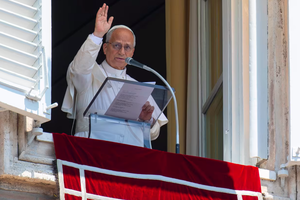
In this Jubilee Year, Pope Leo XIV has reminded us that Nicaea was not only a doctrinal milestone but also a sign of the Church’s capacity to gather, to discern, and to speak in one voice.
In 325, bishops from across the known world, summoned by an emperor but sustained by the Spirit, bore witness together to the divinity of Christ. Today, no emperor compels us to gather — but the Spirit of Christ himself calls us to do so. Fidelity to Nicaea requires that we recover this capacity: not for imperial peace, but for ecclesial communion, not for political concord, but for evangelical witness.
Conclusion: The Prayer of Christ
The Jubilee calls us to repentance; the anniversary of Nicaea calls us to fidelity. Together they summon us to the path of unity. The lesson of history is sobering: Language, culture and politics can obscure truth and deepen division. But the lesson of faith is stronger: the Spirit who guided Nicaea still guides the Church, and the mercy that reconciled Jews and Gentiles at Jerusalem can
reconcile us again.
In the end, the prayer of Christ should not be postponed: “That they all may be one, as you, Father, are in me and I in you, that they also may be one in us, so that the world may believe that you sent me” (John 17:21). To delay this hope is to delay our obedience to Christ, beloved Son of the Father, and to work for its fulfillment is to enter into the will of God.
May this 2025 Jubilee and this 1,700-year anniversary of Nicaea embolden us to trust the Spirit, to embrace the medicine of mercy, and to take the risk of reconciliation. If we dare to do so, then the tragedy of our divisions may yet give way to the irony of our amazing unity in Christ, and the world will once again see in us the promise of Christ, to the glory of the Father and joy of the Holy Spirit.
Bishop Gregory John Mansour leads the Eparchy of Saint Maron and is the Catholic Co-Chair of the Oriental Orthodox-Catholic Dialogue.