Lessons for Obama
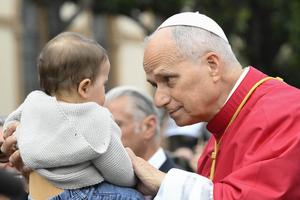
In a commentary posted at Politics Daily, Elizabeth Lev points out it was always a mistake to attach too much importance to last Friday’s meeting between Pope Benedict XVI and President Barack Obama:
There is little to fear (or expect) from this meeting; it is merely an introductory step to allow each leader to get beyond the endless distortions of the press and size up one another. Benedict met and befriended President Bush in the midst of the Iraq maelstrom, so perhaps we can hope for another small miracle in the encounter with Obama; after all, the Vatican has been known to produce a prodigy or two.
So what “small miracle” might Catholics reasonably hope for, to use Lev’s phrasing? Perhaps the beginning of some incremental change in Obama’s understanding of the importance of defending the sanctity of life, courtesy of his study of the reading material the Pope gave to him — the Vatican document Dignitas Personae (The Dignity of the Person).
This June 2008 instruction from the Congregation of the Doctrine of the Faith anchors its discussion of bioethics in its opening two sentences: “The dignity of a person must be recognized in every human being from conception to natural death. This fundamental principle expresses a great “Yes” to human life and must be at the center of ethical reflection on biomedical research, which has an ever greater importance in today’s world.”
And while it was issued under the hand of the current prefect of the CDF, American cardinal William Levada, rather than the Pope himself, Dignitas Personae is unmistakably Benedictine in its insistence on the integration of faith and reason as the proper way to grasp what is and isn’t morally acceptable with respect to embryonic research:
In presenting principles and moral evaluations regarding biomedical research on human life, the Catholic Church draws upon the light both of reason and of faith and seeks to set forth an integral vision of man and his vocation, capable of incorporating everything that is good in human activity, as well as in various cultural and religious traditions which not infrequently demonstrate a great reverence for life.
The immediate utility of Dignitas Personae for Obama would lie in his new rules for embryonic research that allow for federal funding of research that involves the killing of so-called surplus embryos stored at in vitro fertilization clinics, as the Vatican document carefully explains why these actions — which are really early abortions — are completely unacceptable offenses against the human dignity of these embryos.
But more broadly, one can hope that it will also help Obama to see the flaws of his contradictory current position on abortion, considered from the light of reason and the Christian faith the president professes. Of late, Obama has taken to acknowledging frequently that abortion is never a happy choice, yet since taking office, he has consistently made decisions that increase the number of occasions where a choice is made to kill unborn human beings.
Employing arguments that should resonate with an African-American president who began his working life as a community organizer defending the rights of disadvantaged Chicagoans, Dignitas Personae frames its conclusions in the context of the contemporary prohibitions that have been instituted to protect against other offenses against human dignity like racism and the marginalization of society’s most vulnerable members:
States the Vatican document:
36. There are those who say that the moral teaching of the Church contains too many prohibitions. In reality, however, her teaching is based on the recognition and promotion of all the gifts which the Creator has bestowed on man: such as life, knowledge, freedom and love. Particular appreciation is due not only to man’s intellectual activities, but also to those which are practical, like work and technological activities. By these, in fact, he participates in the creative power of God and is called to transform creation by ordering its many resources toward the dignity and well-being of all human beings and of the human person in his entirety. In this way, man acts as the steward of the value and intrinsic beauty of creation.
Human history shows, however, how man has abused and can continue to abuse the power and capabilities which God has entrusted to him, giving rise to various forms of unjust discrimination and oppression of the weakest and most defenseless: the daily attacks on human life; the existence of large regions of poverty where people are dying from hunger and disease, excluded from the intellectual and practical resources available in abundance in many countries; technological and industrial development which is creating the real risk of a collapse of the ecosystem; the use of scientific research in the areas of physics, chemistry and biology for purposes of waging war; the many conflicts which still divide peoples and cultures; these sadly are only some of the most obvious signs of how man can make bad use of his abilities and become his own worst enemy by losing the awareness of his lofty and specific vocation to collaborate in the creative work of God.
At the same time, human history has also shown real progress in the understanding and recognition of the value and dignity of every person as the foundation of the rights and ethical imperatives by which human society has been and continues to be structured. Precisely in the name of promoting human dignity, therefore, practices and forms of behavior harmful to that dignity have been prohibited. Thus, for example, there are legal and political — and not just ethical — prohibitions of racism, slavery, unjust discrimination and marginalization of women, children, and ill and disabled people. Such prohibitions bear witness to the inalienable value and intrinsic dignity of every human being and are a sign of genuine progress in human history. In other words, the legitimacy of every prohibition is based on the need to protect an authentic moral good.
37. If initially human and social progress was characterized primarily by industrial development and the production of consumer goods, today it is distinguished by developments in information technologies, research in genetics, medicine and biotechnologies for human benefit, which are areas of great importance for the future of humanity, but in which there are also evident and unacceptable abuses. “Just as a century ago it was the working classes which were oppressed in their fundamental rights, and the Church courageously came to their defense by proclaiming the sacrosanct rights of the worker as person, so now, when another category of persons is being oppressed in the fundamental right to life, the Church feels it is duty bound to speak out with the same courage on behalf of those who have no voice. Hers is always the evangelical cry in defense of the world’s poor, those who are threatened and despised and whose human rights are violated.”
In virtue of the Church’s doctrinal and pastoral mission, the Congregation for the Doctrine of the Faith has felt obliged to reiterate both the dignity and the fundamental and inalienable rights of every human being, including those in the initial stages of their existence, and to state explicitly the need for protection and respect which this dignity requires of everyone.
The fulfillment of this duty implies courageous opposition to all those practices which result in grave and unjust discrimination against unborn human beings, who have the dignity of a person, created like others in the image of God. Behind every “No” in the difficult task of discerning between good and evil, there shines a great “Yes” to the recognition of the dignity and inalienable value of every single and unique human being called into existence.The Christian faithful will commit themselves to the energetic promotion of a new culture of life by receiving the contents of this instruction with the religious assent of their spirit, knowing that God always gives the grace necessary to observe his commandments and that, in every human being, above all in the least among us, one meets Christ himself (Matthew 25:40). In addition, all persons of good will, in particular physicians and researchers open to dialogue and desirous of knowing what is true, will understand and agree with these principles and judgments, which seek to safeguard the vulnerable condition of human beings in the first stages of life and to promote a more human civilization.