A Landmark of Early American Catholicism
In Bally, Pa., a town named for a priest, the faith took root even before the Revolutionary War
Sixty miles north of Philadelphia, in the town of Bally, Pa., St. Paul's Chapel is located in the apse behind the sanctuary of Most Blessed Sacrament Church. The historic chapel remains one of the oldest original places of Catholic worship in the 13 colonies.
When it was built — with nearly three-foot-thick stone walls — Daniel Boone was a child playing at his family home a few miles away.
George Washington wasn't yet a teen. By the time he became our first president, when most towns didn't even have a Catholic church, the Krauss brothers were building the organ for St. Paul's new 35-foot addition. This organ is still in use today.
Visitors to the historic church quickly realize it continues to be an active parish of 800 families in a well-preserved context that dates to the initial mission stops in the English colonies.
A stately colonial structure, St. Paul's received its name change to Most Blessed Sacrament in 1837, the year of its final (80-foot) addition. Since then, the exterior has remained true to the facade depicted in 19th-century postcards of it. The few changes include the front vestibule, side entrance, and stained glass windows.
In the 1750s, half the Catholics in the state were members of this parish. At the time, the area was known as Goshenhoppen. The first resident pastor, Father Theodore Schneider SJ (previously the rector of Germany's Heidelberg University) emigrated to the colonies to found St. Paul's in 1741 as a mission primarily for German Catholic settlers. Sacramental records begun that year are now the oldest such accounts in existence among the 13 colonies.
Because the times were unfriendly, legally speaking, for Catholics, early missionaries concentrated their pre-American Revolution efforts in Maryland, then Pennsylvania, where oppressive laws went largely unen-forced. With milder restrictions because of William Penn's policy of peaceful toleration, a Jesuit came to Philadelphia and soon began Catholic services in what became Old St. Joseph's Church. By 1741 two other hubs on the missionary circuit emerged: Conewago Chapel (to be described in an upcoming “Catholic Traveler” feature) in Hanover, Pa., on the other side of the Susquehanna River, that covered the western portion of the state to the limits of civilization; and Goshenhoppen, with a mission trail that covered eastern Pennsylvania and extended to Lake Erie.
Father Schneider's congregation wasn't made up only of German immigrant farmers working the fertile countryside. Early parishioners included some Irish and English Catholics, Native Americans who had converted, and black Catholics — both free and slave. Many worked for the nearby large iron industry.
For 23 years the pastor shepherded his territory, plus much of the state for a few years when he was appointed simultaneously to head Conewago Chapel. He even ventured east into New Jersey, often disguised as a physician because of Catholic oppression, and is credited with laying the foundation of the Church there.
At St. Paul's Chapel, he also founded what is believed to be the first Catholic parish school in the country. Today, centuries later, it remains vibrant with 270 students.
Father Augustin Bally SJ, appointed pastor in 1837, also strongly promoted the school. At the time he arrived, the town's name was Churchville. On Aug. 7, 1883, a year after he died, the name was officially changed to Bally in his honor. Even the town's non-Catholics mourned him. During his 45 years at the parish, he completed the extension of the church begun by his predecessor and oversaw construction of a new school building as well as the rectory, which is still in use today.
Including these two priests, members of the Society of Jesus administered the parish for 148 years before diocesan priests took over.
Despite many changes, St. Paul's Chapel has remained. With the 1799 addition, it was used as the sacristy. In 1837 it returned to a chapel, still used today for small baptisms and weddings. On Holy Thursdays, the Blessed Sacrament is reserved in its wooden tabernacle, surmounted by a carved statue of Mary holding the child Jesus.
The chapel is well-preserved and looks much as it did in the mid-1700s. The wooden candlesticks and altar remain flanked by tall pedestal candelabras in the shape of wooden wagon wheels.
Once behind the altar but now relocated is an 18th-century painting of The Last Supper, a gift from the prince-elect of Saxony. Displayed on the side wall is the tall cross of iron used on the steeple erected in 1743. Father Schneider and other early priests are buried at the foot of the altar.
The main church, restored and renovated most recently in 1990, is beautiful. Sublime religious art combines with colonial, Roman, and gothic touches that lift minds and hearts to God.
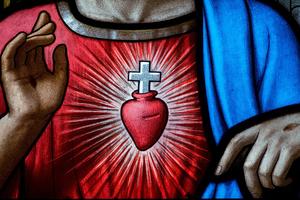
Beneath the intricately painted barrel vault, the reredos has a moving painting of the Crucifixion. A magnificent mural fills the arched top of the reredos — before a heavenly background, the Sacred Heart holds a chalice from which emerges a dazzling white host.
Mid-sanctuary, the vault has a mural of the Last Supper, while in the center of the nave, a huge mural depicts the Holy Trinity crowning Mary. These were completed within the last century.
Highly detailed stained glass windows from the early 1900s line the nave with such scenes as the Good Shepherd, the Holy Family being blessed by God the Father and the Holy Spirit, and the death of St. Joseph.
Among other highlights are the intricate side altars and white walk-up pulpit with canopy, and the gleaming oak, spindle-top pews installed on the occasion of the church's bicentennial. The white side altars honor Mary as the woman in chapter 12 of the Book of Revelation, and St. Joseph with the Child Jesus.
Original pews remain in the balcony and choir loft, where the 1799 Krauss organ is situated. With late baroque-style white case trimmed in black and gold, it is the oldest Krauss in continuous use. Since its installation it has been expanded by a Krauss grandson, rebuilt early this century, and restored in 1990. Professional organists, who come across the country to play it, marvel at its perfect tones.
Everything from the church's original bell, cast in Paris in 1706, to many sacred and colonial artifacts and items make the historic Most Blessed Sacrament Church, situated in the midst of picturesque farmland, recall the nation's early heritage.
From Philadelphia, take Interstate 76 (west) to Route 422 into Pottstown and Route 100 (south). In Bally, take a right on 7th Street and travel three blocks to Pine Street. The steeple is a landmark. From New York, pick up Interstate 78 (west) in New Jersey, follow to Allentown, Pa., and Route 100 (south) into Bally, then as above. Padre Pio National Center (to be featured next week) is about two miles from Bally. There are tourist activities in the Allentown and valley area, with motels and plenty of restaurants. Contact the church at 610-845-2460.
Joseph Pronechen writes from Trumbull, Connecticut.
------- EXCERPT: CATHOLIC TRAVELER- Keywords:
- August 30-September 5, 1998