Print Article | Email Article | Write To Us

Daily News

U.S. Bishops: Homilies Should Invite Catholics to Conversion (1405)

Every homily should center on Jesus, they stress in a new document on preaching.
11/15/2012 Comments (8)
Catholic News Agency

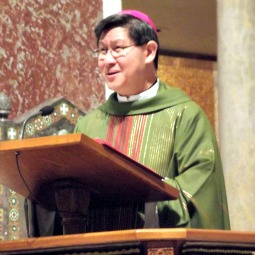
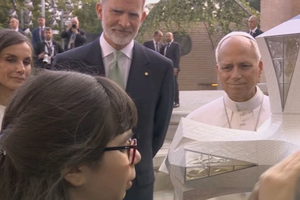
Manila Archbishop Luis Antonio Tagle of Manila gives the homily during Mass at the Cathedral of St. Matthew the Apostle May 28 in Washington.

– Catholic News Agency

BALTIMORE — Sunday homilies should promote repentance, instill a sense of mission and lead Catholics to grow in understanding of their faith, the U.S. bishops said in a new document on preaching.

“The ultimate goal of proclaiming the Gospel is to lead people into a loving and intimate relationship with the Lord, a relationship that forms the character of their persons and guides them in living out their faith,” the bishops emphasized.

In “Preaching the Mystery of Faith: The Sunday Homily,” the bishops offered a reflection on preaching for priests, deacons and those who are responsible for forming them.

Members of the U.S. Conference of Catholic Bishops voted to approve the document — which will also be translated into Spanish — on Nov. 13 at their fall general assembly in Baltimore. The vote tally was 227-11, with four abstaining.

The bishops noted that Catholics have asked for “more powerful and inspiring preaching” in surveys and that the laity can become discouraged by a “steady diet of tepid or poorly prepared homilies.”

Homilists should respond to this desire by preaching with a “sense of urgency and freshness,” connecting Scripture, the Eucharist and the Creed, they advised.

As an “intrinsic part of the Sunday Eucharist,” the bishops said in the document, every homily must be centered on Christ, whose death and resurrection are at the heart of our salvation.

“If a homilist conveys merely some example of proverbial wisdom or good manners, or only some insight gained from his personal experience, he may have spoken accurately and even helpfully, but he has not yet spoken the Gospel,” they stated.

And while “every effective homily is a summons to conversion,” the bishops also said this does not mean that a homilist should “simply berate the people for their failures.”

Instead, the clergy should emphasize the “offer of grace” and do so with “pastoral sensitivity.”

This invitation and “promise of grace” is an important context, particularly when addressing those who do not regularly attend Mass or discussing the moral challenges presented by Church teaching on delicate issues such as sexuality and marriage, they added.


Lack of Knowledge

The bishops also acknowledged that many Catholics seem to lack knowledge of Church teaching and are in need of stronger catechesis.

Since “the Sunday liturgy remains the basic setting in which most adult Catholics encounter Christ and their Catholic faith,” they counseled homilists to use the opportunity to present Church doctrine.

Over time, the homilist should cover the entire scope of the Church’s rich catechetical teaching, including its stance on critical issues such as the respect for human life, the importance of religious freedom and justice for the poor and migrants.

“Homilies are inspirational when they touch the deepest levels of the human heart and address the real questions of human experience,” the bishops said, noting the importance of incorporating both ordinary experiences and the deeper hopes and longings that give meaning to them.

“Our encounter with Jesus inevitably leads to mission,” they noted, adding that homilies are incomplete if they do not inspire a sense of mission that translates love of Christ into love for others.

Building on the New Evangelization, the Year of Faith and the call for a renewal of preaching by Pope Benedict XVI at the 2008 Synod on the Word, the bishops explained that preaching is a participation in the apostolic continuation of Jesus’ ministry.

They pointed to Mary as an example of hearing and proclaiming the word of God without hesitation. 

In their personal lives, homilists should work towards ongoing spiritual renewal, seeking to lead lives of holiness, with a deep love of Scripture and respect for Tradition, they said.

The effectiveness of preaching can also be improved through an understanding of contemporary culture, including the music, movies and websites that are a part of people’s lives.

The bishops offered several factors to consider when preparing homilies, including the growing individualism in modern culture, the need to speak respectfully about other religious traditions and the cultural diversity of Church communities.

Said the bishops, “Once he has come to know the customs, mores, practices, history and religiosity of a people, a homilist can draw on that richness in order to make his presentation of the faith fresh and enlivening.”

 

Filed under catholic faith, homiletics, priestly formation, the mass, u.s. conference of catholic bishops

Comments

Post a Comment

Yay, finally! I am hopeful that our parish priest does get this message and takes it to heart! And perhaps if the priests lack for inspiration, just reviewing the talks of Venerable Fulton Sheen could give them some core ideas to include in their homilies!

Thank you, Lord.  I guess some bishops must have read my comments on various websites of this topic. Maybe it will trickle down to the priests in my diocese.  My pastor already gave a better homily than he ever has. With Christmas coming, the topic of abortion and marriage would make great homilies.

With exception of the Bishop’s initiative regarding religious freedom this year, you never hear a homily that is informative of the Faith and our form of government.  Inform the people of what is really social justice and how it differs from Marxism.  Address the myth of “seperation of Church and State” and how our faith works with our daily lives.  Address marriage and the ramifications of same sex marriage and living our faith etc.  Talk about living in the footsteps of Christ and the impact of socialism, American exceptualism etc.in trying to do that.  It can be done without stepping on political toes among the faithful (though I’m not sure being a “democrat” and a “Catholic” thess days is reconcilable)

I’m so glad that this document was written. I hope it does some good.
If our religious education doesn’t happen on the parish level, it usually doesn’t happen at all. How else are people to learn? For people who do not have research skills, or don’t subcribe to a good Catholic newspaper, or don’t have cable TV, internet, etc., it is almost impossible to learn the faith short of private revelation! If the priests don’t hammer it home when it’s convenient or inconvenient, it won’t be known.
They also need to be EXTREMELY vigilant about choosing the right people to teach parish religious ed courses (including RCIA).  All religious ed techers should have a certificate and be able to pass a test on basic Catholic doctrine before being allowed to form parishioners.

Also, I don’t think the “trickle down” of teaching is happening. I think the Bishops would be surprised at how much of their instruction, initiatives, requests, letters, etc., is not passed on by the priests.Parishioners are clueless.

Amen!! No more corny homilies with silly jokes or stories - back to meat and potatoes basics!!!

I am getting tired of our parish priest’s attempts at doing poor imitation of stand-up comedy.  Not much reverence on display, but at least he doesn’t do horrible abuses of the liturgy, but his homilies could be better!

“Since “the Sunday liturgy remains the basic setting in which most adult Catholics encounter Christ and their Catholic faith,” they counseled homilists to use the opportunity to present Church doctrine.”


Yes, please!


“In their personal lives, homilists should work towards ongoing spiritual renewal, seeking to lead lives of holiness, with a deep love of Scripture and respect for Tradition, they said.”


Good!


” the need to speak respectfully about other religious traditions and the cultural diversity of Church communities.”


...hopefully, this respect will also extend to those who love Latin and the Traditional Latin Mass.  There is absolutely nothing to be afraid of in loving the EF.  Furthermore, please stress the need for regular Confession when talking about the Eucharist.  As we’ve seen from our politics and culture, enough people who identify as “Catholic” think that one is somehow “entitled” to receive Communion, but don’t seem to be aware of how much our sins prevent it from working as effectively as it otherwise would.

I am glad that you used in this article the photo of newly designated Cardinal Luis Antonio Tagle, the Archbishop of Manila, Philippines, who is a very excellent preacher and homilist.  Check his TV program, seen also on YouTube,  “The Word Exposed,” wherein he explains the Sunday readings in a clear and inspiring manner. He can relate the Sunday readings to basic Catholic doctrines which should be the purpose of every preaching or homily.

Post a Comment

By submitting this form, you give The National Catholic Register permission to publish this comment. Comments will be published at our discretion, and may be edited for clarity and length. For best formatting, please limit your response to one paragraph and don't hit "enter" to force line breaks.

The time period for commenting on this article has expired.