Pope Francis: Mercy Pleases God the Most
The jubilee, he said, ‘is an ideal time for all of us, because in contemplating Divine Mercy, which overcomes every human limit and sheds light on the darkness of sin, we can become more convincing and effective witnesses.’
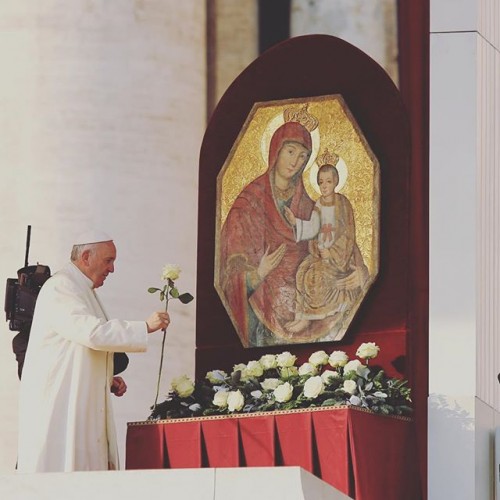
VATICAN CITY — The day after opening the Year of Mercy, Pope Francis dedicated his general audience remarks to answering the question of why he called for a jubilee on the subject, saying the primary reason is simply because it’s needed.
“Why a Jubilee of Mercy? What does this mean?” the Pope asked pilgrims present in St. Peter’s Square Dec. 9.
The answer, he said, is because “the Church needs this extraordinary moment. I’m not (just) saying, ‘It’s good,’ — no! I’m saying: The Church needs it.”
Pope Francis opened the Jubilee of Mercy, an extraordinary holy year, on Dec. 8, the Solemnity of the Immaculate Conception. The Holy Year will close Nov. 20, 2016, with the Solemnity of Christ the King.
The jubilee was officially inaugurated by the Pope when he opened the holy door in St. Peter’s Basilica. Pilgrims who pass through the door — which is only opened during jubilee years, ordinarily every 25 years or when a Pope calls for an extraordinary jubilee — can receive a plenary indulgence under the usual conditions.
Francis presided over the rite of the holy door’s opening before passing through himself. He was followed by retired pontiff Benedict XVI, who attended the rite in one of his rare public appearances.
The opening of the door is meant to symbolically illustrate the idea that the Church’s faithful are offered an “extraordinary path” toward salvation during the time of jubilee.
In his remarks at the general audience, Francis noted that in an age of great change, the Church is called to make God’s presence and closeness known.
The jubilee, he said, “is an ideal time for all of us, because in contemplating Divine Mercy, which overcomes every human limit and sheds light on the darkness of sin, we can become more convincing and effective witnesses.”
Through the holy year, the Church is turning our gaze to the heart of the Gospel, Jesus Christ who is “mercy made flesh,” the Pope said. To celebrate a jubilee dedicated to mercy, he added, means putting “the specific aspects of the Christian faith” back at the center of our personal and communitarian life.
“This holy year is offered to us in order to experience in our lives the sweet and gentle touch of the forgiveness of God, his presence beside us and his closeness above all in moments of greatest need,” he said.
Pope Francis then noted that mercy is in fact what “pleases God most” and is what is most needed by the world today, when there is “little forgiveness” in society, institutions, work and even the family.
He stressed the importance of recognizing that forgiving his children is what most pleases God, but without falling into the temptation “of thinking that there is something else more important or more of a priority.”
Nothing, he said, “is more important that choosing that which pleases God most: his mercy!”
The Pope then observed that this need for mercy also includes the reform of the Church and her structures and institutions.
“Mercy is truly able to contribute to the building of a more human world,” he said.
Francis cautioned that the biggest enemy of mercy is “self-love,” which in the world is manifested in the exclusive pursuit of one’s own interests, in the search of hedonistic pleasures and honors, as well as the greedy desire to accumulate wealth.
However, in the life of Christians, this self-love is often disguised “in hypocrisy and worldliness,” he said, adding that “all these things are contrary to mercy.”
“The movements of self-love, which make mercy foreign in the world, are so numerous that, often, we fail to recognize them as limitations and as sin. This is why it’s necessary to recognize that we are sinners, to reinforce in us the certainty of Divine Mercy,” he said.
In forgetting God’s mercy, we become blind to seeing sin for what it really is, the Pope said, explaining that this is why this Jubilee of Mercy is so important.
Francis closed his audience by praying that Mary, the Mother of God and also our mother, would intercede for us “so that in this holy year we can experience the mercy of God and manifest it to others.”