Marriage Preparation 2.0
Preparing Catholic couples is a complex task in today’s society — and requires new strategies.
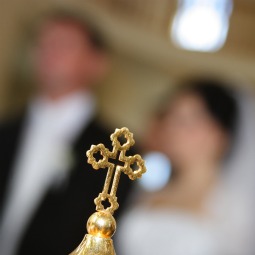
BELLAIRE, Texas — Meeting with the wedding coordinator made it hit home. Like many young adults, Todd and Christa Chapman, both in their 20s, hadn’t attended Mass regularly during college. But when they started planning their wedding nearly three years ago, they realized they needed to get more involved in their faith.
“We did face the obstacle of saying, ‘We want to have a Catholic ceremony, so we need to be living what we say we believe in,’” said Christa, who lives with her husband in Bellaire, Texas. “It’s one thing to say I’m a Catholic, but it’s another to be a practicing Catholic.”
As Catholic marriage rates decline, many of the couples who do marry in the Church today are older and cohabiting, often impacted by divorce and societal pressures, and have been away from the Church as young adults. Not surprisingly, they often lack both an understanding of the sacrament of matrimony and practical skills to live it out.
“It’s almost like every couple has the window open for annulment because they don’t have a clue what they’re getting themselves into,” said Bill Coffin, a longtime marriage-education advocate from Silver Spring, Md., and executive director of the Institute for Development of Emotional and Life Skills, who helped pilot the Catholic marriage-preparation course “Mastering the Mysteries of Sacramental Love.”
In addressing the problems, U.S. bishops and marriage-education experts have pointed to a need for marriage catechesis among youth and have called for greater education and support for marriage along the entire continuum, from youth education to post-wedding marriage enrichment.
The Pontifical Council for the Family is preparing a document for presentation next year at the Seventh World Meeting for Families in Milan, Italy, that will offer practical applications for the formation of children, the instruction of engaged couples in the faith, and preparation of couples immediately before marriage.
Dioceses and organizations in the United States and around the world are responding to the need for marriage education with programs that reveal the beauty of the sacrament in the context of young people’s lives. From burgeoning youth education to courses and inventories for engaged couples to new online and theology-of-the-body-based preparation programs, a variety of tools are available. In addition, a website initiative of the U.S. Conference of Bishops offers news and information about dating, engagement, marriage and family.
The Church’s role is pivotal because there is an urgent need to make a healthy society, with all the societal components working against it, said Chris Codden, president of the National Association of Catholic Family Life Ministers and director of the Office of Marriage and Family for the Diocese of Saint Cloud, Minn.
Good marriage preparation is necessary more than ever, given societal and family changes, said Redemptorist Father Robert Ruhnke of San Antonio, who developed the marriage-preparation program “For Better and Forever,” which enables couples to practice skills and learn about the impact of their family background on their own lives and relationships. “That’s exactly why marriage is in such big trouble in our society — because when people come out of more dysfunctional families, they have less appropriate skills [needed for marriage]. And when they don’t take the time to do really, really serious marriage preparation, then they’re pretty much going to do badly. You can predict that.”
Asking for a Way of Life
The Diocese of San Bernardino, Calif., seeks to break this cycle with a five-year plan to promote marriage preparation and formation at all levels, said Maria Covarrubias, diocesan director of the Office of Catechetical Ministry. Since starting the program last year, the diocese has offered communication courses, and this month hosted a two-day marriage conference for youth, singles and engaged and married couples. The diocese also wants to include dating, discernment and marriage in its confirmation program, as well as offering more resources for engaged couples, she said.
“By the time these couples come to do this marriage preparation, they have already made choices for their lives,” she said. “They come and ask for the sacrament of marriage sometimes not even really understanding what this entails for their life, for a long-life commitment — that when we ask to get married by the Church we’re really asking for a way of life.”
While marriage-preparation requirements vary by diocese, some say not all are extensive or effective enough. “Priests … have eight years of training for their vocation, and most Catholic couples have eight hours of training for their vocation,” Coffin said. “What’s the relative importance of those two vocations in our Church?”
Engaged couples need both catechetical and skills-based instruction because they are immersed in society’s complex issues, such as in vitro fertilization, infertility, cohabitation and divorce, Codden said.
At the same time, they need to learn communication and other skills, rather than just being told they’re difficult, said Diane Sollee, director of the Washington, D.C.-based Smart Marriages and The Coalition for Marriage, Family and Couples Education.
David and Kayla Meier of St. Paul, Minn., said they came to their marriage preparation with a fairly good understanding of the sacrament from their parents, catechesis and young-adult ministries. However, going through the weekend engaged retreat, and meetings with their pastor and a mentor couple required by the Archdiocese of St. Paul and Minneapolis helped the couple, both 26, to consider important issues and share experiences with a wide range of couples before they were married last year.
It also spurred on conversations they were having on their own, Kayla said. Marriage “was not just an idea anymore, but We’re really going to do this. It was a good opportunity to take it to heart.”
The Meiers also attended a retreat for newly married couples, which was helpful, David said. Overall, the preparation was adequate, he said, adding that other couples may be in different places. “Ultimately, it comes down to the couple and how they approach it.”
Sharon Harry, who with her husband, John, has sponsored engaged couples, including the Chapmans, for more than 30 years, notes that couples face more wedding-planning pressure now than in previous decades.
“I know it’s a distraction for couples, because they’re so wrapped up in that. And a lot of times they’re just fitting the marriage preparation in to get it done with,” said Harry, of Sugarland, Texas. “But what happens is after the second or third session they have to get involved with each other for this to work.”
More than 50% of first marriages are now preceded by cohabitation, and according to Dominican Father Anthony Dao, “When you have people living together, the counseling, the preparation is different from the people who’ve never been married before.” As pastor of Our Lady of Lourdes in Montclair, Calif., Father Dao helps about 25 couples per year prepare for marriage.
Cohabiting couples especially have a problem with trust, Father Ruhnke said. “Most think it’s a normal part of moving toward marriage,” he said. “They know the Church teaches something different, but it’s never been explained. It’s not so much that they haven’t been told, it’s that the educational process has been inadequate, so there’s a failure in communication.”
Theology of the Body
A desire to communicate with couples where they’re at has led the Archdiocese of Chicago to co-develop an online Catholic marriage-preparation class and premarital inventory, according to Frank Hannigan, archdiocesan director of family ministries. Since its release last year, the class has attracted military and other couples from around the country and world, he said.
Other courses incorporate or are based on Blessed Pope John Paul II’s theology of the body. With TOB concepts at its core, the Archdiocese of Boston’s new program, called “Transformed in Love,” fuses marriage and faith instruction, while integrating knowledge about the sacrament and communication and conflict resolution skills, faith and natural family planning.
“People are scared to make a commitment and fall in love nowadays, said Stephen Colella, assistant director of the archdiocese’s Office for the New Evangelization of Youth and Young Adults. “When they hear [the truth about what the Church teaches] and they experience it, … they actually are immersed,” he said. “Just like you try to learn a language, we try to immerse them and steep them in this type of TOB culture in the Church.”
Also integrating TOB is an Australian program gaining ground in the United States called “Engage: Preparing to Live in Love.” Along with providing relational skills, empowering the couple’s sacramentality and revealing the beauty and balance of the sexes through the theology of the body, the program also seeks to welcome couples into the parish community, according to Edmund Adamus, pastoral affairs director for the Diocese of Westminster, England, who spoke at the Third International Symposium on the Theology of the Body in London earlier this month.
As he put it, couples are “not getting married at the church, but in the Church.”
On the Right Track?
Along with preparation for marriage, couples’ first months and years after the wedding are critical, Sollee said.
The San Bernardino Diocese plans to offer couples annual enrichment, Covarrubias said.
On the parish level, said Father Dao, it’s important to create a relationship with couples to give them a reason to stay involved.
Now more than two years after their wedding, the Chapmans believe that having God at the center of their marriage strengthens and enriches it. With divorce in her family background, Christa said she understands the need for stronger marriages: “I just think it’s so important for Catholics in particular, but all of us in America, to try to make strong marriages, because there’s so much divorce and so much heartache — and if we can get people on the right track or help them find out if they’re not on the right track before they get married.”
Register correspondent Susan Klemond writes from St. Paul, Minnesota.