Print Article | Email Article | Write To Us

Daily News

Christians Help Israel's Poor by Practicing the Biblical Mandate of Gleaning (2529)

Pilgrims get to know the land where Christ walked — and help provide meals.
06/13/2012 Comments (14)
Courtesy of Leket Israel

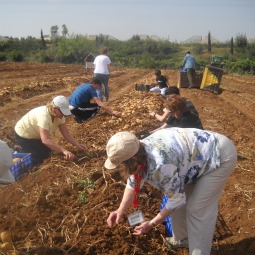
A growing number of Christian pilgrims volunteer to harvest fruits and vegetables in the Holy Land during their pilgrimages.

– Courtesy of Leket Israel

Janara Walker, 30, wanted her first-ever visit to the Holy Land to be about giving, not receiving. So last October she and 11 other members of the non-denominational Vineyard Columbus Church in Ohio flew to Israel and drove just over an hour to the Palestinian-ruled West Bank.

Once in Bethlehem, the group met up with the Holy Land Trust, a Palestinian non-governmental organization that, among other things, recruits volunteers to assist Palestinian farmers during olive-picking season.

Covered in sunscreen to protect against the strong Middle Eastern sun, Walker and her friends spent most of their pilgrimage picking olives from about 8:30am until 3:30pm. During their free time, the Holy Land Trust arranged tours of Bethlehem — home to the Church of the Nativity and a Christian community dating back 2,000 years — and nearby Jerusalem, as well as other activities, some with a clearly pro-Palestinian political agenda.

“Every couple of days we went to a different family and worked alongside them picking olives,” said Walker, who has been volunteering in the Holy Land ever since. “The families told us about their lives in the West Bank and were filled with thankfulness.”

Most of the Palestinian farm families were Muslim, Wilson noted, reflecting the dwindling number of Christians in the Bethlehem region and the fact that most Christians are merchants or professionals.

Asked why she chose olive picking over a more traditional pilgrimage tour, Wilson said, “As a follower of Jesus, it was already in my heart to serve those in the Middle East and to build a relationship with those living in Palestine.”

She admitted that, prior to her arrival, “I thought Palestinians were terrorists. Now I know they’re human beings … and I have a greater heart for finding peaceful solutions between Palestinians and Israelis.”

Though their numbers are still small — probably a couple thousand per year — a growing number of Christian pilgrims have begun to avail themselves of opportunities to harvest and glean produce in the Holy Land, just as the Bible dictates.

In Leviticus 19:9-10, the Lord says to Moses: “When you reap the harvest of your land, you shall not be so thorough that you reap the field to its very edge, nor shall you gather the gleanings of your harvest. Likewise, you shall not pick your vineyard bare, nor gather up the grapes that have fallen. These things you shall leave for the poor and the alien.”

For decades Christians, especially from Germany, have volunteered on kibbutzes — Israeli collective farms — for months at a time, in part to make amends for their countries’ role in the Holocaust. More recently, Holy Land Trust began offering social-justice-based experiences that attract Christian groups, among others.

Father Ibrahim Shomali, a parish priest in Beit Jala, a village near Bethlehem, said that volunteers not only help local farmers, but “also see the reality on the ground and can then go back home and share what they’ve learned.” He noted that the number of volunteers “is small” and expressed the hope that more Christians, including Catholics, will take part in this unique way to experience the Holy Land.  


Outreach to Christians

Leket Israel, Israel’s largest food bank, relies on more than 40,000 volunteers annually, including many tourists, for harvesting, food rescue and meal preparation. Each year, the national nonprofit rescues 700,000 meals (from restaurants and caterers) and 21 million pounds of produce and perishable goods. It also supplies 1.25 million volunteer-prepared sandwiches to underprivileged children and food to nearly 300 nonprofit institutions that feed the poor.

Leket provides food to all sectors of Israeli society, regardless of religion or ethnicity.  Volunteers, either as individuals or in groups, are welcome to work, free of charge, from a few hours to a few days — season and weather permitting.

Joseph Gitler, Leket’s founder and chairman, said the organization actively began to reach out to Christian pilgrims five years ago, first because of their heartfelt desire to connect with the land and also because the majority of visitors to the Holy Land are Christian.

“When it comes to the fields, we rely on volunteers, and we need masses of people,” Gitler said.

Both Christians and Jews are drawn to the fields, Gitler said, “because there is a biblical commandment for farmers to give to the poor. This is a biblical imperative people can do today, in modern times, in the Holy Land.”

Raymond MacDonald, the Canada-based director of Christian Friends of Leket, said Christian pilgrims are usually “shocked” to learn that Israel has a great deal of poverty and food insecurity — the inability to consistently consume healthy food.

While no one in Israel is starving, he said, vulnerable individuals, such as the elderly poor, sometimes have to decide between a meal or filling a prescription.  

When Christians discover the situation, “they want to help,” MacDonald said.

Volunteering with Leket is also an opportunity to meet Jewish Israelis, MacDonald noted.

“Millions of Christians come to Israel and don’t meet a Jew, except for their tour guide. Through the centuries, Christians and Jews have had their differences, to put it mildly. If there’s one thing that unites us, it’s the Judeo-Christian ethic to help the poor.”


Outgrowth of Faith

Those who specifically want to assist Israel’s Christian Arab community can do so on a pilgrimage organized by the Christian Holy Land Foundation, an American nonprofit dedicated to “proclaim[ing] the Gospel of Jesus Christ throughout the Holy Land and its surrounding areas.”

The Indiana-based foundation, which is an outgrowth of the Independent Christian Church, works with “Arab believers” in the Galilee.

“Picking olives is a way to bring economic value to the local believers while providing a ‘work project’ to the pilgrims in the midst of their pilgrimages,” explained John Samples, the executive director. “Even our Jewish tour guide and our Muslim bus driver participate in the picking.”

Samples said his ministry had been searching “for several years” for a type of “mission trip” that would meet the needs of local believers.

Most grassroots church efforts revolve around building cars or medical clinics, Samples said, “and the people of Israel simply do not need these things.” Picking olives “was a way to bring economic value to the local believers while providing a ‘work project’ to the pilgrims in the midst of their pilgrimages.”

In addition to the actual assistance mission members provide, it is also “a great way to teach about the spiritual significance of the olives and olive oil in the biblical perspective. This led to some very nice moments in other parts of Israel as well, as the practical and metaphorical significances continued to be apparent.”

Janara Walker, who stayed on in the Holy Land following her time as an olive picker, said she has shared her love of Christ not through proselytizing, but through example.

Said Walker, “My service is an outgrowth of my faith.”

Register correspondent Michele Chabin writes from Jerusalem.


Filed under agriculture, bible, farming, gleaning, holy land, hunger, israel, leket israel, old testament

Comments

Post a Comment

If I wanted to know what Protestants were doing I would subscribe to a Protestant paper.

Come on, Boyce.  Don’t be uncharitable.  If anything, Catholics hide their light under a bushel when it comes to Evangelization at times, whereas Protestants seem unafraid to share what they believe.  So in many ways, it puts us to shame, and we can learn from that.  Alas, what they do can be a bit problematic, in the sense that some commentators like Patrick Vandapool (if I recall correctly) have noted that they also Evangelize before they’ve acquired much in the way of depth or spiritual maturity.  In a similar vein, I would direct you to the story about the Iraqi Chaldean Catholic bishop some posts down, whereby American Protestants come “in ignorance,” telling him, “we’re going to show you Jesus Christ,” and he replies, “Yes.  I know Him.”  What all of this seems to suggest is that Catholics should be evangelizing, definitely.  But we also must know who we are, which means knowing Jesus (Body, Blood, Soul and Divinity) and knowing who we are in Him.

This is a fine example of secular human philanthropy. This woman’s unitarian faith has lead her to consider others’ needs. However, I wonder what a self-professed follower of Jesus is doing in a non-denominational church that believes Jesus is just another holy man, like every other prophet, since all paths lead to God (a unitarian view.) Secular philanthropy is a poor substitute for the Catholic duties of corporal and spiritual works of mercy, since they focus on man and not God. The best example of true charity is Mother Theresa. When we share our one true faith as she did, its value exceeds earthly economic terms. Janara Walker couldn’t proselytize because she has no definitive faith, and you can’t give what you don’t have. I wished she had first taken a pilgrimage to places where Jesus walked. The Holy Spirit is very powerful when you visit these places. My own pilgrimage saved me from my lukewarm Catholicism. No doubt the Holy Spirit would have advanced her to seek real truth, discover the one true faith, and leave unitarianism forever. Instead, she returned from those olive groves with the same social justice goals shared by atheists, socialists, and false religions all over the world. What a pity.

Posted by Boyce on Wednesday, Jun 13, 2012 5:32 AM (EST):“If I wanted to know what Protestants were doing I would subscribe to a Protestant paper.”
**********
Wow. If you turned this comment around to reflect reading about Catholics from a Protestant perspective how would it make you feel? Either way,as a Christian it makes me uncomfortable.


I want to clear up info concerning Vineyard Church of Columbus since that has been my church for the last 10 years. Vineyard is Trinitarian and a strong movement in the Evangelical world. It actually was instrumental in my becoming Catholic ( Easter Vigil 2011)because of their open arms to the truth of the catholicity of christian history. In my journey to the wonderful Catholic Church, they have been supportive and have always encouraged me to follow where God was leading. They are a church that loves and serves Jesus. Since becoming Catholic, obviously many of my paradigms have changed for which I am so thankful, but I will always love those who love and serve Jesus,whether Catholic or Protestant, for as Father John Ricardo says in his program title “Christ is the Answer”.

The comment about human secular philanthropy shows a remarkable lack of knowledge of what a non-denominational Vineyard church professes.  Perhaps, before we throw stones, we should do a minimal amount of investigation… and kudos to Janara Walker, who certainly appears to be practicing corporal works of mercy, and not sitting in her home issuing bon mots concerning the Catholic Church.

@Boyce -  You read this story and the only thing you can comment upon is the fact that the people practicing the charity aren’t Catholic, and thus you shouldn’t have to read about it??

When reading the Bible, do you avoiding the story of the Good Samaritan because it was a story about the goodness of someone perceived to be an enemy of the Jews?

@ The Hat Lady - If you look up the Vineyard Columbus Church in Ohio, you will discover that they are not Unitarian, but are in fact a Christ-centric Orthodox evangelical Church which adheres to the Apostle’s, Nicene, and Chalcedonian Creeds.  She is pretty much the opposite of a Unitarian.  And the first job of a missionary is not to proselytize, but to love, which is exactly what she is doing.

It is so embarrassing to come to a Catholic combox and find such ignorant and uncharitable statements.  It makes Catholics, and yes I am a cradle Catholic, look small minded and uncharitable.

I, for one, am inspired by the witness of these people who are brave enough to venture into such a troubled area to practice true catholic charity.  They are doing a truly righteous thing and I am humbled by their example as I sit so comfortably in my living room!

“I thought Palestinians were terrorists, now I know they’re human beings…” SNORT! Sorry. I’m Lebanese, and this attitude has been foisted upon the Religious Right for decades while Israel can do no wrong! Poor devils learned something I guess.

@Tim: faith without works is dead, and works without faith is dead. There is nothing wrong with secular philanthropy from man’s point of view, but that view is not God’s. Even an atheist can feed the starving and heal the sick, and in so doing they receive their reward in this life. The bible’s reference to a certain king says this. But if you find in your work you’d rather not proselytize, can’t evangelize, won’t share your faith, you merit nothing in the next life. As for the Vineyard Church, it lacks the Holy Eucharist and is therefore only a stepping stone toward the full truth. The biblical mandate of gleaning, like many laws of the Old Testament, is antiquated as a means of salvation and Paul was clear about this. What is most pleasing to God is not gleaning but sharing the one true faith.

By the way, the corporal works of mercy according to the Catholic encyclopedia are:
•To feed the hungry;
•To give drink to the thirsty;
•To clothe the naked;
•To harbour the harbourless;
•To visit the sick;
•To ransom the captive;
•To bury the dead.
Olive picking has economic value to society, but does not qualify as a corporal (referring to the individual’s body) work of mercy.

By helping poor farmers pick crops, those people who traveled to Israel to help are helping to feed the poor (farmers and their family), and to clothe (their otherwise naked children).  Your own lack of charity toward others who don’t fit your version of perfect Christian is so sad.

May the Lord bless you all richly. Over the last 8 months, my faith in the Lord has been strengthened and grown so much. I love that followers of Christ are allowed to participate in God’s work; that we get to be the hands and feet of Christ all over the world. Following the Lord to this part of the world and remaining here for 9 months has been the biggest blessing in my short 30 years of life. I thought I was coming here to bless others through service AND through proclaiming the gospel of Christ, but I have been blessed in more ways than I can fully communicate at this time. Please continue to pray for the Holy Land of Israel—and the West Bank as well. There are both believers and non-believers there that need to know God’s love for them. And if you ever get a chance to visit the Holy Land, please do so. God Bless.

@new Catholic convert: I also attended Vineyard Columbus for a couple years back in the 90’s. What you say is so true. Rich Nathan, who converted from Judaism himself, has a very profound understanding of the historical church. Welcome to the Catholic church!

Just as long as it’s done under the auspices of the Israelis, the ones who created the problem in the first place! Total hypocrisy IMHO!!!

Post a Comment

By submitting this form, you give The National Catholic Register permission to publish this comment. Comments will be published at our discretion, and may be edited for clarity and length. For best formatting, please limit your response to one paragraph and don't hit "enter" to force line breaks.

Name:

Email:

Write your comment:

Please enter the word you see in the image below:


Notify me of follow-up comments.