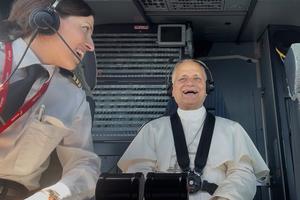
This week's question for Fr. Barron comes from Mike Hayes of BustedHalo.com. And you're going to get a great list of the great books throughout history that every Catholic should read.
Get ready to make some serious additions to your reading list!
What are some other books that you would add to the list? Please comment below.
View the entirety (so far) of my Ask Fr. Barron series by clicking here.

Comments
Post a Comment
Okay - well that list (what I heard through all the kids talking and shrieking and running around) made my head spin just hearing it! Maybe when the kids are grown I can tackle it, lol!
Yo Padre - these folks are not pursuing a theology degree. How about just a little “Brideshead Revisited”, “Come Rack, Come Rope”, or “Death Comes to the Archbishop”?
I love Fr. Barron, but, I think he could have summarized the list and said, “Read anyone Catholic you have ever heard of.”
Great recommendations and yes, it would take ten years to read them and comprehend all that is in them. I will add some of my favorites:
Imitation of Christ by Kempis.
Into Your Hands by Fr. Wilfrid Stinissen.
Jesus of Nazareth, Holy Week by Pope Benedict XVI.
All books by Rev Jacques Philippe.
The Three Ages of the Interior Life by Rev Garrigou-Lagrange.
The Twelve Steps of Humility and Pride by St. Bernard of Clairvaux.
God Alone: Collected Writings of St. Louis De Montfort.
Joan of Arc by Mark Twain. (his best book)
Before the Dawn by Eugenio Zolli.
Jesus Shock by Peter Kreet.
Beginners Guide to Holiness by Dom Hubert Von Zeller. (anything by him)
The Mystery of Faith by Fr. Tadeusz Dajczer.
The Gift of Faith by Fr. Tadeusz Dajczer. ***** Five stars
Sanctifier by Rev Luis. M. Martinez
Definitely Apologia Pro Vita Sua by John Henry Cardinal Newman. It is a masterpiece.
There are sooooo many others, but these are ones I go back to time and time again.
JamesIgnatius, those are Catholic books, but the question was about spiritual works.
I would add The Imitation of Christ by Thomas a Kempis and the works of St Theresa of Avila. He also forgot The Story of a Soul, and I’m shocked he forgot both Theresas, because they are two of his favorites!
I am not an authority like Father Bsrron, but I recommend that every Catholic should read The Mystical City of God, a private revelation by Ven. Mother Mary of Agreda with several approbations of the Church that is reputed to be the autobiography of the Holy Family dictated by Almighty God and Mary. I am allowed to believe Almighty God when he says it is intended to be reliable truth. It has been the definitive reference source for me for over 30 years.
Phewww! I’m intimidated by even the Summa of the Summa (Peter Kreeft); and have not been able to get all the way through Confessions. Would I need to read Latin and/or Greek to get through those earlier recommendations?
a couple of major works of the Eastern Church that I would wager Father Barron would know and might recommend are the Philokalia (a collection of spiritual writings from the Eastern tradition) and The Ladder by St. John Climacus. I say this because of his familiarity with such Eastern Catholic writers as St. Maximus the Confessor.
I find it amazing that in the whole list that took 4 minutes to cover, Fr. Barron never mentioned it would be a good idea for Catholics to read the Bible, the inspired Word of God, or even just the New Testament! How about the Epistles! Paul’s 13 letters! Not one word. “Too Protestant” to read the Bible outside of hearing a few verses on Sunday at Mass?
By the way, many of the church fathers disagreed with each other, which is why Origin (Fr. Barron’s first choice) was never made “St. Origin”. Origin had odd ideas about some matters. The institutional church in his day battled him about it. And Thomas Merton? He went Buddhist at the end of his life. God help the people that were swayed by his influence about those Buddhist ideas.
While Chesterton is an excellent source, I still think, hands down, the best “book”: old, new & relevant, that Catholics should read is the Bible.
Catholics take credit for the Bible: how about reading it? Watch the news tonight & think, “Hmm. I read about that in God’s word, today!”
For every generation, God’s word is relevant. The Bible is also not difficult to understand, when its read in context and in its fullness, not in bits and pieces, distorted beyond recognition by people with an agenda. So Catholics: give the Bible a try? In this Year of Faith?
Father - what books do recommend for BEGINNERS? I’ve purchased so many books that are spiritually over my head and just get put aside.
Thank you!
As for contemporary authors and books the common human can understand, I’ve been reading a lot of the books by Ascension Press and Ignatious Press. Check out their websites for some beginning reading and great Bible studies too! Jeff Cavins is a favorite of ours.
St Basil, St Athanasius and Didymus the Blind on the Holy Spirit
Terah James, the Bible is so basic to Christianity that I would think anyone listing it first would say, “Of course!” Do you really need that kind of reminder?
It is Sunday, have to go and get my two Bible readings at Mass today.
Thank you for this excellent article. Father Barron is such a genuine and humble person. I see that in each of his appearances and hope that the commentary here will not sink to the level of the Washington Post in taking shots at the man. He’s doing his best to answer what is an impossibly difficult question. All said and done, one needs to shut off the constant noise of the 21st century and do as the Bible says: “Go into your room, shut the door and speak to your Father, who waits to hear from you.” Peace to All! Just read something, please.
Father Barron just laid down a gold mine of books VERY RICH in HISTORY, which help lay a solid Catholic foundation. Many Catholics today would gain to appreciate what appears to be the headiness of theology; and what they might discover is that it not only connects and enhances their respect for our Early Church Fathers, but also connects and enhances them to Pope Benedict XVI and our current leaders too. If a Catholic (or anyone for that matter) reads any ONE of the books recommended by Fr. Barron at any time in their lives, this will affect them on a deeper level forever. Catholics own this rich history. Instead of being overwhelmed, we need to allow ourselves to take our pace at reading what we can from this list—even if we only read part of one in our life! Just pick one; and take your pace. Ask ourselves; How many Catholic Books did I read in 2012?
Father Barron just laid down a gold mine of books VERY RICH in HISTORY, which help lay a solid Catholic foundation. Many Catholics today would gain to appreciate what appears to be the headiness of theology; and what they might discover is that it not only connects and enhances their respect for our Early Church Fathers, but also connects and enhances them to Pope Benedict XVI and our current leaders too. If a Catholic (or anyone for that matter) reads any ONE of the books recommended by Fr. Barron at any time in their lives, this will affect their own soul on a deeper level forever. Catholics own this rich history. Instead of being overwhelmed, we need to allow ourselves to take our pace at reading what we can from this list—even if we only read part of one in our life! Ask; how many Catholic Books did I read in 2012? This year, just pick one of the ‘GREATS;’ and take your pace no matter how long it may take.
I am disappointed; this list is made up of obscure, scholarly works.. Not likely I will be able to wade through all of them in my lifetime. A couple of readable works I’d like to add would be St francis De Sales’ “An Introduction to the Devout Life” and the writings of St Robert Bellarmine; also the writings and books of Bishop Fulton J Sheen, Popes Benedict XVI and John Paul II are so applicable in our times. All of that said, I think Fr Robert Barron has a true gift for sharing the Faith - the Catholcism series is evidence of that.
I think one thing Fr. Barron didn’t mention was the importance of reading works that, though perhaps not strictly speaking theological, are important for Catholics to read because of the universal truths that emerge from them. Here are a few suggestions… (I also recommend the works of Tolkien and C.S. Lewis.)
1. The Gospel of John
2. Shakespeare’s Hamlet
3. Plato’s Symposium
4. Aristotle’s Metaphysics
5. St. Thomas Aquinas’ Summa Theologica
6. St. Augustine’s The City of God
7. Homer’s Odyssey
8. Dante’s Divine Comedy
9. Dostoevsky’s Crime and Punishment
10. Sophocles’ Oedipus Rex
Another book to read is the diary of St. Faustina “Divine Mercy in My Soul”. Don’t forget that Jesus called her “His Secretary and Apostle of Divine Mercy”. He told her that she was going to help Him prepare the world for His Second Coming. If she is His secretary, then I would think that reading what He wanted her to write, would definitely be a must read!
Thank you everyone for your comments & suggestions, they have been very helpful… I HAVE taken notes. St. Faustina’s Diary is one of my favorites…I need to pick it up again. God Bless Everyone!
Terah James - i do think that Fr, Barron took the Bible as a given, but I agree with you that we should be encouraged much more so to read the Bible. I would say - read it cover to cover. I don’t think I ever understood it before doing that (which I’ve now done 8 or 9 times… it doesn’t grow old). The first time I did this it became one Word for me, the Old Testament bleeding into the New and it all being of the Breath of the Spirit - one Word, as I say (that Word would be YHWH, if I might get literal).
It seemed Fr. Barron was just giving titles off the top of his head rather than having sat down to work out a list. I’m with Mike re The Imitation of Christ - that would be first for me after the Bible - as well as Teresa of Avila… but there are just so many good books (thank God), especially those by the saints.. but none is on par with the Bible.
Peace of Christ!
I humbly ask: how does one actually read Numbers? I’ve tried. Maybe not hard enough. I usually end up bashing my head into the wall a few times after any attempt, which I understand is not a good practice. ;-)
ADTWF - re Numbers (and Leviticus)… 1. Endure (there will be an end). 2. Don’t get bogged down (i.e. do minimal skimming).
I wouldn’t worry about understanding or remembering details re names or temple accouterments, etc. but I wouldn’t entirely skip over them either. The first time go “through” them to get through them, but do go through them; in subsequent readings even some of those seemingly insignificant details may take on meaning for you.
Thanks, James! That makes sense. It’s actually how I approached reading works of theory and criticism in graduate school. I’ll blame pregnancy brain for my not having made the connection between using this strategy then and using it for works like Numbers (except that I wasn’t pregnant in graduate school . . . ).
ADTWF - Everyone seems to have problems getting through Leviticus and Numbers, so it is a good question to ask. (I’m glad the answer helped a bit. I suppose I’ve done similarly with Aquinas… and Finnegans Wake!)
I had trouble understanding what he said. Would someone be so kind as to type into a comment the list of books Fr. Barron rattled off. God bless you!
I wrote rather quickly while watching, but this is my list: Origen, First Things; the commentaries of Jerome, anything by St. Irenaeus, Maximus, Aquinas, Bonaventure, newman, Chesterton, John of the Cross and Merton. The ignatius exercises. The Summa or the Summa by Peter Kreeft (which is available - I looked it up - from The Catholic Company at $29.95. They also sell a shorter version of this filtered apologetic by Kreeft titled “A Shorter Summa” at $11.95. Hope this helps.
Peace.
I so much this fr barron prm
I so much like this fr barron program. It make people to be spritually filled
Rose… thank you for taking the time to write those down for me. Of all the things I’ve lost, I miss my mind (and hearing) the most!
Some of these books are “too deep” for some of us Catholics. I love reading books written by Bishop Sheen, and although C.J. Lewis wasn’t Catholic, he definitely hit the mark on some of his books, particularly “The Screwtape Letters”. I re-read that every Lent. also “The Imitation of Christ by Thomas A. Kenpis and St. Augustin’s City of God isn’t too difficult to read in segments. Chesteron is also good as he mentioned, but some of the earlier Fathers will require a lot of concentration. Also, some aren’t easily available in print or in e books. I think a good collection of the Doctors of the Church would require a considerable sum of money. Another one he should have mentioned that is 2nd to the Bible is “The Catechism of the Catholic Church.
Debra: i am in the same boat: both the mind and the hearing are playing tricks on me. But, that’s OK. The One Who Loves Me still loves me anyway. Happy reading! The things is to just get started. If something isn’t right for you, put it down for now and try something else.
Peace
Also wondering why Origen, declared a heretic, and Thomas Merton were included.
For Fr. Barron: Theistic Evolution by Wolfgang Smith. Angelico Press (2012)
Is there a way his list can be printed for those of us whose youtube access is blocked at work?
“...Instead of being overwhelmed…”
There are many people here who have expressed the need for direction because they are at a different stage in learning about Catholicism or have different abilities. Obviously Fr. Barron could not tailor a personalized course of study for everyone who reads this article. If I was able to ask follow-up questions I would try and get from him guidance for my unique need. The best we can do at this point is to consider his list a list we can respect, even if we don’t manage to get it all.
specifically from St. Louis Marie de Montfort - True Devotion to Mary (with its consecration to the Blessed Mother, which Pope John Paul II did at a young age and held to dearly all his life - his papal motto ToTo Tuus comes from this book)
rosemarie kury, just go in with an open heart and an open mind, and don’t rush. If you don’t understand something, but would like to, there’s no shame or harm in asking someone else to explain it, and even to pray about it. When I was first coming back to the Church and didn’t know much about Catholic teaching, I’d tried to read Joseph Ratzinger’s Spirit of the Liturgy, which I thought could teach me more about the Mass. Well, I was right, but I’d in many ways put the cart before the horse: it was tough going at first because I had yet to understand more about what the Mass was, and I am no trained theologian. But once I learned more about praying it, then Spirit of the Liturgy read a lot more easily. Both the first two Jesus of Nazareth books took a bit to read, unpack, and digest (and people wonder why I mark up my books with copious notes in the margins…). But so what? We don’t always understand things instantaneously or immediately, and with things as profound as the relationship between God and Man, I’m not sure we’re meant to. That understanding tends to unfold over time, and good books are meant to be revisited time and time again. Since Fr. Barron mentioned that anything by G.K. Chesterton makes his list, then Orthodoxy is a good place to start. Sure, the Catholic faith gives us a lot to chew over, not just in our intellects but our hearts, but did we really expect any less? That’s the beauty of it, and that’s what makes it bristle on so many levels.
I’m grateful that Fr. Barron has given us his list. Many of us on here may not be studying for theology degrees, but there is no harm in being curious, and no harm in wanting to learn more from those who have written some truly brilliant works. As he’s asked before: how well do we know and understand their arguments? Especially when the Church is called not to capitulate to the world or hide from it, but to engage it. Fr. Barron has stressed tirelessly that the Catholic tradition is a smart tradition with its faith-and-reason approach. And at least in the Church in the U.S. today, certainly whenever any debate arises over what the Church teaches and why, I sometimes get the feeling that quite a few people first complain that the faith is “too hard,” and then want it watered down. And if and when it does get watered down, then they complain that the faith has no substance, and then use that as an excuse among many to leave the Church or pick and choose what they wish to believe regarding “hard teachings” that the Church teaches with good reason, but which they themselves happen not to like.
“Will Many Be Saved?” by Ralph Martin
1) Catholic “Bible”;
2) “Catechism of the Catholic Church, Second Edition”
3) “Dominus Est - It is the Lord” by Most Rev. Athanasius Schneider
4) And any book written by Pope Benedict (he is brilliant and logical).
Someone asked about for Beginners…I recommend “This is the Faith”,but I can’t recall the author and I’m at work right now.
MATTHEW KELLY has a series of books at inexpensive prices which are geared toward current times, very easy, at times amusing, and theologically sound drawing from Catholic history. I would recommend REDISCOVER CATHOLICISM and THE FOUR SIGNS OF A DYNAMIC CATHOLIC. Those books reawaken an appreciation and love for Catholicim, examine our own soul, and set a great foundation for evangelizing in these challenging times.
@Howard: [“Terah James, the Bible is so basic to Christianity that I would think anyone listing it first would say, “Of course!” Do you really need that kind of reminder? It is Sunday, have to go and get my two Bible readings at Mass today.”]
.
.
You’ve exposed yourself by your own statement. There are 3 readings at Mass,—not 2. One OT, NT and the gospel. Thus you do need a reminder. The average pew Catholic couldn’t locate Galations, Malachi or the Book of Judges without a Table of Contents.
Casting Crowns: I agree! James Kurt: I agree! Reading the Bible from cover to cover was the BEST thing I ever did too. It took me 4 months. I just continued to plow through it, like Leviticus, Numbers, etc., it all came together, by the last book of Revelation. Old Testament? About Jesus. New Testament? About Jesus. How many authors? Only One Author: the Holy Spirit.
Still waiting to see someone answer Pam’s Question - Sunday, Jan 20, 2013 11:29 PM (EDT): “Also wondering why Origen, declared a heretic, and Thomas Merton were included.”
About Origen, Pope Benedict has pushed him a lot over the past several years. I suspect that’s why he was included. Merton was bringing Eastern philosophy when he died, I think of electrocution. Imagine the damage Merton would have done, if more of his writings were published.
This is why I believe that UNTIL Catholics are 100% Bible literate, they ought not be reading anything else. We need to be equipped in God’s Truth, in order to discern what is NOT true.
This will only happen, by becoming familiar with God’s word, Genesis to Revelation, in context & in its fullness. We are so blessed to have easy to read Bibles, in everyday language, with the teachings intact. Every parish should have a Truth and Life AudioBible on hand, to lend the New Testament in dramatized form, to families that want to borrow it. Just a suggestion!
For what it is worth, I think he mentioned many of these authors because you can find them FOR FREE. Yes, you can find the Summa Theologica in a couple of different translations if you look diligently on-line. Archive.org is a brilliant and valuable resource. Ditto Orgien and many of the Church Fathers are available for ebook, which can also be read on a computer. There are many authors that I could not find for a reasonable price any other way. Another way to find them is on Amazon or Google—but be careful, it can be hard in Google books system to tell the difference between copyrighted and non-copyright books in their collections.
IF that is not possible, then you can go to Archive.org’s audio files, and you can download—for example, “The City of God” by Augustine for free in it’s entirety and it is one of the nicest recordings they have. I want to see if anyone was brave enough to read the Summa, because I find that the much older theologians are much easier to understand when you listen to them, rather than read. I’m not sure why—Augustine was entirely opaque to me until I listened to “The City of God’ and it was almost like listening to him explaining things to you.
http://archive.org/details/city_of_god_ds_librivox
Check out libra vox, not all the recordings are this excellent, but the more… theoretical works tend to have quality adherents.
The hardest thing about Aquinas is that he begins from the very beginning, and uses words that mean different, sloppier things to the modern ear. Philosophy majors still use those words correctly, but there is a certain learning curve, but if you go to the “Aquinas Online” site, there are articles written for beginners that explain patiently without all the philosophical nonsense that you might get on University websites. Below are a few links…
http://www.aquinasonline.com/index.html
http://www.aquinasblog.com/outline.html
Also, the Catholic Encyclopedia is also on line. Just about everything I have ever read either makes more sense, because of Aquinas. So much of the modern nonsense wouldn’t stand for two seconds if we still knew him and his basics.
And it doesn’t cost a thing… except time. Which I think is the real barrier.
Thank you, V, for these resources. I would like to add one other idea - The Liturgy of the Hours (the Prayer of the Church, the breviary), which is required to be prayed by the ordained and many religious but has also been recommended for lay folks. You might start with reading the Word Among Us or with a single volume version (perhaps a priest has an extra copy on his shelf)… but the best would be to get to the four volume version, which contains what is called the Office of Readings (traditionally said by religious in the night or early morning). Every day there is a reading from Scripture and a second reading from one of the Fathers or other saints or popes or Vatican II… most of those Fr. Barron mentioned are represented here (in about a page or so a day). I would say I learned from the regular exposure to the Fathers in these selected readings how to read Scripture, and so much more… Just another idea.
My Other Self by Clarence J. Enzler
The Rhythm of Life by Matthew Kelly
Would someone better at note-taking than I am kindly put this list into print for me? I’ve only read five or six of the books mentioned by Fr. Barron and, at age 69, I may not have ten years left to live. My philosophy/religion library—mostly Catholic books—fills an entire room (I am a dyslexic bibliophile!) but obviously I have not yet scratched the surface of spiritual books every Catholic should read. So prioritizing the list instead of putting it in historical period order might be more useful at this point. Thanks. Thanks also to the commentators who listed some more familiar books that would’ve been on their lists of important books for Catholics.
Post a Comment
By submitting this form, you give The National Catholic Register permission to publish this comment. Comments will be published at our discretion, and may be edited for clarity and length. For best formatting, please limit your response to one paragraph and don't hit "enter" to force line breaks.
The time period for commenting on this article has expired.