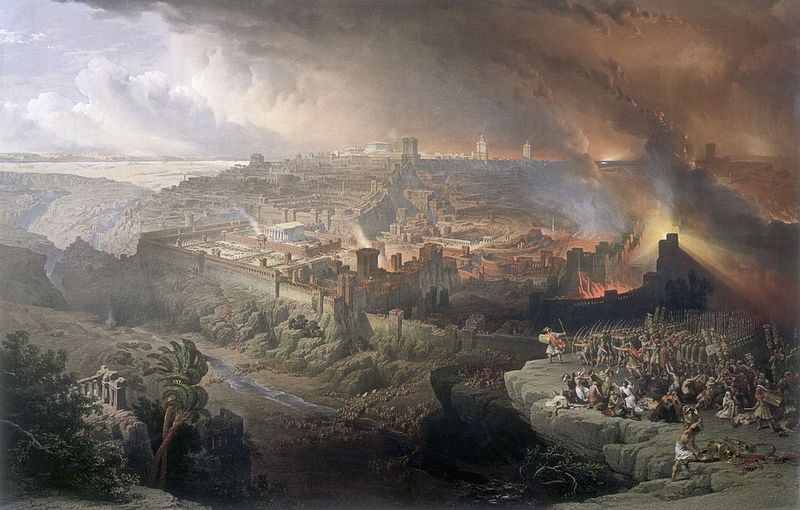
Jesus couldn't have predicted that event in advance, it is supposed. Therefore, the gospels had to be written after the event.
Really?
Would it surprise you to learn that Jesus wasn't the only person to predict the fall of Jerusalem and the temple before it happened?
Or that we know this apart from the Bible?
I find your lack of faith disturbing
First things first: Jesus is God. He knows the future.If he chooses to disclose to man part of what he sees, that's well within his ability.
The idea that Jesus couldn't predict the fall of Jerusalem, the destruction of the temple, or any other future event displays a lack of faith.
That is to be expected from people who don't profess to have faith, but it is not expected from professedly Christian biblical scholars.
Why invent a postdiction?
There's also a question of why the evangelists would make up a postdiction (a "prophecy" given after the fact).Sure, if they wanted to paint Jesus as a prophet, making up predictions known to be fulfilled by subsequent developments would be one way to do that.
Writing after A.D. 70, they could know all about the fall of Jerusalem and--to make Jesus look like a far-seeing prophet--they could come up with a postdiction and put it on his lips.
But if that were what they were doing, they would have done it differently.
Not enough detail
One characteristic of postdictions is that they tend to be specific about the details. After all, if you're making up a prophecy, the more it detail it contains about what happened, the more impressive it will be.And so when we find people in history making up prophecies after the fact, they tend to be very detailed.
But Jesus' prediction of the destruction of Jerusalem and the temple are not detailed. They're quite general.
No "and he was right!"
Then there's the fact that none of the New Testament authors--including the evangelists--speak of the event as a past fact.In particular, they never add--after recording the prophecy--the note that it it was fulfilled. They never say, "and he was right!" or "and it came to pass, just as Jesus foretold."
This is significant because it is precisely the kind of thing that would have been said. The evangelists love to record the fulfillment of prophecy.
Matthew, in particular, makes repeated references to how events in Jesus' life fulfilled various Old Testament prophecies. And in Acts, Luke gives an example of a contemporary prophecy that was fulfilled:
And one of them named Agabus stood up and foretold by the Spirit that there would be a great famine over all the world; and this took place in the days of Claudius [Acts 11:28].
If the evangelists were writing in A.D. 80 or 90 (or any time after A.D. 70), they would have little reason to try to make their documents appear a handful of years older than they were.The "I told you so" value of recording the prophecy's fulfillment would have outweighed any slight benefit that might arise from making it look like your gospel was written in A.D. 60 rather than A.D. 80.
He wasn't the only one
But the fact is that one could predict what would happen before A.D. 70, and we know that someone else did predict it.What's more, we are not dependent on the Bible for that knowledge.
It's found in the writings of the Jewish historian Josephus (himself writing about A.D. 75-80) described several portents of the destruction of Jerusalem, including this one:
But, what is still more terrible, there was one Jesus, the son of Ananus, a plebeian and a husbandman, who, four years before the war began, and at a time when the city was in very great peace and prosperity, came to that feast whereon it is our custom for every one to make tabernacles to God in the temple, he began on a sudden to cry aloud,
"A voice from the east, a voice from the west, a voice from the four winds, a voice against Jerusalem and the holy house [i.e., the temple], a voice against the bridegrooms and the brides, and a voice against this whole people!"
This was his cry, as he went about by day and by night, in all the lanes of the city [Jewish War 6:5:3].
Josephus says this occurred "four years before the war began." The war began in A.D. 66, so this would have been A.D. 62, "at a time when the city was in very great peace and prosperity."So what happened with Jesus ben Ananus (also called Jesus ben Ananias)?
Trouble with the law
Ben Ananus basically ticked off the local leadership, including the Roman governor, and suffering ensued:However, certain of the most eminent among the populace had great indignation at this dire cry of his, and took up the man, and gave him a great number of severe stripes; yet did not he either say any thing for himself, or any thing peculiar to those that chastised him, but still went on with the same words which he cried before.
Hereupon our rulers, supposing, as the case proved to be, that this was a sort of divine fury in the man, brought him to the Roman procurator, where he was whipped till his bones were laid bare; yet he did not make any supplication for himself, nor shed any tears, but turning his voice to the most lamentable tone possible, at every stroke of the whip his answer was, "Woe, woe to Jerusalem!"
And when Albinus [for he was then our procurator] asked him, Who he was? and whence he came? and why he uttered such words? he made no manner of reply to what he said, but still did not leave off his melancholy ditty, till Albinus took him to be a madman, and dismissed him.
Amazing stick-to-it-ive-ness
Ben Ananus displayed amazing determination in driving home his message:Now, during all the time that passed before the war began, this man did not go near any of the citizens, nor was seen by them while he said so; but he every day uttered these lamentable words, as if it were his premeditated vow, "Woe, woe to Jerusalem!"
Nor did he give ill words to any of those that beat him every day, nor good words to those that gave him food; but this was his reply to all men, and indeed no other than a melancholy presage of what was to come.
The end of ben Ananus
Eventually, ben Ananus stopped prophesying doom to Jerusalem and its temple. Joseph records the circumstances, which are tragic, touching, and funny.This cry of his was the loudest at the festivals; and he continued this ditty for seven years and five months, without growing hoarse, or being tired therewith, until the very time that he saw his presage in earnest fulfilled in our siege, when it ceased; for as he was going round upon the wall, he cried out with his utmost force,
"Woe, woe to the city again, and to the people, and to the holy house!"
And just as he added at the last, "Woe, woe to myself also!" there came a stone out of one of the [Roman siege] engines, and smote him, and killed him immediately; and as he was uttering the very same presages, he gave up the ghost.
There is, of course, a remaining question . . .
How did ben Ananus know?
There are a number of possibilities.- Maybe he was a nut who made a lucky guess four years before the war.
- Maybe was a shrewd observer of the political scene and knew that the pent up Jewish resentment of Roman rule was likely to burst forth under zealot and sicarii agitation--and that the Romans would inevitably crush the rebellion.
- Maybe God gave him a private revelation.
- Maybe--like Agabus (mentioned above)--he was a Christian prophet of the New Testament period.
- Maybe he was a Christian--or even just somebody who heard about Jesus of Nazareth--and knew of Jesus of Nazareth's prophecy.
Therefore, it was possible for Jesus of Nazareth to do this.
Therefore, there is no reason to date the gospels to A.D. 70 or after simply because they contain such a prediction.
In fact, the absence of a "and it was fulfilled, just as Jesus said" points to them being written before A.D. 70.
What Now?
If you like the information I've presented here, you should join my Secret Information Club.If you're not familiar with it, the Secret Information Club is a free service that I operate by email.
I send out information on a variety of fascinating topics connected with the Catholic faith.
In fact, the very first thing you’ll get if you sign up is information about what Pope Benedict says about the book of Revelation.
He has a lot of interesting things to say!
If you’d like to find out what they are, just sign up at www.SecretInfoClub.com or use this handy sign-up form:
Just email me at jimmy@secretinfoclub.com if you have any difficulty.
In the meantime, what do you think?


Comments
Post a Comment
There is a deep aspect of Christ’s prediction that a later falsifying but well intentioned evangelist would not have dared to fabricate. Christ gives two deep reasons for the doom: Jerusalem has not known the time of its visitation ( Luke 19:44) and the Jewish leaders are filling up the complete measure of their sins ( Mt. 23:32) which filling up…precedes a doom as happened with the Amorites according to God’s words to Abraham about His waiting 400 more years in relation to their sins in Gen.15:16, ” …for the wickedness of the Amorites is not yet complete.”.
No evangelist would have dared place such words in Christ’s mouth because only God knows when a peoples’ sin is “complete” in His judgement and only God knows when a people have not known the time of their visitation. The dooms of the OT Canaanites were brought by God only after 400 years plus of their sins becoming complete in His eyes. We know from Wisdom 12 that all that time, God punished them ” bit by bit that they might have space for repentance”...Wisdom 12:10. The doom of Jerusalem was the worst of the dooms of the Bible…1.1 million people were killed according to Josephus but again in this case as with the Canaanites, it happened only after centuries of God’s patience with the offenses of the Southern kingdom of Judah.
Postdiction and unfulfilled prophecies are favorite atheist beliefs, but are based on two fallacies: circular reasoning (“miracles don’t happen, so prophecies are fake”) and red herring (“this prophecy isn’t fulfilled, so prophecies are fake”).
Using occam’s razor, one can see that the historic documentation of miracles and prophecies in the Bible are historic instances of miracles and prophecies, and with no evidence to the contrary, one would be right in believing they are authentic.
But atheists prefer to interpret these miracles personally: so when it comes to the Emmauel prophecy, they say it doesn’t point to Jesus because it can’t, because the prophet couldn’t know Jesus: again, this is circular reasoning and red herring.
All you have to do is ask “Why does the prophet not know Jesus?” to see they’re wrong, because they got nothing but their own assumptions without any evidence to back them up: “Because God doesn’t exist”, “because the prophesy isn’t about the Messiah,” etc.
One more thing: The evidence for the prophecies are their fulfillment, because a lack of evidence is no evidence to the contrary and no evidence to the contrary is not evidence in the affirmation.
Learn more about the Faith at: http://www.youtube.com/mariomusicmadness
Please, also, sign my petition: https://petitions.whitehouse.gov/petition/alleviate-laogai-victims-and-end-laogai-which-still-ongoing-day-1949/F7wWWbMQ?utm_source=wh.gov&utm_medium=shorturl&utm_campaign=shorturl
Thanks Jimmy
Some interesting points - particularly the lack of detail in Jesus’ prediction of the fall of Jerusalem.
It is also possible that Jesus’ prediction of the fall of Jerusalem was insightful ‘natural’ punditry, made before the event which would suggest an earlier dating of the writing of the gospels.
The fall of Jerusalem was THE significant event for Jews and Jewish Christians. Its absence in a document of that general era, suggests that document was written before 70AD.
The fall of Jerusalem does not appear in the Acts of the Apostles.
Since Acts is the continuation of Luke, this would suggest that Luke was also written before 70AD. Luke had access to Mark’s gospel (if we follow the majority Q hypothesis) so this would give a composition date of before 70AD for Mark, Luke and Acts.
The gospels were written after 70AD. Predictions about the fall of Jerusalem, amde by Jesus or not, were/are irrelevant.
It strikes me that the very act of pushing the timeline for the Gospels past the Fall of the Temple is powerfully suspect as are those who pushed it and, even to a lesser extent those who have critically accepted it.
Given that there is shocking little in the way real evidence to support the idea aside from presuppositions piled on presuppositions adopted as conclusory assumptions for the purpose recasting Christianity and bringing it under the control of the State, it has always bothered me that virtually no-one ever points out that by the very act of pushing the dating of the Gospels back and assigning authorship to some committee of followers had the immediate effect of accusing those initial drafters of being liars when saying
Inasmuch as many have undertaken to compile a narrative of the things which have been accomplished among us, just as they were delivered to us by those who from the beginning were eyewitnesses and ministers of the word, it seemed good to me also, having followed all things closely for some time past, to write an orderly account for you, most excellent Theophilus, (Luke 1:1-3)
or
This is the disciple who is bearing witness to these things, and who has written these things; and we know that his testimony is true. (John 21:24)
It should not be lost on folks that this narrative came out of 19th Century Germany when Protestant theologians were folding under the Prussian and later German state and sought the subordination of belief to the state out of complete fidelity to Hegel. Used to subordinate all belief to that end, it was also used to drive the Kulture Kampf.
Real scientific research into the scripture would have started with a presumption that when the authors said they were the authors, that a prima facia case was made that should have served as a bar to all arguments that could not (really) defeat it. Today we have the bizarre situation where all the (real) evidence and forensics points to a dating in line with what the New Testament authors suggest as against a bad construct that never should have been allowed to establish itself.
Outside of there being a need for one, there NEVER was a Q and there is no evidence that there ever was one. And yet the NAB cites to in footnotes as if it were real. Just how should that strike professional Catholics or other Christians who understands the role of citing to (real) authority and understands the difference between (real) evidence and the reification of an abstraction when reading such footnotes?
As a former linguist, just for curiosity, I decided to grammatically parse out Chaire Kecharitomene. What a disgrace!
The entire pursuit, including the faux theories, the faux science and faux neutrality was done with hostile intent. The only real question is how many witlessly went along. There has been nothing neutral about the effects of this entire process.
I just cant figure out why we are supposed to act so polite (docile) about it!
Lisa:
How do you know the gospels were written after 70 AD?
Sam,
Go ot he website of the US Conference of Catholic Bishops. On the site, the RC bishops have posted the books of the Bible (from the New American Bible, the Catholic Bible approved by the RC bishops). Each book has an introduction that sets out the Biblical scholarship re that book. Each of the gosples ahs an introduction. Each introduction to each of the 4 gospels indicates that each gospel was written after 70CE. That is the consensus of all reputable Biblical scholars (RC, Christian, Jewish) and that is the consensus of the RC bishops. Your church and the Biblical scholars it rlies on for the New American Bible all say that the gospels were written after 70AD. None of the gospels writers knew Jesus, witnessed anything Jesus said or heard anything Jesus said. That is the reaching of the RCC. If you disagree, take it up with all the Biblical scholars in the world and take it up with the RC bishops.
Why was I flagged for being “spam”? Why is it taking so long to post?
Lisa,
.
Thanks for your response.
.
I am familiar with the NAB and the introductions and footnotes to that translation. It is true that a majority of Biblical scholars - at least those currently active in Western academia - think that the gospels were written after 70 AD (I’m referring to the synoptic gospels - very few scholars think that John was written prior to that date). It is also true that the US Catholic bishops have no objection to this view. However, it is in no way an official teaching of the Church, and it is perfectly legitimate for a Catholic to disagree with this opinion. So I don’t have to “take it up” with the bishops.
.
For example, the Ignatius Catholic Study Bible, with notes by Curtis Mitch and Scott Hahn, dates the gospel of Matthew to the 60s AD. These notes have an official Catholic “imprimatur” and “nihil obstat” which means they contain nothing against Catholic faith or morals. So clearly, this view is not problematical in terms of the Catholic faith. Mitch and Hahn offer good arguments for their view - at least I believe so. So the question raised in the blog post is by no means “irrelevant.”
.
But my original questions was how *you* knew when the gospels were written. I did not say anything about what I thought.
Sam,
I vote with the scholars of the NAB and with all the reputalbe scholars, the majority, who understand that the gospels were written after 70CE. Mitch and Hahn are in a minority.
Jimmy Akin’s article above seems not to agree witht he 70CE dating of the gospels, and that idea flies in the face of decades of thorough, reputable, analytical Biblical scholarship. Plus, its a silly article
I realize Curtis and Hahn are in the minority, but that doesn’t make them wrong. Have you looked at their arguments? I hope you don’t accept an opinions simply because the (current) majority holds it to be true. At one time “decades of thorough, reputable, analytical scholarship” held, for example, that the five porticoes mentioned in John chapter 5 were fiction, or that the Hebrew text of the Old Testament was very corrupt (until the discovery of the Dead Sea scrolls). I’m not saying that current Biblical scholarship is all wrong - far from it - but that it isn’t to be taken as gospel but just like any other work of scholarship: with a grain of salt. I’m more interested in the arguments than in the current consensus - which, needless to say, can change.
Sam,
I think we will have agree to disagree.
That’s fine - I was just interested to know if you had any arguments (besides majority opinion) to support your position.
There are a lot of arguments not to mention the weight of scientific research. In fact, the general thrust of biblical research is to radically move the timeline back. You would have read this earlier but my entry was “flagged” because is was suspected of being spam and has still not posted.
The truth of the matter is that there is little basis for the timeline ever being pushed to after the fall of the Temple. If that original post does not clear NCR soon, I’ll rewrite it.
While I fully believe in prophesy, I don’t think it would take much divine inspiration to predict the destruction of Jerusalem from any time after about 40 AD.
But it is also significant when dating ancient texts to decide ‘what you are looking for.’ Books were not usually published as such. Important texts ‘evolved’ and multiple authorship was more common ( or editorship if you prefer). In any case, the Gospels are reporting what Jesus said. If you don’t believe that, then it doesn’t really matter when they were written.
Jes, et al,
I wrote a comment that got stuck in “possible spam” purgatory for longer than it should have. It was finally put in the string above at the timestamp of 27 November at 3:33. I would recommend checking it out.
Given that some fragments from Qumran and other “real” scientific analysis argues dating much closer to the historic timeline and the modern very 19th Century statist German schholarship that shifted the timeline by fiat (really little more than an agreement to do so), why would someone feel at ease simply challenging the integrity of what was stated by John and Luke when declaring their personal authorship. There were many debates about the Gospels by the early Church fathers, none, that I know, actually challenged the authorship or basic timeline. When the Rabbi Akiva, around events associated with Jamnia (as a place the Rabbis were allowed to assemble, not as the mythic “Council of Jamnia”) and the Bar Kochba rebellion looked to codify an Jewish Canon of scripture around the 130’s, one of the thinks that was condemned were the Christian Gospels, that had to already be disseminated and in broad use. There was never a real bona fide basis to move the dating in the first place.
Jes, what you said is “the narrative” associated with the prevailing meme that has been accepted more than it’s been proven. It supports a conclusory assumption. Just as there is no evidence to “q”, there is also no evidence that there were ever multiple authors to a book of the New Testament or that there were editorial boards.
If your “multiple authors” editorial oversight model that allowed for “evolution” over time were valid, it would not be the same as Luke or John directly claiming authorship, as they did, as first person or contemporaneous observers and hence there would be powerful reason to suspect that what was written was not “what Jesus said.” The intent of the German hermeneutic was to create doubt. It did. It has.
Regarding the USCCB “officially approved” NAB. Notice how disfavored it has always been even among Catholic institutions. Ignatius press stuck with the RSV-CE. For use in the Mass, that NAB could only be used when reverting to some earlier language (I am told).
In his 3 volume work written since becoming Pope on Jesus of Nazareth, Pope Benedict his overt skepticism of historical critical approach - not as a field but how it has been used - and has used his work to powerfully rebut them.
It will take for this generation of biblical scholars to die off before things will correct themselves. But real evidentiary analysis and real science is ever more clearly siding with the WYSIWYG understanding of the dating of the the New Testament texts.
Apologies and corrections to all—
After whining about what I wrote being held back, the entries posted, then I read them, OUCH, and noted that the quickness of what I wrote, not being familiar with the non-spacing structure of this format, and an Apple wireless keypad that causes whole words to disappear, caused inaccuracies to what I intended to say. The corrections – the major ones – are below. I will be more considerate of others expectation that they read something written intelligibly. The words in CAPS reflect either missing terms or better-suited terms. Apologies!
CORRECTIONS TO THE FIRST ENTRY TIMESTAMPED 27 NOVEMBER 2012 AT 3:33—
… had the immediate effect of accusing those initial drafters of being liars when saying – (BREAK TO LUKE CITATION)
Inasmuch as many have undertaken to compile a narrative of the things which have been accomplished among us, … most excellent Theophilus, (Luke 1:1-3) ///
Real scientific research into the scripture would have started with a presumption that when the GOSPEL authors DECLARED THEMSELVES the authors, that a prima facia case was made that should have BEEN REQUIRED TO BE OVERCOME – TO served as a bar - to all arguments that COULD not (really) GET PAST it. Today we have the bizarre situation where all the (real) evidence and forensics points to a dating in line with what the New Testament authors – AND ALL PRIOR TREATMENTS - suggest as against a POORLY BASED construct that never should have been allowed to establish itself. NOT THE INSTITUTIONS DEFEND IT AS INSTITUTIONS DO IN SUCH CASES.
Outside of THE FACT THAT THE CURRENT CONSTRUCT DEMANDS IT, there is no evidence that there ever was A Q AND NO REASON TO THINK THAT THERE EVER WAS. And yet the NAB cites to IT in footnotes as if it (REALLY) EXISTED. Just how should that strike CATHOLICS WHO ARE professionalS or other Christians WHEN THEY READ THE NAB AND SEE ACTUAL FOOTNOTES TO Q AND who understand the role of citing to (real) authority and LIKEWISE understand the difference between (real) evidence AS OPPOSED TO the reification of an abstraction? AS A LAWYER, IF A WITNESS FOR THE OTHER SIDE DID SUCH A THING, IE, CITE TO AN AUTHORITY THAT DOES NOT EXIST AS IF IT DID, I AND ANY OTHER ATTORNEY WOULD LICK THEIR CHOPS AT A PROSPECTS OF A PURE TAKE-DOWN.///
CORRECTIONS TO THE SECOND NOTE(TIMESTAMPED – 28 NOVEMBER 2012 AT 1:27)—
In his 3 volume work written since becoming Pope on Jesus of Nazareth, Pope Benedict EXPRESSED his overt skepticism of THE historical critical approach - not as a field of study but how it has been SEVERLY ABUSED BY ITS LEADING PRACTITIONERS - and has used his JESUS OF NAZARETH to powerfully rebut them.
Our concept of history is evolving with each year, especially if you look at how our perceptions have changed regarding the middle ages. If you were to ask someone 100 years ago what the middle ages were like you would get a completely different answer to what one would say now. there is considerable work in the field of antiquity, especially when it comes to such works as the bible. Carl’s article is by no means silly. There are other historians that are backing it up. The now accepted ideas of the middle ages were accepted only by a minority until it was shown such perceptions were indeed correct. it is ignorant and even arrogant to dismiss such claims of historical study without at least giving the ideas a chance to prove themselves right or wrong. Currently earlier dates for the gospels are getting more and more recognition in the church and the RCC is definitely following the history of this.
Ireneous according to The International Bible Commentary, A Catholic and Ecumenical Commentary for the Twenty-First Century, (citing Adv. Haers. 3.1.1) p 1254, (ed. W Farmer), claimed they were written during the time Peter and Paul were in Rome, i.e. before 67 AD. Just because the NAB committee states something doesn’t make it true.
Br. K,
With respect, it’s the historical critical approach - at least as its been used by its adherents to deconstruct the Bible - that has come under intense fire for being both ahistorical and driven more by current academic caprice than science. Science increasingly backs the much tighter timeline. I have a good understanding of Medieval History as I spent some time back in my uni days studying it through, among other things, primary text research.
The point of my earlier saying “as a former linguist, just for curiosity, I decided to grammatically parse out Chaire Kecharitomene. What a disgrace!” was to point out the gratuitous need of the NAB to minimize the more accurate (if Latinized) “full of grace” by very unlinguistically saying “Hail favored one” for a perfect passive participle that UNIQUELY designated Mary as the one who is THE “fully graced by God” or, if you will, “completely favored by God” There was no linguistic reason for the NAB to pull back as it did - and in the interest of some faux sense of academic neutrality (that actually serves to delegitimize). It is less accurate both because it minimizes the passive tense (graced/favored [by God]) and because it minimizes the perfect form of the participle designating Mary as being(fully/completely graced/favored [by God]).
As in almost all other substantive modifications, the NAB followed modern academic trends of extreme criticism that is itself a form of postmodern deconstructionism. It is hardly historical. Hardly scientific. It would be one thing if the Gospels were silent on authorship but, as noted, two Gospels claimed specific authorship and prophesy of the fall of the Temple as a future event. It would be a second thing if such claims of authorship or prophesy was challenged in its own time. It was not! This was a time when Christians were a minority and very much detested by powerful entities. Had there been fraud in the documents, someone would have called them out. Akiva didn’t condemn the Gospels in the 130s because they were false - there is evidence that allusions were made to Matthew by Gamaliel in Jewish writings even earlier - he did so because they were a threat to Judaism precisely because of such claims.
There is NO factual basis to support ANY claim that a Q Gospel ever existed. Its rise to prominence was borne of the necessity that such a text exist to support a modern theory (born of the same movement that drove the Kulture Kampf and the Hegelianism that gave rise to Marxism and Fascism) to push the timeline of revelation past the period of the temple and that also existed in part to subordinate Matthew to Mark and in-so-doing subordinate the primacy of the gospel making the most direct claims of Petrine supremacy (also arising out of the Kulture Kampf). While there is no evidence in antiquity of a Q Gospel, there is ample, actually dispositive evidence of the need for one emanating from a 19th Century Prussian/German Protestant hermeneutic that was overtly anti-Catholic in many of its objectives. The Church was in the way of a Prussian unification of Germany.
The idea that an “official” text of the USCCB, an entity Pope B said carried no independent official status, would provide footnotes to a document that DOES NOT EXIST where there is NO EVIDENCE that such a text ever existed is a commentary on the state of the USCCB.
If this issue were ever debated in a forum where rules of evidence like those used in a court of law were applied, the modernist position would not be allowed to present its case because it would fail to establish the evidence needed to support its foundation. “Objection, lack of foundation!” “Objection upheld!” As it is, and very circular, the Q that does not exist outside the theory must be accepted as if it were a fact so as to the allow the theory to be debated as if a foundation were laid. The question is, outside of the need for professional biblical scholars to publish, that and also the delegitimization of faith through the subtle undermining of its principle text that only academics would find a way to look past, why was this current paradigm ever accepted let alone allowed to become the de facto standard.
Post a Comment
By submitting this form, you give The National Catholic Register permission to publish this comment. Comments will be published at our discretion, and may be edited for clarity and length. For best formatting, please limit your response to one paragraph and don't hit "enter" to force line breaks.
The time period for commenting on this article has expired.