Print Article | Email Article | Write To Us

What Are Dogma, Doctrine, and Theology?
Monday, September 17, 2012 9:19 PM Comments (10)

Dogma, doctrine, and theology--what's the difference?

Many people are curious about the difference between dogma and doctrine. I'm asked about it surprisingly often.

It would be nice if the Church had an official dictionary I could use to answer this question, but it doesn't.

Instead, it uses terms in documents and most of the time it expects you to already know them. Sometimes it gives you a partial definition, or at least clues about what a word means, but in general it leaves the writing of dictionary-style definitions to the writers of Catholic dictionaries.

Recently I wrote a study of the terms "dogma," "doctrine," and "theology." You can read it here, but in this post I'll give you with the results in an easy-to-read form.

So let's get started . . .


What Is Theology?

The broadest of the three categories is theology. The name "theology" is derived from a couple of Greek words (theos and logos) which combine to mean "the study of God."

You could study God in different ways, though. You might study him based on what he has revealed in his word, which is found in sacred Scripture and sacred Tradition.

Or you could study him in other ways, such as using philosophical reasoning without divine revelation--the way that Plato and Aristotle did.

To keep the philosophical study of God separate from theology, it is customary to add a qualifier and say that theology is the study of God based on divine revelation.

That's the standard, brief definition of what theology is (see, for example, the glossary at the back of an English edition of the Catechism of the Catholic Church).

You'll note that it does not say anything about who is studying God. You don't, for example, have to be the pope or even a bishop to do theology.

Some people--theologians--do it professionally, and others do it informally.

In the broadest sense, any person who is reasoning about God based on divine revelation is doing theology--though that's very far from saying that they are doing it well, as the enormous amount of theological confusion that is out there illustrates.

Precisely because of that theological confusion, God has given the Church a teaching authority--the Magisterium (from the Latin, magister = teacher).

This leads us to the next concept . . .


What Is Doctrine?

The term "doctrine" comes from the Latin word doctrina, which simply means "teaching."

As used today, though, the word means a bit more than that. Ideas developed by a faithful Catholic theologian may represent Catholic theology but that do not make them Catholic doctrine.

For that the intervention of the Magisterium is needed, so a basic definition of the term is that a doctrine is a proposition (or set of propositions) taught by the Magisterium of the Church.

In some cases the term "doctrine" may be used to refer to things that have been infallibly taught by the Magisterium. It may even be used as a synonym for "dogma," but it is easy to show that this is not always the case.

For example, the Code of Canon Law provides that:

Can. 749 §3. No doctrine is understood as defined infallibly unless this is manifestly evident.

All dogmas are infallibly defined, as we will see, so this reveals that there can be doctrines that are not infallible and thus that are not dogmas.


What Is Dogma?

The Greek word dogma originally meant "opinion," but it has come to mean something much more specific.

The current understanding of "dogma" arose in the 1700s (so be warned that earlier documents, such as the writings of the Fathers or Medievals like St. Thomas Aquinas tend to use the term in the broader sense of just a theological opinion).

Cardinal Avery Dulles explains the present meaning of the term:

In current Catholic usage, the term “dogma” means a divinely revealed truth, proclaimed as such by the infallible teaching authority of the Church, and hence binding on all the faithful without exception, now and forever. [The Survival of Dogma, 153].

There are two essential elements here: First, a dogma must be divinely revealed. That is to say, it must be found explicitly or implicitly in the deposit of faith that Christ gave the Church. This is found in sacred Scripture and sacred Tradition. If something is to be a dogma, it must be in one of those two places--or in both of them.

Second, a dogma must be infallibly taught by the Magisterium as divinely revealed.

This is an important qualifier, because the Magisterium is capable of infallibly defining certain things that aren't divinely revealed. According to Church teaching, the Magisterium is able to infallibly teach both things that have been divinely revealed and truths that have a certain kind of connection with them, so that they may be properly explained and defended.


Dogmatic Facts?

For example, suppose a particular pope or ecumenical council tried to infallibly define a particular teaching but that later a question arose about whether he was really a valid pope or whether it was really an ecumenical council.

If the Magisterium did not have the ability to infallibly settle that question then the status of the previous definition would be uncertain, which would defeat the point of infallibly defining it.

To resolve this kind of situation, God gave the Church the ability not only to define dogmas but also the fact that a particular man was a valid pope or that a particular council was ecumenical.

These facts were not revealed by God as part of the deposit of faith that Christ gave the Church, though. They're facts that deals with later history, after the close of public revelation.

Still, they are facts that are necessary to properly defend a dogma, and so they are called "dogmatic facts" (facts connected with dogmas).

This is just one kind of example of non-revealed things that the Church can infallibly define. There are others.

The point, though, is that the Church can infallibly define certain things that are not divinely revealed and thus things other than dogmas.

Thus for the Church to define a dogma, it must not only infallibly teach that a particular point is true but that it is a divinely revealed truth.


From Theology to Dogma

The Church is not in the habit of leaping straight to the dogma stage. It tends to define dogmas only rarely, and usually only when there is a controversy about them that needs to be settled.

Most of the time it leaves particular matters at the level of non-infallible doctrine.

Or it leaves it as a matter freely discussed by theologians but not taught by the Church--ie., at the level of a theological opinion.

Historically, the progression often works like this:

1) A theologian or theological school proposes a way of understanding the revelation God has given the Church.

2) If it deems this a valuable and important contribution to the understanding of divine revelation, the Magisterium may begin to teach this authoritatively, raising it to the level of non-infallible doctrine.

3) Particularly if a controversy over the teaching arises at some point in Church history, the Magisterium may choose to settle the matter infallibly by defining the matter.

4) The Magisterium may infallibly define the matter with or without defining that it is a divinely revealed truth, but if it does the latter then then it elevates the matter to the level of dogma.


By the Way . . .

Incidentally, if you're interested in this type of information, you might want to check out my Secret Information Club.

If you're not familiar with it, the Secret Information Club is a free service that I operate by email.

I send out information on a variety of fascinating topics connected with the Catholic faith.

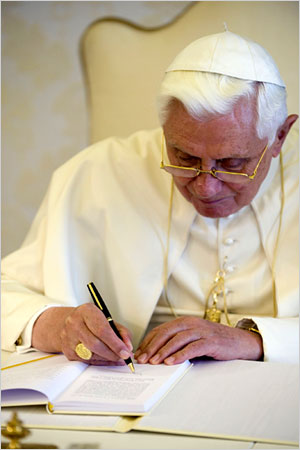
The very first thing you’ll get if you sign up is an “interview” I did with Pope Benedict on the book of Revelation. What I did was compose questions about the book of Revelation and take the answers from his writings.

He has a lot of interesting things to say!

If you’d like to find out what they are, just sign up at www.SecretInfoClub.com or use this handy sign-up form:

Just email me at jimmy@secretinfoclub.com if you have any difficulty.

In the meantime, what do you think?


Filed under

Comments

Post a Comment

I love your words, and have always been a fan.  God bless your daily life, Jimmy.

This may be a stupid question but is there a compilation of Catholic dogmas that I can reference so as not to get doctrines confused with dogmas and vice versa?

“Historically, the progression often works like this:”
... and no mention of scripture.
But, you had written, “based on what he has revealed in his word, which is found in sacred Scripture and sacred Tradition.”
By a simple count, then, scripture is ‘outvoted’ 5 to 1. Thinking deeper, your essay confirms my direct experience of Catholic reasoning: ‘We gave the Bible to the world, and don’t you forget it! ... BTW we don’t accept scriptural reasoning where it contradicts RCC dogma, tradition, doctrine, or magisterium.’
Our Lord Jesus- your God, remember?- defined it this way: “Sanctify [Christians] in truth. Your word is truth.”
Simpler, clearer, most authoritative. And most Godly.

Elestethane: There is no official list of that sort, but many older manuals of theology offer unofficial notes—referred to as “doctrinal notes”—as to the status of a particular teaching. These are not official, but they are helpful. An example of such a work is Fundamentals of Catholic Dogma by Ludwig Ott. Hope this is of help.

Doug,

It sounds good to say that Scripture is your only infallible authority.  I said it, believed it, and lived it for years, myself, as a Protestant.  However, what does one do with all of the areas where Protestants disagree, among *themselves*, as to what Scripture *teaches*?  From the question of whether or not a Christian can lose his/her salvation, to infant baptism vs. *believers’ only” baptism, to the whole matter of which matters are even “clear” or “unclear” in Scripture, Protestant denominations cannot agree among themselves on what Scripture teaches.  I love my Protestant brothers and sisters in Christ.  As I mentioned, I used to be a Protestant myself.  However, in the final analysis, the Protestant doctrine of “Sola Scriptura” still leaves one’s personal understanding and interpretation of the Bible as the “last word” to be obeyed in one’s life.  This leads to the ever-continual founding of new denominations, as Protestants cannot agree among themselves about Scripture.  Jesus did not leave us to theological confusion of this sort.  God is not the author of confusion.  Christ founded a Church, with His first apostles as the original ministers, and with their ordained successors carrying on the message and mission of the Church—right up to the present day.  There is an unbroken line of Popes (Bishops of Rome and leaders of the worldwide Church), from St. Peter in the 1st century A.D. to Benedict XVI in the present day.  For more on how the early Christian Church thought, lived, and looked, yes, look at Scripture, but also look at the record of history just after the deaths of the original apostles.  One site that could help here is Church Fathers dot org. God bless you, brother.

Jimmy:
I seem to remember reading [somewhere] that the Catholic Church has officially defined very few Scriptures.  Do you know how many?
Thanks,
Don J.

Elestethane, A couple of books where you can find this information are Apologetics and catholic doctrine by Archbishop Michael Sheehan and Fr. Peter Joseph and The Enchiridion Symbolorum of Denzinger and Schonmetzer.
Apologetics and Catholic doctrine actually lists dogmas in the beginning of its chapters in the Catholic Doctrine part of the book. It says “The Church teaches as of Faith” and lists a number of dogmas that are to be believed by all Catholics. The Enchiridion Symbolorum is being published in November by Ignatius press and lists doctrines and dogmas of the church down through the centuries. Most theological books, including the catechism, reference it with by footnoting “DS 3507” or some other number “DS” referring to the authors of the book.  I hope this helps.

A confession:
I have never been formally trained in any theology.  So it is merely my humble opinion that our church would have been better off had it stuck just with what was accepted by the universal church, and documented in the Nicene and the Apostles Creed.

By simple observation and not by any official study, it seems to me that almost ALL Christians, Catholics among them, would agree with those two Creeds.  Anyone that would not agree with those two Creeds, are not Christian.  The waters are muddied, when anyone (even a saint known for being pious & smart) ADDS TO the revelations in those Creeds, coming up with new, improved relevations about the Christian faith.

The article indicates, about a Dogma:
“First, a dogma must be divinely revealed. That is to say, it must be found explicitly or implicitly in the deposit of faith that Christ gave the Church. This is found in sacred Scripture and sacred Tradition. If something is to be a dogma, it must be in one of those two places—or in both of them.  Second, a dogma must be infallibly taught by the Magisterium as divinely revealed.”

“Found in Sacred Scripture” - Well other than 7 Old Testament books, all Bibles we have today are the same as those when Scripture was copiled.  If Catholics do NOT use any of those 7 Old Testament books, for doctrine or dogma, as Stand-alone verses to prove a point, we could possibly have church unity among all Christians.

“Found in Sacred Tradition” - that’s a bug-a-boo.  Anything could be called Sacred Tradition.  If it’s from the 4th century, it’s considered tradition.  Just today, news was released that a parchment was found, from the 4th century, indicating Jesus was married.  I had to dispute that claim, with an Agnostic friend, and good thing I knew enough of Old Testament and New Testament Scripture/Prophecy Jesus’ life fulfilled, because my friend would never accept an answer that did not have sound reasoning behind it. 

“Infallibly taught by the Magisterium as divinely revealed.” - Even Roman Catholics disagree with each other about this point.  We have those that refuse to believe Vatican II was led by the Holy Spirit, and say that popes to this day, are apostate.  If Roman Catholics cannot manage to stay on point, how can there ever be church unity among them and fellow Christians?  How can even Roman Catholics accept ‘infallibly taught’ by the Magisterium reasoning?  It reminds me of a parent saying to a questioning child, “Because I said so, and I’m the parent.”

The Magisterium is not above God, and it places itself in a precarious place, when it tweaks, changes, alters, adds to or subtracts from, the Deposit of Faith left to us BY THE APOSTLES.  Not the changing deposit of faith left by the Church Fathers in the Year 400.

Terah James
From the catechism

PART ONE
THE PROFESSION OF FAITH

SECTION ONE
“I BELIEVE” - “WE BELIEVE”

CHAPTER TWO
GOD COMES TO MEET MAN

ARTICLE 2
THE TRANSMISSION OF DIVINE REVELATION

74 God “desires all men to be saved and to come to the knowledge of the truth”:29 that is, of Christ Jesus.30 Christ must be proclaimed to all nations and individuals, so that this revelation may reach to the ends of the earth:

  God graciously arranged that the things he had once revealed for the salvation of all peoples should remain in their entirety, throughout the ages, and be transmitted to all generations.31

I. THE APOSTOLIC TRADITION

75 “Christ the Lord, in whom the entire Revelation of the most high God is summed up, commanded the apostles to preach the Gospel, which had been promised beforehand by the prophets, and which he fulfilled in his own person and promulgated with his own lips. In preaching the Gospel, they were to communicate the gifts of God to all men. This Gospel was to be the source of all saving truth and moral discipline.“32

In the apostolic preaching. . .

76 In keeping with the Lord’s command, the Gospel was handed on in two ways:

- orally “by the apostles who handed on, by the spoken word of their preaching, by the example they gave, by the institutions they established, what they themselves had received - whether from the lips of Christ, from his way of life and his works, or whether they had learned it at the prompting of the Holy Spirit”;33

- in writing “by those apostles and other men associated with the apostles who, under the inspiration of the same Holy Spirit, committed the message of salvation to writing”.34

. . . continued in apostolic succession

77 “In order that the full and living Gospel might always be preserved in the Church the apostles left bishops as their successors. They gave them their own position of teaching authority.“35 Indeed, “the apostolic preaching, which is expressed in a special way in the inspired books, was to be preserved in a continuous line of succession until the end of time.“36

78 This living transmission, accomplished in the Holy Spirit, is called Tradition, since it is distinct from Sacred Scripture, though closely connected to it. Through Tradition, “the Church, in her doctrine, life and worship, perpetuates and transmits to every generation all that she herself is, all that she believes.“37 “The sayings of the holy Fathers are a witness to the life-giving presence of this Tradition, showing how its riches are poured out in the practice and life of the Church, in her belief and her prayer.“38

79 The Father’s self-communication made through his Word in the Holy Spirit, remains present and active in the Church: “God, who spoke in the past, continues to converse with the Spouse of his beloved Son. And the Holy Spirit, through whom the living voice of the Gospel rings out in the Church - and through her in the world - leads believers to the full truth, and makes the Word of Christ dwell in them in all its richness.“39

II. THE RELATIONSHIP BETWEEN TRADITION AND SACRED SCRIPTURE

One common source. . .

80 “Sacred Tradition and Sacred Scripture, then, are bound closely together, and communicate one with the other. For both of them, flowing out from the same divine well-spring, come together in some fashion to form one thing, and move towards the same goal.“40 Each of them makes present and fruitful in the Church the mystery of Christ, who promised to remain with his own “always, to the close of the age”.41

. . . two distinct modes of transmission

81 “Sacred Scripture is the speech of God as it is put down in writing under the breath of the Holy Spirit.“42

“And [Holy] Tradition transmits in its entirety the Word of God which has been entrusted to the apostles by Christ the Lord and the Holy Spirit. It transmits it to the successors of the apostles so that, enlightened by the Spirit of truth, they may faithfully preserve, expound and spread it abroad by their preaching.“43

82 As a result the Church, to whom the transmission and interpretation of Revelation is entrusted, “does not derive her certainty about all revealed truths from the holy Scriptures alone. Both Scripture and Tradition must be accepted and honored with equal sentiments of devotion and reverence.“44

Apostolic Tradition and ecclesial traditions

83 The Tradition here in question comes from the apostles and hands on what they received from Jesus’ teaching and example and what they learned from the Holy Spirit. The first generation of Christians did not yet have a written New Testament, and the New Testament itself demonstrates the process of living Tradition.

Tradition is to be distinguished from the various theological, disciplinary, liturgical or devotional traditions, born in the local churches over time. These are the particular forms, adapted to different places and times, in which the great Tradition is expressed. In the light of Tradition, these traditions can be retained, modified or even abandoned under the guidance of the Church’s Magisterium.

III. THE INTERPRETATION OF THE HERITAGE OF FAITH

The heritage of faith entrusted to the whole of the Church

84 The apostles entrusted the “Sacred deposit” of the faith (the depositum fidei),45 contained in Sacred Scripture and Tradition, to the whole of the Church. “By adhering to [this heritage] the entire holy people, united to its pastors, remains always faithful to the teaching of the apostles, to the brotherhood, to the breaking of bread and the prayers. So, in maintaining, practicing and professing the faith that has been handed on, there should be a remarkable harmony between the bishops and the faithful.“46

The Magisterium of the Church

85 “The task of giving an authentic interpretation of the Word of God, whether in its written form or in the form of Tradition, has been entrusted to the living teaching office of the Church alone. Its authority in this matter is exercised in the name of Jesus Christ.“47 This means that the task of interpretation has been entrusted to the bishops in communion with the successor of Peter, the Bishop of Rome.

86 “Yet this Magisterium is not superior to the Word of God, but is its servant. It teaches only what has been handed on to it. At the divine command and with the help of the Holy Spirit, it listens to this devotedly, guards it with dedication and expounds it faithfully. All that it proposes for belief as being divinely revealed is drawn from this single deposit of faith.“48

87 Mindful of Christ’s words to his apostles: “He who hears you, hears me”,49 the faithful receive with docility the teachings and directives that their pastors give them in different forms.

The dogmas of the faith

88 The Church’s Magisterium exercises the authority it holds from Christ to the fullest extent when it defines dogmas, that is, when it proposes, in a form obliging the Christian people to an irrevocable adherence of faith, truths contained in divine Revelation or also when it proposes, in a definitive way, truths having a necessary connection with these.

89 There is an organic connection between our spiritual life and the dogmas. Dogmas are lights along the path of faith; they illuminate it and make it secure. Conversely, if our life is upright, our intellect and heart will be open to welcome the light shed by the dogmas of faith.50

90 The mutual connections between dogmas, and their coherence, can be found in the whole of the Revelation of the mystery of Christ.51 “In Catholic doctrine there exists an order or hierarchy of truths, since they vary in their relation to the foundation of the Christian faith.“52

The supernatural sense of faith

91 All the faithful share in understanding and handing on revealed truth. They have received the anointing of the Holy Spirit, who instructs them53 and guides them into all truth.54

92 “The whole body of the faithful. . . cannot err in matters of belief. This characteristic is shown in the supernatural appreciation of faith (sensus fidei) on the part of the whole people, when, from the bishops to the last of the faithful, they manifest a universal consent in matters of faith and morals.“55

93 “By this appreciation of the faith, aroused and sustained by the Spirit of truth, the People of God, guided by the sacred teaching authority (Magisterium),. . . receives. . . the faith, once for all delivered to the saints. . . The People unfailingly adheres to this faith, penetrates it more deeply with right judgment, and applies it more fully in daily life.“56

Growth in understanding the faith

94 Thanks to the assistance of the Holy Spirit, the understanding of both the realities and the words of the heritage of faith is able to grow in the life of the Church:

- “through the contemplation and study of believers who ponder these things in their hearts”;57 it is in particular “theological research [which] deepens knowledge of revealed truth”.58

- “from the intimate sense of spiritual realities which [believers] experience”,59 the sacred Scriptures “grow with the one who reads them.“60

- “from the preaching of those who have received, along with their right of succession in the episcopate, the sure charism of truth”.61

95 “It is clear therefore that, in the supremely wise arrangement of God, sacred Tradition, Sacred Scripture and the Magisterium of the Church are so connected and associated that one of them cannot stand without the others. Working together, each in its own way, under the action of the one Holy Spirit, they all contribute effectively to the salvation of souls.“62

IN BRIEF

96 What Christ entrusted to the apostles, they in turn handed on by their preaching and writing, under the inspiration of the Holy Spirit, to all generations, until Christ returns in glory.

97 “Sacred Tradition and Sacred Scripture make up a single sacred deposit of the Word of God” (DV 10) in which, as in a mirror, the pilgrim Church contemplates God, the source of all her riches.

98 “The Church, in her doctrine, life and worship, perpetuates and transmits to every generation all that she herself is, all that she believes” (DV 8 § 1).

99 Thanks to its supernatural sense of faith, the People of God as a whole never ceases to welcome, to penetrate more deeply and to live more fully from the gift of divine Revelation.

100 The task of interpreting the Word of God authentically has been entrusted solely to the Magisterium of the Church, that is, to the Pope and to the bishops in communion with him.

Christopher: “Protestant doctrine of “Sola Scriptura” is not my doctrine. The only time I’ve seen it used, in fact, is when a Catholic can’t respond to my use of scripture without a RCC dogma that denies it. (Pray the Rosary? Jesus said don’t use repetitive prayers. ‘Well, that’s Sola Scriptura; now Magisterium says ...’)
“There is an unbroken line of Popes (Bishops of Rome and leaders of the worldwide Church)” Most historians show no such “unbroken” line. “Bishop of Rome” is much later than biblical days; even “Bishop” as a title of a single man over a “diocese” is a much later development. Late in Paul’s career “he ... called the ancients of the [Ephesian] church. And when they had come to him and were together ...” Acts 20:17ff, Douay. Most other translations call the men “elders”. In any case, they were not a single capital-B Bishop. That came later, along with the ‘ravening wolves entering the flock, And of their own selves arose men speaking perverse things, to draw away disciples after them.’ (v.29ff) The founder of the religion Paul represented ‘had nowhere to lay his head’; today’s “Church leaders” ride in Popemobiles and sleep under 500-count sheets. And our Lord himself gave a better standard than a man-made “line”: “Wherefore by their fruits you shall know them.” Mt 7:20 ibid. Begin with Alexander VI ...
There are many other differences between Paul’s religion and yours. You can research them here
http://www.jw.org/en/publications/magazines/g201008/what-do-jehovahs-witnesses-believe/
although you probably won’t. If you do, get back to me.

Post a Comment

By submitting this form, you give The National Catholic Register permission to publish this comment. Comments will be published at our discretion, and may be edited for clarity and length. For best formatting, please limit your response to one paragraph and don't hit "enter" to force line breaks.

Name:

Email:

Write your comment:

Please enter the word you see in the image below:


Notify me of follow-up comments.

About Jimmy Akin

Jimmy Akin
  • Get the RSS feed
Jimmy was born in Texas, grew up nominally Protestant, but at age 20 experienced a profound conversion to Christ. Planning on becoming a Protestant pastor or seminary professor, he started an intensive study of the Bible. But the more he immersed himself in Scripture the more he found to support the Catholic faith. Eventually, he was compelled in conscience to enter the Catholic Church, which he did in 1992. His conversion story, "A Triumph and a Tragedy," is published in Surprised by Truth. Besides being an author, Jimmy is a Senior Apologist at Catholic Answers, a contributing editor to This Rock magazine, and a weekly guest on "Catholic Answers Live."