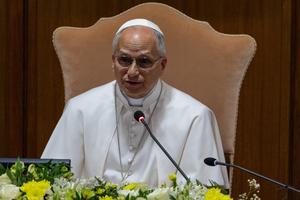
There’s a story that’s been percolating around some quarters for the last few days, but until recently it hasn’t breached the English-speaking news net. It’s likely to.
The nub of the story is this: In 1970 the young(er) theologian Joseph Ratzinger signed a letter to the German conference of bishops suggesting that the Church reconsider the practice of clerical celibacy as the norm for the Latin Church.
Given the MSM’s fixation on the Catholic Church and sex—and particularly its dislike of clerical celibacy—this story could potentially gain traction.
So far, it’s been picked up by the UK-based Catholic Herald, by one of USA Today’s blogs, as well as a number of other outlets, but it hasn’t gotten major airplay yet.
I’ve been holding off covering it for several days in an attempt to unearth a copy of the letter itself, but it isn’t available online, and it appears that the German source which has it may be playing games with it by selectively releasing just parts of it.
This is why it’s always better to read the original documents in their entirety.
In any event, here’s the way the story’s being covered at the moment. The Catholic Herald writes:
Joseph Ratzinger was one of the signatories of a 1970 document calling for an examination of priestly celibacy which was signed by nine theologians.
The memorandum was drawn up in the face of a shortage of priests and other signatories included Karl Rahner and the future cardinals Karl Lehmann and Walter Kasper.
The German newspaper Die Sueddeutsche reported about the document today.
The memorandum, which was sent to the German bishops reads: “Our considerations regard the necessity of a serious investigation and a differentiated inspection of the law of celibacy of the Latin Church for Germany and the whole of the universal Church.”
According to the Sueddeutsche, the document said if there were no such investigation, the bishops’ conference would “awaken the impression that it did not believe in the strength of the Gospel recommendation of a celibate life for the sake of heaven, but rather only in the power of a formal authority”.
If there weren’t enough priests, the document said, then the “Church quite simply has a responsibility to take up certain modifications”.
The signatories who had drawn up the document acted as consultors to the German bishops’ conference in a commission for questions of Faith and Morals.
The document’s release coincides with a renewed debate on priestly celibacy after prominent German politicians called for the Church to change the teaching on priestly celibacy in the face of a serious lack of priests
Since we don’t have the letter itself, I don’t want to comment too much on it, but I will say that I’m not surprised. Throughout his career, Joseph Ratzinger—now Pope Benedict—has displayed an amazing capacity for dialog, discussion, and the calm examination of questions. Even as pope—perhaps especially as pope—when he could exercise his magisterial authority on issue after issue, he has been studiously careful to avoid imposing his personal opinions on matters. If you read his writings and speeches he regularly raises questions for discussion and then does not offer a definitive conclusion. You can generally tell where his own sympathies lie, because after bringing up a topic he will explore a possible solution that he finds “interesting” or “noteworthy,” but then in the end he says something like, “however this may be, let us look at this deeper issue to which the question leads us.” He thus sets aside what is likely his own view, without imposing it on the faithful by his papal authority.
You really gotta admire that. He offers an amazing example of humility and prudence.
Given the serene, open way of approaching controversial questions that has always characterized the man (a habit he may have honed in academia, where detached, scholarly debates are often expected as a matter of professionalism), it isn’t surprising that back in 1970 he and other German theologians would call for a re-examination of the Church’s discipline regarding clerical celibacy.
But a re-examination is just that: a re-examination, not a rejection.
It amounts to proposing the question for study, not leaping straight to the conclusions of that study.
And, such time as we get the actual text of the letter so we can see what was said, we can’t conclude anything more than that: The young Ratzinger and his colleagues suggested that the question of changing the Latin Church’s discipline on celibacy be studied.
This certainly meant that they felt there were sufficient grounds for studying it. But it by no means makes them fire-breathing celibacy haters. One can think a question worth exploring without having pre-determined conclusions in mind.
So we really can’t say what Ratzinger’s mind was at the time, other than that he felt the question should be explored.
Suppose he was, though, of the opinion that the celibacy norm should be changed. What difference does that make?
It would allow some celibacy haters (and associated media types) to score a few rhetorical points (“Why, even the pope used to think this way!”), but this doesn’t add much of a substantive nature to the discussion.
From everything he has said during his pontificate—as well as in recent times before—Pope Benedict seems sold on the value of clerical celibacy in the Latin Church, and not just for utilitarian reasons. That is, not just because it enables priests to devote themselves to full time service of the Gospel. He has specifically articulated the insufficiency of this view, noting also that celibacy conforms one to the eschatological state in which we will be like Christ, for in the next life there will be no marrying and giving in marriage.
On the other hand, Pope Benedict has also been unafraid of having the subject discussed. In the 2005 Synod of Bishops on the Eucharist—the first such synod he presided over—Pope Benedict allowed the bishops in attendance to discuss whether the ordination of married men to the clergy should be further explored. The bishops concluded that the answer (at least at this time) was no.
This was notably different than the way the subject was handled during the reign of John Paul II. At that time the subject was pointedly not on the table, and one can understand why. John Paul II was trying to reign in the chaos that followed the Second Vatican Council and re-stabilize the Church. Amid thunderous calls for married clergy, women’s ordination, and changes on the Church’s teaching on birth control, extra-marital sex, and homosexuality (among other subjects), it’s quite understandable that the pope would feel the need for a collective “time out” on all of these issues, just to let the passions settle and expectations moderate.
By the time of Pope Benedict’s reign, it could well be that the new pontiff judged that the situation had cooled down enough that the question of clerical celibacy could be more fruitfully discussed—a conclusion no doubt shaped by his own personal openness to that kind of discussion.
That won’t stop the press, though, from making it sound like Benedict has done some kind of dramatic about face on the subject, or that he is somehow hypocritically masking his true views—should they take note of the story and decide to give it play.
The truth is that was neither a fire-breathing celibacy hater back in 1970, nor is he a dyed-in-the-wool celibacy insister now. He was, and is, a man of thoughtful reflection, intellectual humility, and openness to the discussion of difficult questions.
Or that’s my opinion.
What do you think?


Comments
Post a Comment
I wonder what the mainstream media would think of the letter to remove Fr. Jean Vianney as the Cure of Ars due to his incompetence - signed by Fr. Jean Vianney himself.
The way they misunderstand humility and even that special brand of insanity held exclusively by the saints is always a bit amusing. Yes, I suspect the he was being humble and perhaps was even signing the letter in order to lead to a formal review so the question could once again be put to rest.
I didn’t know that, Micah! I love Jean-Baptiste Vianney, and I think he’s following me.
Need to make the distinction between celibacy and continence. Wouldn’t it be much more interesting if Fr Ratzinger had desired married YET CONTINENT priests? Perhaps this is the sort of question he wanted to explore when he called for a new discussion and examination.
“...the strength of the Gospel recommendation of a celibate life for the sake of heaven…” is a telling statement. Clearly the undersigned theologians were NOT simply against clerical celibacy!
http://therecusanthousemate.blogspot.com/
No authentically Christian worldview can be opposed to the gift that celibacy is to the Church. It is a charism granted by the Holy Spirit to a number of souls. Like marriage, the celibate vocation has its own eschatalogical dimension and practice of asceticism and opportunities for holiness.
This article on the Syrian Christian term “ihidaya” is a very rich treatment of the spiritual and eschatalogical values of this vocation.
http://syrcom.cua.edu/Hugoye/Vol2No1/HV2N1Koonammakkal.html
At the same time, support for the celibate vocation does not demand support for the canonical mandate which excludes married men from consideration as viable candidates for the presbyterate. One can most definitely be opposed to the canonical mandate while still supporting celibacy as a treasured calling in the Church.
For me, I have always appreciated the Pope’s ability to re-examine scriptural, historic and traditional teachings of the Church for the modern Catholic who is often unaware of its basis and importance. For him to want to look at celibacy in an attempt to help us better understand its value is not surprising.
For me, it is not unlike our need to re-examine our teachings on NFP - not in anyway to disregard it - but in recognizing that newly engaged couples do not know a world without easy access to contraception they have no knowledge of Humanae Vitae’s significance. Every teaching -but especially those that stand in opposition to the secular world - must be accompanied with “why we do what we do” as Catholics. While we might wish and want for all Catholics to have a ‘because the Church teaches it’ attitude, we need to realize that stubborn stand doesn’t work well with toddlers much less adults.
Finally, the fact the letter is being held out with one hand and retracted with other by the German ‘owners’ makes me wonder.
Totally unrelated to the topic, why is the Pope, then Cardinal Ratzinger, wearing a suit in that photo? I thought that the regulation on Priestly dress required them to wear a Roman Collar, etc., in public.
Okay, having gotten around my curiosity about the photograph, I’d note is this.
The requirement that Priests not be married only exists, in so far as I know, in the Roman Rite of the Catholic Church. Those who are members of other Rites may be married. It’s not as simple as that, however. I don’t think, for example, a man may become a Priest and then marry (although I could be in error). This is similiar to the rule for Deacons, who can be married, but if their spouse dies, cannot remarry (I think). If I’m correct, Bishops may not be married in any rite.
Given that, I think this statement is particularly significant:
“If there weren’t enough priests, the document said, then the “Church quite simply has a responsibility to take up certain modifications”.”
There aren’t enough Priests. In our Diocese, the Bishop just sent around a series of questions about how we are going to handle a significant decline in the number of Priests here within the next five years.
I think it correct that the non marriage rule is significant and should be retained as much as possible. But I also feel that we’re reaching a crisis point with the lack of Priests. We’re using Deacons a lot here, whom we are bringing on in large numbers. Given that it is not a universal law that Priests be unmarried, and given that not all Catholic Priests are unmarried, and given that we’re using a lot of Deacons who are married, I really wonder if we shouldn’t seriously consider ordaining Deacons who have served continually for some period of time (five years? ten years).
It be a big change, to be sure, but it would open an avenue up for additional men, who have proved their worth, to become Priests. They’d have to have some sort of lessor status than other Priests, but they’d be Priests none the less.
What I’d also note about this is that it would open the door up to men who for whatever reason missed the boat early on. The Call can get muted in today’s world, where every middle class parent seems to want their kids to be a doctor or lawyer. Men who are established in a community and answer the call to be Deacons are probably too old, too habituated, and too established in a community to take up the wondering life of a single parish Priest. But once their kids are grown, they might be still able to serve as Priests in their Parish.
There is nothing about a married clergy that detracts from the beauty and value of celibacy. The Eastern Church has had both celibate and married clergy from nearly the beginning until the present day. I pray for the day that we have both married and celibate clergy serving God side by side.
As we all know, there is no theological reason why we should not allow married men to be ordained to the priesthood.
Yeoman,
You make some very good points. The document is correct when it says that in view of a shortage of priests, the church has an obligation to modify its disciple.
Why might this be? Because when the faithful are put into a situation where there are not enough priests to hear confessions or to anoint the sick (which deacons cannot do even in emergencies) or celebrate the Mass (which we definitely cannot do), the Church, while still valuing the celibate call and still teaching that celibacy is the optimum state for those called to the priesthood, must own that it is a only an ascetical discipline and an evangelical means to an apostolic end. The celibate priesthood is not, however, an end in itself and should not be an insurmountable obstacle to considering older married men of virtue as candidates, especially from its pool of deacons. (Cardinal Schoenborn said much the same thing in recent years.)
Now I do take some issue here: “It be a big change, to be sure, but it would open an avenue up for additional men, who have proved their worth, to become Priests. They’d have to have some sort of lessor status than other Priests, but they’d be Priests none the less. “
There is a traditional way of ranking clergy, but I disagree with the idea of creating a two-tiered class system based on celibates and non-celibates. Such an approach exists currently between transitional and permanent deacons in the West and does nothing but create a bitter division within the Ordo (and they are of the same Ordo, despite the nonsense of separate ordinations, differences in clerical dress and all that.)
That said, what I believe to be a worthy consideration is the development of the vocation of the non-stipendary priest, who is a married man serving in the parish who also supports himself and his family financially. Deacons have been doing this now for decades and it does work quite well. These associate non-stipendary priests help to supplement and augment the priestly ministry of the larger parish, without necessarily having to serve in the role of the pastor, which could (with some exceptions) be reserved for a celibate man, especially in larger parishes.
Well, I know some “pastor” wives and the few things they agree with me is the fact that our priest are not married. They all complain of having to share their husbands time, parenting and money to their churches and other people, many cases other women. at any given time and under any circumstance. It is hard for any man to serve to wives: the church and a woman with children. I guess it is here from where the celibacy for priest comes from: from a very wise, old and experienced church which has learned lesson through centuries, and sometimes has learned these lessons the hard way. That sometimes we questioned this “rules”? yes we are humans!But there is a reason for most of the rules, and just as a parent knows better than the toddler, the 2000year-old church knows better than any of us. Do not believe me? READ chuch history, you’ll see.
Wearing a suit was, and still is with some, very common among German clergy.
I don’t think there is anything wrong with a “re-examination.” Which I think is a little different than the slightly inflammatory title of this article- “Pope questions celibacy”
@Silvia
With all due respect, but what you wrote is ignorant. You obviously have not seriously studied Church history. It is precisely history which points to arguments against mandatory celibacy. You obviously are ignorant of the fact that the Orthodox share our 2,000 year history and they have a married clergy - practically since the beginning.
What in the world is this c#*$? “But there is a reason for most of the rules, and just as a parent knows better than the toddler, the 2000year-old church knows better than any of us. Do not believe me? READ chuch history, you’ll see.” Toddler - child? Did you graduate from college?
Be gentle, Roger…we can never sacrifice charity to make a point.
Was there not a synod of bishops that examined this issue in 2005? They talked about it at length and concluded no major changes to the current disciplines were called for. But the point is Pope Benedict has never tried to avoid reexamining the issue. He didn’t want to do it again after the 2005 exercise. But that is just prudent use of resources.
I repeat: “Toddler-Child.” We might as well just be drones and turn our minds off. We wouldn’t have any theology with that attitude.
I honestly believe that exploring the issue opens the gift of priestly celibacy. To simply stand in a position that is forbidden to be discussed leaves too vast an opening for priestly celibacy to be attacked. What I find in many of the comments, that is disconcerting, is the thought that open discussion in regards to priestly celibacy, means that the Church is definitively in a position that means to change this mandate as opposed to elevating and substantially solidifying the presence of the gift of priestly celibacy. As with contraception and the ordination of women, Christ has spoken through the Church, not merely to say no, but to open and offer the gifts of Christ to the Church and to the world. Still, many stand in open rebellion within the Church, against her teaching and, ultimately, against Jesus Christ.
A married clergy is a far cry from contraception and women’s ordination. Wanting a married clergy is against Church teaching? I don’t know why I even read this blog. The people on here obviously don’t know anything about theology.
One of the problems with people who have a long track record is that many of them change their opinions with the passage of time. That surely happened with Ratzinger (the suit and tie a good external example of this). There is nothing wrong with evolution of thought. St. Augustine even issued a volume of “retractions”. An objective examination of the record reveals that at certain points, Ratzinger was rather liberal (has anyone read his implicit challenge to papal authority?). For years (even before his election), I thought it would have been prudent for him to indicate that he no longer holds to some/many positions he once espoused. Then, Ratzinger could not be quoted against Benedict XVI, but that did not happen and has not happened.
We should also note that the other two signatories mentioned are Kasper and Lehmann, both of whom became cardinals due to their long-time friendship with Ratzinger. Both of them were problem-children, even as cardinals.
Priestly celibacy is a discipline, not a dogma, so it can be modified. But, unless there are very good reasons for it, I would be against changing it because of a perceived priest shortage until all other options are explored (it is, after all, a 2000 year tradition in the Roman Rite). For example, we get many priests form other countries with higher vocations to serve here, where the vocation numbers are not so great.
Factual incorrect: “...it is, after all, a 2000 year tradition in the Roman Rite…”
Jimmy, I believe that during his <u>reign</u>, John Paul II was very concerned to <u>rein</u> in the chaos that developed under his predecessor.
@Fr. Deacon Daniel: But aren’t clergy in the Eastern Churches ranked by their marital state? In the Eastern Churches, bishops are drawn primarily from the monks and the occasional widower. Human nature dictates that this situation creates tensions in Eastern church life.
Short and sweet, I agree with Yeoman. It’s a step that will eventually have to be taken. It creates problems of it’s own however, paying these married priests,(Fr. Deacon Daniel points to this),divorce-married clergy have a high divorce rate,initial reaction of the rest of the clergy and a lot of the faithful. Yet, the gains are very real, I don’t need to repeat them here. One gain would be significant:the Church currently is in the schizophrenic position of prohibiting homosexual priests, and yet having a priesthood, and Episcopate-remember Bishops are priests,that is close to 50% homosexual. This is intolerable. The time has come to change.
Just for the record, I love Pope Benedict XVI. I has always been a great admirer of his.
@Jim
Wrong. Wrong. Wrong.
@Roger, I did not mean that contraception = womens ordination = married priesthood. While the Church openly discussed contraception and womens ordination and definitively spoke in regards to these matters as a matter of faith and morals, we still have many voices in the Church that stand in open opposition. What the Church is open to discuss should be openly received in her definitive teachings as Christ speaking through the Church. To presume that an open discussion gives us the right to stand before the Church in judgment, rather than solidarity, in her current discipline of priestly celibacy is a matter of great concern.
@Cathy
The purpose of opening a discussion is not to reinforce the current policy. Celibacy is an open question. There is nothing wrong with seeking an open discussion and presenting a dissenting opinion on this matter. We are not judging the Church, we are questioning the current practice in light of the Church’s reality according the signs of the times.
The argument made by Karl Rahner, SJ and Ratzinger (pre-papacy) was primarily a pastoral one. This situation is even more accute now than it was in the 70s.
Canon Law states:
Can. 213 The Christian faithful have the right to receive assistance from the sacred pastors out of the spiritual goods of the Church, especially the word of God and the sacraments.
Can. 218 Those engaged in the sacred disciplines have a just freedom of inquiry and of expressing their opinion prudently on those matters in which they possess expertise, while observing the submission due to the magisterium of the Church.
Can 212 §2. The Christian faithful are free to make known to the pastors of the Church their needs, especially spiritual ones, and their desires.
The faithful have rights to demand adequate pastoral care and we have the right to express our opinions upon matters that are not dogma. Tolle Lege Tolle Lege Tolle Lege
I wonder how people thinks Church councils came to be. Do you people think everybody just sat, listened, and accepted everything? Christians have always been questioning and probing. Questioning open topics that do not contradict articles of faith or moral principles held by the magisterium does not make one a disloyal liberal Catholic. This is called theology!!!! This is called theological reflection!!! WOW!!!!
People on here just sound, frankly, ignorant and have their minds shut off. That’s not Catholicism.
You people would have hung St. Thomas Aquinas if you were his contemporary.
Cathy,
The problem is that, in the mind of some, priestly celibacy has been elevated to a dogmatic level. Nothing could be further from the truth. The Church is quite capable of altering its discipline.
And comparing contraception and women’s ordination to the discipline of celibacy is not only an exaggeration, but more than a little insulting to the other 21 sui juris (self-governing) Churches in the Catholic Communion. The Latin Church, albeit the largest in population, is simply one sui juris Church among others. All of the other Churches have a rich tradition of married men serving as priests.
The Eastern Churches could make a similar argument since having both married and celibate priests serving in Catholic Churches in the East ante-dates the Western restriction which comes many, many centuries later. Has not the Holy Spirit operated in these other jurisdictions, leading them to say that married Catholic priests are not only legitimate but also an authentic and apostolic vocation? Or does Christ only speak through the Latin Church?
@ Jim -
I pointed to no problem of married priests, so please do not put words in my mouth.
I just know how some moan and groan about the issue of how to support a married priest with a family, so I bypassed that discussion entirely.
And please, divorced clergy as a problem? Whether one is celibate or married, there is always the potential risk of personal even moral failure, as we well know.
Just to clarify, I mean mandatory celibacy for priests is an open question. I personally believe that having both a married and celibate priesthood complement each other. But again, we have been so indoctrinated to think that a celibate only priesthood is the GOOD AND HOLY way and that a married priesthood is a COMPROMISE. This is not the case in Eastern Catholicism and Orthodoxy. We are in a paradigm that is not necessarily correct.
We have to accept that mandatory celibacy is not just based on recommendations in scripture, it is based on real political, economic, and historical problems of the past. But hey… What do I know? We should just shut our mind off. If we question anything, we are disloyal. I am just a child right. It isn’t like I have an education.
@ Jim - So sorry - I completely misread your post. Please disregard my post above!
@Jim
What about pedophile priests? Is that a problem? Is this problem over? Nope.
What about active gay priests? Is that a problem? Is this problem over? Nope.
What about priest that have sexual relationships with adult women? Is that a problem? Is this problem over? Nope.
And here we are, worried about divorced priests? I am not convinced.
@Fr. Deacon
You are on target. The problem I have with a lot of these responders is that they have such a narrow view of the Church. The Church to these people is Roman, not CATHOLIC.
“If you read his writings and speeches he regularly raises questions for discussion and then does not offer a definitive conclusion.”
I can’t believe Jimmy Akin is offering that up as an admirable quality to have in a sitting pontiff. Then again, it’s about what I’ve come to expect from the current clique of self-important lay apologists.
Sorry but the Pope never questioned celibacy. Rather a young priest
signed a document calling for a reexamination of the issue. He
later (much later) became Pope. This is a non-story
Celibacy is not the reason why we have a shortage of priests and religious. There were plenty of young men and women entering the seminaries and convents despite knowing that it called for a celibate life.
To say celibacy is the reason for the shortage of priests is a copout and wrong to begin with. The REAL REASON that everyone does not like to realize, is that vocations to be priests are in the gutter because:
1. Young men are by and large living in apostacy and NO LONGER BELIEVE OR PRACTICE Christianity.
2. People NO LONGER BELIEVE IN THE REAL PRESENSE IN THE EUCHARIST!!!
3. Families who NO LONGER BELIEVE OR PRACTICE THEIR FAITH have no reason to encourage their sons or daughters to enter into a religious life, and children grow up seeing no reason or importance to either.
4. The Catholic Priesthood’s image has been UNDER ASSAULT for a long time and you wouldn’t believe how many people view it as a little more than an outdated false identity and priests are considered nothing more than con-men who pretend to do magic and are probably hypocrites who engage in sexual intercourse anyway… So in reality a good number of people don’t really believe priests are being celibate anyway!!! This view also stems from all of the above points, especially that of the Eucharist.
There are good reasons to keep the priesthod celibate. For one it is Biblically known that God desires chastity. The Levite priests could not even enter the Holy of Holies or perform their duties unless they abstained from sex. They would be unclean to enter the presense of God. So how much more important is it then that priests remain chaste when everyday they must hold and consecrate the Body of Christ!!!
Today the sickening downplaying of reverence for the Eucharist from abuses of receiving it to lack of belief have led to no one taking the Eucharist seriously, hence no one takes the Mass seriously, hence no one takes the role of the priest seriously, hence no one takes the Church seriously, hence no one takes Chrisianity seriously, hence no one takes any of its teachings on morality seriously.
Celibacy is the least of your problem. Changing it will not only dishonor God and reduce the priesthood and all it stands for as a representation of Christ’s relationship to His Church, but it will do no good at all and in fact you will only confirm society’s expectations about the Church opening up, and sex being more important and this will lead to a further decline in vocations and further apostacy as the Church will offer nothing and no example of substance.
All this talk about changing the discipline of celibacy is hogwash until you resolve the real problem, which is a much more enormous and gigantic task that no one wants to say out loud!
@Roger Smith
Perhaps you should come off your high horse and realize the fact that the development of Church discipline and teachings concerning the celibate priesthood is because it is a better and superior representation to the world about man’s relationship to God, the relationship of Christ to His Church, the fact that going to heaven depends solely on ones relationship to God, an imitation of Christ’s life on Earth along with His apostles, it reiterates the fact that it is God alone that is enough for man, not sex, food, human relationships thoguh all these are good things. It teaches the value of sex and marriage by having a priest abstaining from it and living chastly. It shows respect for God and the reality of His presense in the Eucharist. Any sufferring a priest experiences from a lonely celibate life is a cross that a priest, acting as Christ carries for himself and the sake of others, a sacrifice by which souls can be saved, and their purgatory lessened. And I can go on and on and on. Perhaps you ought to read more about the many wonderful things that celibacy has to offer. It’s not for everyone, and nobody is forced to be a priest. But it is the most supreme and highest devotion, upheld by Christ, recommended by St. Paul, and even the Virgin Mother of God herself in approved apparitions and messages has herself stood by teh celibate priesthood and called upon the priests, her sons, to see that it is of value to God and He is pleased by their discipline. And you ought to be humble and recognize that Heaven itself has asked for this and the Church in her wisdom has humbled itself accordingly to take this upon herself.
Jimmy, why do you say that “it appears that the German source which has it may be playing games with it by selectively releasing just parts of it”? I haven’t seen any positive claims of that sort. The sueddeutsche article is a bit careful in its language, saying that the reprint is “supposedly” the complete text (angeblich vollständig im Wortlaut). But are there any positive claims that they left something out?
Another reason to study a question is to provide clear answers for those who may be confused or questioning.
Wow! A lot of seemingly angry , shouting people here. Perhaps you wlould have felt right at home at various early church Councils where actual fist cuffs broke out.
Human nature doesn’t change.Just the morality.
People do change their minds! Married priests or non-married priests isn’t a big issue to me. However, a married priest could never be a bishop as I understand it. I don’t think a married priesthood would solve the shortage problem. It might convince some men to stay in the priesthood. Most of those I know who left, left because they met someone they just couldn’t live without. Or they were just lonely, our priest are terribly isolated, even in the big cities. And it is certainly much worse in the country, the loneliness can be unbearable. After all, these men never took the vow of ” isolation.” They didn’t become priests to become ancohorites!!! I sympathize with them. A lot of the layity are condemned to live alone for one reason or another. Believe me it can be very hard!!!
“Throughout his career, Joseph Ratzinger—now Pope Benedict—has displayed an amazing capacity for dialog, discussion, and the calm examination of questions. Even as pope…, he has been studiously careful to avoid imposing his personal opinions on matters. If you read his writings and speeches he regularly raises questions for discussion and then does not offer a definitive conclusion.”
Indeed! If only such traits were more common in the Church today, and in American society. It’s telling that someone (Matt) has already complained that this is a bad thing. Such polarization.
http://chrysologus.blogspot.com
The boys on Catholic Answers may disagree, but how about taking the Bible at its Word, & just obeying the SPECIFIC qualifications for men in ordained ministry? Ideally, our ordained clergymen are to be married men, with children. It’s clear, when the Bible is read in context.
Universal Church Tradition allows for married MEN with children to be ordained, and the Bible and universal Church Tradition together are the Deposit of Faith.
Frankly, if Jesus walked the earth today like one of us, He would not recognize the Church he left, as it was designed by Rome. St. Peter would not be allowed entrance into any Latin rite seminary because he was married.
Pope Benedict, IF he is truly a church historian, would be wise to listen to those that call for an end to mandatory celibacy. Any clergyman (existing priest, bishop or pope, or a seminarian)should be allowed to marry a woman at any time in his life.
Give women back their proper ROLE in the Church, as priests wives. The idea of continence is not Biblical, as a lifestyle. And it’s just silly.
Priests are allowed to adopt children. They need to be able to marry a woman.
I am a married man and for the life of me I cannot begin to imagine how I would be able to perform a priest’s duties well without compromising my family life. I don’t think that people clamouring for married priests know exactly what they’re talking about.
Priestly celebacy seems to be the biggest issue with people who aren’t Roman Catholic. With the murder of christians world wide being at it’s highest point ever in history why not have a married Roman Catholic clergy so that shatan can slaughter their wives and children during half time on the fifty yard line at the super bowl before the priests very own eyes? The grand finalle can be to ask those priests to denounce their faith or see their families slaughtered. They continue doing this in China, Iraq, Sudan, Saudi Arabia, Pakistan, India and on and on and on. Look at a current copy of Martyrs Mirror and God forbid to mention Roman Catholics!
Peace my brothers!
@Nicholas: “Rather a young priest signed a document calling for a reexamination of the issue. He later (much later) became Pope. This is a non-story.”
Amen.
Christian Cochini, SJ, did his doctoral thesis on the Apostolic origins of priestly celibacy - back in 1969. Since then, there has been a resurgence of scholarly examinations into this matter, using the latest historical critical methods. Cardinal Stickler, (“The Case for Clerical Celibacy”), Roman Cholij, (“Priestly Celibacy in Patristics and in the History of the Church” and “Clerical Celibacy in the East and West”), Stefan Heid, (“Celibacy in the Early Church”), and many more.
From the 1970’s on, particularly in Germany, the interest in renewing studies into this matter has been on-going. (See Stickler for a plethora of citations to these works). No one, to date, has surpassed Cochini’s work into the subject, nor offered any serious challenge to it.
So, Jimmy, if you want to know what I think - I think that letter reflects the renewed interest in the subject that began with Cochini’s work. It is a serious challenge to Funk’s view, which in the late 19th century seemed to be the last word in the controversy between Franz Funk and Gustav Bickell. According to Cardinal Stickler, the majority of historians accepted Funk’s view leading many people to believe the matter had been settled.
Bickell traced the origins of clerical continence to the Apostolic rule. Funk challenged Bickell, claiming it could be traced only to the 4th century. Bickell simply quit responding to Funk, Funk kept publishing his views, and that is the view that is dominant even today.
Cochini, Stickler, Heid, Cholij, and others, have picked up the baton from Bickell, and have shown that clerical continence has its roots in the Apostles. I think it’s great that Funk’s views are finally being challenged, and I’m not surprised Cardinal Ratzinger would show an interest in the challenges to Funk that are finally being made.
@ Reuben - You wrote:
“I am a married man and for the life of me I cannot begin to imagine how I would be able to perform a priest’s duties well without compromising my family life.”
Most certainly you are entitled to your views on this point. Your first comment - that you cannot imagine yourself and your family with your current obligations serving as a priest - is simply an honest perspective about your own capacities relative to the needs of your particular situation.
But then you wrote: “I don’t think that people clamouring for married priests know exactly what they’re talking about.”
Perhaps they do or perhaps they do not. Granted until one actually serves as a married priest one may never really KNOW in any actual sense what they are talking about, but I know several married priests and they DO know what they are talking about and they would not trade their dual vocation as father, husband and priest for anything. The same can be said for their wives, who also serve their parishes. They deeply believe - as do I - in the potentialities of a married priesthood.
@ Tom - Your post represents one of the most patently absurd arguments against married priesthood that I have run up against in any discussion. You might consider reading the history of the martyrs in the early Church on up to the present. Whole families gave witness to the Gospel with their lives, and campaigns of martyrdom definitely included both clergy AND laity. The scenario you mention did happen to St. Sophia and her three daughters, Faith, Hope and Charity, under the persecutions of Hadrian in the 2nd Century. And of course, it goes without saying that St. Sophia was decidedly not a presbyter.
@ TheresaEE - You might consider Dr. Dragani’s treatment on this issue.
http://www.east2west.org/mandatory_clerical_celibacy.htm
Also, Cholij has since recanted his position on the matter.
And the most that can be said insofar as what is affirmed magisterially (despite whatever the rigorists may contend) is that as it pertains to service in the office of presbyter the celibate state is not an indispensable condition, but rather an optimum one (one could even say “best suited”) for this ministry. Even I would certainly agree with this, as would St. Paul, who, though, while extolling the value of the single state relative to the concerns of the Kingdom, also instructed his disciple Timothy to identify a men of one wife for the offices of bishop and deacon. Despite that, I believe that maintaining this ideal is why even among Eastern Churches the office of bishop is reserved to celibates, although this has historically not always been the case. But the ideal or optimum state is not an argument against married men serving worthily and heroically as presbyters (also affirmed magisterially), and each sui juris Church must decide for itself what norms it should observe based on its traditional practice and current pastoral needs.
@ Cradle - You wrote: “Pope Benedict, IF he is truly a church historian, would be wise to listen to those that call for an end to mandatory celibacy. Any clergyman (existing priest, bishop or pope, or a seminarian)should be allowed to marry a woman at any time in his life.”
First, if you have not done so, you need to read Pope Benedict to see that there can be no doubt as to the depth of knowledge and wisdom with which he has been graced on virtually all matters theological and historical. There is no “IF” in my own mind. He is truly one of the greatest theologians of the 20th Century (and now the 21st).
Second, the notion that a clergyman should be able to freely marry after ordination is not really supported by the Church’s traditional praxis even in sui juris Churches where a married clerical state is normative for parish clergy. (The Coptic Orthodox do allow for marriage of already ordained deacons, but never presbyters. In whatever state you enter the presbyterate, you maintain until your death or the death of your spouse.) And pastorally the notion of a priest dating women is a disastrous prospect.
First of all, where’s the letter?
Secondly, there’s no way a priest can be married to the Church and to a woman and have a family. There just isn’t enough time for both to be cared for properly. It’s one or the other. Period.
“Secondly, there’s no way a priest can be married to the Church and to a woman and have a family. There just isn’t enough time for both to be cared for properly. It’s one or the other. Period.”
Sorry, Justin. It is and has been done for 2000 years by faithful, devout Catholics. That you disagree with it is another matter.
Ratzinger was named Archbishop of Munich in 1977 - 7 years after this “young” priest in a fit of - what - youthful insanity? Signed this letter.
Not so young. An already wise theologian.
Ratzinger/Benedict does speak highly of celibacy. Most eloquently. But he never suggests that it’s the only way and his equally high reverence for the Eastern Churches indicates his openness to the question in a more than academic sense.
I just rechecked dates - Ratzinger was ordained in 1951. He’d been a priest for 19 years when this statement was signed. This “as a young priest” nonsense implying that he was immature and rash has to stop.
@Fr. Deacon Daniel: “@ TheresaEE - You might consider Dr. Dragani’s treatment on this issue. http://www.east2west.org/mandatory_clerical_celibacy.htm
Also, Cholij has since recanted his position on the matter.”
These statements, while interesting, have nothing to do with my original point - which was that the 1970 Letter Jimmy has written about calling for an examination of priestly celibacy is no surprise, considering the renewed interest into examining the origins of priestly celibacy by scholars at that time - beginning with Christian Cochini in 1969.
The Church has absolutely nothing to fear by using the latest historical critical methods of examining our history, and Ratzinger, if he is anything, is an intellectually honest scholar.
That being said, do you have any proof that Cholij “recanted his position”? I have read this assertion on probably half a dozen sites that oppose the findings of Cochini, Cholij, Heid, Stickler, McGovern, et.al. And, I have searched in vain for actual proof of this allegation - like maybe a quotation from Cholij himself? In addition, others flatly assert that “(and no, Roman Cholij has not “renounced” his position or repudiated his own book),” like the canonist Magdalen Ross (http://casasantalidia.blogspot.com/).
I have read Dragani’s “critical consideration” of Cardinal Stickler’s very short (barely 106 pages) book - and found much of his criticism unconvincing. For example, Dragani writes: “Because of the early date of Elvira, he [Stickler] infers that absolute marital continence must have been required by the early Church. However, in discussing the Council he fails to cite the groundbreaking research of M. Meigne and Roger Gryson, who have convincingly demonstrated that the canons of Elvira are actually a collection of canons spanning the entire fourth century.”
Wheter intentional or not, Dragani sets up a bit of a strawman here, claiming that Stickler’s inference is based on “the early date of Elvira.” Dragani then goes on to “refute” Stickler’s alleged claim by showing the Elvira’s canons are not that “early” but rather, span the whole of the 4th century.
But Stickler doesn’t base his claims on the early date of Elvira. He simply states that these canons “contain the first regulation on celibacy.” (p22). So, whether the canons are from the first decade of the 4th century, or the last, is immaterial to the inferences he draws from them, and his assertion that they “contain the first regulation on celibacy” still stands.
Stickler explains, in the first part, his concepts and methods, before even beginning to examine the evidence of those canons. Thus, he draws his inferences from those canons NOT on their “early date,” but on a “peculiar characteristic of law” - that the “origin of every legal system consists in oral traditions and in the transmission of customary norms which only slowly receive a fixed written form.” (p18). He argues that the early Church was no different in this respect than the Romans or the Germans.
Dragani does state that: “Cardinal Stickler argues that this written law must presuppose a previous practice,” but it appears he states it only in passing, as though it is wholly unconnected to the Cardinal’s conclusions about those early canons.
But Stickler’s argument here is crucial to his conclusions, for it is from THIS he draws his inferences about those early canons. He does NOT “infer that absolute marital continence must have been required by the early Church,” as Dragani claims. Rather, he concludes that:
1. The Bishops, priests and deacons of the Spanish Church were married before their ordinations.
2. After having received orders, they were obliged to completely renounce the future use of marriage and practice continence.
3. Considering the dominance of Roman legal culture in Spain at the time, it is impossible to hold that in these canons we see a “new law.” Rather, these canons are a reaction to the widespread non observance of a traditional obligation, to which retroactive sanctions have been added. He also argues convincingly that, if these canons had been an “innovation” - they would have set off a firestorm of protest.
So, I don’t find Dragani’s critique convincing. I still have not found a single decent critique of Cochini. And, I don’t believe Cholij recanted his entire position. I might believe he modified a portion of it, but have found no proof of that. Would be open to examining any proof of this.
“He was, and is, a man of thoughtful reflection, intellectual humility, and openness to the discussion of difficult questions.”
Unlike your average journalist :-)
A woman at a local Catholic parish I attend first told me of Cardinal Strickler and his book, The Case for Clerical Celibacy. I took the time to read the whole book, and made 4 pages of notes and questions for her, showing where I disagreed with what he wrote. She took my information, and she never responded. It’s not impossible she threw it in the trash, as soon as she got into her car. Either that, or she cannot respond to it.
Why is it that we Catholics are expected to leave our brains at the church door? Pray, pay and obey. That’s fine, if the AUTHORITY is Jesus and the Deposit of Faith, left by Jesus to His apostles for our benefit.
But when Jesus gave Peter the “keys” to the Kingdom, Jesus still owned the “car” - it’s not as if He was handing the keys over to Peter and whomever Peter wanted to pass them on to, taking us all on a wild ride, with us in the back seat, carrying cash to keep gas in the tank, not saying a word, or asking any questions.
Jesus is THE AUTHORITY and the Deposit of Faith is what needs to be preserved. The Bible is the inspired Word of God, and we need to look to what He says, about the ideal qualifications for the ordained ministry. We need to be able to back up what we do with what He instructs.
Like the woman that never got back to me with any response, and after all the work I did, reading that book! Frankly, I was very disappointed in her, but not at all surprised. Pray, pay and obey… whomever. Not Jesus. And few Catholics even understand the letters written by Paul. Paul is ignored, his verses taken out of context, to prove the Vatican’s centuries old ideas. Not the ideals from the Deposit of Faith. Ideals from the year 200AD onward.
“As for me and my house, we will follow the Lord.” - The Bible (New Testament) is the only trustworthy source for Christians, Catholics included, and it has no agenda. The Bible - read in context- unifies. Only the Bible can tell a woman to be submissive, and not sound offensive.
This discussion is worthless without the original document.
First, is the translation sound?
Second, is the “question” meant to be leading into an assume position on the matter to be discussed? Or was it merely a letter asking to have a discussion on the matter, like a scholarly debate?
Third, I’d always thought that lowering the standards for priestly celibacy was extremely wrong-headed. In effect, you’d only get priests out of that deal that wanted to be priests, but who didn’t wish to serve in such a radical way as to offer their potential marriages. That’s not the best kind, and that’s not the kind that the Church deserves or even needs. We are much better served praying for better and more holy priests. (Unless it can somehow be demonstrated or the Chair of Peter can definitively promulgate something that priestly vocations can belong to married men?)
Yes, priests can marry in the Eastern Church. My question is what is gained by allowing it in the Roman Church?
Justin - I know a wonderful American pastor, a conservative married man with children. He was born into a Roman Catholic family, and he wanted to be an ordained priest, but he was not called to a celibate life.
So he had to leave the Latin rite church, to be a married priest. Since he was not ethnic Orthodox by bloodline- not Greek, Russian, Syrian, or Jordanian, or the other kinds of Eastern Rite Churches that are in union with Rome, he became Anglican in America.
So his is the same church that is now so radical all over the world, with the acceptance of women priests and of homosexual clergy and the ‘blessing’ of same-sex unions. In England, many of their Anglican bishops are joining the Catholic church, taking the rank of parish priests because they can no longer serve as bishops, and be married.
It is pathetic that even in the Eastern Rite churches, a bishop has to be celibate. According to the appropriate verses in the Bible, those pertaining specifically to men in the ordained ministry, not only are priests AND BISHOPS allowed marriage, but St. Paul wrote to Timothy and Titus that married men with children was the ideal for the position.
My formerly Roman Catholic friend would have made a wonderful Roman Catholic priest. His parishioners love him, and he is very congenial with Catholic priests, and has even joined our Catholic parish in an annual Pro-Life Walk. But instead, he’s in an Anglican parish that is conservative, but their main denomination is in turmoil.
As for insisting that Eastern Church bishops remain celibate - I have another friend, a woman from the Middle East, who is now in her 50’s. When she was 16 years old, her parish priest, a celibate male in his 30’s, tried to kiss her. She thwarted his pass, and he did not pursue it. But today, that man is still in the ordained ministry. He is still single = celibate. And he is a bishop.
I wonder how many children that celibate priest fathered, outside of wedlock. What would be gained by allowing priests and bishops to marry in the Roman Church?
1) We would finally be heeding the Bible verses that apply specifically to the men in ordained ministry
2) We would not force Roman Catholic men that want to be ordained priests and still be married, to leave the Catholic church
3) We would be able to trust our clergymen more - because it would eliminate the need for them to live double-lives
4) By the churches own statistics, 22-45% (and some sources say as much as 50%) of clergymen, both priests AND bishops, have homosexual inclinations. Many of them are sexually active - not living lives that would be a good example for their parishioners.
There is also the Fr. Cutie type priests that have women on the side, and even families (like the bishop in the Middle East)- I doubt my friend was the only woman he tried to get friendly with. The man should be allowed to be married - and not have to “hide”, or sneak a little on the side.
5) It would assist priests in growing emotionally, and it would help with the problem so many of them have with alcohol. Who among us does not know about problems with priests and bishops drinking too much, and even having anger control issues?
The letter is available here (in German):
http://www.josef-bayer.de/akr/pipeline/210/zoelibat.htm
Today is the first day of Chinese New Year. I saw many people giving angpows (red packets containing money) to the priest but he put them all in the donation box without even looking at the contents. This is what a celibate priest would do. Would a married priest do such a thing? He needs money to pay his children’s school fees. He needs money to take his wife for a holiday ... more at http://passionofchrist-lechemindecroix.blogspot.com/2011/02/should-catholic-priests-be-allowed-to.html
Lavinia Tai—Why are Chinese Catholics giving RED PACKETS containing MONEY to priests? Is the color red considered “lucky”? Is giving priests money considered a way to bring good fortune to the New Year?
If so, a married priest would educate his flock about being superstitious and he would be able to TEACH AND PREACH matters of eternal value, about what we are to believe.
If ANY priest can do that, he (and his wife) would deserve a holiday. It is written, “Do not muzzle and ox.” Read what St. Paul wrote about how to treat our teachers.
St. Paul’s writings could be found in the New Testament. He wrote 13 letters, and maybe Hebrews too - that author is unknown. St. Paul’s letters are the ones that most Roman Catholic priests do not understand, so they avoid teaching and preaching about what he wrote.
The Vatican does not understand St. Paul’s writings at all. They never have and it does not look like they ever will. Even though 2009 was the Year of St. Paul. It’s just words. The Vatican likes celebrations.
Like Chinese New Year, with red packets containing money. It’s silly. It has no ETERNAL VALUE. Everything St. Paul wrote about has eternal value. Everything he wrote.
Lavinia Tai writes: “Would a married priest do such a thing? He needs money to pay his children’s school fees. He needs money to take his wife for a holiday.
Lavinia, Diocesan priests do not take a vow of poverty. They can drive a Toyota or a Corvette. One local priest drives a brand new $30,000.00 Harley-Davidson. They are paid a salary and often have “family” money as well. My Pastor annually takes a Summer vacation and is gone for a month on group or personal tours all over the world.
@Cradle Catholic
We have no doubt had this discussion before. You still continue to fail to see that the celibate priesthood is a more authentic priesthood that represents Christ and the role and person of the priest has developed over time. The Church devlops doctrine and her role to better represent the mysteries and dogmas of the faith. It is not subject to sticking to the ceremonial rules laid out in the Bible, which since you’re obviously still have trouble understanding the Bible, ought to recognize that the priesthood and the role of the priest changes. It started off with the first borns of each Hebrew family being the houshold priest. This then shifted to the Levites, then eventually down the line to those consecrated men who took on Holy Orders, each time becoming more exclusive until we reach the current form where the celibate priest gives himself totally to God to live relying not of any thing in this world but God alone, this is what it means when Christ quotes Moses who said that ‘man does not live by bread alone but by every word of God’ indicating that it is not the manna that they ate for 40 years that kept them alive, it was the supernatural power of God that kept them sae in the wilderness of the desert, thus we must rely on nothing but God Himself for all our needs. And the celibate priest best represents that. The ones who argue to not be celibate all 100% fail to see this truth and how celibacy represents that.
And also note how those who would enter the Holy of Holies and serve in the temple had to abstain from sex or else become unclean and could not show themselves to God. Also note how that the Catholic priest holds in his hands something of far greater value with the body of the Lord Himself present in the Eucharist that he must consecrate every day! Now also when we understand that it is good for a man to marry, the context has to do with laypeople. In other words those who do not take on Holy Orders and a mission to devote themselves to God in an exclusive way. Single men who have no plans to be priests or devote their lives totally to the service of God… these men ought not to be single, for this could be seen as a form of selfishness (But this does not apply to all). The celibate role was always considered superior. The early Church went about making converts of whom many would already be married. It was a concession given the times and they required people. The beauty of taking a vow of celibacy to God is an example of complete faithfulness, the same as that when a husband pledges himelf to a monogamous relationship to his wife. In the example of the priest, he takes the highest form of self giving in the truest form of marriage. Marriage as a sacrament is a repreentation of something more primordial, far more beautifully preent in the Holy Trinity and God’s relationship to his Church before any of us existed or even the universe itself was formed. Human marriage represents this symbolically. The priest and the vow of celibacy and his consecration to God even more explicitly represent this and it is closer to the reality of what happens in Heaven.
Celibacy in those who served God was always a great example of someone who being close to God has everything and thus is of no great want for other things in this world. He sees nothing but God as the dearest thign in his hear, whereas another man would usually see his wife. But a wife will not save your soul. Only God can do that, the priest thus recognizes this reality and lives by example of one who strives to achieve this more glorious relationship to which we can all be a part of in heaven where there are no husbands or wives or marriage except in unity to God through His Son. The marriage of the bride, the Church to the lamb. The priesthood is a difficult path, and those who feel too weak to accept what it asks have then no business or right to demand it to lower itself to their level.
Furthermore if you will still persist on being stubborn to your opinion. Consider that the Virgin Mother of God herself has made it known that God explicitly desires this chastity in his Catholic priests who she considers her sons and offers them the gift to remain chaste just as she had remained a virgin throughout her life. And any who are wise will listen to her. She knows what she is talking about.
What you seek to do is to destroy the beauty of the celibate priest out of a misguided attempt to somehow solve the scandal in the Church. But imgaine if we applied the same logic to child molestation. Why not change the law such that molestation is not a crime? Then the Church will be even less scandalized! Here’s the reality… Letting priests marry WILL NOT AND NEVER stop fallen priests from scandalzing themselves and the Church. It will not stop those determined to molest children or others, or even to cheat on their own wives and have multiple families and illegitimate around the world such as the example of Fr. Maciel. Letting him be married would never have stopped his lustful attitude. Furthermore you treat women badly but recommending them as a simple solution to tame unchaste men, sort of like how some poor women are forced into marriage to homosexual men in order to magically ‘cure’ them. This doesn’t help. All these unchaste priests who broke their vows of celibacy, even if they were allowed to be married, would’ve succumbed to sinning in some other way. Satan will find their weakness and take advantage of it.
Furthermore, heed the wisdom of the Church and its saints where they declared that when God is angry at the world, the worst thing He does is to allow ravenous wolves (fallen, unfaithful, scandalous, heretic priests) to spring up from within the Church clergy as a judgment on the immorality of mankind, and judging from the nature of the scandal, I bet I can guess at what God is most angry about with the world today. And by arguing that the Church should change, you ironically take away the one true shining example of what the world lacks. The world loves indulging in sex and hate the fact that there are those religious people who have risen above it. It embarasses them in the darkness of their hearts, and that is why they would love to see the celibate priesthood eliminated, as some misguided attempt to legitimize this sin and validate what they falsely beliee all along that the Church is just like any other institution and thus its moral teachings and message of Eternal Judgment by God ought not to be taken at face value, and this grants a false pschological comfort to those who revel in their sin.
@cradle
St. Paul explicitly recommends celibacy. And not just for consecrated men, but for everyone! Finally as great as St. Paul is, he is not the final arbiter of Church discipline. That always belongs to Peter and the decision of the Church as a whole. St. Paul knows this even when he admonishes Peter for acting hypocritically when fearing the popular opinion around him concerning gentiles. Finally you fail to understand that St. Paul’s letters are no different than letters and documents released by the Church today. The Vatican, bishops and especially the Pope hold as much authority on matters as St. Paul. Popes, bishops and cardinals and plenty of priests discuss things and question things and recommend things no different than St. Paul does, it’s just that we no longer include these in the Bible, but if the Bible had never existed as we know it and it was to be compiled today, it would no doubt include more modern letters and documents, especially things important from and relevant to our era. St. Paul is also open to correction if he is wrong in his advice and recognizes the authority of the Church and Peter. He never thought his letter would ever be part of a collection of books that we call the Bible which, by the way, comes from the Church now HQ in the Vatican. And he would think it madness that anyone would resort to the things he wrote in the context of his time over what the Church officially taught and instituted as discipline in the future as it more fully comprehended God and His will and as a light to the current world it occupied. So, no, it is not the Vatican that fails to understand St. Paul. It is you and your pride that fail to understand anything of which you are not knowledgable enough about and you fail to humbly seek out and understand what the Church has continued to develop and deliver to us in the celibate priesthood. The fact that you openly do this shows exactly why God established a visible authority in the Church and a visible head, least people with limited knowledge and understanding reduce the mysteries of the faith and prevent men from fully serving God to the best capacity they can, and lead more souls to their ruin.
The Church may be inefficient in many things, but where it is lacking is nothing to do with its teachings, morals, dogmas or understanding of Scripture. And these things the Church reflects through the actions, lives and disciplines of its members. Her priests.
@ New Observer
There are plenty of Diocesan priests all over the world who do not afford such luxuries and live in and amongst poverty. Some are better off and good for them. Diocesan priests in the west are allowed money because there are demands to be met that reqire them to have a car etc. Depending on how much they are blessed to have from themselves or family or how generous their parishoners are is all variable to their comforts. But someday they can be called to reduce themselves to that level should they have to do so and they ought not to burden a family as well, and thus no priest, ought to rely on their comforts or money, for they do not know what the future holds nor where God will require them to be next. For all purposes, they are soldiers of Christ on a mission in the world and are always to battle it in whatever way and be free to do so. (Also note, that even the Israelites were required to abstain from sex before battle. Hint hint!) That said, the celibacy of the priest is not simply just for some practical considerations like money or time. It is representative of far greater things even with practical considerations thrown out which I have posted about above and before. Furthermore, celibacy is also a cross, a burden a priest takes upon himself for the sake of souls. Anything he suffers must be offerred to God in sacrifice so God make take mercy on him and others. This along with fasting, poverty and other practices of self denial are a duty of those consecrated religious. They take upon themselves what is practical for them in their order or mission. Sufficient money is a requirement for some. As is food where it is impractical to always be fasting. However, celibacy is not like those two as sex is never a requirement to live or work, and celibacy is always able to be practiced, so there is no excuse.
@Cradle Catholic:
“The Vatican does not understand St. Paul’s writings at all. They never have and it does not look like they ever will. Even though 2009 was the Year of St. Paul. It’s just words. The Vatican likes celebrations.”
Wow! If you truly are a Cradle Catholic, you might want to check yourself because you might have just pulled a Martin Luther (he also was a cradle Catholic after all) with that one! With all due respect, how can you actually believe what you just said with a name like “Cradle Catholic” and honestly not be a hypocrite? The Pope, who governs the Vatican, has settled disputes on how to interpret Sacred Scripture for centuries via appeals to him in the Early Church and having the final say in councils. Considering that the books that make up the Bible were formally defined at a couple of councils, it seems that “the Vatican” must have known that St Paul’s writings were not only inspired by the Holy Spirit, but also had to have understood them in order to know that they were inspired in the first place (understanding the message kinda presupposes knowledge of divine inspiration, necessarily).
Further, if we believe St. Augustine, the only RELIABILITY that we have for placing St. Paul’s letters and Hebrews into the category of Sacred Scripture (i.e. the Bible), as opposed to “orthodox ecclesial writings” like The Didache or any of St. Ignatius of Antioch’s writings, IS completely dependent on the AUTHORITY of the Magesterium of the Church (i.e. “the Vatican” and the bishops in communion with the Pope). Here’s what St. Augustine had to say on the matter, which neutralizes dangerous statements of infidelity to the magesterium like the one that you just publicly announced, as well as all claims to supposedly “authentic” interpretations of Sacred Scripture by those who are, unlike yourself, outside of communion with “the Vatican” in general:
“The consent of peoples and nations keeps me in the [Catholic] Church; so does her authority, inaugurated by miracles, nourished by hope, enlarged by love, established by age. The succession of priests keeps me, BEGINNING from the very SEAT of the apostle Peter, to whom the Lord, after his Resurrection, GAVE IT IN CHARGE to feed his sheep, down to the PRESENT EPISCOPATE. And so, lastly, does the name itself of Catholic…”
“If you should find someone who does not yet believe in the gospel, what would you [Mani] answer him when he says, ‘I do not believe?’ Indeed, I WOULD NOT BELIEVE IN THE GOSPEL MYSELF IF THE AUTHORITY OF THE CATHOLIC CHURCH DID NOT MOVE ME TO DO SO.” (both quotes from “Against the letter of Mani Called ‘The Foundation’” 4:5, and 5:6, emphasis added… and might I add ironically found in Jimmy Akin’s “The Fathers Know Best”)
Therefore, be very, very careful with saying dangerous things like “The Vatican does not understand St. Paul’s writings at all. They never have and it does not look like they ever will.” On the contrary, “the Vatican” has always understood St. Paul’s writings, which begs these questions: Do you truly understand the letters, objectively speaking, as well as what “the Vatican” actually teaches about them? In one of St. Peter’s letters, he commented on the difficulty of understanding St. Paul, so how is it that you got it right when “the Vatican”—i.e. the successor of Peter himself—supposedly can’t do this? Most importantly, by what authority do YOU have in authentically and INFALLIBLY interpreting them that “the Vatican” does not have?
My dear friend, I may seem harsh in what I’ve said, but you need a serious wake-up call if you honestly believe the dangerous statements that you just stated, concerning questioning the authority Christ Himself established (Mt 16:18) in matters such as these (remember, we are held accountable for the things we say and do in this world). I say this out of love for you, for I am concerned for you, due to what you have said. I will pray for you to receive an increase in the virtue of obedience, as well as myself and everyone else in this discussion (everyone—especially us Americans—could always use more of this after all, so why not?). May Our Blessed Lady, who is an invaluable model of obedience, be our guide to practicing and increasing the virtue of obedience in us always; and may we place all our trust in her. Amen!
God Bless
Johnno, stick to the point, please, instead of writing a whole novel.
Ms. Tai was making the case that all priests have no need for—and thus do not/should not accept money as a result of not having any marital obligations. She says: “This is what a celibate priest would do.” To accept the idea that priests do not accept or have need for financial gifts, stipends or a salary is to live in a dream world.
Menotti - I am a Cradle Catholic, and I never left the Latin rite church. I am old enough to remember Pre-Vatican II high Masses, etc. Now there are hootenany-type Masses, with guitar, etc.
What makes me similar to Martin Luther, was that he, an ordained Roman Catholic clergyman, picked up the Bible, read it and believed it. It’s the same thing that happened to me- I had 12 years of Catholic education, but I really KNEW my Christian faith, when I simply picked up the Bible (Roman Catholic version, by the way) and read it and believed what it said, in context. I found that in context, the Bible differs from what the Church Fathers came up with 200 years after Jesus ascended to Heaven, and Pentecost.
If I’m not a “Cradle Catholic”, what am I? Please, be kind in your response. I ask because by disputing that I’m a Cradle Catholic, it’s like Jews for Jesus that are persecuted by their own, for calling themselves “Jews”. Fellow Jews say they are NOT Jews anymore. They claim they are worshipping idols (Jesus is an idol to the average Jew), and they have abandoned their culture too = no longer “jewish”.
It’s said a Protestant cannot read the Church Fathers and not be Roman Catholic. But I say a seeker cannot read the Bible & not be “Christian”-seeing himself/herself as part of the Body of Christ, the invisible Church, the Bride of Christ. Now THAT has eternal value. Just like being in “Jews for Jesus” = that has ETERNAL VALUE.
It makes no difference what we are called. It makes all the difference in the world what we ARE = Children of God, through Jesus. Jesus alone.
I’m curious Cradle Catholic on what matters do the Church Fathers differ from the Bible say 1800 years ago? You mentioned it but gave no example. This is just your opinion of course. It just seems like something a Protestant would say. Of which I am one. I have high curiosity about the Roman Catholic Church but if this is the type of fellowship I’d receive by entering it some day I might as well stay Protestant.
If the RCC is indeed the Church Christ started, why would anyone want to walk away from that for Bible alone nonsense? Have you ever been to a Protestant Bible study? The amount of times I’ve seen people just take Scripture and “run” with it without context is baffling. Granted, I myself am also susceptible to this.
I think Menotti has a right to question you. I’m on the outside looking in and since this is a RCC matter in general I’ll leave it be. For wanting something more for my life on Spiritual terms I find this all disappointing what some people are saying.
Come on over Eli,“BE NOT AFRAID” There will always be sufficient Priest for the amount of the faithfull,LESS FAITHFULL LESS PRIEST.His mother said to the servers, “Do whatever he tells you.” John 2:5.have a safe journey.
Menotti writes to Cradle Catholic: “Therefore, be very, very careful with saying dangerous things like “The Vatican does not understand St. Paul’s writings at all. They never have and it does not look like they ever will.” On the contrary, “the Vatican” has always understood St. Paul’s writings, which begs these questions: Do you truly understand the letters, objectively speaking, as well as what “the Vatican” actually teaches about them?”
That’s a valid question, Menotti, which you pose to Cradle Catholic. On the other hand, here is a troubling situation going on in my sister’s parish in Washington State. They are putting on a series called “The Catholic Letters.” Since she was totally unfamiliar with this “title” she told me she decided to attend and found out they were covering the Epistles of St. Paul. Why then the “Catholic Letters” title? It is also interesting that Paul’s letter to the Hebrews was omitted from the series along with Timothy. It is in “Hebrews” where Paul calls all believers priests because the OT Aaronic Priesthood (as mediator) was done away with by Calvary. Even at mass, the priest makes reference to Peter calling us all a royal priesthood.
Also, in 1 Timothy 2:5 Paul writes: “For there is one God and one mediator between God and men,—-the man Christ Jesus.”
Seems it is a valid question why Hebrews and Timothy are not being covered in the parish series. Some of my fellow Catholics have also been troubled over time by certain omissions in Paul’s writings which are not taught nor explained. Paul does call for church order, however, in terms of church structure, discipline, and in leadership with Bishops and local church Elders to hold the church accountable in various matters.
Cradle will need to speak for himself/herself, but perhaps this is an example of what Cradle Catholic is referring to?
Ratzinger was pro optional clerical celibacy in the 70s because he was young then. Now, that he is old, and no hope for marriage, he is pro mandatory clerical celibacy. I was talking to an old priest one day in graduate school in the 90s, and he said honestly that he’ll be angry if young priests were allowed to get married because he was not given a chance to do so during his early life. Sometimes theologians and bishops use Scriptures and research for their own personal preference and convenience. Bishops should really reflect on the Bible, the will of God, and read the “signs of the times.” With these can true reform in the Catholic Church happen to minimize the clergy sex scandals and priests shortage.
kryga - So much for rejoicing with those that rejoice, mourning with those that mourn, and wanting the best for OTHER people. From what you wrote, their mentality is: “It’s all about me.”
That’s not a good character trait in a pew person, let alone a clergyman. God help us, if you’re right about that.
Just a few thoughts to consider:
Jesus chose Peter whom He knew to be married to be “the rock” of His Church on earth. He chose Peter as a high example of one who listens to God the Father and understands the Father’s acknowledgement of Jesus Christ, His Only Begotten Son. Therefore, Christ gave Peter the Keys to the Kingdom, responsible for binding and loosing, teaching and “feeding his lambs.”
Yet, Christ realized Peter was a married man. That did not seem to influence His decision to Choose Peter. Did Christ also not expect Peter to “Do This in Rememberance of Me”? From this perspective, mandatory celibacy seems to be irrelevant…point being married men are capable of deep theological concepts, AND, occupying a demanding Church office.
Here is a translation of the letter into English:
http://www.pathsoflove.com/blog/2011/02/ratzinger-et-al-called-for-reexamination-of-clerical-celibacy/
“Yes, priests can marry in the Eastern Church. My question is what is gained by allowing it in the Roman Church? “
Breaking the cliques of homosexual priests who seek and hold power in so many dioceses. The greatest opponents to married clergy within the hierarchy are gay priests.
I was very amused to hear Fr. James Martin debating Fr. Cutie on the Diane Rehm show - speaking of the value of what the celibate priest sacrifices. What - pray tell - does a gay priest sacrifice? He’s supposed to be celibate anyway.
Frank - I agree with you 100%. For instance, I dislike eating liver. I don’t like the taste or the texture of liver. If someone told me I had to “give up” liver for the rest of my life, it would be a breeze. So for a homosexual man not attracted to women, but rather, attracted to other men, how is not marrying a woman and having a family with her a sacrifice?
Now if I had to give up chocolate for the rest of my life….
The sad part is God does not expect any man to forsake marriage. In fact, God said, “It is not good for man to be alone..” He gave man a woman as a “help-meet”, to compliment him in every way through his life.
God made Adam and Eve. Not Adam and Steve. Thus, the Vatican and the unhealthy “priest=brothers” mentality must be challenged and changed, to structure the Church God’s way. We know how it is to be. Just read the Bible, IN CONTEXT, and OBEY it. The ideal qualifications for men in ordained ministry is right there - in the Pastoral Letters Paul wrote to Timothy and Titus.
So far, the Vatican has been able to ignore it, because the average Catholic refuses to read the Bible, and pew people leave their brains at the church door. But God is finding a way to get everyone’s attention. It’s called the secular press. And the messes are headline news. No one is escaping it.
Frankly, I was sad to read about Fr. Euteneuer and his ministry of 22 years, now wasted. All for what? The Vatican insistence on not obeying the Bible, in CONTEXT, about the qualifications for men in ministry. God is bringing the Vatican to its collective knees. I applaud Him!
My understanding is that Paul himself was unmarried. Did he fail to understand his own writings?
When Paul was converted, he was unmarried. But as a Pharisee of Pharisees, it’s believed that he would have been married, and his wife, died or… left him, or he left her. Who knows.
The important thing is: What are the specific qualifications for those in ordained ministry, according to the Bible? Specific to MINISTRY.
My point is Paul himself failed to meet what you consider essential, non-negotiable qualifications. You are speculating about Paul’s past. There is no evidence for your conjectures. The waxen nose of authority.
Rick
Cradle Catholic, Paul also writes that in addition to being the husband of one wife, a bishop must also the the father of “children” plural and that those children “must not be unruly”. Is a married man with one child or less, or whose children are rebellious, not eligible on scriptural grounds?
Rick -
1) That Paul would have been married early in his life is more than conjecture. He would have had to meet strict qualifications for being a Pharisee. In those days, a male was not considered grown up until he was married. To take a VOW of celibacy was unheard of, even frowned upon. When a person took a “Nazarite Vow”, consecrating themself to God, the person was promising to 1) Never consume the fruit of the vine = not drink wine, 2) Not cut their hair and 3) Not touch a dead person. The vow had nothing to do with not marrying, or of staying away from the opposite sex, intimately. Marriage was the norm. Everyone that took a Nazarite Vow in Scripture was married. Look up Samuel- he was consecrated to God, from birth.
2) No. A single man without children would not be prevented from being ordained to the ministry, provided he was a seasoned Christian, and considered having qualifications for preaching and teaching the Gospel.
John the Baptist was in ministry, and clearly single. Though his ministry was over by the beginning of Jesus’ 3 years of public life. The Baptist was already dead, by Pentecost, and the birth of the Church. John, the apostle, was young when he and his brother, James, followed Jesus, and there are no indications he ever married.
With that said, please answer this question for me:
Why do you and others refuse to accept what the Bible outlines as the ideal qualifications for the ordained ministry? Why do you insist on taking other verses out of context, verses meant for people that are NOT in ordained ministry, and apply them as ONLY to those in ministry? I don’t understand that. Will you please tell me why there is resistance, to merely take the proper Scriptures verses, and obey them?
Further, how can you read verses specific to MEN in ordained ministry, and still defend the older practice of taking young boys ages 13 and up to their older teenhood, and putting them in the “minor” seminary, ordaining them as priests by age 25? That’s another point that I truly don’t understand. While that is not happening in the US today, I believe it still happens overseas.
It is written that a man is best married with children because, “..for if a man cannot manage his own household with dignity, how can he take care of the Church of God?” But that remains completely ignored. It has been ignored for years. How can grooming a 13 year old boy, taking them from their families, putting them in all-male seminary environments obey that instruction?
According to your logic, Jesus, John the Apostle never grew up because they never married.
Your statement that Paul was married is conjecture. Tell me where it says in the Bible he was married. The ancient tradition among Catholics and Orthodox is that like Jesus he was celibate.
I think the context of the passage is that ministers should live sexual morality whether they are celibate or married. You seem to be saying that one part of Paul’s sentence must be read literally, but the second half of the same sentence is not literal. If ministers MUST be married to only one women, then they MUST also have children (plural) and those children MUST be well behaved. Do you have a problem with pastors who divorce and remarry or whose children have behavior problems? Do Protestant churches “not get” the scripture if they allow divorced men and sterile couples to continue to serve?
Along the lines of your statement that a seasoned married man can minister (even if he does not have children or if his children are unruly) it would seem that a celibate man who is a “seasoned man”, with a vocation, can also serve.
I honestly don’t think that you are currently a Catholic—you talk about ministry as teaching and preaching. Catholics look at priestly ministry as more than teaching and preaching. Maybe you were born Catholic, but did you ever understand it? Do you still believe it?
—I simply picked up the Bible (Roman Catholic version, by the way) and read it and believed what it said, “in context”. I found that “in context”, the Bible differs from what the Church Fathers came up with 200 years after Jesus ascended to Heaven, and Pentecost.—Cradle Catholic
Could you clarify what it is that you mean, Cradle Catholic, by that expression you’ve used several times, “in context”?
I come from a Evangelical Protestant background and am familiar with the ongoing disputes many of them had with each other and that was one expression that often came up. “In context.” It usually was code for “interpreted my way,” or “interpreted the way my pastor does,” or “interpreted the way my denomination does.”
And while you are at it, perhaps you might give the “in context” perspective on Jesus’ words in Matthew 19:11-12;
[11] But he said to them, “Not all men can receive this saying, but only those to whom it is given.
[12] For there are eunuchs who have been so from birth, and there are eunuchs who have been made eunuchs by men, and there are eunuchs who have made themselves eunuchs for the sake of the kingdom of heaven. He who is able to receive this, let him receive it.”
Now, were those who ““made themselves eunuchs for the sake of the kingdom” self-mutilated, or simply celibates?
As Jesus said, not all men can receive this saying. Just like St. Paul, the great follower of Jesus, who said it is better to be celibate, but it is not for everyone.
Perhaps that is the best first qualifier for the priesthood. Those who cannot, should not, and those who can, should discern the priesthood.
If everyone else, the married people, were not using contraceptives, there would be a lot more Catholic children, and likely more young men along the way who could be celibate for the sake of the kingdom. If you think about it, done that way, it all has a natural rhythm.
By the way, married Protestant clergy are not immune to infidelity, child molestation, and a range of other sins of the flesh. Marriage is no magic bullet to make saints of men with certain predispositions, however they got them.
That clergy be allowed to marry (or not) is a church leadership decision. Priests know what they are accepting when they agree to be ordained. No one is twisting their arm. To hold a position, however, that celibacy should only be based upon Christ Jesus being unmarried seems not the strongest argument one can make. The incarnation of Christ was to liberate man from his lost condition. Nowhere in Scripture can be found the idea that the Messiah would be married. Here below is the reason for the incarnation and the prime focus of Christ:
Isaiah 61:1
The Spirit of the Lord GOD is upon me, Because the LORD has anointed me to bring good news to the afflicted; He has sent me to bind up the brokenhearted, To proclaim liberty to captives and freedom to prisoners;
New Observer,
And yet, Our Lord chose BOTH married and celibate men to be among the 12 and the 70 apostles.
As St. Paul observes: “Do we not have the right to be accompanied by a believing wife, as do the other apostles and the brothers of the Lord and Cephas?” (1 Corinthians 9:5)
Also, if we as Catholics accept the Divine Inspiration of Sacred Scripture, we could never posit in any serious way that an exclusively unmarried apostolic ministry is the immutable and divinely revealed will of God. All of the data of Sacred Scripture points to quite the opposite conclusion - a mixture of married and celibate men serving as apostles, bishops, priests and deacons. Even the magisterium of the Church does not assert this, and says that while the discipline of celibacy may be preferred for those in Holy Orders (particularly the priesthood) it is not an indispensable requirement for ordination.
Celibacy is ultimately an ascetic discipline, one which the Church should wholeheartedly defend as a legitimate and blessed charism for certain members of the faithful called with much discernment to embrace it. It does not necessarily follow that it should therefore be a canonically mandated discipline for all in Holy Orders. And as the Eastern Catholic Churches have demonstrated in an unbroken canonical tradition, married men have served and do continue to serve in Holy Orders including the Order of Presbyter.
To Fr. Deacon Daniel: Whether the church maintains celebacy for priests or eventually allows priests to marry remains (as I stated) a church leadership decision. My point is that for those holding that all clergy must be celibate **because Jesus did not marry** is a false starter. From time in eternity, the prophecy in Isaiah 61 indicates the role of Messiah. Marriage was not on the agenda. That Christ was celibate is the wrong argument to make for clergy today to also be celibate.
New Observer,
Thank you. In my pre-coffee morning haze I missed the “not” in your statement:
“To hold a position, however, that celibacy should only be based upon Christ Jesus being unmarried seems not the strongest argument one can make.”
Fr. Deacon Daniel —not a problem. Starbucks has enough blends to cure the early morning haze.
Gentlemen,
Catholics love to say the ‘church is the bulwark of truth’ which is taken from 1 Tim 3:15. Several verses later in 1 Tim 4, Paul explains about what constitutes deceiving spirits and things taught by demons.
1 Timothy 4:1-5 (NIV) : 1 The Spirit clearly says that in later times some will abandon the faith and follow deceiving spirits and things taught by demons. 2 Such teachings come through hypocritical liars, whose consciences have been seared as with a hot iron. 3 They forbid people to marry and order them to abstain from certain foods, which God created to be received with thanksgiving by those who believe and who know the truth. 4 For everything God created is good, and nothing is to be rejected if it is received with thanksgiving, 5 because it is consecrated by the word of God and prayer.
Notice that one of the signs of an apostate church is forbidding people to marry. Let us see the Catholic church forbids Nuns and Priests from marrying. Maybe that should be a read flag that the Catholic Church is ‘NOT the bulwark of truth’. Look I can claim that I am a championship quarterback with the Green Bay Packers, but that does not make it true.
St. Bart,
You wrote:
“Notice that one of the signs of an apostate church is forbidding people to marry. Let us see the Catholic church forbids Nuns and Priests from marrying. Maybe that should be a read flag that the Catholic Church is ‘NOT the bulwark of truth’. Look I can claim that I am a championship quarterback with the Green Bay Packers, but that does not make it true.”
First of all, the Catholic Church does NOT forbid anyone to validly marry. Even current celibate priests, deacons, brothers and nuns can be dispensed from any promise or vow to remain celibate. What the Church does say, though, is that if you are dispensed from your vow/promise, you can no longer function in a particular Office or live in the monastery/convent. There are exceptions to this rule, in particular with deacons, but it is taken on a case by case basis, usually where a widowed deacon has small young children to care for.
Secondly, the Catholic Church DOES ordain married men to the priesthood and diaconate. There are 22 sui juris (self-governing) Churches that are in communion and do make up the one Holy Catholic and Apostolic Church which is in communion with the Apostolic See of Rome. The Latin Church is the largest, but it is nevertheless just 1 of these 22 Churches. The remaining Churches are Eastern and generally have a tradition of married priests and deacons. So the Latin-Western Church is not the whole Catholic Church and there are plenty of married priests and deacons around the globe! Additionally, unless you have not been following developments pertaining to the ordination of convert clergy from the Anglican and Lutheran traditions, even the Latin Church has been ordaining married deacons to the priesthood for the past 20 years and even longer to the diaconate.
Thirdly, those who are celibate priests, deacons, brothers and nuns have freely chosen that vocation, often over the course of many, many years of discernment. The Church does not have the power (nor would she claim to) to forbid the valid marriage of anyone. Rather, this is the nature of the sacrifice that they have undertaken freely and with full knowledge.
What Paul is condemning in 1 Timothy 4:1-5 probably relates more to certain early Gnostic teachings which attempted to deny the inherent goodness of marriage in particular or created, visible realities in general. He does not intend to condemn asceticism, and even himself recommends the embrace of the celibate state for the kingdom. (cf. 1 Corinthian 7:25-26) while simultaneously upholding the inherent goodness and sanctity of marriage (cf. Eph 5:21-33).
So to review, your accusation of apostasy is incorrect because: a) The Catholic Church does not forbid anyone to validly marry. b) The Catholic Church, especially through its Eastern Catholic jurisdictions, has been ordaining married men for 2000 years. c) Catholics who embrace a celibate state in life do so freely, since the Catholic Church cannot force anyone to enter into the celibate state, and she does freely dispense those in this state if they petition for such a dispensation. d) The verses you cite simply do not apply to the Catholic Church, in any of its various Western or Eastern jurisdictions.
The Bible gives clear requirements for being a elder/priest in the church. Interestingly this also comes from 1 Timothy 3
Qualifications for Overseers and Deacons
1 Here is a trustworthy saying: Whoever aspires to be an overseer desires a noble task. 2 Now the overseer is to be above reproach, faithful to his wife, temperate, self-controlled, respectable, hospitable, able to teach, 3 not given to drunkenness, not violent but gentle, not quarrelsome, not a lover of money. 4 He must manage his own family well and see that his children obey him, and he must do so in a manner worthy of full[a] respect. 5 (If anyone does not know how to manage his own family, how can he take care of God’s church?) 6 He must not be a recent convert, or he may become conceited and fall under the same judgment as the devil. 7 He must also have a good reputation with outsiders, so that he will not fall into disgrace and into the devil’s trap.
So one of the requirements for managing the church is managing his own family (verse 5). How can a priest be tested to show he is a good leader unless he has a wife and children that can validate to everyone the effectiveness of his leadership?
Fact is that the celibate priesthood has proven to be poor managers of the church. Let me see the Celibate priesthood has brought us inquistions, heresy, homosexual clergy, assassinations, forged decretal, fictional hagiography, manipulation of kingdoms, anti-popes, forged papal bulls, treachery, scandal, and coverups. Maybe it is time for a change?
“How can a priest be tested to show he is a good leader unless he has a wife and children that can validate to everyone the effectiveness of his leadership?”
Not sure - perhaps you can ask Paul, John, and any number of early apostles, bishops, presbyters and deacons who were NOT married in the early Church.
You read this passage to Timothy as though marriage was a requirement for ministry. If that is a proper interpretation, you would then have to argue that Paul himself (not to mention the Apostle John and Our Lord) were not suited for ministry. How do you explain his advocacy for his own state in 1 Corinthians 7:7-8?
Now, I agree with you that the method of discerning a vocation outlined in Paul’s Letter to Timothy is one that all Churches would be wise to embrace for many vocations, especially later ones. How a man serves his family is truly indicative of how he will serve in the household of faith, that is the Church. It is a prudent means of discernment that is also divinely revealed. That said, it does not follow that clerical marriage is thus mandated by the Gospel. Paul’s prudential guidance in the selection of bishops and deacons does not mean that the early Church did not have clergy who were unmarried. In fact the historical evidence is that both celibates and married men served in ministry.
“Fact is that the celibate priesthood has proven to be poor managers of the church. Let me see the Celibate priesthood has brought us inquistions, heresy, homosexual clergy, assassinations, forged decretal, fictional hagiography, manipulation of kingdoms, anti-popes, forged papal bulls, treachery, scandal, and coverups. Maybe it is time for a change?”
My you play loose with Scripture and with the facts of history. Celibacy has done all that, has it?
Then how do you explain the fact that Our Lord God and Savior Jesus Christ, High Priest of the New Covenant was Himself - gasp - a celibate?
I think you need to read more than Jack Chick Comic Books to really understand these issues, rather than simply regurgitating a list of unfounded accusations, some without even a tangential connection to history of the ascetical discipline of celibacy. Celibacy as “eunuchs for the kingdom” (cf. Matt 19:12) is for those who can live it out faithfully. Many have and continue to do so. Not all, of course. But let us recall that even Judas broke bread with Jesus as a member of the 12.
And I say this as both a married clergyman and an advocate for a married priesthood.
St. Bart - your comments are profound and on target. Your questions deserve to be answered by the Vatican. Yes, it IS time for a change, and to listen and HEED the qualifications outlined in Scripture, specific to men in ordained ministry. That will be a refreshing change, and a step towards health.
For anyone saying our priests should be like John the Baptist and Jesus, and Paul (I won’t include Peter, because he was married) I ask: are our priests willing to DIE like they did, for the Gospel and for their parishioners, the flock Jesus loves? I think not.
Some pastors have self-imposed rules that if one of their parishioners, even long-time parishioner, of 40 or 50 years, is in a hospital further than 15 miles from his parish, he neither goes to visit them or is even willing to give them the Last Rites. Those kind take off two months of every year - one month for a silent retreat, and the other, to vacation.
Only if you have a lot of $$$ can you get their attention. Would they DIE for us? Let’s get real here.
And many priests and bishops abuse alcohol. Prior to the sex abuse scandals being exposed in the Boston Globe - abuse of alcohol was common, and it was that problem they were trying to solve. Alcoholic clergymen now is not so bad - or is it? Is it what God wants? Read the Bible for the answer. The truth will set us free.
Time for change. No women priests - the proper ROLE for women in the Church is as a priests wife. His “help-meet”. St. Bart: thank you!
Fr. Deacon Daniel - Paul was speaking to LAY PEOPLE when he advocated remaining single. We must read the qualifications specific to MEN in ORDAINED ministry to see what he wrote about the ideal for them. Surely, you know that? Did you not learn about the Pastoral Letters, Timothy and Titus, and study them in the seminary? Anyone can just pick up the Sacred Word now, and read it. It’s never too late to obey God (not men).
The Catholic church has now opened the door to this issue. By allowing clergy to be married in the first 1,000 years, they then said: “I guess we had it wrong.” Did they have it wrong for the first 1,000 years? As we now enter the 3rd millenium,—they have created a dual system of allowing married former Anglican and Episopalian priests (with children) to pastor and minister in Catholic parishes. Such a dual system opens the door to unmarried priests to question the fairness of such a dual system. A priest ordained at 26 years old may feel totally different about marriage, family and celibacy at 35 or 40. The church has now created this new problem.
On the other hand, could the Holy Spirit be leading the Vatican to make a course correction back—whereby marriage was, in fact, allowed?
Cradle,
How do you explain Paul’s own reference (and stated preference) for the celibate state?
Just as there is no celibacy mandate to be found in Sacred Scripture there is no marriage mandate for clergy either. Such an interpretation of “man of one wife” as a mandate for marriage not only contradicts the facts of history and the witness of sacred tradition, it also contradicts St. Paul who was himself a celibate, and Our Lord who chose both married and celibates to be among the 12 and the 70.
And by the way, vapid, judgmental and patronizing exhortations do not constitute an argument. Please stop assuming people do not read the Scriptures or understand them because they do not agree with your own misreadings.
There should be no change in the celibacy requirement. St. John Eudes has written that the laity get the priests that they deserve; I would expand this to the number of priests also. The laity have to do their duty and quit practicing contraception. Large Catholic families have always been a seed-bed of priestly vocations. And we must also pray—really pray—that the Lord of the harvest send more laborers.
Priestly celibacy is a wondrous spiritual witness to eschatological realities and serves as a support for marital chastity.
Fact is that Paul was a member of the Sanhedrin. ALL members of the Sanhedrin were required to be married. MOST likely he was a widower. So Fr. Deacon Daniel, who is being vapid?
Where in scripture does it say that Paul was a member of the Sanhedrin? Most Protestants expect a clear passage from Catholics on disputed ideas, please do the same here.
The Bible never says whether Paul was married or not. Some think that he was at one time based on what he said in 1 Corinthians 9:5, “Don’t we have the right to take a believing wife along with us, as do the other apostles and the Lord’s brothers and Cephas?” If Paul was married at one time, his wife likely passed away considering he never mentions her in any of his writings. Paul declared that he had the gift of celibacy in 1 Corinthians 7:1-7.
Paul’s statement to the unmarried and widows in the Corinthian church gives evidence that he was not married at the time of his writing the letter: “Now to the unmarried and the widows I say: It is good for them to stay unmarried, as I am. But if they cannot control themselves, they should marry, for it is better to marry than to burn with passion” (1 Corinthians 7:8-9). Clearly, he was not married at that time, but whether he married afterward is also a matter of speculation.
Some believe that the Apostle Paul was married because history tells us that a member of the Sanhedrin was required to be married. However, Paul never stated that he was a member of the Sanhedrin. He definitely seemed to be on the path, “I was advancing in Judaism beyond many Jews of my own age and was extremely zealous for the traditions of my fathers” (Galatians 1:14). Source: gotanswers.com
There is only vague speculation Paul was once a member of the Sanhedrin. Don’t bet the farm on it. Even most scholars do not assert Paul was ever a member of the Sanhedrin. There is, however, agreement Paul was a Pharisee.
Scripture nowhere says that Paul was married or a member of the Sanhedrin. Chances are he was never a member. When Stephen was stoned, Scripture mentioned that Saul was a “young man”. Members of the Sanhedrin were elders—wise men over the age of 30. Saul/Paul probably wasn’t quite there yet.
There were rare exceptions that were made allowing celibate men to sit on the Sanhedrin—but Saul being a young man probably didn’t qualify for the exception.
Cradle,
All Christians believe that God is unchanging. All Christians believe that Old Testament Judaism was non-sacramental. Similarly early New Testament Christianity was also non-Sacramental. Evangelical Protestants claim that modern Christianity should remain non-Sacramental. Therefore, the dividing line becomes the following: Is the TRUE church sacramental or non-Sacramental? I argue that if Christ, Judaism, and the Apostles were all non-sacramental then Christianity must be non-sacramental.
History records that ALL pagan religions were sacramental. Buddhism, Hinduism, Shintoism, and Animistic religions are ALL sacramental.
Thus my contention is that sacramentalism polluted a strain of Christianity, which later became Catholicism. Therefore Catholicism is a false religion that is incapable of providing salvation, holiness, healing (physical/emotional), or a resurrection from the dead. Catholicism is ruled by men and not Christ and thus always at the cusp of the next major scandal. Give the Catholic church power and you will see all her vices such as indulgences, crusades, inquisitions, torture, and assassinations increase.
“Similarly early New Testament Christianity was also non-Sacramental.”
Based on what evidence, st.bart? Your assertion?
You might consider this link which offers some counters to your claim:
http://www.ewtn.com/expert/answers/sacraments_in_scripture.htm
So far you have demonstrated a propensity to assert things for which little evidence exists (other than speculation) and to question explicit evidence when it runs contrary to your own assumptions (and somewhat wild assertions).
The evidence of history - and of Scripture - points to an early Church that was very liturgical, sacramental and hierarchical/conciliar. It was all rather UN-like what evangelicals and fundamentalists assert, which is why Blessed John Henry Newman said that to be a student of history is to cease to be a Protestant. If you have not read much of Newman, I would highly recommend his Essay on the Development of Doctrine, which was written prior to his conversion to Catholicism. What is more, I would highly recommend picking up a copy of the writings of the Apostolic Fathers from the 1st and 2nd Centuries. These were the writings of the disciples of the apostles. They give witness, again, to a Christian Church that looks remarkably Catholic.
That is, unless you want to continue consuming a steady diet of seedy anti-Catholic speculations.
Also, one of the best resources on the connection between the Sacraments and Scripture is Jean Danielou’s “The Bible and the Liturgy.”
Here is a great treatment by Danielou of the connection between the Bible/Sacred History and the Sacraments, which is well worth examining:
http://www.scotthahn.com/download/attachment/2469
Some additional resources by Dr. Scott Hahn can be found here:
http://www.scotthahn.com/readings.html
St. Bart - you post interesting comments. Thank you for the data about sacramental versus non-sacramental history of the Church. I would NEVER, ever in a million years, hang my hat on any institution that is run by men, be they sincere or not.
When I face Jesus, it will be me alone, giving an account for my life. I will not have my parish priest, bishop, or any other cleric speaking on my behalf, and frankly, many of them (including popes) may be in the southern section of the cosmos, and no one will be able to depend on them, as they too, will have to answer for their own lives.
Jesus, alone, is my Advocate to the Father, and He lives to make intercession for my sorry little forgiven soul, bearing witness with the Holy Spirit that lives inside of me, and expressing my sorrow in groanings, when I have no words to express how I feel for grief I’ve caused a holy Godhead. By the shed Blood of Jesus, I enjoy eternal life and it began when I came to that saving knowledge.
That is why I read the Bible, and I study, on my own. I am in Bible study classes with fellow Bible-believing Roman Catholics. At Sunday Mass we only get 7 minute sermonettes, not verse-by-verse explainations that expose the readings and help me grow in knowledge of God, or that help me learn about what has eternal value. Matters of Eternal Value are of utmost importance to me, because in the long run, that is all that matters!
Regarding the Catholic Mass - I think it’s the perfect prayer, when I look at the whole liturgy. From beginning to end, it is worship for me. It is my participation in the Communion of Saints - on earth and in Heaven (but those in Heaven have NO contact with anyone on earth, they too, are merely praising God, casting down their crowns at His Feet).
All that happens in the Mass now is the same as what St. Justin Martyr wrote about in the very early second century. So I have no problems with the Catholic Mass or the Anglican service, which is also very reverent. Liturgical worship or not - God knows our heart.
But as for “We need our priests to bring us Jesus” - I don’t buy it. Our Lord would never allow His precious children to be basically held hostage to the whims of any man. I believe in the Real Presence, and it is because we, His Children, are worshipping Him, not because an ordained clergyman said pre-scripted words, and Jesus “obeyed” the man.
So if you, St. Bart, are not Catholic and you partake in Communion wherever you worship on the Lord’s Day, I believe that your reception of the bread is the Body of Christ too. Roman Catholics do not have an inside track to Jesus. We are IN CHRIST, or we are not.
Fr. Deacon Daniel:
you asked me why St. Paul expressed preference for the celibate state: First, he thought Jesus was coming back soon, as so many did, that’s why in one of Paul’s letters, he scolded some for sitting back and not working, and just twiddling their thumbs, until the end came.
Secondly, Paul went on many missionary journies, and he was passionate about spreading the Word, even to his death. But in his pastoral Letters to Timothy and to Titus, he was writing for the benefit of how to establish a NON-mobile church. He wrote to Timothy, who was setting up the church in Ephesus, and to Titus, who was doing the same thing in Crete.
Please will you answer this for me: How do you explain that Jesus chose Peter as an apostle, and the church claims the pope is the descendent of Peter, yet the Pope is not allowed to marry? Jesus could have chosen only single men, but He did not. Especially, why would He have left Peter in authority, when He could have picked John, who was single, and John lived longer? Why Peter? How do any popes in history, current or earlier, even compare to Peter?
By the way, when celibacy was made mandatory, the pope at the time was married with children. He abandoned his wife and his children to assume “the papal throne.” I’ve seen a photo of the pope before John XXIII and he was being carried on a “throne” by several men, and he had feathers all around him, like he was royalty. Where is THAT in the Bible? How about the cardinals, the “princes of the church”, where is THAT?
Next:
The Magesterium claims women are not to be priests because Jesus chose only MEN as apostles. But would not that argument be deemed invalid, because Jesus chose MARRIED men, most obviously, Peter, and yet the church declares married men non-ordainable?
Please understand - I do NOT support women priests. But I have to bring up the fact that if the argument about WHO Jesus picked is the reason for not ordaining women, then, it does not hold up under even a little
scrutiny. Wouldn’t you agree at least to that one point? If not, why?
If Jesus chose a married Peter, and the pope is to be in the line of Peter, then the pope should be married, or at least, he should be able to be married.
Lastly, why do you think Paul even mentioned qualifications for ministry in Timothy and Titus as married men? Why did he not mention single men, if the church is INSISTING that those in ordained ministry be single in the Latin rite?
Fr. Deacon Daniel—your reference to: “Some additional resources by Dr. Scott Hahn can be found here:
http://www.scotthahn.com/readings.html.”
It is dangerous and bad theology for Catholics to keep rallying around Scott Hahn and praising him to the point of he’s “next up for canonization.” This man professes salvation by “works.” Try reading his authored prayer in this month’s publication of “Magnificat.” (Some) of the most biblically ill informed Catholics are former Protestants like Hahn.
Cradle,
If you look at my posts, I do support married clergy. I am not arguing for the canonical mandate of celibacy. I think such a mandate is reflective of a certain rigorist strain of thought in the West. I do, however, believe that celibacy is a legitimate state of life for certain members of the clergy, but I also believe that the married state is also compatible. I will not go to the extreme and say that there has ever existed or ever should exist a marriage mandate for clergy. To say such a thing is just patently absurd and has no historical basis and is based on poor exegesis.
I think it is sufficient to say that what Paul offers to the Church is a divinely inspired means of discerning the worthiness of certain men for Holy Orders that the Western Church has - for whatever reason - seen fit to mostly exclude from consideration when discerning or promoting vocations. Is such a thing worthy of criticism? I believe so, yes. But I do not agree that it merits the opposite position (a false marriage mandate) is either helpful or factual.
New Observer,
I believe that it is neither “dangerous” nor is it “bad theology” to read or promote the writings of Dr. Scott Hahn. His works have been extremely helpful to many, and I include myself among them.
Two recent works which are more scholarly in nature are: “Letter and Spirit - In Letter and Spirit: From Written Text to Living Word in the Liturgy” and “Kinship By Covenant.” If you are basing your critique primarily on a single prayer in Magnificat magazine or on his writings at a popular level, than I urge you to tackle these two works and then come back and say that he is “biblically illiterate.”
What I find far more puzzling is the frequent envy I encounter among those who are jealous of his popularity, his supposed “canonization” that you snidely reference. If anything he consistently illustrates that no good deed goes unpunished. I pray that God grants him many years in his wonderful apostolate of teaching and defending the Catholic Faith.
And nothing I have ever read or heard from him has ever led me to believe him to suffer any hint of Pelagianism or “works righteousness” in his soteriology. If you believe you are up to the challenge and can do so respectfully, I can only venture to guess that he would welcome a theological critique of his prayer to lay out your far more biblically literate views of where you believe he has fallen into error. Otherwise all you have done is to besmirch the good name of someone else - and done it in a cowardly and anonymous way at that - without breaking a sweat.
New Observer and Cradle Catholic—you guys kind of enjoy stirring things up, don’t you? I don’t think you’re trying to witness to anything (let alone the Gospel of Jesus Christ). You just like messing with people. You don’t really want to talk, discuss or reason. You just want to taunt, tease and have a little fun. Good job!
Rick, your comments are baseless. I have agreed with and supported your post that Paul was never a member of the Sanhedrin when you challenged st.bart. I further have not stated any support for married clergy but only to point out a problem the church has created with a dual system. Deacon Daniel and I have been in agreement on earlier topic as well even though we disagree regarding Scott Hahn.
You’re right, New Observer. I’m sorry. I shouldn’t type when I’m tired. I should have written Cradle Catholic and St. Bart.
By the way, I think married priests are a wonderful idea. (Cradle Catholic and St. Bart, the Western Church sees celibacy as a changable discipline not unchanging doctrine.)
At our parish we have an married priest (previously Episcopalian). He’s incrediby prayerful, a fantastic homilist, and seems to be truly at prayer when he says the Mass. We do have a dual system but I think that is only a signal that we continue to be a period of reform informed by continuity.
Sorry again, New Observer.
Rick
Returning to the issue (gift) of celibacy, I ran across this article wonderful today and thought it worth posting.
http://blogs.telegraph.co.uk/news/damianthompson/100050393/a-catholic-bishop-looks-back-gratefully-on-87-years-of-celibacy/
One of the things that is notable about the Bishop’s comments here is the role community played in his life as a celibate Christian man and priest. This to me has been one of the great issues with the canonical mandate. The shortage of priests has created not just a scarcity of ministers, but also a weakened, almost non-existent fraternal life among them. If the Gospels reveal anything to us regarding the apostolic life, it is that all ministry is at its heart fraternal. Jesus called the college of 12. When He sent out the 72 (cf. Luke 10:1-24), he did so in two’s. Paul’s apostolic labors involved a number of others. When the Apostles established the diaconate, they ordained 7 deacons, including Stephen, the proto-martyr.
As I have stated before, the notion of Fr. O’Malley rattling around alone in the rectory is something of an aberration in priestly ministry. As one Coptic priest has observed, the priestly ideal in the Eastern tradition is that he is never supposed to be alone. He either resides in the common life of a family (for a parish priest) or a monastery. In the West, long gone are the days when Fr. O’Malley was joined in the parish rectory by a common life with several brother presbyters who engaged in a fraternal way in their service to a parish.
The point I take away from the good bishop’s account of his love for this ascetical dimension to his vocation was that it was rooted in a Franciscan community. If the Latin West is going to continue to insist on canonically mandating celibacy for most of its priests, pastorally it needs to ensure that these men exist somehow in the common life of a fraternity of priests, whether formally through a society or association or in a parish setting where perhaps several priests who serve local parishes build a common life in a single location, praying the Office together and serving together in ministry.
It was for reasons of experience and the wisdom of God that St. Benedict of Nursia in his Rule indicated that the eremitical life was only for the most advanced in the spiritual life, whereas the normative monastic form of life was cenobitic, that is, lived in common. (I realize that most diocesan clergy are neither “monks” in any formal sense nor are they “hermits” - just look at their busy calendars!, but they often do live alone as monks do.) If the West is going to impose what are really monastic ascetical practices on those ordained to diocesan priesthood, it should work to ensure that some semblance of the supports and accountabilities of monastic life are present.
PS: I am also of the opinion that the development of the parish system is also partially to blame for the loss of fraternity. The norm of the local church is the Cathedral parish, with the bishop concelebrating with his presbyters and deacons and the whole church. With the development of the diocesan-parish system, the delegated responsibilties for governance and service apart from the personal presence of the bishop also brought with it a corresponding loss of fraternity among the “elders” (presbyters), and eventually even the loss of the diaconal ministry in the West, which had always been closely associated with the personal presence of the bishop. The true solution for this problem is simply to create more dioceses and consecrate more bishops with smaller, more manageable territories, but such a thing is highly unlikely. Somehow, though, the West needs to restore the episcipo-centrism of the early Church (ala Ignatius of Antioch in the 2nd century), which has become essentially sacerdotally oriented. The bishop has become the occasional “visitor” in the mind of the faithful, instead of the pastor and main celebrant at EVERY liturgy. But the reality is that priests and deacons are the bishop’s delegates and co-workers in the Vineyard of the Lord. And within their respective Ordos, they serve fraternally the minsitry and office of the bishop.
Rick -
If you’re in support of married priests and ending the MANDATED practice of celibacy for clergymen, then you and I are in agreement.
I’m glad you wrote about your parish having a married Episcopalean priest convert to Catholicsm. ALL of how you described him is how an elderly cousin of a friend of mine describes her parish priest, also married, and also an Episcopalean convert. What you wrote is 100% how she describes him. The parishoners LOVE him, his wife, & teenage daughter. Engaged in the parish, excellent homilist - he even asks if there are any questions about what he teaches.
Right now, Catholic priests learn about marriage and family mostly through the Confessional. Couples and children, in confession, show the trying side of family life, not the wonderful aspects of it. It gives priests a skewed view of family life.
Priests are sheltered from the day-to-day aspects of family give & take, and they’re not in anything for the long haul, having 4-6 year terms at parishes, and then moving on.
The current issue of Psychology Today has an excellent article about “Reading People” where they interview a few investigators. One was raised Roman Catholic. He said as a kid, he’d often get into trouble, and need discipline, where he would study his teacher’s behavior.
He said one day, he was in a hurry to go home and had to catch a bus, so he went to the priest-Dean of Discipline and he told him what the priest was going to tell him, “You can do better than this. You need to be a team player. Yada, yada, yada…”
The priest was so freaked out, thinking the boy had read his mind, by the time the kid got home, the priest had called his parents, and suggested they get an exorcism on him!
Really - it comes down to the fact that so many can’t deal with children, because they don’t have any of their own. They don’t know how to handle a normally quiet or a more precocious child.
In a homily, one priest I know said his niece and nephew would “rip into Christmas packages!” and not even look at the contents for more than a second, before going on to the next package.” He said he told his mother unless the kids stopped and looked at the gifts, and showed appreciation for each to the giver, that he “was not going to join the family” for the next Christmas.
Well that’s not a good way to handle it. Did it ever occur to him ALL kids do that, and he could better resolve his problem by sitting on the floor with his littlest family members, showing them how to open gifts slowly (as slowly as an excited kid can manage…) and display proper thanks?
Wouldn’t THAT be a better way to handle it? That would build rapport, and allow him to be seen as a role model and a teacher. He would be in those positions, given the opportunity to marry and have his own family. The priest could not only be a good role model to his children, but also to his PARISHIONERS, and that is what would bring health to our church and the ripple effect would cause more health to our society, in general.
Fr. Deacon Daniel - I think you and I are in more agreement than not too.
I urge all Catholics to follow the teaching of the Vicar of Christ—a sacrament of truth, a marvellous term coined by the late Cardinal Gilroy in his wonderful essay on the papacy. Simply go to the EWTN document library and insert Cardinal Gilroy in the search box to pull up his essay. On June 24, 1967, Pope Paul VI issued the encyclical Sacerdotalis Caelibatus, which is the true magisterial teaching of the Catholic Church regarding celibacy. Let us all please Christ by following His Vicar on earth.
Bill - You wrote, “Let us all PLEASE CHRIST by following His Vicar on earth.” When we follow teachings that are contrary to Scripture, we grieve the Holy Spirit.
In the book of James, it’s written that not many of us should become teachers, because when we lead others down the wrong path, we will be judged harsher.
I have not read what “Prince of the Church” Gilroy wrote, but I suspect many of these extra-biblical writings are what caused our church to get off-track. Too much time spent on writing encyclicals that have little or nothing in them that is of ETERNAL VALUE. Like “Prince of the Church”.
Did you ever think about that? There were no ‘princes’ in Jesus church.
Mandatory celibacy is a man-made practice that could change tomorrow, and it should change because it’s contrary to Scripture. If you’re new to this blog, check out 1Timothy 3: 1-5, Titus Chapter1 & 1Corinthians 9:5.
If Bible verses illustrating married priests is the ideal, and universal Church Tradition showing married priests were the norm until 1139AD isn’t good enough proof for you, perhaps just looking at how enforced celibacy has worked for us to date, is worth consideration. It’s broken. It needs fixing.
Until this simple fix is made - we will continue to have “Catholics” like those Pro-Choice and same-sex marriage supporting politicians and their ilk, for whom the Christian faith is ignored, making our collective voice irrelevant. Few listen to Catholics anymore. Even I weigh what bishops are saying, before deciding if they are on-target or not. Gone are the days of “Because I said so, and I’m the boss”. Pew people pay the bills, in order for these “princes” to have time to write their musings.
I ask you this:
Isn’t it better for all Catholic Pro-Life, Family Values Preserving supporters of a MALE-ONLY priesthood, to get on the same page, so we can reach out to other conservative Christian denominations, resulting in a positive effect on our American culture and the world?
That will not happen with the call to “please Christ by following His Vicar”. It is that kind of mentality that causes people to drink the Kool-Aid. Bill, please give what I propose in this comment some thought? Thank you.
Bill,
Here is a link to Pope Paul VI’s encyclical letter, SACERDOTALIS CAELIBATUS.
http://www.vatican.va/holy_father/paul_vi/encyclicals/documents/hf_p-vi_enc_24061967_sacerdotalis_en.html
In the middle of the document, he offered a very respectful - if incomplete - treatment of the differing discipline of the East. Of course, his purpose was to support the law of clerical celibacy as upheld in the Latin West, so while he spoke with admiration of the clergy of the East, he did not relate any of the benefits a different discipline inspired by the Holy Spirit has brought to the Churches of the East since this would fall out of the scope of his pedagogical purpose. In fact, he mostly treats of the Eastern discipline only insofar as it appears to provide some implicit support for Latin views on the subject, which a balanced critique would regard as fairly one sided.
Infallibility certainly guarantees that a Pope doesn’t get it wrong, but it is no guarantee that the best thing is said at the best time in the best and most complete way.
But otherwise it is a pretty complete summary of what has developed as the Latin position on the matter.
Cradle,
Every church is full of “man made practices” (and I include Protestant churches in this) and it is certainly within the purview of the Church to elect to follow or require the following of certain practices so long as they are not contrary to the moral law. This is the nature of the charism of governance granted to the Church.
That said, certain “man made practices” while they may reference principles in revelation (fasting during different seasons of the year, for instance…we are commanded by Christ to fast, but it is up to the judgment of the Church to determine the minimal requirements for when and how) does not mean that the Church’s prudential judgment in these matters is beyond question or even beneficial at all times and in all circumstances.
I think that there are certain points in these “man made matters” when one can disagree, so long as it does not offend either truth or charity.
But we have to be wary of developing a dismissive posture towards those who are given authority in the Church as shepherds. We have to be wary of sitting in judgment upon the Church, even in matters of discipline and prudential judgment. In the end, these are our spiritual fathers, and by the grace of God they govern the Church. The Scriptures speak about the need to be respectful to all authority. The grace of loving obedience is first and foremost to the Truth, but we must own that we ourselves cannot claim authority to be the arbiters of truth, and that for most of us we do not bear the difficult burden of apostolic authority.
Also just a point of distinction: I am not speaking about matters relating to infallible dogmas and official doctrine. Here especially we have to be ready to think at all times with the mind of the Church - which is far more expansive and diverse than some give it credit, but without violating the basic principles of non-contradiction.
Is there some kind of short list of what the Roman Catholic church says we must believe in? I assumed it was The Creed. There’s no way I’m reading volumes of catechism. Any short list of “to do’s”?
The Vatican “Wish List” may have grown over the years, with Easter Confession and Mass at least once a year, etc. I’ve always gone to Sunday Mass -not out of duty. But out of love and gratitude to my Holy Father in Heaven. I worship. I give Him praise. Though I can’t carry a tune in a bucket, I sing out hymns to Him. He must like it.
Why the Roman Catholic church is apostate!! The Western church only spoke Latin by the 4th century. Latin is a legal language, while Greek is a philosophical language. The Latin allowed for a more legalistic interpretation of Scripture than lead to a more strict sacramental liturgy. The Greek lead to a more mystical understanding of Scripture. Thus there was less unity between East and West than most people realize. The dividing line has always been hermeneutics. Unless a person can understand hermeneutical issues he will forever be incapable to understand the issues that really affected the church. The historical grammatical hermeneutic is the only one practiced by Jews, Rabbi Hillel, the Antiochian school, and Evangelical Protestants. Catholics practice a hermeneutic based on Alexandria and Philo. So unless you study this in detail you will not be able to make sense of history. History is filled with poorly educated church fathers. Catholic want you to follow history. Why? Because they can not win the hermeneutical battle, so they befuddle a person with history composed of forged decretal, crusade, bad philosophy etc. The Jews were people of the book. God has always commanded His people to be people of the book. It is novel doctrine for people to be the people of church history. Thus state churches because they really have no foundation must constantly appeal to church history, which is a type of novel doctrine. TRUE churches say all truth can be derived from Scripture, just like Athanasius said. Thus Athanasius was very Protestant in that regard.
Deacon Daniel, “We must be wary”—as you said. We must also be wary to not dismiss Catholics in good conscience who call for reform by dismissing them as bashing the faith and bashing the church which is what ususally happens. Catholics who speak up in parishes or in the diocese when identifying unbiblical practices such as merging eastern mysticism or yoga with the mass or other parish events (for example) are summarily dismissed as trouble makers and are ostracized. If you are not conforming you are thus not a Catholic in “good standing.” The standard reply is: “We are in charge,—and you’re not.” Was Luther such an evil Catholic priest that the church needed to place a bounty on his life to have him executed? Surely you can find some reforms Luther called for as having merit.
“Catholics who speak up in parishes or in the diocese when identifying unbiblical practices such as merging eastern mysticism or yoga with the mass or other parish events (for example) are summarily dismissed as trouble makers and are ostracized.”
I never had anything like this in mind in my earlier remarks. Of course ridiculous things like this which offend the sensus fidelium should be vehemently opposed. I would not wish for a laity that simply “pray, pay and obey,” but rather one that advocate for orthodoxy and orthopraxis in the Church.
I think we can all agree that authority can be and has been abused at times. I think we can respectfully handle ourselves in the face of such abuse and injustice, however. As the Scriptures teach us, it is far better to suffer injustice than to commit it.
@ Cradle Catholic
“If I’m not a “Cradle Catholic”, what am I? Please, be kind in your response. I ask because by disputing that I’m a Cradle Catholic, it’s like Jews for Jesus that are persecuted by their own, for calling themselves ‘Jews’.”
My reference to questioning you being a cradle Catholic had nothing to do with whether or not you were baptized as a Catholic as an infant, historically. Rather, it had to do with whether or not you CURRENTLY believe yourself to be a catholic who just so happened to be baptized while in the cradle (pay attention to this example of the problem of one’s subjective interpretations for future reference in this response). Like I previously said, you need to rethink your position, my friend, because what you are stating is very dangerous; there is no salvation for heretics and schismatics. Now, I will NOT label you as either a heretic or a schismatic, for it is not my place to judge you (I’m just relaying the message in case you need to hear it). God knows what is in your heart, so it is quite possible that you have never actually known the truth of the Catholic Church albeit you were baptized as one.
By the way, I was being kind and still am, for sometimes love means telling someone the truth, even if that means saying something that the recipient may get upset about. Why? Because Truth isn’t something, He’s Somebody, and His name is Jesus Christ, as Fr. Corapi would say. If you still don’t believe that, read about Jesus’ reaction to the merchants who made a marketplace out of God’s Temple in the Gospel. If you remember, He got angry, started turning tables over, told them to quit making His Father’s house a marketplace, and started whipping them… now, I’m sure the recipients didn’t think He was being nice. What do you think about it? Either way, did they need that sort of response? Obviously, since Christ is God, He knew that they did; maybe they changed (we don’t know because Scripture is silent on that one, which brings me to my next point).
You say over and over that you interpret Scripture properly and contextually. Ok, I’ll play ball with you for a moment on that one. Read Jn 21:25 in context: “But there are also many other things which Jesus did; were every one of them written, I suppose that the world itself could not contain the books that would be written.” Now read 2 Thess 2:15 and 3:6 in context: “So then, brethren, stand firm and hold to the TRADITIONS which you were taught by us, either by WORD of MOUTH or by LETTER;” and “Now we command you, brethren, in the name of our Lord Jesus Christ, that you keep away from any brother who is walking in idleness and not in accord with the TRADITION that you received from us.” What I am getting at is the fact that Scripture points the way to Sacred Tradition, which is what Jesus clearly handed on to the apostles (Jn 21:25) and then the apostles to the Apostolic Fathers (2 Thess 2:15), then the Apostolic Fathers (i.e. Sts. Polycarp, Ignatius of Antioch, Clement of Rome, etc, etc) to the succeeding Church Fathers, who passed it on to us down through the ages. When you combine Scripture and Sacred Tradition, it is called the Deposit of Faith or Divine Revelation, which the Holy Spirit has preserved intact. Do you accept this? If you do not accept Sacred Tradition, then you do not accept all that Christ Himself revealed to us (which is why those outside of the Catholic Church do not have the fullness of the faith)—just read the above passages, and see it in action in Acts 2:41-42 (verse 41: Peter’s preaching converts about 3,000; verse 42: “And they held steadfastly to the apostles’ TEACHING and fellowship, to the breaking of bread and to the prayers.”) and in Acts 15 with the ruling of the Council of Jerusalem.
Now, do you abide by Sacred Tradition, or do you need the Bible alone, as well as your interpretation of what it says? Clearly, the first converts, as well as the apostles themselves needed the Traditions Jesus established for us through the truth that He revealed via Sacred Scripture and Tradition. If you DO need Sacred Tradition, which we do, then obviously you need an infallible magesterium to not turn Sacred Tradition into traditions of men, which is exactly what the Catholic Church has by having St. Peter as her first Pope and the purity of Apostolic Succession that continues throughout history (see Mt 16:18-19, Jn 21:17, Acts 15:19, Jn 14:16, Mt 28:19-20, Jn 16:13 & 14:26, Acts 15:28… I could honestly go on and on, for the evidence is overwhelming!). Therefore, those members of the Mystical Body of Christ (i.e. the Church) who are obedient to the teachings of the Magesterium, do not cut themselves off from the Head, who is Christ Our King. Interestingly enough, that is exactly what a schism is—a division or a cutting off of oneself from the very Person of Christ for whom they proclaim to love above all things! If they truly love Him, they will do His Will, which is to hold fast to the Traditions He established and to be obedient to the teachings of the authority figures (i.e. the Magesterium) that He put in place Himself! If we do those things, THEN we will absolutely read Sacred Scripture in context; for our own fallacies will be in check due to the virtue of obedience and others (analogy: think of the checks and balances system that the US Constitution has in place only infallible, divinely inspired, and fool-proof). Even more interesting is the fact that in just a little over 500 years ago when the Protestant Reformation began to spread the tradition of men known as sola scriptura, Protestants have been protesting against Protestants and Catholics alike to the tune of a current figure of over 20,000 different denominations; all in which claim that their interpretation of Scripture is authentic, contextual, and “what the Early Christians believed,” even though they contradict each others’ doctrines and authority. Compare that to the 2,000 year history of the One, Holy, Catholic, and Apostolic Church and you STILL see just that—one single, infallible Catholic Church that authentically has the Apostolic Tradition! Seems to me like the “Bible alone” theory has produced an obvious amount of continual division and seperation in Christianity in literally a quarter of the time of all-encompassing Christian history! I for one will accept the Church’s teachings of what Scripture says, rather than relying on my own fallible weaknesses. What do you have to say for your own subjective, interpretational faults and weaknesses?
Finally, to best illustrate what Bl. Cardinal John Henry Newman meant when he said, “To study history is to cease to be Protestant,” I will leave you with three quotes from three Chruch Fathers who wrote before 200 AD to show you that this stuff wasn’t made up after that date:
“And thus preaching through countries and cities, they appointed the first fruits [of their labors], having first proved them by the Spirit, to be bishops and deacons of those who should afterwards believe. Nor was this any new thing, since indeed many ages before it was written concerning bishops and deacons… Our apostles also knew, through our Lord Jesus Christ, that there would be strife on account of the office of the episcopate. For this reason, therefore, since they had obtained a perfect foreknowledge of this, they appointed those [ministers] already mentioned, and afterwards gave instructions that when these should fall asleep, other approved men should succeed them in their ministry.” [Pope St. Clement of Rome, c. 70-90 AD, Letter to the Corinthians 42:4-5; 44:1-2]
“Let no man do anything connected with the Church without the bishop. Let that be deemed a proper Eucharist, which is [administered] either by the bishop, or by one to whom he has entrusted it. Wherever the bishop shall appear, there let the multitude [of the people] also be; even as, wherever Jesus Christ is, there is the Catholic Church.” [St. Ignatius of Antioch, c. 107-110 AD, Letter to the Smyrnaeans 8]
“It is within the power of all, in every church, who may wish to see the truth, to contemplate clearly the Tradition of the apostles manifested throughout the whole world; and we are in a position to reckon up those who were instituted bishops in the churches by the apostles, and [to demonstrate] the succession of these men to our own times; those who neither taught nor knew anything these [heretics] rave about.” “Since, however, it would be very tedious… to reckon up the successions of all the churches, we put to confusion all those who, in whatever manner, whether by an evil self-pleasing, by vanity, or by blindness and perverse opinion, assemble in unauthorized meetings, by indicating that Tradition derived from the apostles of the very great, the very ancient, and UNIVERSALLY known Church founded and organized at Rome by the two most glorious apostles, Peter and Paul; also [by pointing out] the faith PREACHED to men, which comes down to our time by means of the successions of the bishops. For it is a matter of NECESSITY that every church agree with this Church, on account of its PREEMINENT AUTHORITY, that is, the faithful everywhere, because the apostolic Tradition has been preserved CONTINUOUSLY by those [faithful men] who exist everywhere.” [St. Irenaeus of Lyons, c. 189 AD, Against Heresies 3:3:1 and 3:3:2 respectively, emphasis added]
... Oh, and if you’d like to read about this “tedious reckoning” of the successions of all the churches that the last quote discusses, you should read Eusebius of Caesarea’s “History of the Church” (a.k.a “Church History” or “Ecclesial History”) because that is pretty much what he wrote in the early 4th century… just without the “tedious” part, in my opinion.
@ st. bart
“Why the Roman Catholic church is apostate!!” “TRUE churches say all truth can be derived from Scripture, just like Athanasius said. Thus Athanasius was very Protestant in that regard.”
Really? What history do you read, sir? Is it a bunch of secondary sources that typically do not cite their sources, or if they do, misrepresent them in a very polemic way? Considering that I did study history in college, I dare you to read the primary sources themselves objectively and open-mindedly. If you do, you will discover that you are wrong. I’m sure you’ll accuse me of being polemic with that latter part, but the truth is that those Church Fathers had a much better contemporary idea of where orthodoxy came from because of how chronologically close they were to the birth of the Church than say a skeptic like yourself who lives in the 21st century. Thus, their “opinions” should hold more weight than those who object to what they say, don’t you think? The biggest problem history has is the problem of subjective, “contemporary” interpretation, not a lack of objective historical facts, typically speaking.
As for the second quote, do you realize what Athanasius also wrote around 360 AD? Allow me to help you:
“let us note that the very TRADITION, teaching, and faith of the Catholic Church from the BEGINNING, which the Lord GAVE, was preached by the Apostles, and was preserved by the Fathers. On this was the Church FOUNDED; and if anyone departs from this, he neither is nor any longer ought to be called a Christian…” [Four Letters of Serapion of Thmius 1, 28, emphasis added]
What St. Athanasius said, in regards to your paraphrasing, was true—all of Scripture is about the Word of God, who is Jesus Christ; therefore all truth is derived from it. However, judging by what else he had to say, as I have pointed out clearly, it seems like you might want to reread Athanasius’ works to get a consensus of what he was really talking about because it wasn’t anything like sola scriptura, nor anything remotely close to Protestantism.
Menotti,
I have read a lot of the churches fathers. I even went to Russia and looked at the primary documents myself. Not the Latin Translations from the primary documents that are in Rome. You will find the Latin Translations have been deliberately tampered with to promote a Roman Catholic Agenda. Furthermore you will find that there was no consensus among the church fathers. They would constantly contradict each other. Furthermore Augustine constantly changed his position on many doctrines. Initially he was more Roman Catholic, however in his later life, see Redactions, he became very Protestant. The problem is that Catholics are the one who read the secondary sources from Jurgens, who is notorious for taking things out of context. So you my friend are the one who probably has read MUCH less of the fathers than I have. So I can say the Catholic Church is sending people to HELL by the MILLIONS!
Menotti,
The Coptic and Eastern Orthodox churches will absolute dispute that the Roman Catholic church is the church that Jesus founded. They rightfully claim that the Latin church twisted history and documents to gain it self-professed primacy. This does not sound like the church that Christ built. Again, I can claim to be a championship quarterback for the Green Bay Packers, but that does not make it true. The Catholic church makes many claims about herself, and the Russian Orthodox politely shake their head and say lies, lies, and more lies. As one Russian monk told me: “Is their any truth that comes from Rome?” But as a cradle Catholic you have no idea about the other side of history and again I say with complete confidence that the Catholic church is sending people to Hell by the MILLIONS.
As I have challenged countless Catholics. Show me a teaching from the Apostles that was orally transmitted that is not found in Scripture. Nobody has been able to do this.
Menotti, you do need to shorten your posts unless your intention is to throw as many things out there as possible.
In your Magna Carta to Cradle Catholic, you wrote: “What I am getting at is the fact that Scripture points the way to Sacred Tradition, which is what Jesus clearly handed on to the apostles (Jn 21:25) ...” Menotti, Jesus also in Mark 7 rebukes the Pharisees sternly for placing the importance of (or equating) Tradition over God Himself.
You tell Cradle Catholic that what he/she “is stating is very dangerous; there is no salvation for heretics and schismatics.” Have you also considered, Menotti, that you as well are on “dangerous” ground for placing Catholicism OVER the importance of Christ Himself? You yourself may want to consider whether salvation is found in Catholicism or is salvation really found “in Christ?”
You further write to Cradle Catholic: “I for one will accept the Church’s teachings of what Scripture says, rather than relying on my own fallible weaknesses. What do you have to say for your own subjective, interpretational faults and weaknesses?”
How do you know Cradle is relying upon his/her interpretation rather than being lead only by the Holy Spirit?” You have no way of knowing what is leading Cradle Catholic except assuming it must be false. Your logic would have the faithful belive that the Holy Spirit only —only—has a one way channel through the Vatican and cannot work through mere men, women and even children. If everyone, Menotti, follows your instructions then each man, woman and child should now immediately close their Bible, throw it out and simply wait for the Magesterium to decide “what” you should know AND “when” you should know it.
Menotti, closing our Bibles and abdicating our responsibility when God calls an individual to closer and personal intimacy is the rejection of His Spirit —the unpardonable Sin of Blasphemy Jesus speaks of in Luke 12:10 and in two of the other 3 Gospels.
Salvation is not found in the Protestant church, the Catholic church, the Evangelical church or even in and by the “Magesterium.” Salvation is found ony in Christ and by His shed blood at the cross.
The argument that removing the requirement of celibacy would allow more men to enter the priesthood and replace the shrinking ranks is purely utilitarian, but fallacious and suspiciously so. Note that at the moment, most priests live in some kind of housing belonging to the Church, and their salaries are quite small in comparison to the norm. With the shrinking number of Catholics in most of the West (oddly enough not in Scandinavia where growth is actually modestly positive), it follows that priests with families would need to either acquire second jobs or receive more money from the Church to support their families, and that this would impose significant drain on resources.
Re: Pope Benedict, I do like his quiet reasoned approach, and it a far cry from the yammering masses (those of the chanting, protesting, anti-Catholic activist sort, or the stodgy, disgruntled pseudo-Catholics who live by some crusty version of stagnating “petty Catholicism”, steeped in a Holier-than-thou mentality that is antithetical to love).
Bob, we have a former Anglican Priest (with wife and family) plus a former Episcopalian priest (also married with family) here in our diocese. Their salary is sufficient that a second job is not required. You do raise a structural issue concerning the church, however. If Bishops would keep their hands off parish funds, probably all parishes could afford to pay sufficient salaries given market conditions in their region. Don’t hold your breath, though, thinking Bishops will ever yield financial control over to individual parishes. If they did, Bishops would then be looking for a new line of work.
I know a local, celibate priest whose total comp package is about 100K…and he has a nice house and a car to boot.
That is more than sufficient to support a family. As I have argued here before, I would think the use of non-stipendary priests (just as we have non-stipendary deacons - as I am) to serve as weekend associates would be well worth considering, especially for mature deacons who can be ordained to serve as priests.
I also know of multi-million dollar fund-raising campaigns in some Latin parishes to build monstrous architectural space-age nightmares that bear little resemblance to Christian Temples. Hundreds of thousands of dollars are spent on all sorts of strange “ministries” and outreaches.
The drain on the resources argument, unless in the US we are talking about Appalacia, is generally bunk. Think about the millions that are poured into the Conference of Catholic Bishops and the various subcommittees. If it is a priority, it can be done.
As to the increase in vocations, married vocations to the Eastern Churches are exploding in Eastern Europe. They have so many young men applying in Ukraine, for instance, they have to turn away applicants. Before ordination to diaconate, these young men will go back to their villages and many will marry and return for ordination to the diaconate and the priesthood. In a recent meeting of bishops, an Eastern Catholic bishop offered priestly resources to the new military chaplain program after the Latins complained they could not supply clergy. They told him “no thank you” because it would be a scandal to Latin Catholics to have a married priest serve their needs. Again, the undercurrent to much of the opposition is rigorism masked as sacerdotal piety.
As to the idea that advocating for married vocations is somehow “utilitarian,” I suppose it depends upon whether you consider a woman dying in a hospital with the benefit of the sacraments because there were not enough priests a “utilitarian” reason to advocate for the removal of the canonical exclusion of married men. Holy Orders is a sacrament of service which means that it must by necessity serve a purpose, a ministry a role. A vocation is not purely utilitarian or functional reality - no authentically Christian view of ordained ministry could hold to such a notion. But to hold up the desire to see good, virtuous, devout men serve their parishes as priests and not have their married state automatically exclude them from consideration for priesthood (but rather to restore Paul’s divinely inspired method of discernment for vocations as he indicated to Timothy) as pure, fallacious and suspicious utilitarianism is simply false.
Obviously I meant “dying in a hospital withOUT the benefit of the sacraments…”
It seems that priest are good In the US, but some Latin American priest do not have such commodities. I’ve been to parish house where they do not even have floor tiles, nor doors, or curtains (even in big cities like Mexico City). I cannot imagine a priest living like that and with a family. And it’d. E hard for a wife to be at the mercy of a Bishop, and having a priest moving from a rich neighborhood to a suburb parish wouldn’t be easy for a family to assimilate, or even accept.
Roberto,
I agree that economically it is not always easy - or even possible - to support a parish priest and a family on the income of the parish alone. In certain cases in our Eastern Catholic missions, priests have even had to take on outside employment (PT or FT) to provide for themselves and their family. It is for this reason that I mention the non-stipendary idea. In this regard, priests could work as weekend associates in addition to other pastoral duties throughout the week, much like deacons do. In the end, you have have more priests to meet a pastoral need of the faithful without creating an undue burden on a poorer parish.
Funds could also be set up in wealthier countries to assist with the needs of married priests and their families.
Again, it is all possible.
In my diocese, there are also non-diocesan priests who actually have professional employment aside from priestly obligations, yet support local parishes when called upon as a “stand by.” Jesuits, Francicans, Dominicans and Maryknoll priests. I suppose you could say they are priests but they only perform priestly functions as part-time. This is similar to Protestant churches who also have some part-time pastors who serve their church (and the Sr. (full time) Pastor in the same way. They have a secular income and a priestly income. This applies to some women religious as well who are also professionals drawing secular business salaries. The Pastoral associate of my parish —a nun, receives a salary from the parish/diocese + a salary from her order. She owns and drives her own late-model car and lives in her own apartment —not with other nuns in a convent.
The reality is that for many Catholics who have not taken notice, the church has changed to both adapt and accommodate the world and society in which we operate. The lives and images of both women religious and priests from those portrayed during a our childhood are vastly different today. This does not mean that every priest or nun ought to be married. Every situation is different. Leveling the playing field to total conformity does not necessarily, however, advance the Gospel nor the cause of Christ and His church.
@st. bart
“The Coptic and Eastern Orthodox churches will absolute dispute that the Roman Catholic church is the church that Jesus founded. They rightfully claim that the Latin church twisted history and documents to gain it self-professed primacy. This does not sound like the church that Christ built.”
So says YOUR interpretation of history, as well as theirs… at least from their post-“11th century” schism-based mindstate (they obviously wouldn’t have claimed that prior to the seperation of East from West). Furthermore, your analogy of claiming to be a Green Bay Packers championship quarterback is humorous, mainly because in claiming that the Catholic Church is an apostate church you are basically claiming something that is just as ridiculous. Here’s why: in claiming that any church is an apostate church, first it is necessarily presupposed that there was or is still in fact a true church established by Jesus Christ (in claiming X is false, it must be assumed something else must be true or else there’s no point in claiming X is false in the first place because all others would have to be completely false or completely true). Secondly, you have not actually told us which church you think is the real church, or which type of Christianity best fits that mold, in your opinion. Therefore, you are making a claim, but not providing an alternative that you must necessarily believe in, in order to legitimize your claim that the Cathoic Church is an apostate church. Thus, it’s just as ridiculous as claiming you’re a championship quarterback, a CEO, or that, historically, “the church fathers never had a consensus on anything” and especailly “the Catholic Church is sending souls to HELL by the MILLIONS” because your just rambling and making a baseless claim without providing a “better solution” or any specific factual evidence in general.
Where’s your proof on any of those? I showed you that Athanasius wasn’t Protestant (a term/ideology he for sure wouldn’t even understand because sola scriptura didn’t exist until the 16th century), and if Augustine would have “changed his views” on what the Catholic Church teaches, he wouldn’t have been canonized just like Origen never has been for his sketchy theological speculations and odd scriptural interpretaions at times (i.e. the “enuchs” passage in specific and what he did). Read Eusebius’ “Church History” and tell me there was no Apostolic Succession… oh, I forgot there’s a huge historical Latin conspiracy in changing a bunch of texts to sound good for Rome! Well, I could say the same thing about the Packers winning the Super Bowl this year, but that doesn’t make it true either, now does it? Just because you say something negatively nuanced by a conspiracy theory doesn’t make it true either. It’s obvious that those who were closer to the time of Christ knew what had been authentically passed on and what hasn’t, as opposed to 21st century “enlightened” pseudo-historians such as yourself, who seem to know so much more just by picking up a Bible (in which the canon of it, by the way, was formally pronounced by Catholic councils—you necessarily acknowledge Catholic authority without even realizing it just by acknowledging Scripture as inspired by the Holy Spirit) or going along with some contemporary historical opinion. You’ve ran your mouth, now give me SPECIFIC examples/sources of the claims you’ve made and especially SPECIFIC souls who are in Hell because of the Catholic Church! How do you know the texts of the Church Fathers that YOU read weren’t tainted in the way you accuse the Roman Catholic Church of doing? What is the true Church of Chirst? You can’t say there isn’t one because in denying that you’ll deny your claim that the Catholic Church is an “apostate” church.
@st bart/anyone else
So how do you interpret Jn 21:25 then? If you won’t accept that there are things Jesus said that are in Sacred Tradition, don’t you think that what He had to say was always important, even those things that didn’t make it into the Bible? Since He is God, anything that He passed on to the apostles was definitely true, so if there is no Sacred Tradition, then you must nevcessarily admit—just as St John admits—that Scripture cannot possibly be all that is revealed to us from Our Lord Jesus Christ. Furthermore, when considering the vast majority of the first converts in the 40s AD most likely couldn’t read, and that none of them had access to the entirety of the Bible because that wasn’t even available until the 90s AD when the last book(s) were written, then it would have been impossible for them to open up their Bibles and allow the word of God to lead them into all truth. Similarly, the lack of an education/mass illiteracy down through the ages, as well as the lack of a practical means of public availability for owning a personal/family copy of the Bible up until the printing press, makes something like sola scriptura seem like a practical impossibility throughout the history of the Early-Medieval Church. Therefore, there must have been something else Divinely Revealed to help lead the first Christians and those who came after them into all truth of Christ’s teachings, and we know this to be Sacred Tradition.
@ Observer
Those who have never been Catholics, nor professed the truth that the Catholic Church teaches qualify as a heretic or a schismatic. Why? Because they’ve never denied what they knew to be true and they’ve probably been born/grown up outside of the fullness of the Christian faith (i.e. Catholicism). Therefore, there is very much a possibility that they could be saved via baptism of desire or baptism of the heart. Only God knows what’s in a person’s heart, so the Catholic Church does not teach that you must be a Catholic or else it’s enevitable that you’ll go to Hell. What’s funny is that some Fundamentalist Protestants will claim that if your a Catholic, God will without a doubt send you to Hell. Last time I checked, no Fundamentalist or anyone else who wants to make that claim (i.e. st bart) is God—nor has God revealed that to them—and therefore they shouldn’t say those things or else they are violating Jesus’ teaching to not judge others because they really can’t know that to begin with; it’s nothing more than prejudice reeling its ugly head in the direction of Catholics.
@ Observer
“Salvation is not found in the Protestant church, the Catholic church, the Evangelical church or even in and by the ‘Magesterium.’ Salvation is found ony in Christ and by His shed blood at the cross.”
Since the Catholic Church is the Bride of Christ—the very Mystical Body of Chirst Himself—then salvation can be found in her because Christ is necessarily found there and united to her. You wouldn’t say to a husband that one cannot find him by going to his wife and asking her to guide you to him, now would you? Especially when considering the Real Presence in the Eucharist that we partake each Sunday/day in general, this is even more true. You can’t say there is no true church and still believe in Jesus’ words because if there is no true church, then there is no true message that has been preserved for 2000 years. Furthermore, He gave St Peter the keys to the Kingdom and the powers to bind and loose in Heaven (Mt 16:18-19), said He would be with us throughout the ages (Mt 28:19-20), and that He wouldn’t leave us desolate/the Holy Spirit would leads us into all truth (Jn 14:16-18, 16:13). Without a Church upon which Christ works His salvation through, all truth is lost and what Christ said about being with us always and allowing the Holy Spirit to preserve us from error looks like a lie; it’s quite necessary that there be a true Church, which is without a doubt the Catholic Church (otherwise all denominations—even those whose doctrines contradict one another—must be both true and false at the same time, which is ridiculous). However, I do agree with you that only through Christ can we have salvation and that He has won for us this salvation in which there is nothing that we could do to pay the eternal debt of our sinfulness. Our works are sanctified by His grace and by being united to Him by being a part of the Body of Chirst (i.e. the Church) as well as pataking of it (i.e. Eucharist/Holy Communion), then those good works become united to Him and thus meritorious.
Menotti - Your posts do real damage. For a refreshing change, why don’t you try sitting down & reading the Bible, from cover to cover? Even our Magesterium agrees that Scripture is the holy Word of God.
Reading your theological interpretations and convoluted arguments should be enough to cause stocks in U.S. aspirin companies to soar.
Fr. Deacon Daniel - New Observer - Roberto - St. Bart: Your points are well thought out and presented. Thank you for your views.
Actually, to be fair, I agree with many of Menotti’s points.
And Menotti, I’ve given up responding to st.bart and his “the Catholic Church is apostate and sending millions of souls to hell (but don’t ask me for supporting evidence)” ilk. Only grace can soften this person’s heart and remove the proverbial scales of anti-Catholic bigotry from his eyes.
Fr. Deacon Daniel - I don’t presume to speak for St. Bart, but when I read about the Catholic church being apostate, and souls will go to hell as a result of being misled by it, I think he/she may mean that most Catholics follow a PERSON, the pope, and not The Person, Jesus.
I look back at my lifetime of being Roman Catholic and I often felt I was being asked to leave my brains at the church door, and not to question anything.
“Faith” per the Vatican is faith in THEM, and these men make mistakes. All we have to do is to look at history. So often, they will try to re-write history too. Cleaning it up, and making the church leaders, even those in the Middle Ages/Dark Ages, look good. I have trouble with that, as a Catholic. Perhaps St. Bart is a former Catholic? I don’t know- but he/she is passionate about seeing truth brought to light. We all need to remember that The Truth is a Person = Jesus. His Truth is found in Scripture, and that’s the ONLY infallible revelation from God.
What has ETERNAL VALUE? Life with Jesus forever. If we can see that in the Roman Catholic Church, great. But if we lose sight of Jesus, and His Truth from Scripture, because we are paying more attention to the Magesterium, that HAS lost sight of Him, over the years… we’re in deep doo doo. We need to focus on that which has eternal value. Sounds to me as if that’s what St. Bart is trying to get across.
“most Catholics follow a PERSON, the pope, and not The Person, Jesus.”
I do not see this as dichotomous in any way. I follow Christ in union with Peter.
I actually see more of a cult of personality (and the dictates of the tyranny of personal taste) in Protestantism.
A small observation: how many Catholic Churches are named after the pastor? None that I know of. On the contrary, how many Protestant churches and ministries are named after the person at the helm? Countless numbers…
If you believe that as a Catholic you have to leave your intellect at the door, I do not think you understand the nature of Catholicism and Catholic teaching. What you do need to leave at the door at any presumption of sitting in judgment over official Church teaching. Sometimes in our life we have to say “Lord I believe, help my unbelief.” We cannot presume to be our own authority, giving magisterial weight to our opinions even if we personally attribute them to the grace of the Holy Spirit.
But this is not the same as being brainless, stepford Catholics that simply pray, pay and obey.
When I read the writings of say an Henri de Lubac, Jean Danielou, Yves Congar, Louis Bouyer or a Joseph Ratzinger, I certainly do not get the impression that any of these men left their brains anywhere!
BTW, you might consider reading Fr. Louis Bouyer’s “The Spirit and Forms of Protestantism.” It is really a masterful and very positive treatment of certain aspects of the Reformation.
Here is a Google Book link:
http://books.google.com/books?id=dTVjTpcG1RsC&printsec=frontcover&dq=spirit+and+forms+of+protestantism&source=bl&ots=U8R-qcY0fc&sig=WXd015JHqkCLIuPyDhhJqDhM0m4&hl=en&ei=BT1dTfLwGcGBlAfsxP2NCw&sa=X&oi=book_result&ct=result&resnum=4&ved=0CDEQ6AEwAw#v=onepage&q&f;=false
Finally, you say that the magisterium of the Church has lost sight of Christ and His saving truth. Do you have any evidence for this? I read the amazing magisterial document, the Catechism of the Catholic Church, or the recent work of Pope Benedict on the Scriptures, Verbum Domini, which was the fruit of the work of the Synod of Bishops and can only wonder at such an accusation.
Fr. Deacon Daniel, you seem like a reasonable person and often try to be fair and make cogent points.
You say a “countless” number of Protestant churches are named after the Pastor. Please enlighten me unless I have failed to recognize a twist on your meaning. If the Lutheren church is what you mean, then point taken regarding the “generic” Lutheren name. However, since all Pastors come and go after a time (as with Catholic Pastors) that would make no sense. In my town there are Methodist churches but none having John Wesley’s name on them. Same for John Calvin, Oroville Moody or Billy Sunday. As for Presbyterians, I see no churches named after such notable Pastors like Donald Barnhouse or James Montgomery Boice. And, for that matter any man of God would not be so prideful as to put his own name on a church. Perhaps you are referring to something else I am not seeing when I drive around town? Independent Christian churches as well all have abstract names not associated with a “person” except for the person of Christ.
Cradle Catholic raises some (albeit brazen) points which many Catholics do not always vocalize yet think often about. We should not be worshiping at the altar of the “all and powerful” Magesterium. At least for American Catholics, the Magesterium seems to be a group clouded in mystery issuing proclimations and interpretations for our consumption to the point of “we say it—so you must believe it.” Our salvation is not based upon the Magesterium.
You say you follow Christ in union with Peter. I follow Christ but not in union with Peter or Benedict or with any other man. Peter is dead on this earth. Each of us have our own relationship and union with Christ. It is in this we will be judged —not in my relationship to or obedience to the man —Benedict or any other Catholic leader. This does not mean we do not respect church leaders, but they are as fallible as are we all. To follow your argument, I wonder who, then, Benedict will be judged with? Only in union with Christ —as we all will be. One to one.
Cradle Catholic seems to underscore a frustration with what is seemingly an increasing lack of central focus within the church. The current push to revitalize or change the verbiage of the liturgy, editing out certain long standing hymns, new designer vestments for priests, correcting Gospel language to be more inclusive to women, etc is all window-dressing and “puff” for many Catholics who view the role of the church as vastly more critical. Issues like these seems more like fodder for old women gabbing at a sowing circle. Catholics want men speaking bolding about Christ, for Christ—and making the Gospel plain rather than wasting valuable Sunday homilies about endless fundraising events or coming changes in the liturgy. And by the way, the increasingly preoccupation our church has with money is now bordering upon sinful.
As for losing sight, yes, Cradle Catholic has it correctly. As as typical parishioner, the church has lost sight of their “Great Commission.” They are off track. The first order of business for the church is to save the lost. The church should be a hospital for sinners and not a retirement center for Catholics. If you, too, as a Deacon think this is not the first order of business then you, Daniel, are also off track and are thus part of the problem. My hope is that by your Deacon title you are in a position to influence change up the leadership totem pole for a positive outcome.
Father Deacon Daniel - You asked, “Finally, you say that the magisterium of the Church has lost sight of Christ and His saving truth. Do you have any evidence for this?”
Yes, for starters:
1) Catholics are not taught the tenets set out in the Book of Romans. No knowledge of justification, sanctification, so how will they ever be glorified? I know a woman whose sister-in-law, age 51, died suddenly of a massive heart attack two weeks ago. The family is Catholic, and her son is the one that found her in the hallway of their home, dead or dying. He went to the kitchen sink, sprinkled water on her and blessed her, later asking the priest that presided at the funeral, “Was that okay? Do you think my mother is in Heaven?” A classic example of Catholics knowing NOTHING of Eternal Value.
2) All the emphasis on Maryology. It’s ridiculous. No matter how often they say, “Oh, Mary just points to Jesus!” - it doesn’t cut it. The dogmas coming down the Vatican pike about Mary over the past 200 years are enough to choke a horse. Jesus saves, not Mary. JPII and his ilk were obsessed with the Blessed Mother, showing they were emotionally immature, regardless of how good he was in helping stop Communism in Poland, or how prettily he wrote about church matters. No one is all good. No one is all bad. He was not a “Holy Father”. We have but ONE Holy Father, and He is in Heaven, with Jesus.
3) All the emphasis on causes for more new saints. I know someone that is well-connected (and wealthy) and he’s been pushing for several years to make a local woman a saint. From what I pieced together, many years ago, a wealthy Catholic socialite funded his project with his uncle who was a priest, since deceased. Over the years, these backers got bishops to give credibility to their project.
Seems like if an outgoing bishop supported something, the replacement bishop does too (tradition is important, don’t ya know!) - no matter how much it differs from Scripture, any project that “sounds good” to them is a go! As with JPII, this lay-driven exercise to beatify this woman is on a fast track.
I wouldn’t be surprised to know this is how we got most of our “saints”, over the years. Much of it lay driven, FUNDED by pew people with bucks and clout, and weak bishops prostituting themselves, falling over backwards to please these backers, with their impramaturs.
When St. Joan of Arc was being burned at the stake by the institutional church of HER day, too bad there weren’t so many pew people that left their brains at the church door, being afraid to speak out to clergymen, saying the three words our priests and bishops NEVER hear: “You are wrong.” These men are accustomed to being treated as God, or at least as Official Spokesmen for God, who is never questioned. I obey God, not men.
It’s time for them to hear: YOU ARE WRONG. It can be said nicely. No need to be disrespectful or to shout it.
Father Deacon Daniel - do you think indulgences ought to be sold again? That too, was ‘tradition’, during its day. How about burning dissenters at the stake? Threatening them with arrest or physical harm? That’s our church ‘tradition’ too.
What about the “princes of the church” - the cardinals? The dry-cleaning bill in the Vatican for their royal robes would be enough to support a third world country; yet these pampered men find ways to pick the pockets of American pew people, for second collections repeatedly. Sometimes I laugh out loud, at the names of their latest “causes”. They must think we’re stupid. If they had families, they’d know what it is to be on a budget, and they’d understand how to cut back on spending.
You trust these men? I don’t. No matter how prettily they write, are NOT like St. Peter, who gave his life on a cross, for what he believed. They are NOT like Jesus. If we had St. Peter as our leader, I’d give him 100% allegiance. Peter and Paul stuck to doctrines (the Deposit of Faith) that we have in Scripture. But frankly, the clergy crop we’ve had for years seem to love their pretty things MORE than any pew person. Overall, they have NO CREDIBILITY.
I doubt they know what “LOVE” is. When one loves someone else, one puts the needs of the OTHER person first; one gives to them, even if it is at great personal sacrifice, and for no thanks or recognition.
It is like what it means to be in a family, where one gives unconditional love to a family member. But these “princes of the church” that are so used to being obeyed and supported so lavishly, show no evidence of ANY love, most certainly no unconditional love for anyone but themselves, and their “brother- priests”. Check out some photos of the Vatican on=line, they live like Kings. Their banquets are like royalty- and by the way, it’s ALCOHOL that they should keep away from, not women. Clergy are best tea-toddelers, not celibate men.
The first thing God said that was NOT GOOD was for man to be alone. He gave Adam, Eve, as a help-meet, and He made men and women different, for balance and health. But in their “wisdom”, to protect “tradition”, and to avoid being WRONG, the Magesterium insists on prohibiting marriage for clergy, and by doing so they DISOBEY God’s Word, so there is no way I would obey them- they have no credibility. Pretty writings aside.
Let these men manage their own families with dignity, and show their stuff as MEN, and perhaps they will EARN the respect of pew people. Until then, I obey God ... not men that themselves may be on their way to hell in a handbasket.
I have been divorced for many years and not by choice. I am now celibate but only by the Grace of God. It was something I would never have chosen but,again by the Grace of God,I consider it a great gift. A great many divorced men and women are commanded by God and the Church to be celibate.
@Cradle
“Menotti - Your posts do real damage. For a refreshing change, why don’t you try sitting down & reading the Bible, from cover to cover? Even our Magesterium agrees that Scripture is the holy Word of God.
Reading your theological interpretations and convoluted arguments should be enough to cause stocks in U.S. aspirin companies to soar.”
Cradle, what’s truly baffling and will “cause stocks in U.S. aspirin sales to soar”—at least in my hometown as I read what you write under the guidence of serious cognitive dissonance—is that you continually ATTACK “our” Magesterium and then you go on to actually use the word “our” next to “Magesterium” as if you presuppose their authority over you! Thus, you reject their authority throughout your posts yet somehow presuppose it as well… which is it? I hope you do still consider yourself Catholic, my friend, because the indelible mark upon your soul via baptism absolutely does. I, unlike some, will not say that you are no longer a Catholic just because you are not practicing your faith publicly.
Further, where in my posts did I say that Sacred Scripture is not worth reading or authoritative, and how do you know I haven’t read it cover to cover? I can definitely tell you this: the idea of sola fide (i.e. faith alone) is absolutely NOT biblical. If you don’t believe me, open your Bible to Jas 2 and read the whole chapter in context. Notice where it says—the ONLY place in the entire New Testament where the concept “faith alone” appears by the way—“You see that a man is justified by works and not by faith alone” (Jas 2:24). Similarly, Jas 2:26 sums it all up clearly: “For as the body apart from the spirit is dead, so faith apart from works is dead.” Now, how do you reconcile “faith alone” with Jas 2? I dare you to read the entirety of Romans AND James in one sitting, cross-reference them, and analyze them. If you do this objectively, you’ll find the Catholic interpretation of what justification equates to is correct (as opposed to your misunderstanding of what you think it is by the way… read the Catechism on what justification really is please, because all justification in Catholic thought presupposes Christ paying the eternal debt for us; our good works are Him working through us because we can’t do it without Him and thus are meritorious of Heaven). You’ll also see, if your read objectively, that sola fide places Romans and James at odds, and therefore, makes one book of the Bible contradict the other. I assume that you are beginning to believe in these Protestant ideas from your previous posts’ language. It seems to me that you definitely must believe in sola fide, as well as sola scriptura (Bible alone), if you think you can go solo on interpreting Sacred Scripture and therefore reject what the Magesterium has to say on it. If I am wrong about that, I offer my sincere apologies, but it seems to me from what I have continually read that you definitely accept these fallacious doctrines.
Think about it, pray about it, then learn what the Catholic Church REALLY teaches concerning the Bible (i.e. not everything has a formal pronouncement like you believe it does, so there is room for us to think about stuff).
@Cradle (bear with me, it’s worth reading entirely)
Please honestly think about this and relate it to reading the Bible: Is it possible to read something and NOT correctly understand the author’s original meaning? The Bible has ONE message, not 20,000 Christian denominations’ worth, plus the Catholic Church and Orthodox churches’ interpretations that ALL differ in completely different ways! That one message of the Bible is Jesus Christ—that you will agree with me on I’m sure. Every book in the Bible points to Jesus albeit differently, for the Word of God became flesh and dwelt among us, right? The Word of God is Jesus, yet the Bible is the Word of God. Therefore, the Bible must absolutely be about Jesus Christ, and none of its books can contradict themselves; they must be synergistic.
Secondly, I want you to think about a time when you had to read the Illiad, Odessey, any of Hesiod’s poetry (assuming you did), or any of Shakespeare’s plays. Unlike, the ancient Greek references, Shakespeare is written in modern English, which is something most people don’t realize, yet how difficult is it to understand even for those of us who are native English speakers and proficient readers of English? Keep this in mind…
Finally, I want you to ponder this analogy in light of the previous points: Suppose I write the following down in a letter to my wife tonight (2/17/11): “Honey, I went out of town for the evening with my secretary—the one who you thought was harassing me the other day and trying to cause problems at home. Turns out that this one is a wise-guy who likes to stir the pot a bit with rookies at the office. Kris, Lesley, and Kelly are also going, so please don’t freak out when you read this! I’ll be home tomorrow with a sick, lit up smirk on my face cuz of all the greens we’ll have soon—we’ll be livin’ high soon! Love you!”
Now, imagine that somebody discovered this note in the year 4011 AD and was trying to make sense of it. The person could conclude that I was telling my wife I was bringing back a bunch of dope for us the next day, while also trying to ease her suspicions of me running off with some alleged home-wrecking woman who I worked with, knowing that the American culture in the 21st century was sex and drug crazed; that I left a message for her to let her know what I was doing; that this slang seems to indicate a possible marijuana drug run at the end of the message; and that the secretary referenced is probably female because it said “don’t freak out when you read this,” “wise-guy” is a generic and often a non-gender related term, indicated three others were going along to possibly supervise our behavior, and that the secretary had “harassed” me, in which my wife thought was “causing problems at home.”
However, this doesn’t necessarily mean that at all. Nowhere does it say that the gender of the secretary is female; perhaps the “problems at home” were due to me losing my temper at home because the secretary was giving me a hard time everyday and I was taking it out on my wife; the three persons who were going with us could b either male or female; my wife “freak[ing] out” when she read it might be in reference to not knowing previously that I was leaving town at all; and what if the “greens” referenced are talking about a bunch of overtime pay from this unexpected business trip that my family will be enjoying soon—i.e. “livin’ high” meaning added material wealth.
Now, it could be any number of combinations between the two hypotheses, and possibly other hypotheses could arise as well. The reason for all this is philosophically simple: the subject does NOT always receive the object necessarily when the subject examines the object. In this case the person reading my note (subject) 2000 years into the future is NOT guaranteed to know for sure what exactly I was talking about in my note (object) because my audience was primarily my wife, and that futuristic person would need to know the given context in which I wrote it/background information to correctly interpret the note’s proper meaning.
Now, considering the Magesterium has NEVER contradicted their successors on matters of faith and morals, especially considering biblical exegesis, then those who were first in the unbroken chain of succession would have had that background info/cultural context to properly interpret scripture and hand it down successfully and infallibly—that would be a piece of Sacred Tradition by the way—due to the aid of the Holy Spirit through the ages. What do you think? Can YOU interpret my passage correctly where YOU sit in the modern day, or should I hand on its meaning to you so that you may correctly understand it? If you can, I will admit it to you out of honesty. It will not matter because someone 2000 years in the future would have that much harder a time doing so, regardless.
@Cradle/anyone who opposes Marian dogma
If you believe Jesus is God, then Mary logically must be the Mother of God. Even Martin Luther and John Calvin did not deny this!
If you believe Jesus did not have Original Sin and he had two natures—one being completely human—then you must logically admit to the Immaculate Conception of Mary due to Jesus inheriting His mother’s humanity while His divinity came from God solely. God preserved her from the stain of sin in light of the ETERNAL Redemptive Act of Christ on the Cross.
If you believe that Jesus is God and that the Ark of the Covenant was the holiest thing the Jews had during Old Testament times, then you must believe that Mary’s womb NECESSARILY had to have been much holier, and therefore, it MUST have been reserved for Jesus alone (i.e. Perpetual Virginity). Mary cradled the Incarnate Word in her womb just as the Ark cradled the holy artifacts of the Jews (pause, pray, and meditate on the ramifications of that for one moment)! Mary must truly have been always “full of grace,” as Luke’s gospel tells us, if she were worthy in God’s eyes to carry Jesus. In being so “favored,” it only makes logical sense that God would reserve her womb as a holy and pure place for Him alone.
Throughout Christian history, many saints’ bones have been claimed by Christians as relics and venerated. Especially when considering a well-known saint, this would be well documented historically in many writings. However, NOT ONE SINGLE CLAIM on Mary’s remains has EVER been made! Antiquity is unanimously silent on this as if to suggest that Mary was assumed body and soul into Heaven upon her last day on Earth (Elijah was assumed into Heaven on a chariot in the Old Testament as well, so this has precedent apparently). Archeologists have found the house that Mary lived in at Ephesus, but they have NEVER located her remains… ponder that as well.
If all else, for man these things are not possible, but with God ALL things are possible! Why not believe in Our Lady’s astoundingly significant role as co-redeemer (“co” meaning “with” NOT “equal to” Christ)? If you were Jesus, wouldn’t you honor your mother by giving her special graces and gifts that nobody else would have? Most of us honor our mothers above all other earthly persons without even realizing it sometimes, so why is it so ridiculous for Jesus to elevate His mother into a very significant role like the one she has?
@Cradle
Indulgences were NEVER licitly sold, even at the time of the Reformation. That is an exaggerated MYTH and an Anti-Catholic garbage-shoot interpretation of history. The licit money that was allowed to be given to a priest for reception of an indulgence was charitable. It was not buying, it was giving someone something in return for their time, travel, etc. Just because one gives someone money in return for a gift does not necessarily mean that one is buying anything. It is possible to reward charity with charity out of the goodness of one’s heart, isn’t it? Unfortunately,this was severely abused and is no longer aloud because it was wrongly forwarded as “purchasing” an indulgence, which has always been forbidden by the Church.
Just for the sake of argument, what exactly is an indulgence, Cradle? Since you have such extensive “proof” that the Magesterium is corrupt, why don’t you tell me what it teaches about indulgences, what they do, and how we can obtain them licitly?
Further, will you also tell us what justification and sanctification mean from the Church’s view point?
Finally, if you’ll give St. Peter your 100% allegiance, why won’t you give his lawful successor, Pope Benedict XVI your allegiance?
Menotti responds ad nauseum to Cradle Catholic: (“i.e. not everything has a formal pronouncement like you believe it does, so there is room for us to think about stuff”).
For “us”—to actually “think,” Menotti? Isn’t that what you have been trying to make the case against —and for why the Magesterium exists? Your thesis is all about the Magesterium doing the thinking while “we” should not “think” on our own. If we do, sakes alive !! —we would get the wrong interpretation and be in mortal danger for (as you say) our very soul.
Menotti Responds to Cradle Catholic: “Notice where it says—the ONLY place in the entire New Testament where the concept “faith alone” appears by the way—“You see that a man is justified by works and not by faith alone” (Jas 2:24). Similarly, Jas 2:26 sums it all up clearly: “For as the body apart from the spirit is dead, so faith apart from works is dead.” Now, how do you reconcile “faith alone” with Jas 2?
Menotti, I do not see where Cradle Catholic is making any case for salvation by faith alone. A believer’s “works” are a natural outpouring of one’s faith in Christ. One’s “works” are an expression of humility and gratitude to the Lord FOR having been saved from sin. There is one exception where “faith alone”—absent of works would be applicable. One can come to faith in Christ and be incapacitated or near the hour of death and thus be unable to perform any “works.” The thief on the cross next to Jesus is proof of this. He had no time left to perform any “works.” Thus, faith alone in Christ would be sufficient. Catholics are always blasting Protestants with that tired “sola fida” argument when people like you and Scott Hahn are knowingly being disengenuous for how Protestants (and you can include Paul’s letter to the Romans) view that term.
Menotti responds to Cradle Catholic: “Now, considering the Magesterium has NEVER contradicted their successors on matters of faith and morals, especially considering biblical exegesis, ...”
Menotti, of course the Magesterium has not ever contradicted their successors. To do so would expose both errors and problems in some areas of Catholic doctrine. The Magesterium would thus prove their own human fallibility on a variety of interpretative teachings.
Menotti responds to Cradle Catholic: “Archeologists have found the house that Mary lived in at Ephesus, but they have NEVER located her remains… ponder that as well.”
The absence of Mary’s remains does not “prove” anything. Authorities in Detroit, Michigan have also found the house where Jimmy Hoffa lived but they, too, have NEVER located his remains. Ponder that as well.
Menotti responds to Cradle Catholic: “If you believe Jesus did not have Original Sin and he had two natures—one being completely human—then you must logically admit to the Immaculate Conception of Mary due to Jesus inheriting His mother’s humanity.”
Menotti, Mary’s conception/pregnancy of the Christ-child was immaculate as a result of the Holy Spirit. However, He inherited not Mary’s humanity since her fleshly nature was that of sin. She was an earthen vessel only. If she were not of a sinful nature she would not have declared her “rejoicing in God my savior” pronouned in her Magnificat. By her own admission, she required a savior as do all sinful humans. Jesus the Christ is the Son of God—born of Mary—but carried none of Mary’s DNA.
Menotti- You asked what I thought the RCC taught about Justification. I’ll go straight to the catechism for my reply: “#1987: Justification is the grace of the Holy Spirit has hte power to justify us, that is, to cleanse us from our sins and to communicate to us the ‘righteousness of God through faith in Jesus Christ’ and through Baptism.”
It goes onto say “Through the power of the Holy Spirit, we take part in Christ’s Passion by dying to sin, and in His Resurrection by being born to a new life; we are members of His Body, which is the Church, brances grafted onto the vine, which is Himself.”
And “The first work of the grace of the Holy Spirit is CONVERSION, effecting justification in accordance with Jesus’ proclamation at the beginning of the Gospel: ‘Repent, for the kingdom of heaven is at hand.’ Moved by grace, man TURNS toward God and AWAY from sin, thus ACCEPTING forgiveness and righteousness from on high. Justification is not only the remission of sins, but also the sanctification and renewal of the interior man.”
In short, other quotes are:
1) Justification detaches man from sin
2) Justification is the acceptance of God’s righteousness through faith in Jesus Christ.
3) Justification has been MERITED FOR US by the Passion of Christ.
4) Jusification establishes COOPERATION between God’s grace and man’s freedom
5) Justification is the MOST EXCELLENT WORK OF GOD’S LOVE.
I agree 100% with every word the catechism teaches about Justification. I never hear this preached from pulpits. And the Vatican and the men with their flowery words, either do not understand what their OWN predecessors have written, or they just ignore it, as they do so many other teachings that make Christians ask us, “Are Catholics Christian?”
Menotti- You said the Roman Catholic Church never SOLD indulgences. Have you never heard that Thomas More and Desiderius Erasmus wrote a LOT about the abuses that went on by Pope Leo X in his day?
In the Spring of 1517, Pope Leo wanted money. The sale of indulgences was big business for him. He had an UNholy alliance with rulers in Europe at the time. There was papal and political corruption.
Not only did Thomas More and Erasmus take issue with the sale of indulgences, they also balked at the Church’s tradition of “simony”, the sale of ecclesial OFFICES (the appointing of nephews, brothers, etc. to clerical offices: priests, bishops, etc.) to keep money and control in the family. It was big business. Papal scandals. You didn’t know about this?
@ Don - You wrote: “I have been divorced for many years and not by choice. I am now celibate but only by the Grace of God. It was something I would never have chosen but,again by the Grace of God,I consider it a great gift. A great many divorced men and women are commanded by God and the Church to be celibate.”
God bless you for your fidelity to the Church on this point. Such a sacrifice will be for your glory in the Last Day.
@ All -
I believe that the MagISterium of the Catholic Church teaches faithfully the fullness of the Catholic Gospel. That I take issue with any canonical mandate of celibacy in no way means that I question what the Catholic Church teaches definitively as a matter of faith. Far be it from me, a lowly deacon, to sit in judgment on the Church’s faith or on my brethren. I stand with my Synod and uphold our Catholic communion, as many of my co-religionists have done even to the point of shedding their blood.
I think in the end, you either profess the faith of the Church and strive to think with her mind and live according to her teachings guided by the Holy Spirit, or you do not and set up your own personal magisterium following your own way. Of course, I do not believe that such a thing is the way of salvation in this life or the next.
The Church and its members (which include the clergy) are not perfect. I think the majority of us stumble, but repent and press forward. Some of us obtain high degrees of heroic sanctity, which the Church honors canonically as “saints.” I think we have our share of Judas’ in our midst, but they are not the majority by any stretch.
St. Augustine had a saying: “There are those who are in the Church but are not of the Church and those who are of the Church but are not in the Church.” I want to be a person who is both in the Church and of the Church. I am grateful for my Catholicism as an Eastern Christian. I am grateful that I am both an Orthodox Christian and in communion with the Apostolic See of Rome. I am grateful for a Church “mudsplashed” with human history, since I believe that it is a testament to the grace of Christ and the working of the Holy Spirit that she still exists despite the best efforts to destroy her from within and without. We have had and still have our share of saints and scoundrels and everyone in between. This is not a point that should inspire a mocking, self-assured derision (much in the spirit of the “accuser of the brethren”) on anyone’s part. It is the tragedy that the “mystery of iniquity” is still present in our members, like a toxin working in our system which Christ our High Priest has come to heal with the balm of truth and charity.
But we must always be on guard against “prelest” or “spiritual delusion” which springs from pride. Pride still remains the deadliest of sins, since it was pride that inspired the first angelic and human rebellions. The ladder of humility provides the proper steps out of the mire that prideful delusions create.
Fr. Deacon Daniel, I agree with you entirely when you write: “But we must always be on guard against “prelest” or “spiritual delusion” which springs from pride. Pride still remains the deadliest of sins, since it was pride that inspired the first angelic and human rebellions. The ladder of humility provides the proper steps out of the mire that prideful delusions create.
Amen. We can only pray that those (some, not all) of our Magesterium who are under this delusion and pride will also be on guard.
@New Observer
Like I said, if I am WRONG about my ASSUMPTION that Cradle believes in the UNBIBLICAL idea of sola fide, then I fully and completely APOLOGIZE… please read more thoroughly. Further, Dr. Scott Hahn studied at a very prestigeous Protestant seminary BEFORE he converted to Catholicism. I think he would know what sola fide is and he is absolutely right in denouncing it as fallacy and unbiblical. Further, how do you know that the theif on the cross next to Christ didn’t offer up his sufferings for his own sinfulness after defending Jesus? We don’t know what he did before he died because the Bible is silent on that issue, so your point doesn’t really work there. Even if it did, God knows the heart and if one cannot do any works, but God knows they love Him, there’s no reason for Catholics to limit God’s mercy— and the Church wouldn’t anyway—so that would be an exception to the rule, not the rule itself. An example would be innocent unborn children being aborted without ever having the opportunity to even be baptized. Do you think they’re going to Hell because they haven’t “accepted Jesus as their Savior and been baptized?” I’ll leave that to God to decide their innocence, for He is omnibenevolent, and I hope you will to.
Menotti writes: “how do you know that the theif on the cross next to Christ didn’t offer up his sufferings for his own sinfulness after defending Jesus? We don’t know what he did before he died because the Bible is silent on that issue, so your point doesn’t really work there.”
Excuse me? I don’t even think you edited your statement before posting.
Menotti, this is the same Scott Hahn argument he makes about the thief. It doesn’t work for him nor does his argument work you. You are trying to prove a negative. You cannot,—unless you wish to (a.) violate Catholic teaching (b.) fail to rely upon the Magesterium and (c.) “make up your own interpretation of Scripture” that you say Protestants do.
You further write: “innocent unborn children being aborted without ever having the opportunity to even be baptized. Do you think they’re going to Hell because they haven’t “accepted Jesus as their Savior and been baptized?”
More nonsense, Menotti, Baptism is not a condition of Salvation and innocent children pre-born or alive are not bound by such legalism.
@Cradle
Concerning my knowledge of the “Chruch selling indulgences” alegedly, please reread what I wrote: “Indulgences were NEVER licitly sold, even at the time of the Reformation.” Notice how I use the word “licitly” in there. That means the Church didn’t sell indulgences, but most certainly some priests, monks, and others absolutely did. They did this against the Church’s teachings on how an indulgence is to be obtained, which prior to the Reformation it was allowed to give alms as one of the things one can do to obtain an indulgence. Notice alms giving is not buying anything, even today. It is a myth that the Church sold indulgences because the Church never legally allowed this to happen via Canon Law and her teachings on indulgences in general. The recent scandal is analgous: the Church has never taught that priests should molest altar servers/children or have sexual intercourse after taking a freely-avowed oath of celibacy. However, there is no doubt that some INDIVIDUALS sinned very grievously and caused great scandal. The same is true for those who sold indulgences in the 16th century, for which Erasmus and others wrote about; it onlyfurthered division in Christendom. Even if the pope did as Erasmus said at that time, it doesn’t mean the pope taught that this should be done. There have been some very sinful popes in the past and we shouldn’t deny this; to do so would be lying. However, even St. Paul rebuked Pope St. Peter in Acts for not practicing what he preached about the Gentiles (notice his actions were contrary to what he taught and proclaimed at the Council of Jerusalem). Therefore, papal infallibility IS NOT papal impeccability—the former means “cannot teach error on matters of faith and morals” and the latter means “cannot sin”—for NO pope has EVER been impeccable and the Church definitely acknowledges this!
The important point here is that INDIVIDUAL priests, deacons, nuns, monks, bishops, etc. or even a small amount of them are NOT “the Church,” nor do they proclaim “the Church’s teachings” unless they are teaching what has correctly been passed on through the ages (i.e. the Church’s true teachings). What the Church teaches is from the Pope and the bishops IN COMMUNION with him, which has been passed down to us (i.e. deposit of faith). The Church is composed of those in Heaven, those in Purgatory, and those here on Earth. Thus, the Church is the same yesterday, today, and forever. Maybe who you truly have a problem with are the small minority of clergy who DO NOT profess the truth of the faith from the ambo, as well as those religious who falsly denounce the Church’s teachings publicly. I am with you on that one, but remember that heresy has always been with the Church, even from the beginning. We shouldn’t abandon ship, thinking that the Church is corrupt, when in fact the Church is composed of sinners and always has been. The Holy Spirit guarantees the truth that the Church professes and always has; the only reason truth has remained is because of His guidance and direction, which Jesus promised at the Acension, at the end of Matthew, in the middle of John’s gospel, and elsewhere in the NT.
By the way, thanks for posting what the Church teaches on justification. If you agree with that, then you agree with what is preached from the high majority of clergy. Have you listened to every single clergyman preach on this topic? If you haven’t, then maybe you shouldn’t generalize them all as being against the Truth. What I’ve been trying to tell you, and perhaps I haven’t done a very good job of doing so, is that just because there are a few bad apples out there it doesn’t mean ALL clergy are guilty, as well as ALL of the magesterium. Finally, in regards to the point about other Chirsitians asking “Are Catholics Christians?”, it should be noted that those Christians who ask this question DO NOT understand what the Church teaches on justification. Us doing good works PRESUPPOSES God’s grace, which you have shown from the catechism. Further, we cannot do good, nor anything without God—we are DEPENDENT on His grace to turn our works into His good works. Therefore, whenever you hear someone say that we can merit Heaven, they are most likely PRESUPPOSING a state of grace and our dependence on Jesus to work through us; we are His “instrument,” He is the “Musician” who brings the “beautiful sounds” out of us. Don’t assume the clergy don’t presuppose this when preaching, for unless they literally state this, you might just be wrong in your interpretation of their message. Again, the subject does not necessarily receive the object just because the subject interacts with the object.
@Observer
“Excuse me? I don’t even think you edited your statement before posting.
Menotti, this is the same Scott Hahn argument he makes about the thief. It doesn’t work for him nor does his argument work you. You are trying to prove a negative. You cannot,—unless you wish to (a.) violate Catholic teaching (b.) fail to rely upon the Magesterium and (c.) “make up your own interpretation of Scripture” that you say Protestants do.”
What teaching have I or Scott Hahn violated, in which his works by the way receive imprimaturs and he teaches at an orthodox Catholic univeristy (Franciscan U)? I’ll tell you what, you pull out the Catechism of the Catholic Church and show me verbatim which teaching I and he have violated. If it is true that I have made an error, I will take my statement back and stop posting. Prove it to me, for I think you don’t know what I not he mean by “offering up his suffering for his own sinfulness”—he cannot atone for the guilt and eternal consequences of his sins, for only Christ could pay that debt for us. However, the thief could have offered up reparation for the TEMPORAL EFFECTS of his sins. If you don’t think one can atone for even those, read Prov 16:6: “By love and faithfulness iniquity is ATONED for, and by the fear of the Lord a man avoids evil.” Clearly there’s a different kind of atonement going on there, don’t you think? Now, ou explain that verse to us if one cannot atone for the bad effects of his sins. Surely you won’t suggest this is like the atonement Christ offered up, so what is it? Just as a person can do community service for the crimes he has committed, so to can a man offer up reparation for the EFFECTS of his sins. That’s Catholic teaching from all that I’ve studied and have been told. If I’m wrong, you prove it to me and I’ll learn from you, shut up, and apologize to all Catholics who read this post.
@Deacon Daniel
Amen! I appreciate all that you have said in your posts. It’s refreshing to hear you offer your opinion on celibacy, while allowing others to have thiers; this is an issue in which the Church allows us to think about and legitimately agree or disagree on because there is good in either position (i.e. comparing the Eastern Catholic position to the Latin Rite’s). I personally think there is much to be said for the argument for celibacy, which absolutely is biblical, but I also respect our Eastern Catholic brothers and sisters whose tradition differs. Thanks for your insight, especially your humbleness and humility in your posts. I have learned a lot from you, sir, and I hope I can follow your good example one day as well as you do. God Bless you.
@Observer
“Menotti, Mary’s conception/pregnancy of the Christ-child was immaculate as a result of the Holy Spirit. However, He inherited not Mary’s humanity since her fleshly nature was that of sin. She was an earthen vessel only. If she were not of a sinful nature she would not have declared her “rejoicing in God my savior” pronouned in her Magnificat. By her own admission, she required a savior as do all sinful humans. Jesus the Christ is the Son of God—born of Mary—but carried none of Mary’s DNA.”
You’re right to say that Mary admitted to needing a savior, just as we all do. Christ IS her savior, for she is a creature just like us. However, since Christ’s sacrifice on the cross for us was ETERNAL, time does not impead Mary from being saved by Christ. If one were to be saved from falling in a mud hole, it is possible that one could be saved either after falling into the hole (i.e. pulled out of the mud) or one could be PREVENTED from falling into it altogether. We are all saved by Christ via the former, but Mary was saved via being preserved from the stain of sin. If you say that this is not possible, then you would also have to say that nobody until those who died AFTER the time of Christ could be in Heaven. Further, you would limit the cross to being a temporal event, when it’s obviously eternally binding, and therefore not extend salvation to all of humanity from the time of Adam and Eve to the time of Jesus.
As for saying that Christ did not inherit Mary’s humanity or DNA… well, congratulations—you’ve just denied that Jesus had a fully human nature! You can’t say that he didn’t inherit his humanity from Mary, yet in the same breath believe what Matthew’s geneology says (Mt 1). He shows that Jesus decends from Mary, Abraham, David, etc., which shows Jesus is fully human as well as fully divine—two natures, not one. The beauty of the Marian dogmas is that they protect the truth about Christ. Mary leads us to Jesus, as opposed to contradicting the Truth of who he was. If you say that Christ did not inherit His humanity from Mary, then who could he have gotten it from? He was conceived by the Holy Spirit, so that’s obviously where He got His divinity, but His humanity obviously has to come from Mary. Even when God made Adam, he made Him out of clay—in other words God used matter to make Adam. Thus, God MUST have used matter to give Jesus His humanity, in which the only matter on hand was IN MARY’S WOMB. Therefore, to deny that Jesus’ humanity/DNA came from Mary is to deny Matthew’s geneology AND Jesus’ humanity altogether, which is absolutely nonsense and unbiblical.
@ All
Unless New Observer takes my challenge and shows me my error from a previous post, I will have posted my last comments. Thank you for your arguments, even if I don’t agree with you (i.e. st bart, Observer, Cradle). However, I realize that I’m probably not going to convince some of you, and my job is to plant seeds, not convince. Therefore, I have said all that I will say. I will pray for you and for myself to always be obedient to the Truth, for the Truth is Jesus Christ. Amen and God Bless you all and please pray for me as well.
Menotti, I sense you are sincere in your response so let’s examine only two of your comments. Perhaps we can arrive at a better understanding.
Menotti writes: “Prove it to me, for I think you don’t know what I not he mean by “offering up his suffering for his own sinfulness”—he cannot atone for the guilt and eternal consequences of his sins, ...”
Menotti, if you and those who follow Scott Hahn theology believe the thief executed with Christ had to perform works or “offer up” anything, you are then denying Romans 1: 17. You are thus in error of making a private interpretation of the Bible which is the purview of the Magesterium. Personally, I don’t mind if you choose to do this, but as a Catholic you cannot on the one hand say the Magesterium is responsible for official biblical interpretation and then (as in this case) yourself hypothesize a possibility of “what if?” Hahn further theorizes that the thief also had to perform works manifested in witnessing for Christ by his admonishing the other man being executed by telling him “We are guilty and deserve our punishment but THIS man —Jesus—has done nothing wrong.” There is nothing is scripture to suggest the thief needed to perform any “works.” A Believer’s works are not part of a legal system of requirements. Moreover, they are performed in gratitude for having received the grace of His salvation for the forgiveness of our sins. We personally do not store up a cache of merit badges of works to present to God. If we seek to present our works to God, whom are we honoring, ourselves or the Lord? Only a prideful man or woman desires to present God with his or her “works.” Consider also a dying person in their last hour or perhaps an incapacitated man or woman in a convalescent facility who comes to faith for the first time in their life. They are incapable of “works” and perhaps are even unable to speak. Men as well as the church need to be careful to not become modern day Pharisees which Jesus had no use for.
Futher examples of faith alone (without) the legalistic requirement of “works” men tack on.
Luke 7:50 —to the woman: Jesus said to the woman, “your faith has saved you.”
Luke 7:19 —then He said to him: “Rise and go, your faith has made you well.”
Luke 18:42—Jesus then said to him: “Receive your sight, your faith has healed you.”
Mathew 9:22—Jesus turned and saw her. “Take heart, daughter.” He said, “Your faith has healed you.” And the woman was healed from that moment.
Another comment:
Menotti writes: “If you say that this is not possible, then you would also have to say that nobody until those who died AFTER the time of Christ could be in Heaven.
Menotti, you are forgetting Romans 4:3 concerning Abraham’s obedience. “Abraham believed God, and it was credited to him as righteousness.” This refers to Abraham’s faith. We also know Moses and Elijah appeared with Jesus at the Transfiguration so this is prior to Christ’s death on Calvary.
Menotti, keep in mind that OT saints (Believers) looked “forward” in time to Messiah while we, NT saints, look behind in time at what Messiah has already done on our behalf.
New Observer - Wow. What a wonderful collection of Bible promises. You have succinctly presented “THE GOOD NEWS!” Thank you!!!
@Observer
So… I ask a question about what Prov 16:6 means and you just ignore it? I will assume that you just forgot to get to it since I posted a lot to sift through. What you just don’t understand is that Catholics need to listen to the Church when she pronounces a truth on what the bible teaches, but if there is no such pronouncement, then we are free to come up with a view on it ourselves unless it contradicts a Church teaching, or at least until the Church pronounces definitively on the given subject. Just because we need to accept the magesterium’s pronouncements doesn’t mean were aren’t free to think for ourselves, for we are all Catholics by our own choice to believe in the truth that the Church professes. We need to accept them because the magesterium is the valid teaching authority that CHrist Himself established for us to look to on matters of faith and morals. Divine revelation clearly can only have one message, not as many messages as there are Christians. Therefore it is obvious that in order to preserve the one true message of divine revelation, and esepecially that of the unity of the Bible’s message, then we need to have the Holy Spirit profess the turth infallibly to one person (i.e. the pope) rather than over one billion! The problem with Protestantism is that it rejects papal infallibility, yet has the audacity to then assert that everyone who can pick up a copy of the Bible and read it can also infalliblly interpret it, de facto.
Furthermore, neither I, nor Scott Hahn, have gone against any magesterial pronouncements on any biblical verses that I am aware of, so until you show me some definitive, objective proof from the Catholic Church’s documents that I’m contradicting myself, I’m not going to buy it. Here’s an example of what I mean: The Church has stated that Adam and Eve were real, historical people and that we all descend from them. Concerning evolution, we are allowed to weigh the evidence upon whether evolution is correct or not, as long as we don’t subscribe to the Darwinist, “random chance/all beings came from dead matter” nonesense. We must concur that if evolution is true, there was intelligent design and rational organization behind the creation of the world and evolutionary function. Therefore, we may interpret that the “7 days” in which the world was created were not necessarily 7 literal days, but they could have been much longer than one Earth day (consider a day’s length on Pluto or the fact that during the first day in Gen the sun and moon had not been created yet). So, yes, Catholics can freely think about the truth, as well as accept what the truth is. The truth is that the Catholic Church is the same Church that Jesus Christ established almost 2000 years ago. Since He established a visible Church for alltime, it’s clear that such a Church would need a valid and lawful teaching authority in order to not fall away (He promised this wouldn’t happen in Mt 16:18-19 among others). Furthermore, considering that the canon of the Bible isn’t actually listed anywhere in it, it’s clear that such a teaching authority would need to be infallible in order to properly conclude what is divinely inspired and what is not (there were also spurious and uninspired works circulating amongst Chirstians in the early days of the Church). therefore, if you place your authority in the Bible, you presuppose authority in the Catholic Church because that is the historical Church that decided what books of the Bible would belong and which one would be left out + or - about 7 (Luther threw out at least that many, which were not disputed until he “infallibly” decided they were no good).
@Observer
“We personally do not store up a cache of merit badges of works to present to God. If we seek to present our works to God, whom are we honoring, ourselves or the Lord? Only a prideful man or woman desires to present God with his or her “works.’”
Really? Well, let’s see what Jesus had to say about that: “But he who ENDURES to the end will be saved” (Mt 24:13)... Notice He says “endures”
“Not everyone who says to me, ‘Lord, Lord,’ shall enter the kingdom of heaven, but he who DOES the will of my Father who is in heaven” (Mt 7:21)... so, if all we need is faith, how come not everyone who says to Him “Lord, Lord” will not be saved? Why must we do anything else?
“He who has my commandments and KEEPS them, he it is who loves me…” (Jn14:21)... All of the commandments imply us avoiding evil and doing good deeds. Thus good works are involved
“If you would be perfect, go, sell what you posess and give to the poor, and you will have treasure in heavenl and come, follow me.” (Mt 19:21)... If it’s faith alone, why wouldn’t the rich young man just have to believe that He is his personal Savior? The treasure promised in heaven sounds meritorious
“Blessed are the poor in spirit, for theirs is the kindom of heaven. Blessed are those who mourn, for they shall be comforted. Blessed are the meek, for they shall inherit the earth. Blessed are those who hunger and thirst for righteousness, for they shall be satisfied. Blessed are the merciful, for they shall obtain mercy. Blessed are the pure of heart, for they shall see God. Blessed are the peacemakers, for they shall be called sons of God. Blessed are those who are persecuted for righteousness’s sake, for theirs is the kingdom of heaven. Blessed are you when men revile you and persecute you and utter all kinds of evil against you falsely on my account. Rejoice and be glad, for your REWARD is great in heaven; for so men persecuted the prophets who were before you.” (Mt 5:3-12)... There is no denying that living the Beatitudes is in fact doing works for the Glory of God and Him rewarding you for doing so.
“and he will place the sheep at his right hand, but the goats at the left. Then the King will say to those at his right hand, ‘Come, O blessed of my Father, inherit the kingdom prepared for you from the foundation of the world; for I was hungry and you gave me food, I was thirsty and you gave me drink, I was a stranger and you welcomed me, I was naked and you clothed me, I was sick and you visited me, I was in prison and you came to me.’ Then the righteous will answer Him, ‘Lord, when did we see you hungry and feed you, or thirsty and give you drink? And when did we see you a stranger and welcome you, or naked and clothe you?’ And the King will answer them, ‘Truly, I say to you, as you DID IT TO ONE OF THE LEAST OF THESE MY BRETHREN, YOU DID IT TO ME. Then he will say to those at his left hand, ‘Depart from me, you cursed, into the eternal fire prepared for the devil and his angels; for I was hungry and you gave me no food, I was thirsty and you gave me no drink, I was a stranger and you did not welcome me, naked and you did not clothe me, sick and in prison and you did not visit me.’” “Then he will answer them, ‘Truly, I say to you, as you DID IT NOT TO ONE OF THE LEAST OF THESE, YOU DID IT NOT TO ME.’ AND THEY WILL GO AWAY INTO ETERNAL PUNISHMENT, BUT THE RIGHTEOUS INTO ETERNAL LIFE.” (Mt 25:33-43, 45-46)
Notice that in the passage of Mt 25 those who go into the eternal fire call Jesus “Lord.” Now, I completely agree with you that we must profess faith and athat we are saved by faith, but just not faith alone. That “alone” part is where you’re going all wrong, for Jesus is very clear that the things that we do are what we will be judged for or rewarded. Consider these if you don’t believe that: “and he who does not take his cross and follow me is not worthy of me” (Mt 10:38); and “By your endurance you will gain your lives” (Lk 21:19).
Menotti, How many “works” must I do to be saved?
@Observer
“A Believer’s works are not part of a legal system of requirements.”
No, but God has established His commandments and His Beatitudees for us to DO certain things and REFRAIN from doing others. It’s not “legalism” like you think it is. God has established His moral law, which shows us how we should properly live and act in order to love one another, and in doing so, love Him. Laws are nevessary so that we don’t hurt ourselves and others via sin. If this were not so, we would not have God’s natural and moral law, which is written on our hearts, to show us right from wrong. Is God a “legalist” as you would say that the pope is? I doubt you’ll state the affirmative.
Furthermore, let’s look at some of those other verses you stated earlier: Rom 1:17; Lk 7:19, 50; Lk 18:42; and Mt 9:22…
Notice how they all have one thing in common: Jesus or Paul is saying that they are saved by their faith or something along those lines, which you contend shows us that we’re saved by faith alone. Now, where did tehy actually make that latter step? Where did either of them say “faith alone”? Just as I’ve said works are necessary for salvation, so to is our faith. Just because I say we need to do good works doesn’t necessarily mean I’m saying “works alone,” now does it? I’m saying faith adn works both play a role in our salvation.
Look at what Paul also had to say on this subject before you utilize the book of Romans solely to exalt “faith alone” because you are not accounting for these sayings of Paul: “For he will render to every man according to HIS WORKS: to those who by patience in well-doing seek for glory and honor and immortality, he will give eternal life.” (Rom 2:6-7); “knowing that from the Lord you will receive the inheritance as your reward; you are serving the Lord Christ. For the wrongdoer will be paid back for the wrong he has done, and there is no partiality” (Col 3:24-25); “So it is not strange if his servants also disguise themselves as servants of righteousness. Their end will correspond to their DEEDS” (2 Cor 11:15); “You are SEVERED from Christ, you have FALLEN AWAY from grace” (Gal 5:4); and “... work out your OWN salvation with fear and trembling” (Phil 2:12).
How can Paul in the previous chapter (Rom 1:17), as you claim, be talking about faith alone when he goes on to say what I have written above in the next chapter of the same book (Rom 2:6-7)? Obviously, he’s NOT talking about “faith alone”, but rather just stating the obvious —that it is necessary to have faith, for which he later asserts we are justified. Luther and all Protestants following after in his tradition have read into these passages the idea of “faith alone” when really Paul was just talking about “faith” in the particular circumstances referenced. There is way too much evidence showing that we must do good works from both Paul and Jesus, as well as others such as St. James in his epistle, which Luther referred to as the “epistle of straw” because it absolutely contradicts his false interpretation of “faith alone.”
Also, you stated, “Menotti, you are forgetting Romans 4:3 concerning Abraham’s obedience. “Abraham believed God, and it was credited to him as righteousness.” This refers to Abraham’s faith.” Amen, brother! Paul was talking about Abraham’s faith, but he was not necessarily implying that it was Abraham’s “faith alone” by what you have shown! You apparently forgot to account for this: “Was not Abraham our father JUSTIFIED by WORKS, when he offered his son Isaac upon the altar? You see that faith WAS ACTIVE ALONG WITH HIS WORKS, and faith was COMPLETED by works, and the Scripture was fulfilled which says, ‘Abraham believed God, and it was reckoned to him as righteousness’; and he was called the friend of God.” (Jas 2:21-23). Again, the ONLY place in the entire NT in which one finds the infamous “faith alone” concept stated is directly after the passage I just shared about Abraham—Jas 2:24—which says quite clearly, “You see a man is justified by works and NOT by faith alone.” If you wish to abide by the doctrine of faith alone, you are choosing to assert that one divinely inspired text contradicts another divinely inspired text, and there’s no way around that; you are contradicting the epistle of James with the book of Romans. Since God is rational, there’s no way that Turth can contradict Truth!
Finally, it’s absurd to think that the Bible teaches “faith alone,” just as it’s absurd to think that the Bible teaches “Bible alone.” Where’s the list of cannonical books in the Bible’s original text? It’s not like the Table of Contents that we’re used to looking at in the modern day was actually in the original manuscripts! Even if there was a list found in the Bible that contained all of the cannonical texts, it could not account for its OWN authority, for no book can prove its authenticity by just being there and stating that it’s true. Certainly the Bible is authoritative and in fact it is the infallible word of God without a doubt, but my point is that you need witnesses—living persons—to prove its truthfulness by being willing to give up their lives for the truth. That’s exactly what the apostles did for the Bible and the Church. All were martyrs except for St. John, and even he was imprisoned and was supposed to be executed even though it didn’t happen! Again, one needs an authentic and LIVING authority in order to preserve the truth of the real message of the Bible and of divine revelation as a whole. Just as it is easy to subjectively misread a simple blog post or even a grocery list, so must it be that much more possible to misread the Bible because it is an ancient library of books that contain cultural contexts, lingo, and phrases that the modern reader might not even understand (again, simple philosophy—the subject does not necessarily perceive the object correctly just by interacting with it). The last 500 years are proof that if you leave it up to the individual (i.e. sola scriptura and sola fide), you will end up with more than 20,000 (i.e. that’s how many denominations of Protestantism exist right now and the number is growing steadily) DIFFERENT interpretations of the Bible, which all claim to be “the real message of the Early Church.” Pride and a lack of humbleness are what get in the way of people realizing that they are truly capable of screwing up when reading the Bible. If we’re honest with ourselves, we’ll realize that we can’t all be infallible interpreters of the one true message of God—especially not if we reject Sacred Tradition!
@Observer
“Menotti, How many “works” must I do to be saved?”
Like Jesus said in John’s Gospel, (parapphrase) “if you keep [His commandments] you love Him.” It’s not a set amount like you’re trying to pin it down as, but rather it’s very much us loving God by living the Beatitudes and by living a moral life as He wants us to. If we love one another and God, we will keep His commandments and persevere to the end. Similarly, Jesus tells us in the Gospel to not count the specific times that we forgive, as if it’s a set number (Lk 17:3-4; Mt 18:21-22)—the “seventy times seven” in Mt and the expression of limitless forgiveness in Lk show us the answer. Similarly, our Lord is clear when he taught us to pray: “forgive us our tresspasses as we forgive those who trespass against us.”
Focusing on going through the motions of doing something is not expressing love! Just listen to Jesus: “Therefore, I tell you, her sins, which are many, are forgiven, for she loved much; but he who is forgiven little, loves little.” (Lk 7:47). The difference between the “legalism” of the Pharisees in the Gospel and doing good works according to Catholicism is simple: Jesus said not to “go through the motions.” You need to mean what you do, for if your actions, words, and heart are not all in line, then your “works” are not God working through you, but rather you trying to make yourself look good. Your question presupposes superficiality of works, but good works express love to others. This goes for all of us. Just as I show my love to my wife by listening to her when she talks, or not doing or thinking impure things about other women, which is practicing chastity, I am showing her that I love her through my SINCERE actions. Do you really think that what we do or don’t do does not reflect what is in our hearts? God knows why we truly do the things that we do. Do you not think that there is any real need to actually keep God’s commandments because we want Him to know that we love Him above all things?
Menotti writes: ” It’s not a set amount like you’re trying to pin it down as, but rather it’s very much us loving God by living the Beatitudes and by living a moral life as He wants us to.
Menotti, you are misleading people with your advocacy of performance-based religion. You say we must do “works” for salvation, however you are unable to quantify “how many works.” Instead, based upon your comment above you will forever live your life in uncertainty because you will never know if all your “works” have ever really pleased God.
@ Menotti -
Thank you for your very kind remarks. God grant you many years in health and happiness!
@Observer
“Menotti, you are misleading people with your advocacy of performance-based religion. You say we must do ‘works’ for salvation, however you are unable to quantify “how many works.”
No, what I said is that works AND faith are BOTH necessary for salvation, not works alone. Catholics are NOT Pelagians! That heresy was condemed long ago, so why do you act as if I’m promoting works alone for salvation? Faith AND works are necessary, period. Nonetheless, why is it necessary that there would even be a set number of works one must do in order to be saved? That doesn’t even logically follow from anything that I’ve said thus far. God is not a slot machine in which if one pulls “the lever” so many times, salvific graces will poor outward and we’ll all hit the proverbial jack-pot without actually having love in our hearts for Him. Jesus said to pick up our cross and follow Him, not pick it up long enough to accept Him as our savior and then be done with our cross.
Yes, Christianity is a religion that must be LIVED out EVERYDAY, PRACTICALLY; it’s absolutely absurd to think that it’s supposed to be easy to be a Christian… note that Jesus says, “For I have come to set a man against his father, and a daughter against her mother… He who loves father or mother more than me is not worthy of me; and he who loves son or daughter more than me is not worthy of me; and he who does not take his cross and follow me is not worthy of me. He who finds his life will lose it, and he who loses his life for my sake will find it.” (Mt 10:35, 37-39). Similarly, Jesus says, in response to the rich young man’s sadness at hearing he must renounce his posessions and follow Jesus, “...Truly, I say to you, it will be hard for a rich young man to enter the kingdom of heaven. Again, I tell you, it is easier for a camel to go through the eye of a needle than for a rich man to enter the kingdom of God” (Mt 19:23-24). Then, Jesus said, “And every one who has left brothers or sisters or father or mother or children or lands, for my name’s sake, will receive a hundredfold, and inherit eternal life” (Mt 19:29)... notice how he’s telling us we must actually do something difficult—it’s not going to be easy to love God, and what makes it hard is that our actions must back up our professions of faith! If what Jesus said was true when he said, “The harvest is plentiful, but the laborers are few” (Mt 9:37), then we can’t really be laborers for the Lord if we don’t actually have to do more than just accept Him one time as our savior and be saved at that moment. Also, Rev 21:27 is quite clear: “But nothing unclean shall enter it, nor any one who PRACTICES abomination or falsehood, but only those who are written in the Lamb’s book of life.” Therefore, what we practice, is what will determine whether we are clean or unclean. Similarly, “For out of the heart come evil thoughts, murder, adultery, fornication, theft, false witness, slander” (Mt 15:19)—notice that those are all bad works that would make us unclean! If more than 85% of all our communication is non-verbal, and God created us, then it’s obvious we must proclaim God’s message with our ACTIONS to make an impact on others, not just our words alone!
Look, it’s pretty clear that we’re going to have to agree to disagree on this. I realize that I am not the one who is going to be able to convince you; rather, that is the job of the Holy Spirit. I am merely his servant planting seeds while He is the harvester of souls. On that note, however, I’d like you to take a look at this passage: “But if [your brother] does not listen, take one or two others along with you, that every word may be confirmed by the evidence of two or three witnesses. If he refuses to listen to them, tell it to the Church; and if he refuses to listen even to the Church, let him be to you as a Gentile and a tax collector” (Mt 18:16-17). Notice that Jesus assumes “the Church” is visible, for you can’t bring someone to an invisible Church and you can’t tell anything to an invisible Church! From what he’s said, I’m sure that I’ve had Deacon Daniel’s witness in trying to tell you and the others the truth. Furthermore, I have attempted to bring you to the Church, now it is your job to listen to her—the One, Holy, Catholic, and Apostolic Church that Jesus Himself established. If you won’t listen to even her, then it’s futile to think that I can persuade you. Therefore, this will be my last message to you. May God Bless you throughout your life, and may He grant you the graces to see your errors and accept the fullness of the faith that is Catholicism… not the “Romanism” that you erroneously think you know about, but rather what Catholicism truly is and truly teaches.
Menotti writes: “Therefore, this will be my last message to you.” ..... Praise be to God. Glad to hear that. Thank you, Menotti.
Your writing pattern is as voluminous as are the fragmented incoherency of your remarks. You forever love quoting Bible passages without ever explaining in your own words what they mean. I do understand your problem, however, since you really are unable to explain because you would be in violation of church teaching that ONLY the Magesterium can interpret the Bible for you. I sympathize since that must be extremely frustrating. And as for your aversion to (and avoidance of) the Book of Romans, Menotti, you show yourself to be a cafeteria Christian by selectively ignoring Paul letters and how they actually compliment the Gospel of Christ Jesus.
Mandatory celibacy in the Roman Catholic Church was forced on men who wished to be priests in the twelfth century. Before that time, priests could be married.
Mandatory celibacy has been a way for the RCC to use its moral authority to exploit those who wish to give God their all. In reality, we can desire to give God our all in every walk of life, whether we are married or single, for God’s greater glory.
Mandatory celibacy has given the RCC power and control over the precious, vulnerable lives of priests and nuns for centuries.
Mandatory celibacy has created psychosexually immature adults who are priests and nuns and under the control of an institution interested in power and control.
Mandatory celibacy is one of the causes of worldwide sexual abuse of innocent children by Roman Catholic priests and nuns.
As a Catholic physician, I say it is time to end mandatory celibacy in the RCC, if we care to see the RCC survive and thrive.
Also, I would like to see an end to same-sex orders of nuns, brothers, and priests.
Jesus lived in the world and wanted us to live in the world, whether we are single or married.
Jesus never established same-sex orders or communities, they are a creation of the RCC as a method of control over peoples’ lives. Obedience is a cruel tool of the Pope and Curia to gain power and control over the lives of bishops, priests, brothers, and nuns.
I think it is time to stop being enablers of the leaders of the RCC, because they seem focused on being princes with power and control, rather than on following in the footsteps of Jesus as servant leaders of the People of God.
Sincerely, Dr Rosemary Eileen McHugh, Chicago, Illinois
Dr. Rosemary - Your post is eloquent. I agree w/ you 100%. It never occured to me the same-sex orders. The first thing God said was NOT good, in Genesis, was for man to be alone.
I think it came from the desert Fathers that holed themselves away to pray, or… whatever. I know St. Peter Damian wrote in his “Book of Gomorrah” about clergy that were molesting children, even in his day. The pope back then ignored him. This is why I don’t understand why the Vatican & the US & Europe think our recent scandals are so surprising.
Clergymen (priests AND bishops) having sex outside of marriage is old news- further back than St. Peter Damian’s day.
Seems like most men go into the priesthood with good intentions, and after about 5 years, they start to grow, and mature, but they are kept down, by their bishops that they’ve promised to “obey”, serving as a mommy and daddy to them. Or they lose their own integrity, by having “lapses” - in a weird rationalization, each just goes to confession to another priest, and it’s like the slate is clear.
That would NOT happen, in a real marriage. Yet, Catholics are taught that priests are “married TO” the Church. Catholics are taught priests are “alter Cristi”. Many of our priests and bishops wouldn’t even make good and trustworthy elders in a Protestant parish. They have no life experience. What they know of living in a family life comes from Confession. Husbands and wives do not tell priests of the wonderful things their spouses have done in confession. It’s all problems. The priest has a skewed view of family life.
I’ve even heard that priests do not view same sex sexual behavior as being a violation against the promise of celibacy, because they are not marrying a woman, they are “only” having sex with another man. God help us. The qualifications for men in ordained ministry is right there in the Bible. 1Timothy 3: 1-5, Titus Chapter 1, 1 Cor. 9:5.
Priests, bishops and even popes ought to be able to marry a woman at any time in their life. The role for women in the Church is as a priest’s wife. Let’s allow our priests to GROW UP.
Jimmy, a cogent and well put report. BXVI, obviously enjoys postulating question that call us to a deeper and more profund understanding of our Faith as a result of questioning why—i.e. Summa Theologica of T Aquinas.
The plethora of responses indicates the continued need of full discussion within the Magisterium of the Church for full understaning by us all.
Post a Comment
By submitting this form, you give The National Catholic Register permission to publish this comment. Comments will be published at our discretion, and may be edited for clarity and length. For best formatting, please limit your response to one paragraph and don't hit "enter" to force line breaks.