Yes! It’s true!
If you believe all the nonsense there is on the Internet.
Take for example, this story from NBC’s station WTHR and its “Eyewitness News” team:
Pope Challenges Big Bang theory
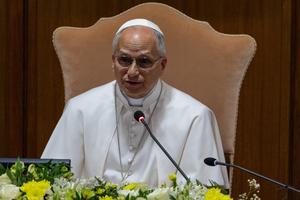
Vatican City - Pope Benedict is offering his thoughts on how the universe was created. Thursday, the Pope said God’s mind was behind the complex scientific theories such as the Big Bang, and Christians should reject the idea the universe was created by chance.
The Pope has rarely talked about specific scientific concepts such as the Big Bang, which scientists say caused the formation of the universe some 13.7 billion years ago.
The Pope added scientific theories on the origin and development of the universe and humans leave many questions unanswered.
And that’s all there is to this story, which was picked up and echoed in other locations in the mainstream media’s vast news echo chamber.
The dateline of the story, you will note, says “Vatican City,” and given journalistic praxis for datelines, that implies that the story was written by somebody in Rome, allowing this to fall under the “Eyewitness News” heading.
But not all eyewitnesses have eyes to see or wits to think—or ears to hear for that matter. And not all editors compose (or approve) headlines that accurately reflect the story.
I held back on commenting on this until the English translation of the homily was available, but even looking over the Italian original I was scratching my head, saying, “This doesn’t seem to say what the press accounts are saying it says.”
This story does have a nucleus of truth to it. Pope Benedict did give a homily for the feast of the Epiphany (when the Magi showed up, following the star) in which he reflected on the fact that God created the universe, but that’s got to be the ultimate dog-bites-man story, right? The pope describes God as the Creator? It’s not exactly like this story is without precedent.
But guess how many times Pope Benedict mentions the Big Bang in his homily?
That’s right! NONE!
And while it’s true that “The Pope has rarely talked about specific scientific concepts such as the Big Bang,” if by “rarely” you mean “not every single day,” you’d be right—though specific scientific concepts do come up rather often in papal statements (every time the Pope addresses the Pontifical Academy of Sciences . . . or the Pontifical Academy of Life . . . or the Pontifical Academy of Social Sciences . . . or, you get the picture. But the ironic thing is that on this occasion the Pope did not address any specific scientific concepts. Not the Big Bang (or anything else except for a mention of novas, which I’ll get to in a minute).
What he did was say was . . .
The universe is not the result of chance, as some would like to make us believe. In contemplating it, we are asked to interpret in it something profound; the wisdom of the Creator, the inexhaustible creativity of God, his infinite love for us.
We must not let our minds be limited by theories that always go only so far and that — at a close look — are far from competing with faith but do not succeed in explaining the ultimate meaning of reality. We cannot but perceive in the beauty of the world, its mystery, its greatness and its rationality, the eternal rationality; nor can we dispense with its guidance to the one God, Creator of Heaven and of earth.
This is hardly the Pope “challenging” the Big Bang. Not only does he not mention it, he acknowledges that scientific theories “always go only so far” and that some “are far from competing with the faith.” If anything, that would be an endorsement of the idea that the Big Bang is compatible with the Christian faith—a papal claim that is hardly without precedent.
While the Pope is certainly aware of the Big Bang, and while it forms part of the background to his remarks, his point is a more general one about the world arising from chance. This claim is not restricted to advocates of Big Bang cosmology. There have been people claiming the world is the result of randomness since ancient times and many advocates of non-Big Bang cosmologies have held the same. For that matter, apart from the question of how the cosmos first came into being, many advocates of biological evolution maintain that the world came to have its present form purely through chance. These theories also form part of the background to what the Pope said. It’s not just about the Big Bang, it’s about the world in general.
So . . . thanks to the media for covering this. It’s always good to get the message out about God being the Creator and him loving us and so forth. But could the message be communicated a little more clearly next time? Pretty please? With sugar on top?
Oh, and speaking of communicating the message clearly, a couple of thoughts for the folks responsible for getting the Pope’s homilies up on the Vatican web site (translators, web guys, whoever):
1) What’s the major international language these days? Hint: It’s not Italian.
It’s also not French, or Spanish, or even Chinese. It’s English. English has 450 million native and secondary speakers. It is an official or the majority language in fifty-seven countries (nearly twice that of its closest competitor, French, which has this distinction in 31 countries).
If you want to get the Pope’s message out to the world and avoid (or at least mitigate) him being misunderstood due to difficulty checking what he actually said, devote the resources needed to get his speeches on the web site in English in a timely manner! Don’t make us wait over a week, as in this case, by which time the media story has grown cold and sewn whatever misunderstandings it contained. Also . . .
2) Make sure that your translation into English is correct.
Because it isn’t always.
There have been any number of cases when people point to a sloppy translation that has been posted on the Vatican web site and come away with a misimpression. This is particularly bad because people will say—and often have said—“Hey, this is what it says on the Vatican’s own web site!” It’s understandable that they’d think that what they find on the Vatican’s web site is accurately translated, and they have every right to think that, because it should be.
But too often it’s not, and it creates a mess for those of us who are trying to help get the Vatican’s actual message out, in spite of mistranslations appearing on its web site.
So lest anybody be too sure that just because something appears on Vatican.va, it must be an accurate translation, consider this passage from the English version of Pope Benedict’s Epiphany homily:
And so we come to the star. What kind of star was the star the Magi saw and followed? This question has been the subject of discussion among astronomers down the centuries. Kepler, for example, claimed that it was “new” or “super-new”, one of those stars that usually radiates a weak light but can suddenly and violently explode, producing an exceptionally bright blaze.
These are of course interesting things but do not guide us to what is essential for understanding that star.
Here the Pope asks a question we’ve all wondered about: What was the Star of Bethlehem? He notes as an “example” (presumably one among several) an idea Kepler had and says it is “interesting” (which means he finds it interesting, not that he’s endorsing it as the truth), and all that’s fine.
What is not fine is the way whoever translated this rendered the Pope’s description of Kepler’s idea.
“NEW”????
“SUPER-NEW”???
You don’t have to have a doctorate in astronomy (or Italian) to recognize this for what it is: a mistranslation of nova and supernova.
I mean, just look at the Italian:
Keplero, ad esempio, riteneva che si trattasse di una “nova” o una “supernova” . . .
It’s got the words “nova” and “supernova” right there! And notice it doesn’t have a bare presentation of these words without the indefinite article (un, una = “a, an”). It’s got the indefinite article right in front of both nouns! That tells you these are nouns, not adjectives. “A nova,” not “new”; “a supernova,” not “super-new.”
The translation is so bad that one wonders if the Italian was plopped into a machine translation program or something. If so, it wasn’t Google’s, because that churns out:
Kepler, for example, believed that it was a “nova” or a “supernova” . . .
So, Google’s machine translation wins hands down on this one.
While even Homer nods, it is hard to imagine how such an obviously erroneous translation could be made by someone with a functional grasp of Italian and English, much less how it could survive any kind of review.
So, it’s not just the mainstream media that needs to shape up in how it presents the Pope’s message.
The Vatican’s translation service needs to, too.
Or that’s my opinion.
What do you think?


Comments
Post a Comment
Fr. Georges Lemaître S.J., father of the Big Bang theory, must be rolling in his grave right now at this opponent of the sciences ;).
Other news stories based on the same material came to exactly the opposite conclusion: God was behind Big Bang, universe no accident: Pope. This is less atrocious than the opposite interpretation, but still: not what he said. The reliable journalistic incompetence on reporting the pope’s words continues to boggle the mind.
Hi Jimmy,
fantastic job again!
Quick typo to edit: NBC’s station WTHR and ITS (NOT IT’S) “Eyewitness News” team . . .
Keep up the wonderful work.
Pax Christi
Cedric
Thanks! I hadn’t caught that one yet!
My pleasure. Please delete my comments they detract from the story.
You really should read up on Fr. George LeMaitre, the Jesuit priest who posed the Big Bang Theory. Not to mention the pope who loved the concept SO much he wished to proclaim it dogma til the good father talked him out of it. After all, it is just a theory.
Jimmy, please edit Cedric’s comment. A period is missing after the word “comments”. And of course capitalize the word “They”. Now what was this article about…
(just joshing)
I agree wholeheartedly about the need for meticulous editing. The pace with which online media flurry to be the first to publish a story has resulted in a deplorable lack of pride in one’s performance and the entity one represents.
I suppose Lisa is referring to Lemaitre’s work titled, “L’Hypothese de l’Atome Primitif” translated into English and titled, “The Primeval Atom Hypothesis”.
I shall enjoy reading it in French, Jimmy. Six years of French study and you popped my bubble with the fact that French is no longer the most used international (business) language. But the shiny side of that coin is I no longer have to feel guilty for not knowing how to “speaka Spanish” like Poppa always thought I should.
The translation of “nova” is even worse than you imagine. The Italian word for “new” is not “nova”, it’s “nuova”. “Nova” is the *Latin* word for “new”.
The translator had to go really out of his way to get this one wrong.
The Vatican needs to hire Jimmy as its English communications editor!
See if you can find the book “God and the Astronomers,” by Agnostic astronomer Robert Jastrow, the head of the JPL at the time.
He tells the history of the Big Bang theory, and how the people who opposed it were the Atheists—because if the universe had a begining, that implied that some Being began it. (As an Agnostic, not an Atheist, he had no horse in the race.)
I read somewhere that Father Georges Lemaitre (sp.?), the discoverer of the Big Bang, went on to head the Vatican observatory. I don’t know if that’s true.
Thank you Jimmy, for this. This is awesome. I hate how the press dumbs down anything the Holy Father says… and lumps Catholics in with Evangelicals when it comes to science. No—Catholics embrace reason so far as it leads to its edges, and that is where faith begins. The two are in harmony, not discord.
The press never seems to get it right. Too many cracks for information to fall through went it is passed on from person to person. Too many individual perceptions of what was actually said, and finally, a desire to sensationalize the story in order to sell papers creates falsehoods in the final print. This is based on my own personal involvement with what was reported about my participation in an incident that was reported in the OC Register back in 1979.
I like John Allen’s suggestion. Although he was referring to a different story (about Discovery Channel teaming up with the Vatican to do a program on exorcisms), his comment applies here as well as to many other articles on the Vatican:
**We live in a world of warning labels, on cigarette packages, slippery floors, rear-view mirrors, and on and on. Whatever one makes of that, if labeling is to be the rule of the day, I hereby propose that any news item with the word “Vatican” in the headline carry the following proviso: “Warning: The following story may be bunk.”**
http://ncronline.org/blogs/all-things-catholic/warning-labels-vatican-stories-especially-exorcism
This sort of thing is always a time where the usual debates about what constitutes science and what is fact and what is fiction come up. Particularly when it comes to the topic of cosmological evolution in this regard. While the Big Bang model is based on very good observations of the universe and the requirements for a beginning, as a model it is always open to question. In fact it would be better to abandon the Big Bang cosmological model as a whole, while retaining some things from it as even the Big Bang model, like all other scientific models accepted by consensus, will have had its time and will come to an end because of things that it cannot account for that are observable. Catholics should return back to the clear Word of God and the parameters of creation outlined in Genesis. It’s length of time (6 days), and order (earth was created before the stars etc.). These are part of clear revelation, though liberal thought today is to attempt to sideline it as merely poetic in order to compromise the Catholic Faith with secular philosophies despite that there isn’t a shred of scientific evidence to back them up.
Creationist efforts alongside those in the ID movement have exposed evolutionary explanations as being without merit and the intensity of biased reasoning practiced in scientific circles. Others try and make it seem as if it is just some ‘Evangelical Protestant thing’ in some vain effort to suck up to atheists who will never ever accept Christianity no matter how palatable you cut it up and disguise it for them. It’s time people started getting involved in the deception that’s been herelded upon us all for years, but those in the Catholic Church are too afraid at times and so as a result, the Curch fails in her mission in these instances. Fr. Lemaitre ought to be well respected for his contributions, but in the end, because he unwittingly diverted from the revealed truths that God Himself, the Creator, has given us in Scripture, like so many others, he is in the end wrong. And whereas God’s Word will always stand firm and unchanging, those clinging to scientific theories built on sand will soon find themselves adrift. When time does come for the Big Bang model to be discarded, one should not be surprised to find secularists blaming its long standing position on ‘dogmatic religious nutbags.’ Currently it’s still around because the secularists don’t have any better ideas aside from the Big Bang, but so long as it’s not necessarily about God (reinterpreted to fit whatever naturalistic delusion they wish to hold) and especially nothing to do with that dreaded Bible least it sound like it could all somehow be legitimate, it’ll do for now.
We must return back to God’s Word and conduct real science untampered by naturalist heresies. This is another way in which I wish Catholics would take up the charge instead of just leaving it to Protestants and dismissing the issue as some Protestant thing that we are exempt from. It affects us too, and we are losing souls because of it and heresy and immorality fester because of it.
Johnno, St. Augustine wrote specifically against the six-day creation being interpreted as a period 6 x 24 hours long. He specifically noted that talking like this was not only theologically iffy because it was never Jewish tradition that those “days” were literal 24-hour ones; but it also made Christians sound like ignoramuses who knew nothing about nature, and thus drove pagans away from Christianity and finding God.
(This was even more disturbing a charge because early Christians made it a point to study nature and the sciences, to know more of the works of God. It was a basic place to start when preaching to the pagans, because many philosophies and religions thought of nature as cruel and chaotic. Christians loved ordered science.)
So going back to basics is not what you’re advocating.
I wrote about this recently comparing Ken Ham’s and PZ Meyer’s opposing comments about the Big Bang:
http://www.acceptingabundance.com/2011/01/big-bang-and-primacy-of-reason.html
Great job Jimmy, If I was a gambling man, I would bet that someone who holds the Naturalism philosophy is behind the false reports. God Bless You and Keep up the good work. By the way, we heard you on 01/07/2011 on Catholic Answers. Great Show!
The “big bang” is a euphro—morphic—-construct to explain a scientific mystery. any words that must be used must be verified within the structure of that science.What I object to is the something that is not ‘beatifull”
Do not overestimate the position of English.
I live in London and if anyone says to me “everyone speaks English” my answer is “Listen and look around you”. If people in London do not speak English then the whole question of a global language is completely open.
The promulgation of English as the world’s “lingua franca” is impractical and linguistically undemocratic. I say this as a native English speaker!
Impractical because communication should be for all and not only for an educational or political elite. That is how English is used internationally at the moment.
Undemocratic because minority languages are under attack worldwide due to the encroachment of majority ethnic languages. Even Mandarin Chinese is attempting to dominate as well. The long-term solution must be found and a non-national language, which places all ethnic languages on an equal footing is essential.
As a native English speaker, my vote is for Esperanto :)
Your readers may be interested in http://www.youtube.com/watch?v=g2LPVcsL2k0
Dr Kvasnak teaches English at Florida Atlantic University.
The Esperanto study course http://www.lernu.net is now receiving 120,000 hits per month. That can’t be bad.
How many of these postings come form astrophysicists and how many from Catholic theologians? When official physics contradicts authoritative theology logically something must be wrong with one or the other. Physicists without exception agree the big bang is a theory and, therefore, can be wrong. To believe it theologians have to reject the ‘de fide’ teaching of Lateran IV which clearly states that all things spiritual and corporal were created by God altogether in there whole substance in the beginning from nothing. The compromise made by Catholic clerics to accommodate a non-Catholic scientific theory is self-evident, and further debate by orthodox Catholics should stop.
Peter
“When official(?) physics contradicts authoritative theology logically something must be wrong with one or the other.”
The two are independent and don’t influence the other. Theology can’t really contradict physics since it presents NO data or testable hypothesis to test.
“Physicists without exception agree the big bang is a theory and, therefore, can be wrong.”
This is true and true of all scientific theories! So what? In science theories are comphrehensive and over arching large scale explanation based on large bodies of data and observations and are PREDICTIVE - AND are subject to revison. Science advances and improves theories! They are never completely “proven” - just improved or overturned.
NOW - does theology discard its dogmas in the face of evidence? Nope.
Theologians don’t do science, or use the scientific method. They don’t present data (nor do they margins of error and degree of uncertainty), they don’t state any testable hypothesis.
For example: “Intelligent Design” is NOT a scientific theory - there is NO testable hypothesis ever stated and no experiental data by ID advocates. Its is a legal and political “theory” used to push creationism into science class.
I do appreciate the Pope’s and RCC’s interest in science in general.
The Visions of Catherine Ann Emmeric, used as a resource by Mel Gibson in “Passion of the Christ”,is a resource for this,too.
dch writes: “The two are independent and don’t influence the other. Theology can’t really contradict physics since it presents NO data or testable hypothesis to test.” This, of course should be the case, but once physics has trepassed onto theological ground it is no longer legitimate science. Catholic ‘de fide’ teaching on origins by Lateran IV, i.e. “Creation”, is metaphysics not physics it does not depend upon scientific data.
I think it is all very very funny and it is amazing any of us have been able to stay catholic, OR BECOME CATHOLIC!!!, inspite of the very excellent efforts inside and outside the church to keep us out or kick us out. I have no doubt about Christ’s promise that the gates of hell will not prevail against His Church. But clearly he wasn’t joking about the wheat and the chaff either.
Mr. Akin, thank you again for your insights and efforts to help us know what is going on with articles like this one. And for all the edifying columns as well. Your presentation of the information here is funny and serious at the same time. I think that is great. Good stuff.
Your blogger writes: “I think it is all very very funny and it is amazing any of us have been able
to stay catholic, OR BECOME CATHOLIC!!!, in spite of the very excellent
efforts inside and outside the church to keep us out or kick us out.”
Shouldn’t this unsigned remark give pause for thought. After all, it was written in the context of previously presented “de fide” Catholic teaching from two Councils (Lateran IV and Vatican I) that all things spiritual and corporal were created at the same time, in their whole substance, “ex nihilo” by God alone, i.e. without (evolutionary) secondary causes . It is these facts which seem to have elicited such mirth and amazement. Why? Presumably, because correctly undertstood they logically invalidate all belief in a “big bang” evolutionary explanation of origins defended by Mr Akin.
Peter
I don’t understand what you are saying Peter. “Ex Nihilo” doesn’t mean all matter was created in its final unchanging form. Or did I misunderstand what you are trying to say?
Stacy,Lateran IV as amplified by Vatican I says is very clear. Things created in their whole substance are unchangeable in their essence. They can adapt to environmental conditions (micro-evolution) but not develop into another species (macro-evolution). Creation from nothing means the prototype of a species or kind was instantly produced in all its parts. There was no subsequent transformation into another different kind. Creation is instantaneous and new essences or beings by definition can only be produced by God during the period of creation. The theological definition of creation is “creatio : productio rei ex nihilo sui et subjecti (“creation : production of a thing out of nothing of form and matter”). Traditional Creation theology and metaphysics leave no margin for evolution theory.
Peter
Twenty-first century science supports the fact that “Traditional Creation theology and metaphysics leave NO margin for evolution theory” as described by Peter Wilders. The new data even challenges the claims of long ages of 4.5 billion years for the age of the earth [mentioned in one of the Internet references] as well of course the Big Bang Hypothesis as those billions of years needed for the evolution of the universe, solar system and evolution of life do not seem to even exist. Some of the many discoveries include: (1) The 65 million years between man and dinosaur do not exist based on C-14 analysis alone for dinosaur bone collagen and therefore no evolution of man from lower forms of life http://www.dinosaurc14ages.com/ REF: Peer reviewed technical paper in the book, “Evolution: The Decline of an Hypothesis,” published in Italian and edited by the VP of the National Research Council of Italy (CNR), Nov. 2009, Dr. Roberto de Mattei, historian and editor. (2) The discovery of collagen and soft tissue and reported in March 2005 of Science Mag. by Jack Horner and Mary Schweitaer, both evolutionists, caused a major problem for main stream scientists as such biological chemicals should not have lasted more than 30,000 to 100,000 years let alone 65 million. (3) To see how sediments form [now sedimentary rock strata] and how fast they were deposited visit this site http://www.sedimentology.fr/ . Space and time do not allow for a listing of the many other 21st century scientific discoveries and arguments that make the hypothesis of macroevolution an impossibility so the above should give pause. Thus science is quickly catching up with Christ and Church fathers so please do not ignore what Christ and his church fathers taught about our creation. You do so at the risk of deceiving yourself and others with the wisdom of worldly men who deny the word of God; that may not sit very well with our Creator and Redeemer.
Has anyone seen the new movie The Genesis Code? Its whole thesis is that Science and faith are not incompatible. I am not sure of the science in the movie, because I was caught up in the relationship plots between the characters, but I liked the idea of a Hollywood movie that allows for people of faith and people in the field of science to work together for answers. I loved the movie, and thought the way it addressed Creation vs. Evolution to be worth discussion.
Thanks T. Bensom for the alert about the movie The Genesis Code. I did not see it but might do so if I can find it. Here is a review that might be of interest to you. See if you can reconcile what you remember about it with what Mr. Rowland said about it. http://www.answersingenesis.org/articles/2010/10/05/review-genesis-code Of course he wrote this for a non-Catholic organization that is biased toward the literal sense of the Bible and do stick to Genesis 1-11 as did our church fathers so you can judge for yourself. Of course as a research chemist myself who has seen the evidence first hand for Creation against the evolution and the Big Bang and those mysterious 15 billion years that don’t seem to exist if must side with the church fathers as I did in my previous commentary.
Is anyone familiar with Fr. Stanley Jaki’s writing? I posted about his work “The Savior of Science” today.
The idea that Lateran IV ruled out evolution is—at the very least—not the way it’s traditionally been interpreted. Even Aquinas (who certainly would have known of and followed Lateran IV’s definitions!) allowed that “But many things were made after the seventh day, as the production of many individual beings, and even of certain new species that are frequently appearing, especially in the case of animals generated from putrefaction.” and “Species, also, that are new, if any such appear, existed beforehand in various active powers; so that animals, and perhaps even new species of animals, are produced by putrefaction by the power which the stars and elements received at the beginning. Again, animals of new kinds arise occasionally from the connection of individuals belonging to different species, as the mule is the offspring of an ass and a mare; but even these existed previously in their causes, in the works of the six days.” (Summa Theologica, Question 73)
So all that is required is that the *means by which new species arise* be original—part of the laws of nature—which is of course allowed for by evolutionary theory.
And Aquinas’ Aristotelian concept of species is if anything broader than the modern biological concept.
Francis Miller’s point that St. Thomas allowed for Your objection is answered by the opening words of Summa Theologica, Question 73: “Nothing entirely new was afterwards made by God, but all things subsequently made had in a sense been made before in the work of the six days. Some things, indeed, had a previous experience materially, as the rib from the side of Adam out of which God formed Eve; whilst others existed not only in matter but also in their causes, as those individual creatures that are now generated existed in the first of their kind
Although biologists at the the time of St. Thomas were unaware of the impossibility of spontaneous generation (www.noevolution.org) he saw the necessity of safeguarding the Catholic teaching of Lateran IV by attributing the first cause of the beings generated to the period of creation.
The Lateran Iv dogma properly understood precludes any form of macroevolution.
Peter
CORRECTION OF PREVIOUS POST. Francis Miller’s point that St. Thomas allowed for new species after the creation period is answered by the opening words of Summa Theologica, Question 73: “Nothing entirely new was afterwards made by God, but all things subsequently made had in a sense been made before in the work of the six days. Some things, indeed, had a previous experience materially, as the rib from the side of Adam out of which God formed Eve; whilst others existed not only in matter but also in their causes, as those individual creatures that are now generated existed in the first of their kind
Although biologists at the the time of St. Thomas were unaware of the impossibility of spontaneous generation (www.noevolution.org) he saw the necessity of safeguarding the Catholic teaching of Lateran IV by attributing the first cause of the beings generated to the period of creation.
The Lateran Iv dogma properly understood precludes any form of macroevolution.
Peter
To Stacey et al: I’ve read one of Fr. Jaki’s little booklets on Julian the apostate which I found fascinating and highly recommend it: To Rebuild Or Not To Try? Here’s a short description: “Although our big newspapers report only on occasion about efforts aimed at rebuilding the TempIe in Jerusalem, those efforts are more intensely planned than one may suspect. In none of those reports does one find even a vague allusion to a monumental failure of a major effort, initiated by none other than Julian the Apostate in January 363. The enterprise, which energized Jewish enthusiasm, had to be aborted no sooner than it had begun. The reason was a series of events, truly miraculous when taken together: earthquake, violent winds, eruption of fire from the ground, and the spectacular appearance of a cross in the sky. Most educated Catholics do not seem to be aware of all this. Yet the historical evidence is beyond any dispute. The documents are presented here concisely and meticulously by a Catholic scholar, internationally known for his books on the relation of science and faith.” By Fr. Stanley L. Jaki $3.00
But my problem with Fr. Jaki is that he could talk about miracles like the above but on the other hand prefered the Big Bang theory and simply ignores the words of God in Genesis 1-11. Why? Perhaps some priests are more interested in telling God how He created the world than accepting how He told us in Genesis 1-11 as well as prefering the company of fellow cosmologists. If Fr. Jaki were alive today I would urge him to consider the simple scientific explantion found on several threads in Catholic Answers forum on how we all got here, namely: IDvolution - God “breathed” the super language of DNA into the “kinds” in the creative act. Contact “Buffalo” Jim at fitting@flash.net for details. I might also ask Fr. Jaki why do scientists keep finding fossils such as dinosaurs with organic chemicals in them like collagen where none should be if dinos were as old as 68 million years and there had been a Big Bang and we evolved from star dust? Perhaps this little jingle tells it all about the paleontologist Jack Horner of Museum of the Rockies:
Big Jack Horner sat in a corner
scraping a dinosaur bone.
Some soft tissue appeared
And he said, “Just what I feared!
Evolution’s long ages are gone!”
IDvolution - God “breathed” the super language of DNA
into the “kinds” in the creative act.
This accounts for the diversity of life we see. The core makeup shared by all living things have the necessary complex information built in that facilitates rapid and responsive adaptation of features and variation while being able to preserve the “kind” that they began as. Life has been created with the creativity built in ready to respond to triggering events.
Since it has been demonstrated that all living organisms on Earth have the same core, it is virtually certain that living organisms have been thought of AT ONCE by the One and the same Creator endowed with the super language we know as DNA that switched on the formation of the various kinds, the cattle, the swimming creatures, the flying creatures, etc.. in a pristine harmonious state and superb adaptability and responsiveness to their environment for the purpose of populating the earth that became subject to the ravages of corruption by the sin of one man (deleterious mutations).
Sorry not to reply sooner, I’ve had a baby and surgery since my first response! :-)
To Peter and Hugh: I started studying Fr. Jaki after my first course in a graduate theology distance learning program from Holy Apostle’s College and Seminary. His book “The Savior of Science” was required reading on the International Catholic University course “Philosophy for Theologians”. I am only in my second and third courses now so that is the extent of my theological training. I certainly don’t intend any heresy, as I’m simply trying to understand the points being made.
Here’s my understanding of what Jaki was saying, or would say. Evolutionary theory is only that, and if it is to remain in the realm of *science* as it should remain, it only refers to a physical process by which each offspring is genetically different from its parents and thus responds slightly differently to its environment. Since these things (genetic mutation and natural selection, however poor those terms are at describing anything) are potentially observable and quantifiable, the theory is a valid *scientific* theory.
However, it is not, can not, and never should be taken for the atheistic materialist ideology that modern science, with the agenda to deny God the Creator, tries to turn evolutionary theory into. That is *not science.*
His point was more to insist that scientists remain limited to what science is, and stop trampling on metaphysical or theological matters where science cannot go. He was, in painful detail, very insistent too on the failings of evolutionary theory and cosmology to adequately explain much at all of how we have arrived at our present state in the world.
His views of Genesis were that it cannot be taken fully literally, that the entire Bible cannot be taken fully literally as many times things were written clearly to be metaphor, analogy or parable.
Consider this: When the author of Genesis writes in Chapter 3 of Adam and Eve, “And the eyes of them both were opened: and…they perceived themselves to be naked,” are we really to believe that they lived with their eyes closed before this moment? Or are we to take that statement figuratively?
What I learned from Jaki is that part of the message of Genesis is that God is Creator, and God could only have created all material things to be perfectly ordered as He intended them, and to change as He intended them to change from the very beginning. I just don’t think we humans yet know what that means fully.
Stacy’s objectivity is refreshing. He mentions Fr. Jaki who was highly respected as a philosopher of science, particularly within the Church. He was a convinced evolutionist and because of his elevated position in academia attracted the majority of the Catholic hierarchy to think likewise. He was so wedded to the idea of evolution that he said, in a taxi we shared, that whatever the proof against evolution he would continue to believe in it. This attitude seems to be reflected in the words Stacy uses in his regard: “ He was, in painful detail, very insistent too on the failings of evolutionary theory and cosmology to adequately explain much at all of how we have arrived at our present state in the world.” The last phrase: “to adequately explain much at all of how we have arrived at our present state in the world” doesn’t show he doubts evolution, but its failure adequately to explain the result of man’s evolution from primitive matter to us today. Fr Jaki, therefore, although with reservations as to the way it is taught, accepts the principles of cosmic and biological evolution. In so doing this celebrated Catholic academic exhibited total support for ideas in flagrant contradiction to the Church’s magisterial teaching in Lateran IV. Once on the slippery slope as to what should be taken literally to accommodate a theory opposed to Catholic teaching, and what not, sacred Scripture is the first casualty. - Peter
I think the “Big Bang Theory” is a lot of nonsense masquerading as science. It is not a product of the Scientific Method. It is the results of scientists speculating, and anyone can speculate.
I can’t understand why so many seem reluctant to challenge scientists when they step outside the real of hard science which can be proved, repeated and falsified. Scientists speculating makes lousy science, and I am here to point that out.
http://catholiceducation.org/articles/science/sc0022.html
Before Catholics jump the gun in accepting and chomping down on Big Bang/Baloney they should take a good look at the very solid Church, Sacred Scripture, Tradition AND scientific case against it. It is quite powerful and convincing indeed. See for example www.galileowaswrong.com, www.galileowaswrongblogspot.com, http://www.scripturecatholic.com/geocentrism.html, and http://geocentrism.com/. The following are the informative and wise words which one Ph.D. from the Massachusetts Institute of Technology had to say about Big Bang and the work of Dr. Sungenis and Dr. Bennett seen in their book Galileo Was Wrong and the Church was Right (found at www.galileowaswrong.com): ” Once upon a time, there was a big bang. It filled the sky with debris that formed into stars and planets. One planet developed a special slime that brought forth plants, animals, and men. The men became wise and discovered the truths of the universe. Or did they? Fairy tales have their place, but they should not be confused with science. Why has speculation come to replace observation as the basis of science? Galileo Was Wrong takes a critical look at the thesis that the Earth is flying through space. Here you will find a thorough review of the scientific observations along with a review of the scientists themselves. You will see how their unquestioning support of the thesis led them to redefine the nature of the universe. You will have the evidence to make up your mind for yourself. Robert Sungenis and Robert Bennett have done a great service to science and to men of good will. Those who see the universe as the handiwork of the benevolent God need no longer be subservient to fairy tales.”
The big bang theory is challenged with every new discovery of fact. The theory is so weak scientists refer to the starting point of this theory as an accidental event in order to promote their own ideas like membrane theory and multiple universe theory. By every right the Pope should challenge the notion of an accidental beginning as well as the notion of an explosion as ‘Gods big creative moment’. There is little or no creativity in an explosion. Rather, the beginning of the expansion of our universe was the result of a central core of matter that was chipped apart by electric discharges from a surrounding plasma field. The tiny pieces took off, spinning and unfolding into the ubiquitous galaxies we see today. The black holes found in the center of most galaxies are the remnant of the tiny pieces and the stars are what came out of them. In a similar fashion, planets come right out of the stars they orbit. Sun spots are evidence of this process. At the moment planets are ejected from a star, heavy elements are created. Scientist shy from the word creation and instead use the word ‘formed’. That is a very misguided road they have taken. If not from the challenge from the Pope, the recent discoveries of planets outside our solar system will mark the end of the big bang/accretion theory. They are finding many planets that do not fit into to big bang theory, and they will find many more.
Jet Thomson’s has a right to his belief regarding the origin of the universe, but it is diametrically opposed to the Church’s magisterial teaching in Lateran IV and Vatican I. Which declare that all things were created by God alone (no second causes, i.e. no macro-evolution)from nothing in their entire substance at the same time (“simul”). The choice is his. God’s “de fide” teaching or his belief.
Peter
Post a Comment
By submitting this form, you give The National Catholic Register permission to publish this comment. Comments will be published at our discretion, and may be edited for clarity and length. For best formatting, please limit your response to one paragraph and don't hit "enter" to force line breaks.