9 things you need to know about Pope Francis's inaugural Mass

On Tuesday, March 19, Pope Francis will participate in his inauguration Mass.
If he hasn't been inaugurated, is he pope yet?
If he is pope, why is this called is "inauguration" Mass?
Here are 9 things you need to know.
1. Is Pope Francis already Pope, if he isn't "inaugurated"?
Yes. According to the Code of Canon Law:
Can. 332 §1. The Roman Pontiff obtains full and supreme power in the Church by his acceptance of legitimate election together with episcopal consecration. Therefore, a person elected to the supreme pontificate who is marked with episcopal character obtains this power from the moment of acceptance. If the person elected lacks episcopal character, however, he is to be ordained a bishop immediately.
This means that if the man elected pope is already a bishop (as Pope Francis was) then he becomes pope from the moment he accepts his election.
That happened during the conclave, and so Pope Francis is already, truly the pope.
2. Then why is he having an "inaugural Mass"?
Although "Mass of inauguration" or "inaugural Mass" is a common way of describing this event, it does not mean that he gains any office, power, or authority with this Mass.
It's just a way of commemorating his entrance into office--rather like an inaugural ball held after someone becomes president, except it is a sacred rather than a secular celebration.
3. How did this rite develop?
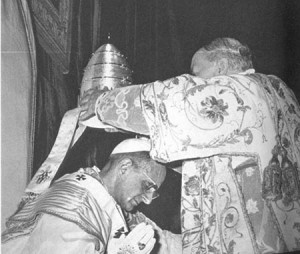 A form of inauguration Mass has been conducted for many centuries.
The early history of this rite is unclear, we know that by 1143, when Pope Celestine II was inaugurated, part of the celebration was the crowning of the new pope with a tiara (triregnum), a kind of three-level crown symbolizing the pope's authority to rule.
This became a fixed part of the rite until the inauguration of Pope Paul VI, who was the last pope to be so-crowned (see picture).
When John Paul I was elected, he omitted the crowning.
Subsequent popes have followed his lead.
4. Why have the recent popes not been coronated?
In his own inauguration Mass, Pope John Paul II explained:
In past centuries, when the Successor of Peter took possession of his See, the triregnum or tiara was placed on his head. The last Pope to be crowned was Paul VI in 1963, but after the solemn coronation ceremony he never used the tiara again and left his Successors free to decide in this regard.
Pope John Paul I, whose memory is so vivid in our hearts, did not wish to have the tiara; nor does his Successor wish it today. This is not the time to return to a ceremony and an object considered, wrongly, to be a symbol of the temporal power of the Popes [N.B. that John Paul II emphasizes that seeing the papal tiara as a symbol of temporal or worldly power is a misunderstanding--ja].
Our time calls us, urges us, obliges us to gaze on the Lord and immerse ourselves in humble and devout meditation on the mystery of the supreme power of Christ himself. . . .
The Second Vatican Council has reminded us of the mystery of this power and of the fact that Christ's mission as Priest, Prophet-Teacher and King continues in the Church.
Everyone, the whole People of God, shares in this threefold mission.
Perhaps in the past, the tiara, this triple crown, was placed on the Pope's head in order to express by that symbol the Lord's plan for his Church, namely that all the hierarchical order of Christ's Church, all "sacred power" exercised in the Church, is nothing other than service, service with a single purpose: to ensure that the whole People of God shares in this threefold mission of Christ and always remains under the power of the Lord; a power that has its source not in the powers of this world but in the mystery of the Cross and Resurrection.
5. If the coronation is gone, what will happen in this Mass?
There are several noteworthy things that are expected to happen:
- The pallium will be imposed upon (i.e., put on) Pope Francis.
- He will be given the Fisherman's ring
- All of the cardinals who are present will pay homage to the pope.
6. What is the pallium?
The pallium is a special kind of vestment worn by the pope, though it is also given by the pope to metropolitans and primates as well.
It takes the form of a long strip of cloth that is worn around the neck, though its precise form has varied in recent years.
Pope Benedict XVI initially wore a pallium that was based on older designs, but later he changed to a pallium of more recent design.
He also famously left the older-style pallium on the casket of Pope Celestine V, an early sign that he was thinking about papal resignations.
Click here for more information about the pallium.
7. What is the Fisherman's Ring?
The Fisherman's Ring is another symbol of his office, and it is unique to each pope.
They destroy or disfigure the previous pope's ring.
This is because the Fisherman's Ring is a signet ring--that is, one used (in theory) to place seals on documents, indicating that they are authentic and have been authorized by the pope.
Destroying or disfiguring the ring would prevent it from being used to forge documents in the former pope's name.
Today this is of ceremonial rather than practical significance since they no longer use the Fisherman's Ring to seal documents, which are authenticated in other ways.
It is called the "Fisherman's" Ring in honor of St. Peter, who was a fisherman.
Click here to learn more about the Fisherman's Ring.
8. Didn't the cardinals already make an act of obedience to the pope back during the conclave?
Yes, but now they will make one publicly, for everyone to see. Papal Master of Ceremonies, Msgr. Guido Marini, explains:
Then regarding the celebration of the inauguration of the ministry of the Bishop of Rome, the act of “obedience” will be made by all the cardinals present at the concelebration.
Thus the act made by the cardinal electors in the Sistine Chapel immediately after the election regains a dimension that is also public and remains open to all the members of the College of Cardinals, while at the same time acquiring a character of catholicity.
9. What happens after the inaugural Mass?
The inaugural Mass is one of several celebrations prescribed in the Church's liturgical book for the beginning of a new papal ministry.
This is known as the Ordo Rituum pro Ministerii Petrini Initio Romae Episcopi (Order of the Rites for the Beginning of the Petrine Ministry of the Bishop of Rome), which was published in 2005 by Pope Benedict.
The USCCB's Committee on Divine Worship notes [.pdf]:
Texts are also provided for the new pope’s first visits to his Basilicas in Rome.
In the days following the Inauguration, he visits the tomb of Saint Paul, Apostle to the Gentiles, at the Basilica of St. Paul Outside the Walls.
Later, he is seated on the cathedra as the new Bishop of Rome during a celebration of the Eucharist at Rome’s cathedral, the Archbasilica of St. John Lateran.
Finally, he completes the rites by visiting the Basilica of St. Mary Major to venerate the icon of the Blessed Virgin Mary, “Salus Populi Romani” (“Protectress of the Roman People”), which is given great devotion by the Roman people and by popes throughout the ages.
Pope Francis has already visited St. Mary Major and venerated the Salus Populi Romani icon, so he may not do this a second time.
If so, he's already altered the expected rites (as is his right as pope), and there might be other surprises.
What Now?
If you like the information I've presented here, you should join my Secret Information Club.
If you're not familiar with it, the Secret Information Club is a free service that I operate by email.
I send out information on a variety of fascinating topics connected with the Catholic faith.
In fact, the very first thing you’ll get if you sign up is information about what Pope Benedict said about the book of Revelation.
He has a lot of interesting things to say!
If you’d like to find out what they are, just sign up at www.SecretInfoClub.com or use this handy sign-up form:
Just email me at [email protected] if you have any difficulty.
In the meantime, what do you think?