10 Things You Need to Know About Jesus’ Transfiguration
What happened at the mysterious event known as the Transfiguration? What did it mean?

The Transfiguration of Our Lord is hard to understand. Why did it happen? What did it mean?
Here are 10 things you need to know.
1. What does the word “transfiguration” mean?
The word “transfiguration” comes from the Latin roots trans- (“across”) and figura (“form, shape”). It thus signifies a change of form or appearance.
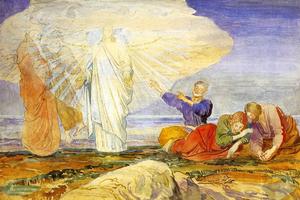
This is what happened to Jesus in the event known as the Transfiguration: His appearance changed and became glorious.
Before looking at the Transfiguration itself, it's important that we look at what happened immediately before it in Luke's Gospel.
2. What happened right before the Transfiguration?
In Luke 9:27, at the end of a speech to the 12 apostles, Jesus adds, enigmatically:
There are some standing here who will not taste death before they see the kingdom of God.
This has often been taken as a prophecy that the end of the world would occur before the first generation of Christians died out.
The phrase “kingdom of God” can also refer to other things, though, including the Church — the outward expression of God's invisible kingdom.
The kingdom is embodied in Christ himself and thus might be “seen” if Christ were to manifest it in an unusual way, even in his own earthly life.
3. Did such a manifestation occur?
Yes, and it is the very next thing that Luke relates: the Transfiguration.
Pope Benedict states that it has been...
...convincingly argued that the placing of this saying immediately before the Transfiguration clearly relates it to this event.
Some—that is to say, the three disciples who accompany Jesus up the mountain—are promised that they will personally witness the coming of the Kingdom of God 'in power.'
On the mountain the three of them see the glory of God’s Kingdom shining out of Jesus. On the mountain they are overshadowed by God’s holy cloud. On the mountain—in the conversation of the transfigured Jesus with the Law and the Prophets—they realize that the true Feast of Tabernacles has come. On the mountain they learn that Jesus himself is the living Torah, the complete Word of God. On the mountain they see the 'power' (dynamis) of the Kingdom that is coming in Christ (Jesus of Nazareth, vol. 1, p. 317).
We thus may have the key to understanding Jesus' mysterious statement just before the Transfiguration. He wasn't talking about the end of the world. He was talking about this.
In fact, Luke notes that the Transfiguration took place “about eight days after these sayings,” thus stressing its proximity to them and suggesting that it was the fulfillment of this saying, concerning the fact that some of them would see the kingdom of God. Mark gives a different number of days, saying it was “after six days” (Mark 9:2), but these both approximate a week.
4. Who witnessed the Transfiguration?
The three who are privileged to witness the event are Peter, James and John, the three core disciples. (Andrew was not there or not included.)
The fact that Jesus only allowed three of his disciples to witness the event may have sparked the discussion which swiftly ensued about which of the disciples was the greatest (Luke 9:46).
Click here to watch a video about how Jesus answered this question.
5. Where did the Transfiguration take place?
Luke states that Jesus took the three “on the mountain to pray.”
This mountain is often thought to be Mount Tabor in Israel, but none of the gospels identify it precisely.
Click here to learn more about Mount Tabor (though be aware that the gospels do not actually say which mountain it was).
6. Why did the Transfiguration take place?
The Catechism explains it this way:
Christ’s Transfiguration aims at strengthening the apostles’ faith in anticipation of his Passion: the ascent onto the 'high mountain' prepares for the ascent to Calvary.
Christ, Head of the Church, manifests what his Body contains and radiates in the sacraments: ‘the hope of glory’ [CCC 568].
7. What does Luke (in particular) tell us about this event?
Luke mentions several details about the event that the other evangelists do not:
- He notes that this happened while Jesus was praying.
- He mentions that Peter and his companions “were heavy with sleep, and when they wakened they saw his glory and the two men who stood with him.”
- He mentions that Peter made his suggestion to put up booths as Moses and Elijah were departing.
8. Why do Moses and Elijah appear on the mountain?
Moses and Elijah represent the two principal components of the Old Testament: the Law and the Prophets.
Moses was the giver of the Law, and Elijah was considered the greatest of the prophets.
The fact that these two figures “spoke of his departure, which he was to accomplish at Jerusalem” illustrates that the Law and the Prophets point forward to the Messiah and his sufferings.
This foreshadows Jesus' own explanation, on the road to Emmaus, of the Scriptures pointing to himself (cf. Luke 24:27, 32).
9. Why was Peter’s suggestion misguided?
The fact that Peter's suggestion occurs when Moses and Elijah are preparing to depart reveals a desire to prolong the experience of glory. This means Peter is focusing on the wrong thing.
The experience of the Transfiguration is meant to point forward to the sufferings Jesus is about to experience. It is meant to strengthen the disciples faith, revealing to them in a powerful way the divine hand that is at work in the events Jesus will undergo. This is why Moses and Elijah have been speaking “about his departure, which he was to accomplish at Jerusalem.”
Peter misses the point and wants to stay on the mountain, contrary to the message the two heavenly visitors have been expounding.
As a seeming rebuke of this, a theophany occurs: “A cloud came and overshadowed them; and they were afraid as they entered the cloud. And a voice came out of the cloud, saying, ‘This is my Son, my Chosen; listen to him!’”
10. What can we learn from this event?
The Transfiguration was a special event in which God allowed certain apostles to have a privileged spiritual experience that was meant to strengthen their faith for the challenges they would later endure. But it was only a temporary event. It was not meant to be permanent.
In the same way, at certain times in this life, God may give certain members of the faithful (not all of the faithful, all the time), special experiences of his grace that strengthen their faith.
We should welcome these experiences for the graces they are, but we should not expect them to continue indefinitely, nor should we be afraid or resentful when they cease.
They may have been meant only as momentary glimpses of the joy of heaven to sustain us as we face the challenges of this life, to help strengthen us on the road that will — ultimately — bring us into the infinite and endless joy of heaven.
What Now?
If you like the information I’ve presented here, please subscribe to my YouTube channel:
This article originally appeared Feb. 21, 2013, in the Register.
- Keywords:
- transfiguration
- transfiguration of jesus