School Choice Movement Seeks to Build on a Decade of Gains in 2026
With a federal tax credit launching and state programs expanding, supporters say 2026 could mark another turning point for school choice.
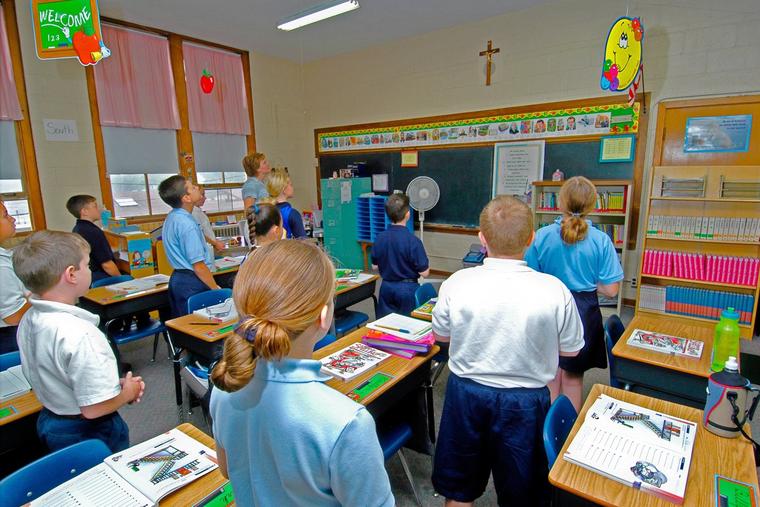
School choice has stacked up wins over the past decade, and leaders of the movement are hoping to keep the momentum building in 2026 at both the state and federal levels.
A top priority is increasing state participation in an unprecedented federal program that could provide millions of children across the country with school choice assistance, including scholarships to attend Catholic schools.
Passed as part of 2025’s “One Big Beautiful Bill Act,” the Federal Education Freedom Tax Credit Program uses tax credits to raise money for scholarship-granting organizations (SGOs), which in turn disperse funds to eligible families. The program begins Jan. 1, 2027, but the enrollment period is live now, with 27 states having already formally opted in since the start of 2026.
School choice advocates are describing the program as nothing short of a “game changer.”
“We have seen incredible demand for school choice programs across the country and believe this Education Freedom Tax Credit represents an inflection point in the education reform movement,” said Patrick Graff, a senior fellow with the American Federation for Children, the country’s largest school choice advocacy group.
Meanwhile, school choice is poised to gain ground at the state level as well. While the movement may not add any new states in 2026, advocates are optimistic about expanding programs in places that already have school choice, like Iowa and Kansas.
And a new program in Texas that provides families with cash assistance for approved school choice expenses has already received more than 100,000 statewide applications since Feb. 4.
Claudia Saucedo, 49, a mother of 6 from the Diocese of El Paso, says her family has applied. She told the Register she hopes to use funds from the Texas Education Freedom Account program to help pay for tuition for her three children in Catholic schools, allowing her family to afford things they’ve previously had to pass on, like school activity fees.
“Catholic education has always been in the forefront of our family,” she said. “Having this opportunity to receive such great financial help is just a big blessing. We’re happy to be able to partake.”
Building on Momentum
The school choice movement’s momentum heading into 2026 underscores just how far the cause has come in recent decades, and also what may soon be within reach.
“Once legislators and the public see that these programs are a positive for their state, the guards come down and [the programs] are generally accepted and embraced,” said Shawn Peterson, president of Catholic Education Partners, an advocacy group focused on expanding access to Catholic schools.
Long championed by Catholic leaders as a concrete way to apply Church teaching that parents have a right to provide an education for their children that corresponds with their convictions, school choice has made significant gains since the first program was launched in Wisconsin in 1990.
Today, there are 75 programs in 35 states, the District of Columbia, and Puerto Rico, serving 1.5 million children, according to EdChoice, a national school choice organization. Much of the progress has occurred in just the past five years, with 17 states passing new or expanded programs over that period. Public opinion has largely tracked, with 71% of voters backing school choice, according to an August 2024 poll by Real Clear Opinion Research.
“There is still much work to be done, but educational choice and freedom are here to stay,” said Peterson.
Challenges Remain
That being said, advocates acknowledge that there are still political obstacles to continued growth.
For instance, so-called blue states tend to oppose school choice on the grounds that it siphons money away from public schools, an argument that advocates dispute. That dynamic seems to be playing a role in who has and hasn’t opted in to the new federal program.
Of the 27 states that have enrolled, all but Colorado and New Hampshire went “red” in the 2024 presidential election. Meanwhile, two of the three states that have officially opted out — Oregon and New Mexico — went blue. The third, Wisconsin, voted for Republican President Donald Trump in 2024 but is currently led by a Democrat governor, who has said he will not enroll the Badger State in the federal program.
The remaining 20 states, most of which are controlled by Democrats, have not indicated whether they will opt in or not. And school choice advocates say the time is now for Catholic and other families to let their voices be heard.
“The Education Freedom Tax Credit will be a game changer for K-12 education, and it is critical that parents make it known to their governors how important this new tax credit is for education in their community,” said Graff.
In some cases, however, it can be local Republicans who pose the biggest obstacle to school choice. In Mississippi, for instance, the GOP-controlled senate killed a proposal to establish the Magnolia State’s first school choice program earlier this month.
“Our focus must remain on strengthening public education,” Lt. Gov. Delbert Hosemann, a Catholic who also serves as president of the senate, told local media after the result.
The Wall Street Journal’s editorial board took Hosemann and Mississippi’s Republicans to task for “invest[ing] more in the status quo” and threatening the state’s recent education gains.
Peterson pointed out that the Mississippi lieutenant governor’s current stance differs from that of other Catholic Republican leaders, such as Governor Greg Abbott of Texas and Governor Ron DeSantis of Florida, who have been great champions of school choice. He expressed hope that Hosemann would reconsider his position and allow the school choice measure back into play at some point during Mississippi’s legislative session.
Still, school choice is on the move in other states. In Kansas, the house passed an expansion of the state’s tax credit scholarship program, while in Iowa, a $4,000 education tax credit is scheduled for a hearing in a subcommittee. School choice proposals are also live in West Virginia, Kentucky, Utah and Oklahoma.
A Higher Purpose
For Catholic school choice advocates, the movement is about making America’s education system more just.
“As a result of explicit discrimination and exclusion from public funding throughout our country’s history, our education system has stacked the deck against Catholic schools since the mid to late 1800s,” said Graff. “Rectifying this issue must continue to be a national priority for the Church and her bishops.”
Advocates say that programs like the Federal Education Freedom Tax Credit provide a practical way of addressing the problem. Once states opt in, taxpayers can donate to approved SGOs in return for a tax credit of up to $1,700. The SGOs, in turn, distribute scholarships for state-approved education expenses, including Catholic school tuition. Students are eligible if their household income is no more than three times greater than the gross median income of their area.
EdChoice estimates that over 83% of American students could benefit from the scholarships, while the advocacy group Education Reform Now projects that more than $24 billion a year could be raised annually through the program.
Peterson added that helping Catholic families access these kinds of programs is another critical part of the equation.
“It is one thing to do all of the work of advocating and passing these programs, but if you don’t seize the opportunity they present, what is the point?” he said.
As models, the Catholic Education Partners director pointed to dioceses in Florida and Arizona where nearly 100% of families in Catholic schools participate in school choice programs. In Florida in particular, high levels of school choice participation have been linked with a national-trend-defying 12% increase in the state’s Catholic school student population from 2015 to 2025. During that same period, Catholic school enrollment nationally fell by 13%.
For Peterson, the point isn’t about filling seats, but allowing more students to experience what takes place in a Catholic school classroom.
“The more children you have attending a great Catholic school, the more opportunity you have to evangelize, reverse disaffiliation and create future saints,” said Peterson, “which is, of course, the ultimate goal of a Catholic education.”
- Keywords:
- school choice
- #wearen2016
- catholic education