Red Mass Honors Judge Roll
Bishops and fellow lawyers recall the Catholic faith and judicial legacy of the Tucson shooting victim.
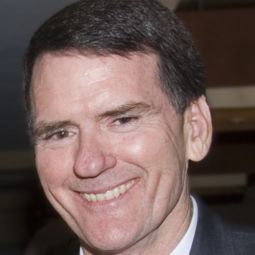
PHOENIX (CNS) — The scores of lawmakers, attorneys and public officials who gathered at St. Mary’s Basilica for the annual Red Mass Jan. 18 had more on their mind this year than the opening of the legislative session.
At the front of the mission-style church in the heart of downtown Phoenix stood a large portrait of John Roll, who until Jan. 8 was chief judge of the U.S. District Court for Arizona. He was one of the six victims killed in the Tucson shooting rampage that left 13 others wounded, and his absence was keenly felt by those at the basilica who knew him.
Roll, 63, was a frequent attendee at the Red Mass and was scheduled to offer the intercessory prayers.
Alan Tavassoli, president-elect of the St. Thomas More Society, recognized the life of Roll in his opening remarks before the Mass.
“It is with great sadness that we mourn the passing of this great and humble servant of God,” Tavassoli said. “Lawmakers and seekers of justice will feel the loss of his presence for many years to come.”
Tavassoli compared Roll’s faith to that of the patron saint of the legal profession.
“His quiet example of abiding faith with its warmth is especially relevant in our society today, as it was in the time of St. Thomas More,” Tavassoli said. “Judge Roll will truly be missed.”
Bishop Thomas Olmsted of Phoenix prayed for those who serve in the Legislature and all community leaders.
“In light of the tragic shooting that took place in Tucson, we pray for God’s protection through the Holy Spirit on those who serve and guide,” Bishop Olmsted said, “and on all of us as we seek to be one and seek to work harmoniously together despite our differences.”
Bishop Salvatore Cordileone of Oakland, Calif., homilist for the Mass and well known for his efforts on behalf of marriage and the sanctity of life, reflected on the meaning and purpose of the law and some of the causes of modern social disarray.
Bishop Cordileone traced the role of the prophet Ezra in redefining ancient Judaism through the Torah: “He was calling people back to purity, to fidelity, to the God of the covenant, the sign of which was their adherence to his law.”
He said Ezra’s philosophy reflected a value that is “universally valid, especially in our secularized society: The law is a teacher.”
“We who have faith need to order our society in this proper way. We need to take heed of the New Testament teaching of putting our inner spiritual disposition in proper order so that our actions will be righteous,” Bishop Cordileone said.
He also addressed those who claim on the one hand to be Catholic but take public stands at odds with Church teaching.
“We cannot separate the demands of faith with our life in public,” Bishop Cordileone said. “We cannot separate morality from policy or conscience from action.”
Referring to a 2002 instruction from the Vatican Congregation for the Doctrine of the Faith, Bishop Cordileone said, “Democracy must be based on the true and solid foundation of nonnegotiable, ethical principles which are the underpinning of life and society.”
The separation of fundamental moral principles from the law has resulted in “the most despicable and blatant attacks on human life and dignity and even the most innocent of human life,” Bishop Cordileone said.
“We are seeing before our very eyes the erosion of the most fundamental good of society, the very institution designed to nourish and protect the most vulnerable — children — by the continual redefinition and ultimate demolition of marriage,” he said.
It will take both the transforming power of the faith and the law to bring our nation back, Bishop Cordileone said, to “the common principles that made it great, to a renewed faith and purpose and fidelity to the One who has endowed us with the inalienable rights to life, liberty and the pursuit of happiness.”
That, he said, will take courage, and “there will be a price to pay in one way or another.” Those who aim to bring laws in line with morality may suffer with regard to their economic status, career advancement or good name, he said.
Bishop Olmsted prayed for all those injured in the Tucson tragedy, “that God’s healing power may renew and restore them.”
He also recognized Maureen Roll, wife of the slain judge, who was in attendance at the Red Mass. Many in the crowd embraced her afterward, expressing their condolences.
“We’re very honored by your presence,” Bishop Olmsted said, “and even more inspired by your marriage and family life and the example you and Judge Roll gave us.”
In a written reflection about an earlier Red Mass in Phoenix, Denver Archbishop Charles Chaput recalled having first “met” Judge Roll through correspondence after the archbishop delivered the homily at the 2008 Red Mass. Bishop Olmsted had invited him to be the homilist that year and in the congregation was Mrs. Roll.
About 10 months later, the archbishop said he received the “first of several extraordinary letters from her husband.”
“Maureen apparently talked about the Red Mass with her spouse,” the archbishop wrote in a Jan. 12 column about the judge in the Denver Catholic Register, the archdiocesan newspaper.
Archbishop Chaput wrote, “It’s impossible to fully know a man from correspondence alone. But each of John Roll’s letters had the same four clear marks: generosity, intelligence, largeness of spirit and a sincere love for his Catholic faith.”