Jordan’s Jesuits Reach Out to Region’s Refugees
In an interview with the Register, Jordan’s Jesuit superior, Father Michael Linden, explains how his community serves people who have been uprooted by violence.
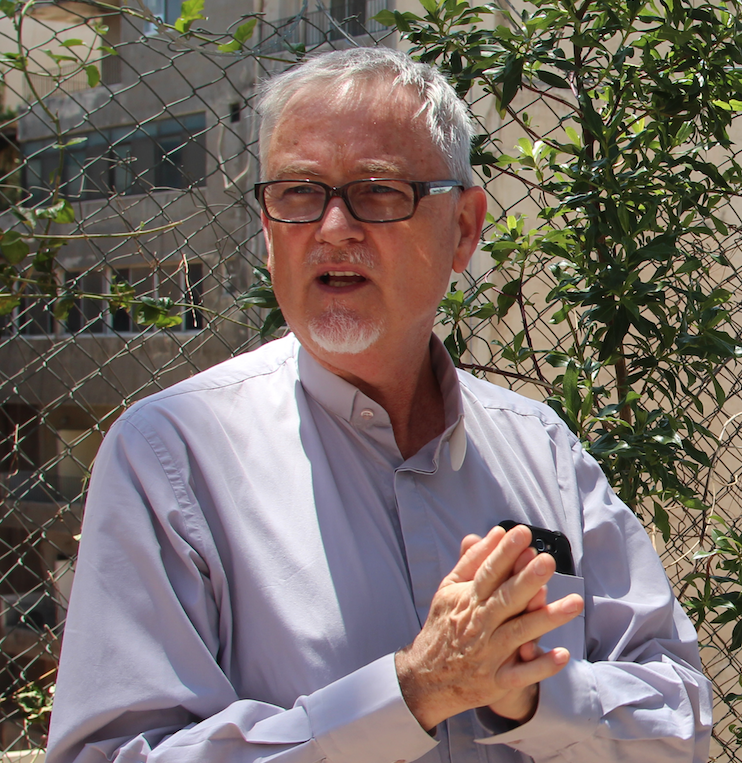
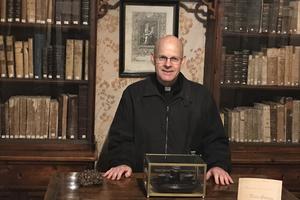
Father Michael Linden, Jesuit superior of Jordan and Iraq, sat down last week with Register senior correspondent Victor Gaetan at the 25-year-old Jesuit Center in Amman, Jordan, where four priests currently reside, to discuss Church life in the Hashemite kingdom and the plight of refugees.
Jordan hosts some 1.5 million refugees displaced by war in the region. When Pope Francis visited in May 2014, he thanked the nation for its welcoming attitude toward all refugees, including Christians.
This interview is part of a series of articles on the state of the Church in Jordan and Lebanon and Christian refugees in the Middle East.
Father Linden emphasized that while helping refugees can be challenging and can leave Church agencies open to outside criticism, it’s a vitally needed service that should be supported by U.S. Catholics.
Please tell me about Jordan and about Church life.
Jordan is a kingdom, where the royal family is very cosmopolitan. King Abdullah’s son, the crown prince, attends Georgetown University. Islam is the only official religion, so this is an Islamic monarchy. Christians have full respect and honor.
Between 3%-5% of Jordan is Christian, both Orthodox and Catholics. Relations between Catholics and Orthodox are very positive. We share calendars on Easter, and there is a lot of support for some of the more public Masses and prayers.
Pope Francis came last year, and it was a terrific visit.
Because of Sharia law, there are civil dimensions to ordinary Church life that you don’t have in the West. The presumption is that each citizen is Christian or Muslim; and if you are Christian, you go to a Church court to resolve certain administrative matters, which has the strength of law. The Church plays an important role for the nation.
Regarding conversions, the government is mostly concerned about Muslims who live here converting. It is part of the culture: If someone converts, it is a disgrace to the family, punishable by law.
What does the Jesuit Center do?
We have a pastoral center, and we spend a fair amount of time connecting Jordanian Christians with their heritage, which is a cultural and religious issue. We work with ethnic subgroups who are Latin Catholics, and we encourage people who would not normally work together, such as Filipinos and Jordanian Catholics or Iraqi Catholics.
The Catholic ethnic groups tend to be isolated, but we are a center that can help people overcome these barriers. It is an accidental charism. We have become a place where people who normally don’t relate can — and do.
We also have a refugee division with about 40 workers, volunteers and a few professionals.
And third, we provide the priest for the English-language Latin Catholics of Jordan. About 1,100 persons attend the English Masses on a typical weekend.
What programs do you have for refugees?
For refugees, there are two types of programs managed by the Jesuits. We visit families, especially refugees not wired into the United Nations system: all urban refugees. By visiting them, we can help connect them to services and information; for example, to let them know they can send children to schools. Sometimes we intervene to help them.
Second, urban refugees need regular things, such as rent assistance, blankets, bedding, heat. They aren’t allowed to work under the law, but many do work, and you find very vulnerable people like women with children and unaccompanied children.
The Christians are not going to the refugee settlements — the camps. They tend to be urban refugees, living across the city in poor neighborhoods. Most refugees are Muslims, although not many Shia [Muslims], who are not warmly received. Urban or refugee camp dwellers, it does not much matter; as long as a refugee is registered with the U.N., they will be in the system.
Iraqis have a higher level of cohesion, and many have family abroad working to bring them to new countries as immigrants. About 16% of refugees from Iraq are Christians.
How is the Catholic Church involved in refugee resettlement?
The Church, around the world, is significantly involved in the resettlement of refugees. It is part of its normal operating process. It is a modern pastoral work. Years ago, for instance, I was in Burlington, Vt., visiting a small diocese, and the diocese and other agencies knew 16 people were coming in on a flight for resettlement — they got the list just a day ahead. It is part of normal pastoral work for Catholics, usually undertaken by Catholic Charities in each diocese.
The absolutely best program I’ve ever seen is in Canada. The Canadian bishops are committed to it, and the law of Canada facilitates the Church’s involvement, as well as other institutions such as universities. The law allows any five citizens to sponsor a refugee. They are vetted for security, obviously. It allows refugees to resettle with local support, and it encourages engagement at so many levels. The process takes about a year.
The archbishop of Toronto sent his people here recently. They were trained in immigration law. They worked out of this center, massaging the archdiocese’s criteria and the government’s requirements. They interviewed families. They took a lot of people from the huge list of people Caritas Jordan [the biggest Catholic aid group in the country] has.
While they were interviewing, I happened to run into an Armenian [Christian] church priest who told me he had refugees living in his churchyard. The Toronto team asked to interview families from there and selected some of them.
Right now, a team from Canadian universities is at our center, giving English-language tests to some students to decide which refugees with English-language skills can come to a Canadian university for one year. The law encourages this engagement of their citizens with refugees.
Do some refugees still hope to go back to their home countries?
Yes. Some Iraqi refugees are now returning to Sunni Muslim areas around Tikrit.
What happens is, there are usually family and friends back home. Everyone has a cellphone. They start calling [to ask], ‘Is my house okay?” and they decide what to do. Some go back.
Syrians too: You know, Syrians are very bonded to their homeland, bonded to their home soil. Syrians who have come here, the vast majority, are family people, and there are so many. They left their country for the sake of safety, not because they wanted to leave.
Last night at the airport, I saw a large group of refugees from Yemen arriving, and most seemed injured. Do you know anything about Yemeni refugees?
In Jordan, there are 27 nationalities here as refugees. Some are more vulnerable than others. Right now, money is flowing for Iraqis and Syrians. Things are happening for them, but other refugees get less attention — people from Sudan, Darfur, Somalia, Ethiopia. They come in smaller numbers. They are largely urban refugees, vulnerable because they can’t work, and many are people of color. Yemeni people are here because it is safe, but the U.N. processes them slowly. We know Sudanese refugees who claim to have an appointment scheduled with the U.N. in 2020!
The Yemenis come by plane, often on a medical visa.
What message do you have for American Catholics on this subject?
Christianity, in particular, is the great world religion that actually does a lot for refugees. Because it does, it succeeds much of the time, but then, it is open to criticism. We aren’t afraid of criticism. Whether we are talking about refugees or the poor, this is the job we have.
The message? Do it, and don’t be afraid to do it.
Victor Gaetan is an award-winning international correspondent and a contributor to Foreign Affairs magazine.