The Heart of Football: Fernando Mendoza’s Faith Grounds Him
Catholic QB led the Indiana Hoosiers from overlooked underdogs to college football glory — with God at the center of it all.
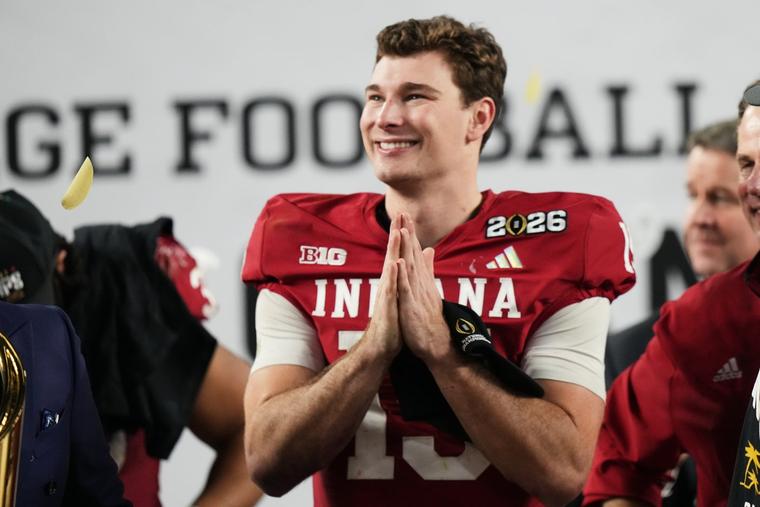
Fernando Mendoza prays the Rosary every Friday. Before games, the perfect-season-winning Catholic quarterback listens to Mass online. He avoids hype music entirely, opting for prayer and meditation to stay “calm, cool and collected” as a quarterback. He maintains close friendships with priests who serve Indiana’s Catholic community — bonds he credits as essential to his growth on and off the field. (The Dominicans were on the field celebrating with Mendoza after the big win on Jan. 19.)
Faith carried Mendoza and the Hoosiers through, in a Cinderella story reminiscent of Rudy, that other inspiring football-related true story from Indiana.
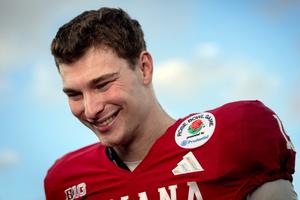
Curt Cignetti, Indiana’s head football coach, stood beneath the Rose Bowl lights on Jan. 1 after an improbable victory. The Hoosiers — a program long accustomed to irrelevance and loss — had just toppled college-football-powerhouse Alabama on one of the sport’s grandest stages. One more win separated them from competing in the national championship game.
Cignetti didn’t dwell on tactics or history. He reached for something simpler. This season, he said during the on-field trophy presentation, would make a great movie.
He was right. A long-suffering program. A Heisman-winning quarterback few initially believed in. A perfect season. A national title.
But Indiana’s story wasn’t just about the scoreboard. In a mainstream culture that often prefers to push faith aside, one player refused to let it fade into the background.
Fernando Mendoza did not merely acknowledge God after wins. He centered everything around the one whom he often refers to as the “Man above” — consistently, explicitly and without apology.
By the Glory of God
“I want to give all the glory and thanks to God,” Mendoza said after Indiana’s 27-21 national championship victory over Miami on Jan. 19. Moments later, as the Hoosiers stood on stage for the trophy presentation, he said it again. At the Heisman Trophy ceremony a month prior, he thanked God for “giving me the opportunity to chase a dream that once felt a world away.”
Unlike many athletes who offer a brief nod to faith, Mendoza lingers there. He explains it. He lets reporters ask follow-up questions. He invites people into what that faith actually looks like in his daily life as an athlete.
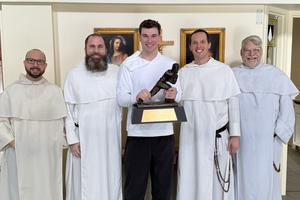
“I am Catholic. I am a Catholic man,” Mendoza said ahead of the title game. When asked why he had brought the Heisman trophy to the St. Paul priests and Catholic Center at Indiana, Mendoza responded: “[The priests] have done so much to help me, whether it’s confession, or being able to talk or just Mass every Sunday.”
“I really give a lot that I accomplished this season and in my life to the Lord, and I want to give thanks to God,” he added.
A Rise Few Saw Coming
Mendoza’s path to this moment was anything but assured. A two-star recruit out of Miami, he was lightly rated and often overlooked — even by his hometown Hurricanes, who declined him a walk-on spot.
He went to the University of California, Berkeley, where opportunities arose naturally. He eventually earned the starting job at quarterback, led the Golden Bears to a bowl game, and then entered the transfer portal in 2024. Miami expressed interest, but Indiana — where Mendoza’s younger brother, Alberto, was a redshirt freshman quarterback — ultimately pursued him further. Under Cignetti, Mendoza led the Hoosiers to a 16-0 season, a Big Ten championship against then-No. 1 Ohio State, and a national title in his hometown.
Before Cignetti’s arrival in December 2023, the Hoosiers football program held the record for the most losses in NCAA Division I history with 713 total, went a combined 9-27 in the three prior seasons, and had never won 10 games in a single season.
“We were never supposed to be in this position,” Mendoza said following the Big 10 championship win. “But by the glory of God, the great coaches, great teammates, and everybody we have around us, we were able to pull this off.”
In his Heisman Trophy acceptance speech, he put that all in perspective, too.
“I want every kid out there who feels overlooked and underestimated, I was you. I was that kid, too. I was in your shoes,” he said.
“The truth is, you don’t need the most stars, hype or rankings. You just need discipline, heart and people who believe in you and your own abilities. I hope this moment shows you that chasing your dreams are worth it, no matter how big or impossible they seem.”
‘I’ll Die for My Team’
If Mendoza’s faith gives his story meaning, his selflessness gives it credibility. Late in the national title game against Miami, Indiana led by three points with less than 10 minutes to play. The Hoosiers were lining up for a field goal — a safe, conventional call that would likely force Miami to drive the length of the field to take the lead.
Cignetti had other plans. “Get off the field! We’re going for it!” he told the kicking team. On 4th-and-4, the call was daring and the pressure immense. Mendoza ran a draw play, absorbing heavy contact in an already-physical game as he strained for the first down and pushed into the endzone for a 12-yard touchdown. The play didn’t seal the win outright, but it gave Indiana the breathing room they needed to ultimately prevail to the 27-21 victory.
Asked afterward about the hits he’d taken and his bruised arm, Mendoza deflected praise, credited Miami’s defense, and then said something that instantly lodged itself in college football lore: “I’ll die for my team, whatever they need me to do. They need me to take shots from the front or the back, whatever it is, I’m going to die for my team out there, and I know they’re going to do the same for me. Give all glory to God.”
This moment wasn’t rehearsed; rather, it was instinctive of a selfless player. Mendoza is emotional in interviews, sometimes nearly tearful. He comes across as earnest, even slightly awkward at times — a quarterback defined as much by his humility and heart as by his talent.
“No one is perfect,” he said ahead of the title game. “The only person I think is perfect is my Lord and Savior, Jesus Christ. And I have a lot of flaws.”
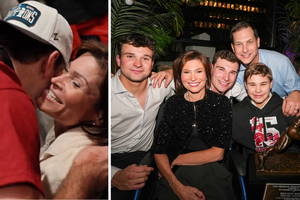
Those flaws, Mendoza has insisted, are kept in perspective by his family, especially his mother. Elsa Mendoza has lived with multiple sclerosis since 2007 and uses a wheelchair. During games, Mendoza’s father, Fernando Sr., remains seated throughout, an intentional act of solidarity and love.
“My mom is my inspiration,” Mendoza said in a profile interview with The Heisman Podcast, tearing up. “She’s the reason I’ve gotten this far. There’s no excuse for complacency when you see what she fights through.”
He has raised more than $150,000 for MS awareness through the “Mendoza Brothers’ Fight Against MS” initiative alongside his brother Alberto, connecting fundraisers in Berkeley and Bloomington. “There’s still no cure,” he said. “We’re praying for one every day.”
That prayer is not theoretical. Before the national championship, video captured both Mendoza and Miami quarterback Carson Beck kneeling on opposite ends of the field before kickoff in silent prayer.
A Platform, Not a Performance
Mendoza has removed nearly all social media from his phone other than LinkedIn (read his takeaways from the national championship and his latest NFL-related post) and YouTube. According to his Heisman Podcast profile, Mendoza “texts his family before kickoff. He taps the ‘WIN’ sign three times with each hand. He never steps on the school seal.”
These are not superstitions he sells but rather habits that ground him.
“Realizing having God on my side — always praising Jesus Christ — it’s incredible,” he said. “I can’t thank the Man above enough.”
Wide receiver Charlie Becker, who made key plays in the championship game, is also Catholic. Teammates have described a quiet but growing faith culture within the program grounded in shared habits of prayer and discipline, not spectacle.
The Hoosiers’ Catholic priests have watched this unfold. Dominican Fathers Patrick Hyde and Ben Keller have witnessed Mendoza’s faith firsthand, whether in Mass or in the way he carries himself publicly.
“The opportunity Fernando has had to share his faith in simple ways through his platform has been a blessing,” Father Hyde told the Register earlier this month. “He is just another person at Mass praying with everybody else. That steadfastness has been his witness to our community here at Indiana.”
Beyond the Stats
After the red and white confetti covered Fathers Hyde and Keller, along with players and coaches on the field on Jan. 19, the celebration spilled into the stands. To the tune of ABBA’s Fernando, the crowd serenaded its quarterback — a rare instance of pop culture and faith intertwining.
In a moment that could have been just another sports headline, Fernando Mendoza made his faith unmistakable. Explained. Embodied. Carried into the center of the story.
Nothing essential was cut or pushed to the side. The glory was not only in the trophy, the stats or the perfect season; rather, it was in a quarterback who plays with courage, leads with humility and lives openly the faith that sustains him.
That is what made this movie-like season, and the story of Fernando Mendoza, unforgettable.