Chaplains and Commentators Weigh In on Abuse of Iraqi Prisoners
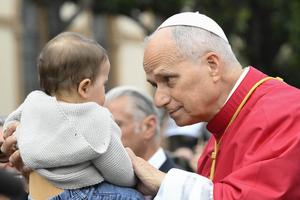
WASHINGTON — The abuse of Iraqi prisoners of war by U.S. military personnel must be “condemned without equivocation” and “we must bring to justice those responsible,” said Archbishop Edwin O'Brien, head of the U.S. Catholic Archdiocese for the Military Services.
He called “outrageous” the abuses that first came to light in photographs presented April 28 on CBS' “60 Minutes II” showing U.S. military personnel abusing and humiliating Iraqi prisoners.
Agreeing with Archbishop O'Brien were two military chaplains scheduled to become auxiliary bishops of the military archdiocese in July. All three said the abuses go against what the U.S. military stands for and are contrary to the actions of the vast majority of the members of the U.S. armed forces.
“The military is no place for Rambos. We have to weed them out,” said Bishop-designate Richard Higgins, an Air Force chaplain since 1974.
Bishop-designate Joseph Esta-brook, a Navy chaplain since 1977, said the abuses show the need for military chaplains because they can provide moral guidelines for military people having to act in complex and stressful situations.
All three spoke in answer to a question by Catholic News Service at a May 7 news conference in Washington to announce the appointments of Bishops-designate Higgins and Estabrook. Archbishop O'Brien spoke via telephone from the Spangdahlem Air Force Base in Germany during a tour of U.S. military installations.
The archbishop contrasted the abuses in the photos to the “excellent attention” he said he saw wounded Iraqi prisoners of war receive at U.S. military hospitals in Germany.
His statements were echoed in Register interviews with a chaplain and a serviceman who recently returned from Iraq.
“This situation is a microscopic, unfortunate event that the troops who are doing honorable duties out there are embarrassed by and regret,” said Father S. Richard Spencer of the Office of the Army Chief of Chaplains at the Pentagon. “But they also realize the greater good they are accomplishing because they are still involved in the orphanages and building hospital clinics and schools, and so they know the good that is being done.”
“It's unfortunate that we have the blemish of these incidents at the prison,” said Father Spencer, a major in the Army. “But by no means does it indicate that that is acceptable or the norm of behavior by our military personnel.”
“I have personally witnessed great compassion by our men and women in uniform as they reached out to hundreds and hundreds of Iraqis who have been injured or who go without shelter or food,” he said, pointing out that service personnel returning to the United States from their tour even donate a lot of their extra civilian clothes rather than bring them back to the states.
“That's a very touching, compassionate gesture,” Father Spencer noted. “The American people can be and should be very proud of their men and women in uniform. They're performing with great pride a heroic service for a better tomorrow not only for our country but also for the world.”
Frustrated Servicemen
From the serviceman's perspective, Specialist Frank O'Farrell with the Army Reserve's 411th Civil Affairs Battalion stationed in Baghdad from March 2003 to earlier this year said there's no excuse for mistreating prisoners, and he has no sympathy for those who abused them.
“It's frustrating for me,” he said. “I left projects I'm incredibly proud of, and I left them in good hands.”
O'Farrell said the U.S. work in Iraq is “still the largest humanitarian-aid effort going on the planet. There are 144,000 of us there rebuilding schools and hospitals, helping to secure free elections, working on infrastructures like garbage, electricity and drinking water. All these good things have been going on since Day One. There's so much good going on there and it's not getting to the press. It's just not news-worthy. It's frustrating for me.”
Bishop-designate Estabrook said he has been teaching a moral decision-making course for Marines in which real-life military situations are simulated and students have to decide which courses of action to take.
Marines coming back from Iraq have spoken about the moral decisions they have had to make and “I'm proud of them,” Bishop-designate Estabrook said.
At the time of his appointment, Bishop-designate Estabrook was command chaplain at the Marine Corps Base at Kaneohe Bay, Hawaii.
Setback With Muslims
John Borelli, special assistant for interreligious initiatives to the president of Jesuit-run Georgetown University, said the abuse “sets back our work on reconciliation” with Muslims.
“We are trying to get past the stereotypes and ill will from our past,” Borelli said in a telephone interview with Catholic News Service.
“The abuse reveals in the minds of U.S. citizens a dehumanizing view of Arabs and Muslims,” Borelli said.
Prior to joining Georgetown in February, Borelli was involved in Catholic-Muslim dialogue as an associate director of the U.S. bishops' Secretariat for Ecumenical and Interreligious Affairs.
“The abuses go against everything the U.S. military teaches its soldiers about treatment of prisoners of war,” Borelli said. “I know from my personal experience as an Army interrogator during the Vietnam War.”
A different take on the matter was offered by the Washington, D.C.-based Family Research Council. In a May 12 statement on the prisoner abuse, Tony Perkins, president of the group, said Americans “must be willing to look deeper — we must be willing to look our culture in the mirror and ask some hard questions about what kind of society our children are growing up in.”
“What is surprising and what should shock our nation's conscience is that these U.S. soldiers took photos and homemade pornography of the abuse as ‘trophies’ for their actions,” Perkins said. “When you mix young people who grew up on a steady diet of MTV and pornography with a prison environment, you get the abuse at Abu Ghraib. America is in a perilous situation. In the eyes of these Muslims, we are the enemy because we are Christian, but in many areas of our culture, our conduct as a nation is anything but Christian.”
Joseph Pronechen writes from Trumbull, Connecticut.
- Keywords:
- May 23-29, 2004