True Cross Relic, Liturgical Vessels Among the Exhibited Treasures Now Touring Outside of the Holy Land
‘To the Holy Sepulcher: Treasures From the Terra Sancta Museum’ begins tour in New York City.

Silver and gold liturgical vessels, including chalices, colorful and intricately designed chasubles and other liturgical items, serve up a feast for the eyes and the spirit in an exhibit called To the Holy Sepulcher: Treasures From the Terra Sancta Museum.
More than 40 of these treasures are now on display at the Frick Museum in New York City. They come from the Terra Sancta Museum in the Old City of Jerusalem and are on display for their first time in the United States. The exhibit comprises part of the treasures safeguarded by the Franciscans of the Custody of the Holy Land for more than 800 years: The Franciscans were charged by Pope Clement VI with the care of the Christian sites.
“Dazzling” is too pedestrian a word for the spectacular beauty of these liturgical items, sacred vessels, vestments and holy artifacts. They were lavish gifts from European Catholic monarchs and Holy Roman emperors given to the Church of the Holy Sepulcher — on the site of Jesus’ resurrection — during the 17th and 18th centuries. The donors spared no expense to give the finest in material and workmanship for liturgical splendor for the celebration of Mass and also for adoration.
These treasures on display were donated mainly from France, Spain, Italy and Portugal. Most were gifts from reigning monarchs — Kings Louis XIII, Louis XIV, and Louis XV, Emperor Charles VI and his daughter Empress Maria Theresa, Philip II of Spain, Philip IV and his son Charles II and John V of Portugal.
Dazzling Highlights
Chalices, cruets, candlesticks, chasubles — everything gleams and showcases the finest of workmanship.
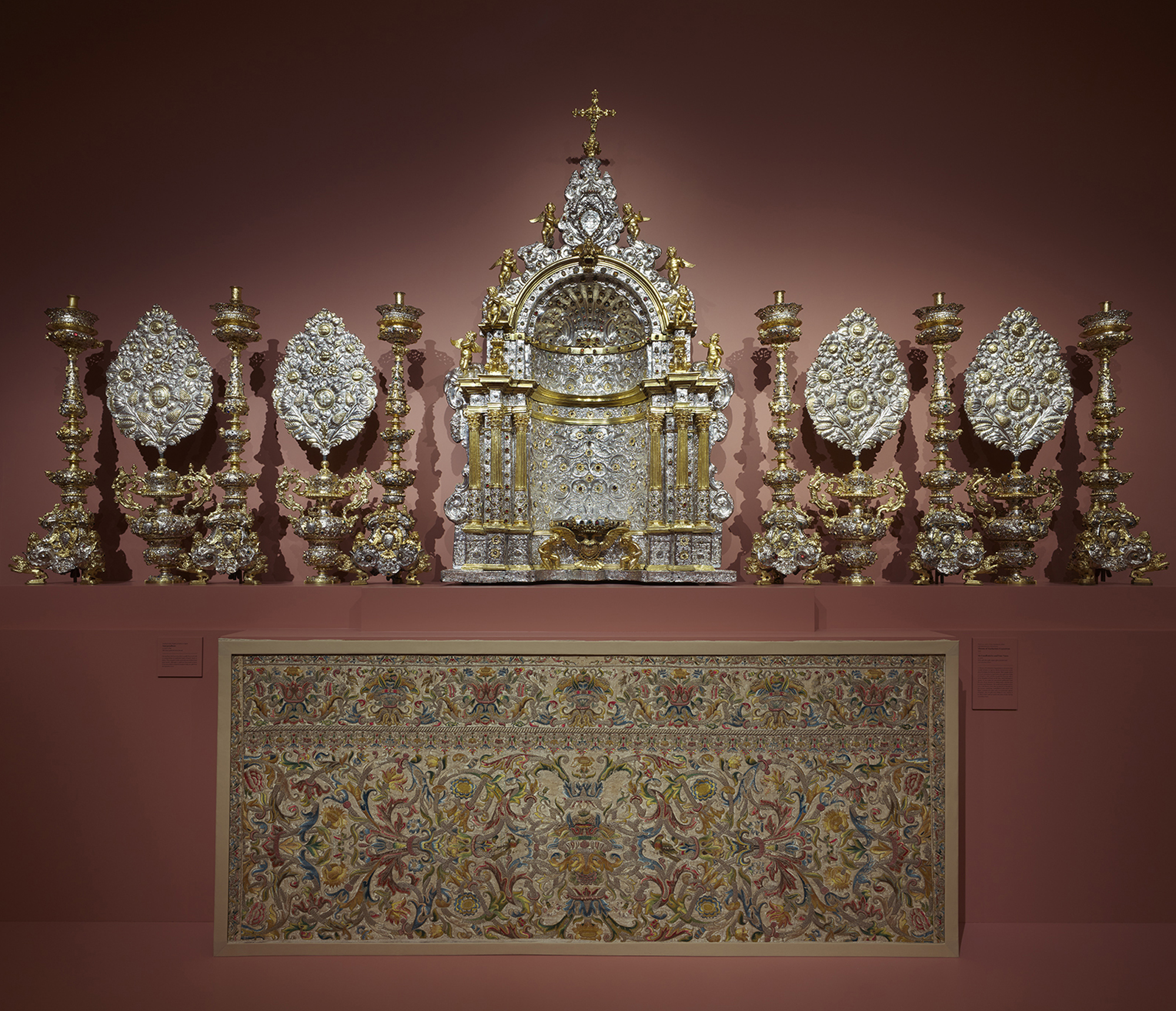
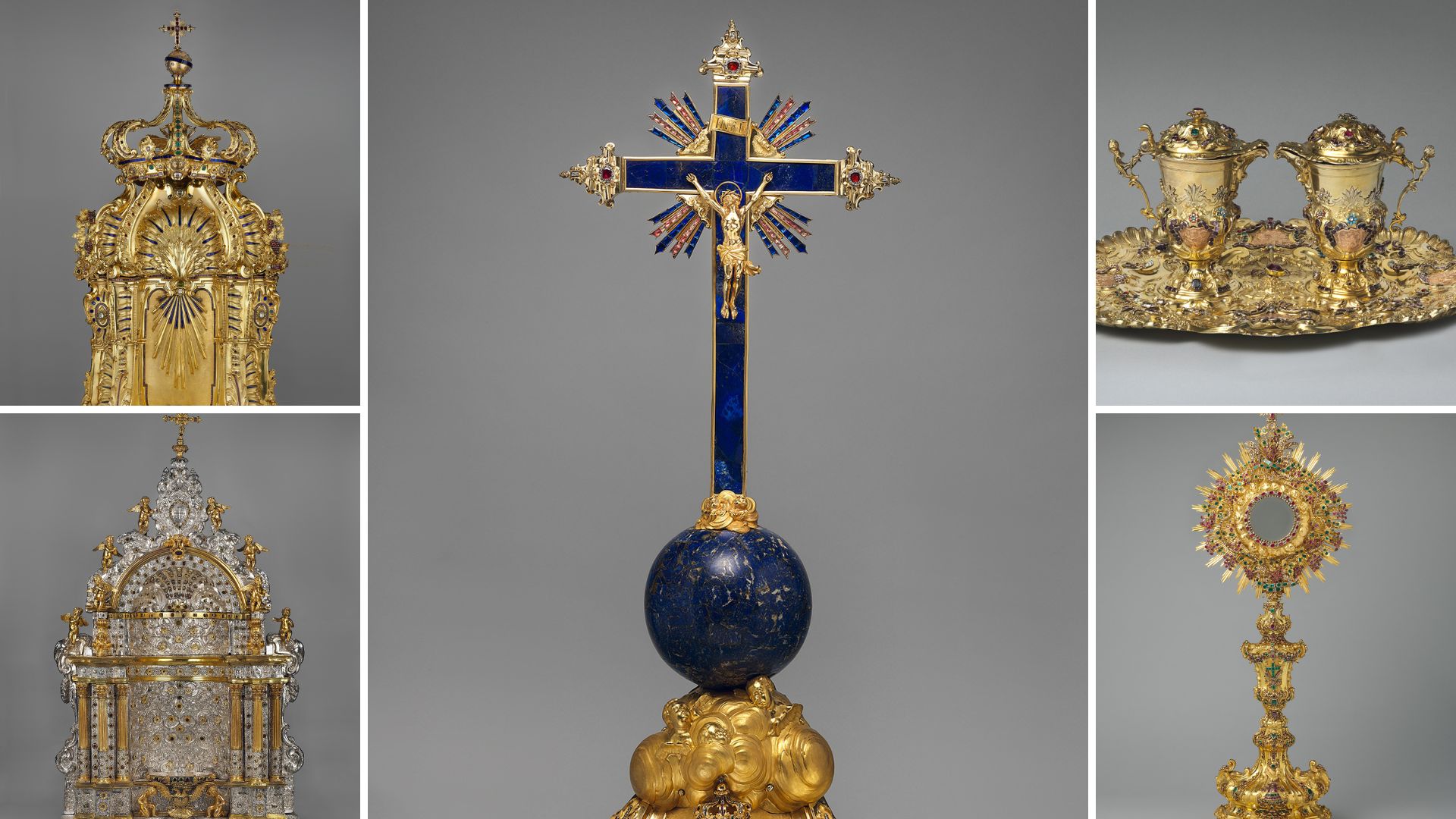
To begin, a throne to hold a monstrance for Eucharist exposition arrived in October 1755; and then, as now, dazzles in height, material and design. The ornamental designs studded with emeralds, rubies and diamonds include grapes and floral patterns. Even jewels form grapes. The throne rises to a crown topped with a globe and a cross. The throne includes the arms of King Charles III and his wife, Queen Maria Amalia of Saxony, who gifted it.
One chalice and paten set in the show from France is made of gilt silver, glass and semiprecious stones. Very tall, it is beautifully decorated with the arms of France and has a relief of St. Louis holding the Crown of Thorns and three nails to commemorate his bringing relics of the Passion to France.
The upper part of this chalice also depicts the scourging, the Crucifixion and Resurrection, while small statues of Christ, St. Francis and St. Anthony circle the stem. A relief of the Assumption of the Blessed Virgin Mary decorates the paten. This gift arrived in Jerusalem on May 4, 1665. Other similar dating in the show certainly bear witness to the meticulous records the Franciscan custodians have kept.
Another sparkling standout on a smaller scale is a tray and cruet set that arrived in 1740. The cruets are made of gold, gilt silver and precious and semiprecious stones. They are extravagantly carved with renderings of wheat and grapes flowing from bowls, plus four biblical scenes in relief: Rebecca at the Well, the Wedding Feast at Cana, the Samaritan Woman at the Well and the Last Supper.
Another dazzling item is the nearly-five-foot-tall, 90-pound monumental silver sanctuary lamp. Likely crafted by an Italian father-son silversmith team working in Spain, this ornamentally decorated lamp is highlighted by four large sculptures around it. They are likenesses of the Four Evangelists, each portrayed holding their symbols of an angel, a lion, an ox and an eagle.
Speaking of height, two monumental torchères (standing lamps) in silver and gilt silver each stand high at eight feet tall. Various angels appear to hold up parts of this highly ornate pair that are also decorated with reliefs from Christ’s passion. Statuettes of the Four Evangelists also take their place on this pair. To show there is no doubt where they were headed, each has a huge base featuring a Jerusalem Cross at the bottom. They arrived in Jerusalem on June 23, 1765.
A particularly distinctive, nearly-three-foot-tall crucifix from Naples dates to June 1757. This crucifix, adorned in gold, lapis lazuli and precious and semiprecious stones, came from King Charles of Naples and his subjects. The gold cross inset with lapis lazuli sits on a very large lapis lazuli globe that rests upon the golden base. Rays of gold and lapis lazuli radiate from the crucifix to jewels at their ends.
Venerate a Relic of the True Cross
Most impressive of all is a tall cross of gilt-silver embedded with glass the color of emeralds and rubies. Dating to 1628-29, it is a reliquary of the True Cross, which was discovered by St. Helena. This cross stands atop a pedestal upon a base with two golden angels “watching.” The best part: the blessed opportunity to venerate the relic of the True Cross in the crossbeam. In the Holy Sepulcher, it is displayed on May 6, the feast of the Finding of the Holy Cross, and Sept. 14, the feast of the Exaltation of the Cross.
Extraordinary Vestments
Everything is extravagant in the best sense because everything is meant for the honor and glory of God. This includes the vestments on display. Some pieces come from a pontifical set of 17 pieces sent by Venice in the later 17th century. One is a beautiful chasuble in crimson. Made of silk, velvet, gold and silver thread and semiprecious stones, it stands out with its extremely detailed embroidery.
The oldest chasuble in the show is circa the Jubilee Year of 1600. More pontifical vestments — including cope and chasuble in the same design done with silk, gold and silver thread, arrived in Jerusalem in April 1741 from Paris during the reign of Louis XV. The design forms extremely fancy florals, and the outline of a cross graces the back from top to bottom.
Another standout is a cope from Genoa that gives the impression of being very heavy for the wearer. What really draws attention is the colorful and quite detailed central image depicting St. George, Genoa’s patron saint, slaying the dragon.
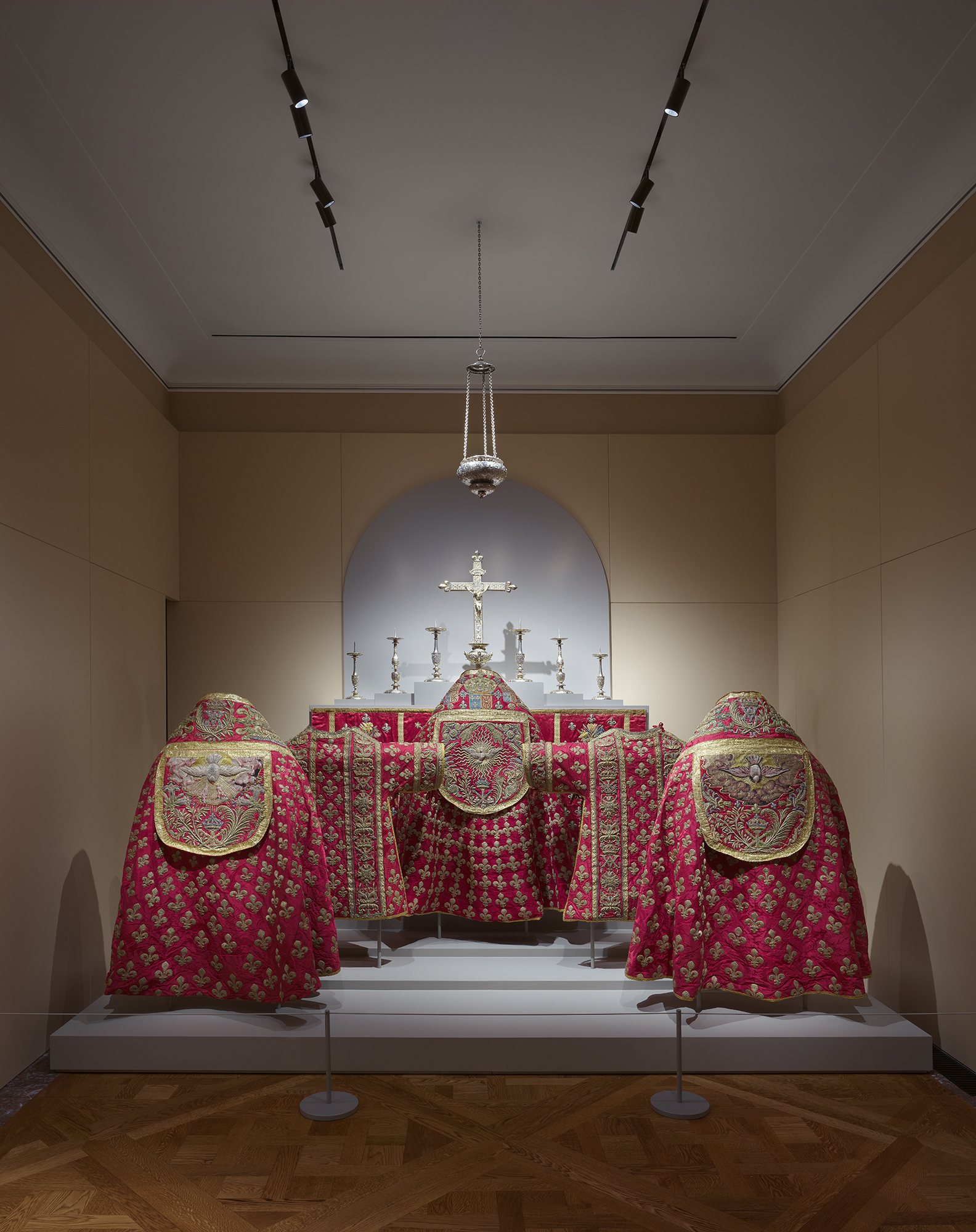
As part of an altar-set display, an amazing red pontifical vestment set dating from 1619 includes three copes, two dalmatics and a nearly-seven-foot long antependium (an ornamental cover for the altar front) — all in matching silk with gold and silver threads.
All vestments are highly decorated with fleur-de-lys and the arms of France. The copes have rows upon rows of fleur-de-lys, with a central image of the Holy Spirit presented in a slightly differently way in each scene. At some point, the red fabric replaced the vestments’ original white. Again, these vestments were donated by French royalty. The entire group is set before an altar.
The show reminds viewers that the altar is where St. John Vianney, although he lived in poverty himself, spent lavishly for vessels and vestments because he believed that only the very best, the highest quality, should be presented to God there. Everything in this exhibit attests to this same belief.
Rediscovered Treasures
Although every piece has been in the Holy Land for centuries, the collection was mostly unknown outside of Jerusalem and to the public until its rediscovery in the 1980s. While the new Terra Santa Museum is currently being constructed at the Monastery of St. Savior in Jerusalem, where these beautiful, heavenly objects will be housed, this exhibit will travel throughout Europe and North America. Until Jan. 4, 2026, visitors can be moved by these precious treasures and marvel about them, at the Frick Museum in New York.
- Keywords:
- relics
- liturgical vestments
- catholic history
- terra sancta museum
- franciscan custody of the holy land
- church of the holy sepulcher