Putting in a Word for Purgatory
Few of us are ready for heaven at once. Yet in the purifying gaze of Christ, God’s justice is revealed as divine mercy, and hope is not extinguished but fulfilled.
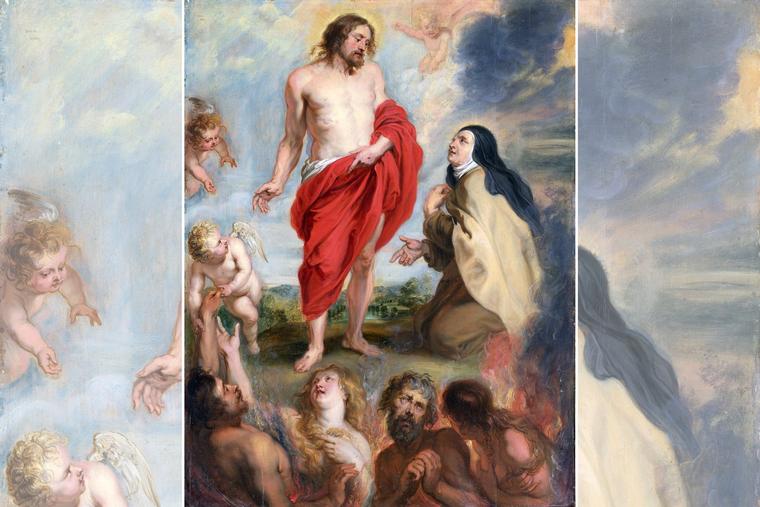
If the ultimate aim of life is to get beyond this life, and thus to awaken on the other side in the arms of a loving God, then everything depends on the state of the soul at the hour of death. Am I truly conformed to Christ at the moment I take leave of this world, or are there yet sins and imperfections that stand in the way of my seeing without shame the pure face of God in the presence of all his angels and saints?
Who among us can — with complete moral certainty, that is — declare before God and man that he is indeed ready to enter the Kingdom, having definitively established himself in a life of perfect virtue? And that heaven will at once throw open its gates to welcome yet another saint into the precincts of eternal felicity?
Are there such people, I wonder, whose souls so shine like the sun that their light not only never goes out, but it scarcely grows dim at all? “There can be people,” writes Pope Benedict XVI in his 2007 Encyclical Letter Spe Salvi (On Christian Hope), “who are utterly pure, completely permeated by God, and thus fully open to their neighbors — people for whom communion with God even now gives direction to their entire being and whose journey towards God only brings to fulfillment what they already are.”
So let’s concede that there are such people who fit the description. In fact, I’m pretty sure I’ve known a few myself. But surely not so many that the Church would need to schedule canonizations every hour of the day to assign halos for all of them. Which leaves, let us assume, vast numbers of people situated somewhere in the middle, neither good enough to go at once to heaven, nor so wicked that they deserve to be thrown straight into hell. Actually, no one gets thrown anywhere; if you end up in hell it’s because you’ve freely chosen to go there. It is a place of self-imposed torment, the door leading into the darkness having been bolted shut from within.
In other words, while few are the souls wafted at once into the bliss of eternal life, so too there may be but few who die utterly unrepentant, either, determined therefore on blowing up every last bridge that leads to beatitude. Which leaves, what exactly? “The great majority of people,” Pope Benedict calls them, in whom, he says, “there remains in the depths of their being an ultimate interior openness to truth, to love, to God.”
This is not a new teaching, by the way, a sudden improvisation untethered to or inconsistent with things believed or taught before. In fact, Benedict had made exactly the same point years before when, as a young priest-professor in Germany in 1967, he reminded his students of it in a series of lectures that famously became Introduction to Christianity, a book so captivating that it caught the eye of the then pope, Paul VI, who straightaway made him a bishop. The rest, of course, is history.
“The beautiful black and white into which one is accustomed to divide men,” declared the then-Father Josef Ratzinger, “changes into the grey of a universal twilight … that with men there is no such thing as black and white, and that in spite of all possible gradations … all men stand somewhere in the twilight.”
So, there we are amid the twilight, soldiering along a path strewn with thistles and thorns that block the soul’s progress; yet, at every turn in the road, armed with “an ultimate interior openness to truth, to love, to God.” To be sure, there will be enough sin and defilement to bedevil us along the way, disrupting our journey home.
“In the concrete choices of life,” the encyclical assures us, “much will be covered over by ever new compromises with evil — much filth covers purity. But the thirst for purity remains,” we are told, “and it still constantly re-emerges from all that is base and remains present in the soul. What happens to such individuals when they appear before the Judge? Will all the impurity they have amassed through life suddenly cease to matter?”
The answer cannot be that it no longer matters. Would not such sleight of hand cheapen and trivialize all the choices that have been made? What we have done, or left undone, surely matters. To that end God has made provision, and in a most generous and ingenious way, by allowing time, as it were, to be extended into eternity, thus enabling true expiation for sin to happen. And where it happens is in that strange, mysterious place we call Purgatory, which, has some have said, had it never existed, we should have needed to invent it. “For who would dare say of himself that he was able to stand directly before God?”
We need a final cleansing, therefore, a purifying gaze from God, which will prove cauterizing enough to burn us free from everything that excludes us from the joy of his company. Short of that purgatorial fire, we can never hope to make our home with him.
And yet we don’t want to be, to use an image from Scripture, ‘a pot that turned out wrong,’ that has to be thrown away; we want to be put right. Purgatory basically means that God can put the pieces back together again. That he can cleanse us in such a way that we are able to be with him and can stand there in the fullness of life. Purgatory strips off from one person what is unbearable and from another the inability to bear certain things, so that in each of them a pure heart is revealed, and we can see that we all belong together in one enormous symphony of being.
It all turns on hope, doesn’t it? Which is the virtue most necessary for those of us still on the way. Who are not yet safely inside the Kingdom, which should certainly keep us from presumption; but neither are we doomed to fall headlong into hell, which likewise keeps us from despair. It is the one virtue whose outcome does not depend on us. Only God can give us the joy of salvation, which is why we must pray to receive it. What else does the language of hope consist of if not prayer?
Especially for those who have gone before us and perhaps stand in the acutest need of it. What a high privilege it is for us to pray for such souls, asking God to look kindly upon them. Do not, in the circumstance, rush to canonize the dead. Rather commend their souls to the tender mercies of the same God who went all the way to the Cross to redeem them.
- Keywords:
- purgatory
- hope
- divine mercy
- four last things