Baptism: Entry Into Church Family as a Child of God
The first sacrament reflects truth of faith.
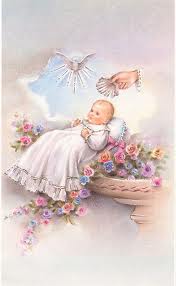
"I don’t think my feet touched the floor at the Easter vigil of 1994," recalls Jennifer Pixler of Maryland. "I felt such love, knowing that God was wiping out all my sins when I was baptized."
"Baptism is the heart of being Catholic," says Jeannine Marino, assistant director of the U.S. Conference of Catholic Bishops’ Secretariat of Evangelization and Catechesis. "It is our initiation into the Church and our call to holiness."
The Church teaches that one is not only purified, but also made "a new creature," an adopted daughter or son of God, a member of Christ’s body, through baptism. "The Christian’s supernatural life has its roots in baptism" (Catechism of the Catholic Church, 1266).
Jesus taught that baptism is necessary, telling his apostles: "Go, therefore, and make disciples of all nations, baptizing them in the name of the Father and of the Son and of the Holy Spirit" (Matthew 28:19).
"Baptism is necessary for salvation for those to whom the Gospel has been proclaimed and who have had the possibility of asking for this sacrament," the Church explains (Catechism, 1257).
Elements of Baptism
There is some variation for baptism among various Christian denominations. In the Catholic rite, the candidate is immersed in water or has water poured on his or her head while the minister of baptism — bishops, priests and, in the Latin rite, deacons — states he or she is baptized in the name of the Father, the Son and the Holy Spirit. These are also the elements necessary to recognize a non-Catholic baptism.
The actual baptismal liturgy can take place alone or as part of the Mass. Adults — known as catechumens — usually attend Rite of Christian Initiation of Adults classes during the previous year, culminating in their entrance into the Church at the Easter vigil Mass.
Baptism leaves an indelible mark on the soul, so it is a sacrament that is received only once. Therefore, a non-Catholic baptized Christian entering the Catholic Church is not re-baptized unless there is doubt as to the validity of the original baptism. The candidate is then baptized conditionally, only as an assurance. Pixler’s husband, Chris, joined the Church seven years after she did. Since the evangelical church he attended as a child had no baptismal records, he received a conditional baptism at the Easter vigil of 2001.
The Catholic liturgy of baptism includes a blessing, Sign of the Cross, the lighting of a small candle from the Easter candle and a short exorcism prayer. "The exorcism prayer is included because baptism frees people from sin," Marino explains. "It helps prepare them to renounce sin and to be free from evil. While praying it, they are anointed with the oil of catechumens."
Baptized infants have godparents selected by the parents to support and assist in raising the child in faith. Adults select a sponsor to support and model the faith. As Marino says, "There is a community supporting a catechumen in this faith journey. They are supported by the sponsor, the congregation and by the whole universal Church."
Baptizing Infants
Parents are encouraged to baptize their children soon after they are born. The Code of Canon Law states, "For an infant to be baptized lawfully, it is required that the parents, or at least one of them, or the person who lawfully holds their place, give their consent." As the Code of Canon Law further explains, "There (must) be the well-founded hope that the child will be brought up in the Catholic religion. If such hope is truly lacking, the baptism is, in accordance with the provisions of particular law, to be deferred" (868).
The Pixlers have five living children, who were all baptized as infants. Of the four children lost through miscarriage, two were delivered in the hospital and immediately baptized before they died; one was baptized by a hospital nurse, and the other was baptized by Chris. In the case of an emergency, where death is a possibility and no ordinary ministers are present, any Christian can baptize someone by pouring water over the person and pronouncing the words, "I baptize you in the name of the Father, and of the Son and of the Holy Spirit."
The Pixlers’ other two miscarried babies died before delivery. "I trust in God’s mercy," Jennifer says.
"As regards children who have died without baptism, the Church can only entrust them to the mercy of God, as she does in her funeral rites for them. Indeed, the great mercy of God, who desires that all men should be saved, and Jesus’ tenderness toward children which caused him to say: ‘Let the children come to me; do not hinder them,’ allow us to hope that there is a way of salvation for children who have died without baptism. All the more urgent is the Church’s call not to prevent little children coming to Christ through the gift of holy baptism (Catechism, 1261).
Joy of Baptism
Msgr. John Esseff, who has been a priest of the Scranton, Pa., Diocese for 60 years, describes administration of the sacrament of baptism as one of the most wonderful parts of his priesthood: "This magnificent gift transforms us to live a new life. How I wish that, throughout the entire Catholic world, everyone would understand the deepest truth about baptism is that we are one with Jesus Christ. Everyone who is a baptized Christian can actually be fed by the Holy Spirit and bring the Good News to everyone that they touch."
Patti Armstrong writes
from North Dakota.

Patti Maguire Armstrong Patti (Maguire) Armstrong is an award-winning journalist and was managing editor and co-author of the bestselling Amazing Grace Series. Her latest books are the humorous and inspirational second-edition Dear God, I Don't Get It, Dear God, You Can't Be Serious!, What Would Monica Do?, Holy Hacks and Michelle Duppong: Hope in the Depths of Suffering. Patti worked in social work and public administration before staying home as a freelance writer while she and Mark raised their 10 children in North Dakota. Follow her on Twitter at @PattiArmstrong and read her blog at PattiMaguireArmstrong.com.