The First Winner of the Modern Olympics Was a Catholic
James Brendan Connolly would have given up a career at Harvard to participate in the revived games in 1896.
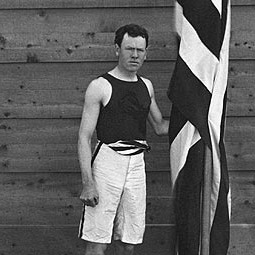
The ancient Olympic Games were of astonishing duration, lasting well over 1,000 years, from 776 B.C. until the Roman Emperor Theodosius the Great prohibited their continuation in the year 393.
The games were revived by Baron Pierre de Coubertin in 1896 and staged, appropriately, in Athens. His inspirational words have been repeated in every succeeding Olympiad: “The most important thing in the Olympic Games is not to win, but to take part, just as the most important thing in life is not the triumph, but the struggle. The essential thing is not to have conquered, but to have fought well.”
A French Catholic priest and personal friend of Baron de Coubertin, Dominican Father Henri Didon (1840-1900), coined the Olympic motto. Its three Latin words — citius, altius, forties — meaning “swifter,” “higher,” “stronger,” were coined to urge athletes to be at their best and were not meant to encourage them to break records. In the mind of de Coubertin, the chief menace to the true spirit of the Olympics was precisely the scourge of “recordism.” The Dominican priest had envisioned the games as a means of using a physical competition to achieve spiritual greatness. “You who wish to surpass yourself, fashion your body and spirit to discover the best of yourself,” he is reputed to have said.
The struggle to attain higher realizations of oneself through athletic competition remains very strong in people the world over. And there continue to be many moments of glory that are in keeping with the true spirit of the Olympic Games. These moments are truly inspirational. They are what justify the continuation of the Olympics.
James Brendan Connolly (Irish: Séamas Breandán Ó Conghaile) was one of 12 children born to poor Irish immigrants. He was a freshman at Harvard in 1896 when he felt the urge to compete in the first of the modern Olympiads. He approached the dean of the college requesting permission to leave school in order to go to Athens. Although Dean Le Baron Russell Briggs had granted permission to a senior, Ellery Clark, to compete, he withheld it from Jim Connolly.
Connolly was one of the few Catholics attending Harvard at that time. The safe and convenient decision would have been to stay at Harvard, get his degree, and then make his mark in the world.
But Connolly, we might say, was made of sterner stuff. “I am going to the Olympic Games,” he exclaimed, rather melodramatically, “so I am through with Harvard right now. Good day, sir.”
The 27-year-old Irish American from South Boston had no idea of the difficulties that lay ahead of him. He came from a poor family, but he managed to save $250 through his own efforts and thought this would be enough to get him to Athens and back. His hopes were nearly dashed when the captain of the German freighter taking the American athletes to Greece announced that the fare would be $75 more than anticipated.
Connolly went to his parish priest, Father Daniel O’Callaghan of St. Augustine’s in South Boston. “I am not a vain man,” he stated. “I’m not out for glory. All I want to do is go over to Athens and compete in the sports competition they are having there next month.” Father O’Callaghan was an avid sports fan. He could have advised Connolly to stay in school and give up his quixotic dream. But he did not. The struggle to be one’s best is also a powerful Catholic trait. Through Father O’Callaghan’s intercession, the parishioners raised the needed money, and Jim Connolly was on his way.
Together with nine other American athletes, Connolly spent 16 1/2 days traveling across the Atlantic. En route, his wallet was stolen. But there was a much more serious problem that was in store for him. The American team had planned to spend 12 days in training prior to the opening of the Olympics. What none of its members had realized was that the Greeks at that time organized their lives according to the Julian calendar. As it turned out, the Olympics would commence the very day after their arrival.
On April 6, 1896, at 2 pm, the Modern Olympics got under way. Crown Prince Constantine of Greece made a speech, and King George I officially opened the Games. James Brendan Connolly entered the first event, the triple jump, or more accurately, at that time, the “hop, hop and jump.” He was the last to compete in this event, and he out-distanced all his predecessors. With a jump of 13.71 meters — or 44 feet 11.75 inches — a remarkable three feet and three inches ahead of his nearest rival — he won the first championship of the modern Olympics and the first for his country. He became the first such champion since an Armenian prince by the name of Barasdates triumphed in boxing in the fourth century. Connolly was the first Olympic winner in 1,500 years — but received only a silver medal. The tradition of awarding gold to the winner was not inaugurated until 1908 at the London Olympiad.
Connolly also finished second in the high jump and third in the long jump. Some 40,000 spectators watched the events, including sailors from the USS San Francisco. In all, 285 men participated in the 42 events, representing 13 nations. Connolly watched with pride as the American flag was ceremoniously hoisted and a 200-piece band played the Star Spangled Banner.
Jim Connolly returned home virtually penniless. He was by no means at that time a national hero. But the hero's welcome he did receive from the Irish community of South Boston made him feel like a king.
Recognizing the merits of its former student and in an attempt to offset an infelicitous and hastily made decision, Dean Briggs offered Connolly an honorary doctorate. Connolly, ever the man of integrity, refused it. He went on to become a noted journalist and war correspondent. In addition, he authored 25 novels, including The Olympic Victory (1908), and 200 short stories. He continued his distinguished and varied career until his death on Jan. 20, 1957, at 87. A collection of items related to Connolly, including his triple jump silver medal, is housed in the library of Colby College in Maine.
Donald DeMarco, Ph.D. is a senior fellow of HLI America, an initiative of Human Life International.