Pope to Bishops: Keep Church Charities Catholic
Pope Benedict XVI’s new motu proprio affirms the importance of Catholic charities and outlines the stewardship responsibilities of bishops.

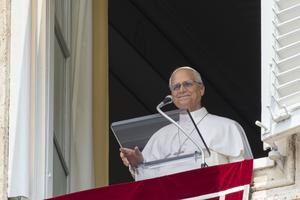
WASHINGTON — Seven years after his first groundbreaking encyclical, Deus Caritas Est (God Is Love), Pope Benedict XVI has issued a motu proprio, De Caritate Ministranda (The Service of Charity), designed to guide and strengthen episcopal stewardship of Church-affiliated charitable institutions.
Formally dated Nov. 11, but released in December, the motu proprio (on his own initiative) affirms the central role of charity in the Church’s mission and provides directives for diocesan bishops charged with securing the Catholic identity of Church-affiliated outreach programs.
While that first encyclical drew praise for its rich portrait of “the God with a human face,” the Pope describes the new document as “an organic legislative framework for the better overall ordering of the various organized ecclesial forms of the service of charity, which are closely related to the diaconal nature of the Church and the episcopal ministry.”
Such guidelines are needed, he states, because the Code of Canon Law had neglected to “mention charity as a specific sector of episcopal activity,” thus giving the erroneous impression that charitable work was not central to the Church’s mission in the world.
In the motu proprio, the Pope directs bishops to foster charitable initiatives across their dioceses and to scrutinize the policies and practices of such programs in order to guard the integrity of Catholic charitable work.
“The Holy Father affirms the importance of my responsibility to provide proper governance over the charitable works of the Church, to maintain the sacramental quality of the charitable works of the Church that are intended to do the work of the Gospel in concrete ways, giving hope, life and help to people,” Bishop Jaime Soto of Sacramento, Calif., told the Register.
Bishop Soto said the guidelines echoed the Pope’s teaching in Deus Caritas Est: Charity plays an essential role in the Church’s saving work, alongside the proclamation of the Gospel and the celebration of the sacraments.
Marie Hilliard, a canon lawyer at the National Catholic Bioethics Center, which advises the U.S. bishops on institutional policies, welcomed the document.
Said Hilliard, “The document lays out the legislative framework under which these charitable endeavors are to be administered, specifically under the authority of the diocesan bishop, particularly in assuring that funds are managed in conformity with the demands of the Church’s teaching and the intentions of the faithful.”
Challenging Times
One directive that will likely draw much scrutiny and debate is the Pope’s statement that Church “agencies do not accept contributions for initiatives whose ends, or the means used to pursue them, are not in conformity with the Church’s teaching.”
Indeed, the Holy See released the motu proprio amid an era of heightened Internet-fueled scrutiny of some U.S. Catholic charities. These agencies have been buffeted by partisan resistance to the Church’s stances on hot-button issues like same-sex “marriage” and by government policies like the federal contraceptive mandate that could result in the closure of Catholic agencies.
But the legacy of Catholic charities at the international, national and diocesan level has also been tarnished by weak or ambiguous internal policies and oversight.
As the chairman of the U.S. Conference of Catholic Bishops’ Subcommittee on the Catholic Campaign for Human Development (CCHD), Bishop Soto has sought to address ongoing concerns from critics who charge that CCHD grantees include groups that actively oppose Catholic teaching on life issues or marriage.
Similarly, Catholic Relief Services (CRS) recently came under fire by critics who alleged Church funds were provided to grantees that actively opposed Catholic moral teaching.
Joan Rosenhauer, executive vice president for CRS’ U.S. operations, told the Register that the relief agency had tightened up its “system of approval,” carefully vetting all proposals that involved external donor organizations and potential collaborators, and that the motu proprio offered encouragement for such efforts.
“As an agency of the U.S. Conference of Catholic Bishops, our first step is to work with the conference to see if they have further guidance” regarding De Caritate Ministranda, said Rosenhauer.
CRS’ annual budget is $700 million, and government grants cover 60%-70% of that figure.
Difficult Judgments
But while the motu proprio stipulates that bishops must end practices that stir up confusion and even scandal, individual bishops must still make their own judgments about how to implement that directive.
Father Larry Snyder, president of Catholic Charities USA, suggested that the directive asking bishops to refuse funds from organizations that work contrary to Church teaching would likely spur debate.
Father Snyder noted, for example, that a large donor like the Gates Foundation, while doing a “tremendous amount of good helping people in need, also supported family planning.”
“Some bishops have said that … in areas where the [donor’s] mission corresponds with Church teaching, it is okay” to collaborate with organizations like the Gates Foundation, said Father Snyder. “Other bishops insist that if the foundation gives any support to family planning we cannot participate at all.”
Over the past decade, local ordinaries have also offered sharply different judgments on another problem: how to respond to statutes that bar discrimination against same-sex couples.
In San Francisco, recent archbishops have addressed such challenges in different ways. At times, controversial decisions have been blamed on the city’s often difficult political climate, but Jeff Bialik, executive director of Catholic Charities CYO, notes that its bylaws give the local ordinary — now Archbishop Salvatore Cordileone — “the authority to approve any member of the board and remove any member of the board.”
Finding the Right People
The motu proprio directs charitable institutions to hire employees who embrace the Church’s mission, or at least respect it, and also asks that “formation of the heart” influences the work of such agencies.
However, state and federal anti-discrimination laws sharply curtail the ability of Church agencies to recruit Catholic employees for non-ministerial positions, though agency leaders contacted for this story say such constraints do not affect their programs.
Msgr. John Enzler, president and CEO of Catholic Charities of the Archdiocese of Washington, said that his organization hires people “who have talents or gifts for serving the poor. We don’t worry about religious background, as long as they can live with the guidelines of our mission.”
Msgr. Enzler, however, meets personally with new hires to review the agency’s mission and values, and prayer and spiritual reflection are part of the daily routine.
J.D. Flynn, the chancellor of the Denver Archdiocese and a canon lawyer, suggested that the Pope was not directing Church agencies to hire only practicing Catholics. Rather, he was making a larger point about the proper orientation of charitable workers.
“The Holy Father is saying the power of charity is only viable if it is orientated to the salvation of souls,” said Flynn.
“That doesn’t mean that everyone must be a daily communicant, but that the Church has a high view of human dignity, and we need to approach charitable service from that viewpoint.”
Agreed Bishop Soto: “There is a sacramental quality to what we do. In his encyclical, the Holy Father says that words are not always needed to bring God to others.”
Joan Frawley Desmond is the Register’s senior editor.