A Pilgrimage to Walsingham, 'England's Nazareth'
Kings and popes have been devoted to Mary’s shrine. Sept. 25 issue feature.

The Norfolk, England, countryside is beautiful. Norfolk is the bit of England furthest from America. It is over in the eastern side of the country, facing out into the English Channel and the North Sea. Nestled there is Walsingham, a tiny village some six miles inland from the sea, reached by winding lanes. The nearest railway station is Kings Lynn, several miles away.
Despite the out-of-the-way location, thousands of people make their way here every year, with busloads of people arriving every weekend in the summer from London and elsewhere, and young people camp in the nearby fields to visit the village.
Praying at a shrine where people have taken their petitions to the Mother of God for so many centuries is an unforgettable experience. In the summer, the throngs of pilgrims make this a place of cheerful community spirit. In the winter, the peace and silence bring their own beauty (but remember to dress warmly — the wind comes straight from the sea across the flat Norfolk fields!).
The Catholic shrine includes a big church where Masses are held, a cafe and shop, a garden with the Stations of the Cross, and the old Slipper Chapel where candles burn before a beautiful statue of Our Lady of Walsingham. It is traditional to walk the “Holy Mile” from the village barefoot while praying the Rosary. The birds sing and a small river gurgles alongside the path, and you feel united with pilgrims down the centuries.
House at Nazareth
The pilgrimage legacy goes back more than a thousand years. The year was 1061, shortly before the Norman Conquest. The lady of the manor, Richeldis de Faverches, had a vision: Mary spoke to her and told her to build a replica of the little house at Nazareth where the Incarnation took place.
The lady did so. The house was built — some versions of the story say that this was accomplished with miraculous help from angels — and became a shrine where Mass was said and pilgrims arrived to pray and to honor the Mother of God.
Soon, pilgrims were coming in vast numbers, so much so that the constellation in the sky that we call the “Milky Way” today became known as the “Walsingham Way” — the myriad stars there seemed similar to the great crowds that thronged the lanes to Walsingham.
The name “Richeldis” is an unusual one, and mystery surrounds this lady. It seems possible that the name is simply a way of saying “a rich and favored lady.” She certainly seems to have had royal connections, being a relative of England’s last Saxon king, Harold (who was defeated by William the Conqueror at the Battle of Hastings in 1066), and the manor of Walsingham was a royal one.
Kings Prayed Here
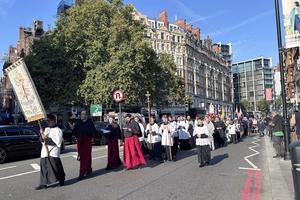
In medieval England, kings visited the shrine at Walsingham, walking in procession, bringing great crowds with them. They arranged for candles to burn there in their names, establishing Walsingham as a shrine that became famous throughout Europe.
And then came the 16th century. Henry VIII decided to make himself head of the Church of England, renouncing the bond with Rome over the issue of divorce. Henry had been a traditional Catholic — he went to a Latin Mass every morning and famously put his name to a book defending the seven sacraments. But he wanted to entrench his own power, and, in due course, in pursuit of this, he oversaw the ransacking of the nation’s monasteries and shrines, including Walsingham. Earlier, as a pious king, he had gone there on pilgrimage, praying for a son who would seal the future of his dynasty. It was not to be, and he seems to have resented Our Lady of Walsingham, as a result. The shrine was destroyed.
Destroyed and Refound
For years — centuries — Walsingham was forsaken. The statue of Our Lady was burned at Chelsea, and pilgrims no longer made their way along the Norfolk lanes. The Catholic faith was itself outlawed. It was only at the very end of the 19th century that the first stirrings of a revival of the shrine came.
An Anglican lady bought the old Slipper Chapel — so called because it stood in the “slyp” or lane that led to the shrine — and when she in due course became a Catholic, the chapel became a place of Catholic worship.
In 1897 by decree of Pope Leo XIII, the sanctuary of Our Lady of Walsingham was restored.
Then, in the early 20th century, the Anglican vicar, Father Hope Patten, created a new Anglican shrine. From the 1920s onward, Catholics and Anglicans came in large numbers on pilgrimage.
In 1934, during a 10,000-person pilgrimage, the Slipper Chapel was declared the National Shrine of Our Lady for Roman Catholics in England.
Americans made a special contribution to the unfolding story: During World War II, young American airmen stationed nearby visited the shrine and had Mass there. Pictures commemorate this and record how their presence helped keep the shrine alive during years when big pilgrimages were impossible.
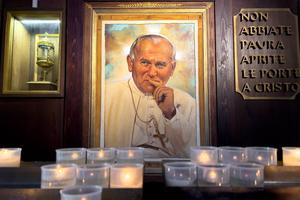
When Pope John Paul II visited Britain in 1982, the Our Lady of Walsingham statue was taken from the Slipper Chapel to Wembley Stadium and placed on the altar while the Pope celebrated Mass for thousands.
Today, the two shrines, Catholic and Anglican, are thriving.
New Chapter
The latest news is related to Pope Benedict XVI’s special offer to Anglicans to join the Catholic Church, as outlined in his 2009 apostolic constitution Anglicanorum Coetibus, allowing them to bring with them their own traditions, forms of worship and general patrimony.
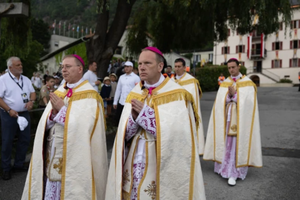
They came — about a thousand of them in 2011, with their clergy being ordained and one of their former bishops, Msgr. Keith Newton, being appointed ordinary to lead them. The new structure created for them has been officially named the Ordinariate of Our Lady of Walsingham, thus honoring England’s ancient shrine and opening up a new and significant chapter of its history.
This summer Msgr. Newton led a pilgrimage to Walsingham. He celebrated Mass at the Catholic shrine, and then the whole group went to the Anglican shrine, where there was fellowship and shared prayer and the traditional
sprinkling with water from the
holy well.
The ordinariate’s patrons, Blessed John Henry Newman, whose feast day is Oct. 9, and Our Lady of Walsingham, surely approve of the resurgence in pilgrimages to this holy place in England’s picturesque countryside.
Joanna Bogle writes from London. She hosted the
documentary Walsingham: England’s Nazareth, which aired on EWTN.
Planning Your Visit
Walsingham welcomes pilgrims. It is a beautiful village, and both shrines are well worth visiting. There are places to stay, including the Pilgrim Bureau, which offers good accommodations at a modest price. Public transportation is limited, as Walsingham is in a rural area some miles from the nearest town. The best plan is to join a pilgrimage being organized by a Catholic group. Contact the shrine for information: Email [email protected] or telephone 01328 820217. Also visit Walsingham.org.uk/romancatholic/.