Every once in a while a wonderful serendipity takes place – a congruence of events or experiences that make you sit up and take notice. While some may call such events coincidences, I prefer to think of them as Godincidences. My most recent Godincidence took place this morning.
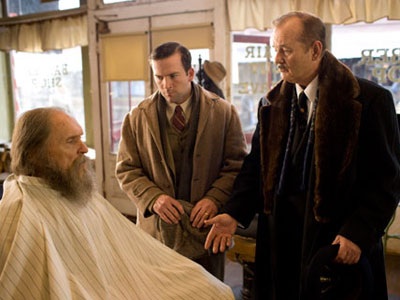
Last night, my wife and I finally got around to watching Get Low, a film about a hermit named Felix (Robert Duvall) with a dark secret who desires to have a funeral “party” while he’s still alive. Based, in part, on a true story, the movie’s Felix enlists the help of funeral parlor owners (Bill Murray and Lucas Black) to make all the necessary arrangements. Felix wants everyone with a story about him to come to the party to share their story.
This morning, a friend, sent me the text of New York Archbishop Timothy Dolan’s pastoral letter – The Altar and the Confessional.
How, you might ask, could a Hollywood film and an archbishop’s pastoral letter be similar? Well, they both focus on the need for confession and forgiveness.
Without giving too much away, Get Low’s Felix has shut himself off from the world, living in a “prison” of his own making, because of a mistake made 40 years earlier. He has the need for confession, grace, and forgiveness, but cannot forgive himself or bring himself to ask for forgiveness.
Archbishop Dolan writes about our “confessional culture.” When I read Archbishop Dolan’s line, “Our culture does not need to be taught how to confess; it needs to discover where forgiveness can be found,” it reminded me of Duvall’s character.
Felix imagines that his funeral party may be an opportunity for him to confess. Think of it as his “Oprah” moment, if you will.
Archbishop Dolan notes that, first, there must be a recognition, a shock, an acknowledgement of the seriousness of sin. It does exist; and most of us – myself included – do it daily. What’s wrong with the world? “I am,” wrote the great British journalist, author, and Catholic convert G.K. Chesterton.
“Some are inclined to replace exaggerated attitudes of the past with other exaggerations: From seeing sin everywhere they pass to not recognizing it anywhere; from too much emphasis on the fear of eternal punishment they pass to preaching a love of God that excludes any punishment deserved by sin; from severity in trying to correct erroneous consciences they pass to a kind of respect for conscience which excludes the duty of telling the truth,” Archbishop Dolan quotes from Pope John Paul II.
Once we’ve acknowledged our sin, we need to know where forgiveness can be found. Our culture has a deep need for this Sacrament, whether it recognizes it or not.
“Our culture does not need to further expose the stain of its sinfulness; it needs to discover the only One who can wash it away,” writes Archbishop Dolan in his appeal to priests to offer the Sacrament, and to Catholics to avail themselves of it.
The timing of my viewing of the movie and the reading pastoral letter isn’t lost on me. My youngest son is preparing to receive the Sacrament for the first time this weekend. When I open the closet door, with him sitting on one side and myself sitting on the other - something I’ve done with each of my previous four children - and go through a mock teaching version of the Sacrament, I pray that I can keep Christ’s perfect justice and perfect mercy in mind.
What about Get Low’s, Felix? His funeral party is his opportunity to “confess.” Is he be able to? You’ll have to watch the movie to find that out.

Comments
Post a Comment
Both the movie and the letter and well-worth reading!
We watched that movie last week and reflected for a long time afterwards about the gift of the Sacrament of Reconciliation and how blessed we are in the Catholic Church to have this gift. Archbishop Dolan is right on and priests do need to encourage confession in their parishes. Our pastor has added a new opportunity on the Fridays of Lent for those of us who attend daily Mass. With only an hour on Saturdays, many folks become discouraged at the long line and just give up…when they are probably more in need than the daily Mass attendees.
While I would never, ever assume to disagree with Archbishop Dolan or His Holiness John Paul II, I must say that the thought progress contained in this quote has much to do with the loss of a Sacramental mentality concerning sin and Confession:
“Some are inclined to replace exaggerated attitudes of the past with other exaggerations: From seeing sin everywhere they pass to not recognizing it anywhere; from too much emphasis on the fear of eternal punishment they pass to preaching a love of God that excludes any punishment deserved by sin; from severity in trying to correct erroneous consciences they pass to a kind of respect for conscience which excludes the duty of telling the truth,” Archbishop Dolan quotes from Pope John Paul II.”
This was the “spirit of Vatican II” mentality that reduced the use of the Confessional by many Catholics. When we were made more aware of our sins by solid Homilies guiding us towards attaining Grace, we were more apt to recognize our need for Absolution and Penance. Now, not so much. I would argue that maybe we DO need more ” exaggerated attitudes of the past”.
WONDERFUL! Good job! Thank you
“This was the ‘spirit of Vatican II’ mentality that reduced the use of the Confessional by many Catholics. When we were made more aware of our sins by solid Homilies guiding us towards attaining Grace, we were more apt to recognize our need for Absolution and Penance. Now, not so much. I would argue that maybe we DO need more ” exaggerated attitudes of the past”.
In the mid 70s I made a wandering return, through various faiths, back to the Catholic Church, the faith within which I was born and raised. This was several years past my college days; I was now married with a couple young boys who would be starting school in a couple years. The most interesting thing I observed upon my return to Mass was the numbers of people who were receiving Communion on Sunday. I remember thinking that people have really gotten “holier;” and the Church must have been doing a really good job ministering to them while I was gone . It used to be that at least half the people would remain sitting in their pews while the other half would stand and step carefully over their feet, working their way to the isle where they proceeded to the alter. Now, everyone in the pews rose and stood there in a line waiting patiently for their turn to move out into the isle to join the slow, long procession down to the alter to receive the Holy Eucharist. I must admit I wondered how many were in that procession out of fear of embarrassment of not wanting to remain seated while everyone else was stepping over them. Something wasn’t making sense because there was hardly anybody at Confession the day before, especially in contrast to the numbers of people receiving Communion. It seemed like “being Catholic,” while I was gone, had become a lot easier then it used to be.
Fr. William Casey has made the observation in one of his Lenten Retreats
on EWTN. He was astounded at the number 0f people receiving Communion
compared to the number of people who went to confession the day before.
But then scheduling Confessions a half-hour or hour before Mass does not
much time for confessions. Not only that many of our brethren no longer
have a sense of sin. May God have mercy
Archbishop Dolan likes to talk. Where’s the action? Why is Dolan allowed to openly disobey Canon 915?
I agree with Stilbelieve and D. Morgan. When I go to Confession, I’m usually the youngest person there (I’m 56). Everyone is 65 or above. However, the last time I went, there were several young people. One young man was even praying the rosary. It warmed my heart to see that.
Post a Comment
By submitting this form, you give The National Catholic Register permission to publish this comment. Comments will be published at our discretion, and may be edited for clarity and length. For best formatting, please limit your response to one paragraph and don't hit "enter" to force line breaks.