Print Article | Email Article | Write To Us

The Many Faces of Mary

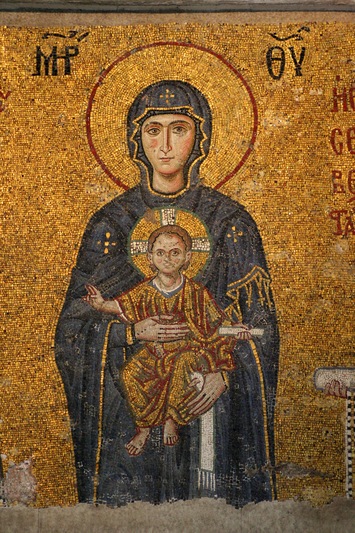
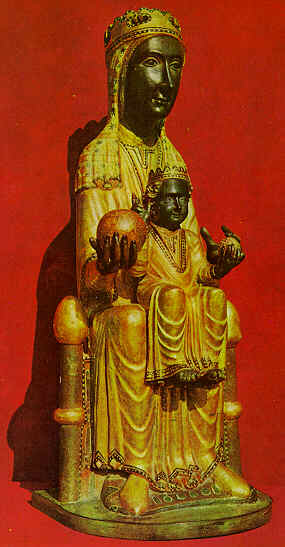
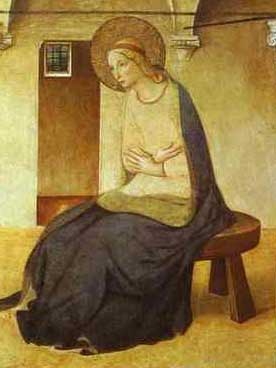
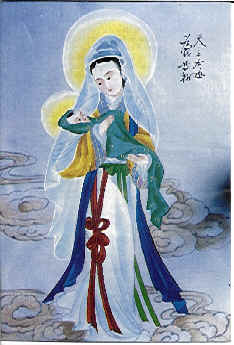
How well do you know Marian iconography?

Tuesday, May 31, 2011 2:00 PM Comments (101)

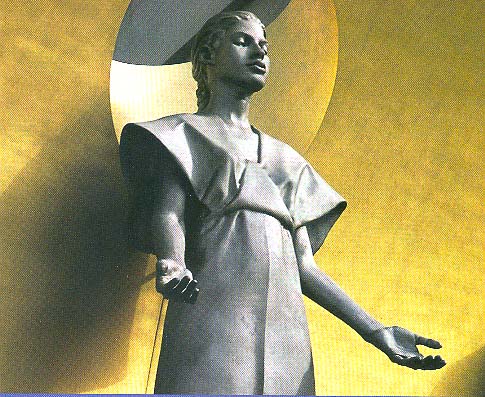
Following up on last week’s “Bad Church Art” post: I don’t mean to pick on Los Angeles’s Our Lady of the Angels Cathedral, but ... well, actually, I guess I do, come to think of it.

One combox reader objected that “Anyone who has even a passing familiarity with Christian and Marian iconography would instantly know that this is Mary.” I’m hardly an expert, but I think I have a more than passing familiarity with Christian and Marian iconography. (I’ve seen a number of the works below in person, to start with.)

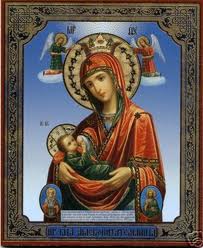
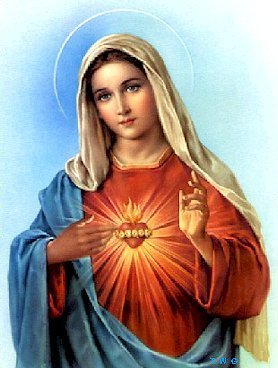
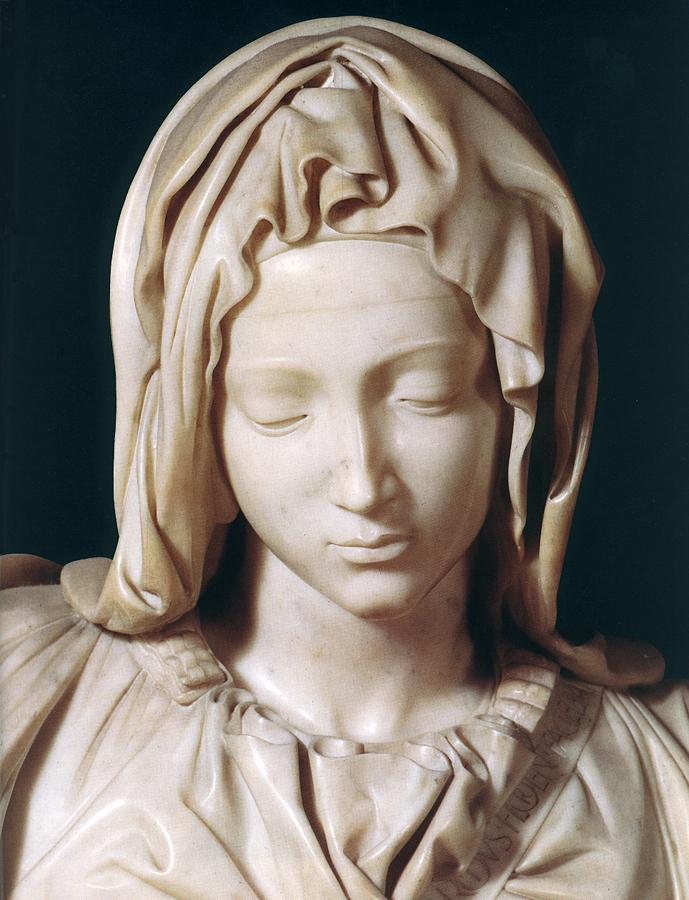
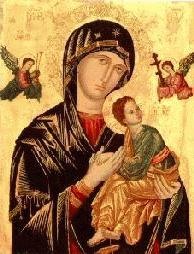
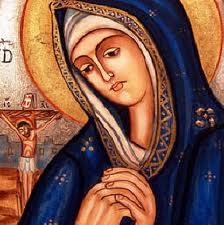
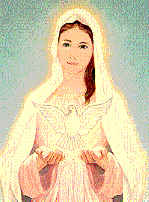
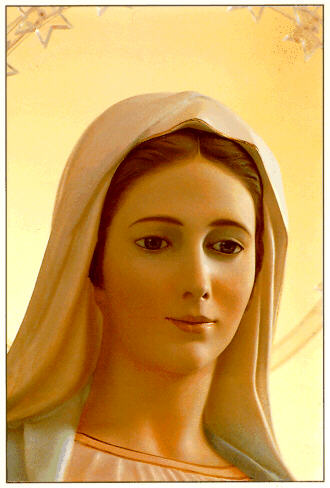
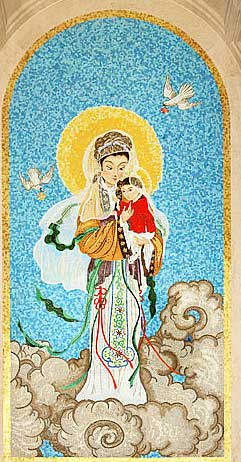
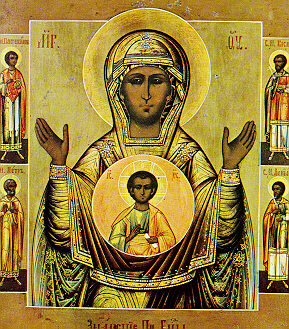
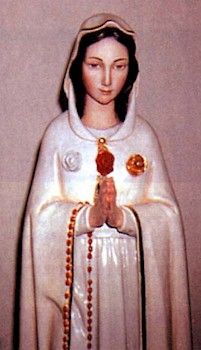
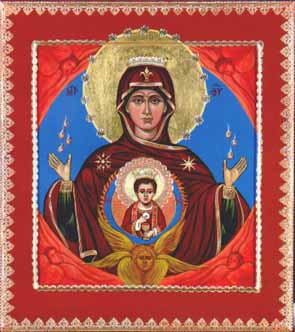
How about you? Some of the Marian works below are famous; others may not be. How many do you recognize? List them in the combox! While we’re at it, let’s play a game of “One of These Things is Not Like the Others.” (Cue “Jeopardy!” music: Do DO do do, do DO do…)
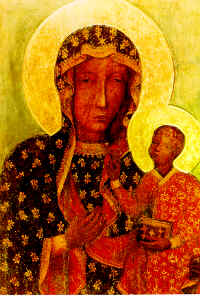
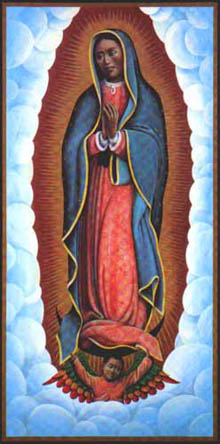
image
image
image
image
image
image
image
image
image
image
image
image
image
image
image
image
image
image

Postscript: A friend of mine once wrote regarding the last image above:

The idea behind it (for better or worse) is that the sculpture incorporates various ethnicities, making Mary a universal. (I see more African than others, but I do see that this is a mix.) I see this statue in the same light as I see pictures of the Gospel from Africa in which Jesus is black, or from Korea in which Jesus is Asian. I know that Jesus and the disciples were Mediterranean Jews, which would mean they would likely have certain features, but I also understand them as being people who transcend that physicality. It is good to have Jesus (and Mary) in whom we can see ourselves.

To this, I responded:

Yeah, but here’s the thing. I’ve seen 100 percent African Marys, Asian Marys, Latin American Marys, etc., that still exhibited continuity with the heritage of Christian sacred art in general and the representation of Mary particularly.

The Mary of popular devotion takes countless forms, Eastern and Western: There is the Virgin of Guadalupe, of Lourdes, of Fatima, of Loreto, of Czestochowa; Our Lady of Africa, of Europe, of Montserrat, of Shongweni; Our Lady of the Snows, of the Valley, of the Wayside, of the Woods; Our Lady of Perpetual Help, of Sorrows, of Victory; She who shows the Way, Mother of Loving Kindness, the Virgin of the Sign.

Yet remarkably despite vast diversity of cultures, styles and traditions, there is still something recognizable about Mary from culture to culture, tradition to tradition. The Mother of God Enthroned in Eastern iconography is somehow recognizably the same figure as the Virgin of a Western pieta, or the miraculous medal image.

What’s going on in the LA cathedral strikes me not as a blending of cultures, but a radical break from all previous Marian iconography. It looks less to me like any conceivable Mary than some New Age goddess or icon of the Feminine As Such. It is as much or more Pocahontas, Joan of Arc, valkyrie, priestess, Amazon, you name it, as the Mother of God.


Filed under art, church art, virgin mary

Comments

Post a Comment

In JPII’s “Letter to the Artists” he writes, “In producing a work, artists express themselves to the point where their work becomes a unique disclosure of their own being, of what they are and of how they are what they are.” I would like to spend time with that piece and hear more from the artist about the inspiration and see it in its designated place in the church itself. Many great works and new styles have come about by artists responding to an inner voice calling them to reveal beauty in a new way.

At first look, I agree with much of what you are saying in terms inconclusive identification through this artist’s representation of Mary the Mother of God. Scripture and Mary herself seem to provide some clue as to her identity when she appears and speaks to us. Even the Angel Gabriel addresses her by name giving us the quote that has been prayed countless millions of times by the faithful. These reinforce the idea that Mary is a specific person. Just as God is three persons and not some mystical force somehow guiding and powering the universe like a giant battery storehouse powering a bunch of energizer bunnies.

The very real person of Mary is very important.  She is the mother of us all AND she is one person, who stood on the Earth at a particular place in a particular moment in history until she was assumed into heaven. “...beauty is to enthuse us for work, and work is to raise us up”. Our work, as she consistently reminds us, is to personally know, love and serve her Divine Son through continual and joyful repentance, prayer and mortification.  This is a very tricky message for us to understand!

When I visited the L.A. Cathedral, I thought it was an angel or something.  Didn’t know it was Mary until I got home and was reading the booklet about it.  In fact it never entered my mind it might be Mary at all!

I hate how un-feminine it is. I’m not saying Mary should look like a female super hero or something, but come on - she was a woman, not a teenaged boy getting his black belt in karate!

No mantle, no sleeves=not Mary.

And that’s putting aside her flat chest, big hands and androgynous face!

Steven, this was clearly sculpted from a still of Dreyer’s “Joan of Arc.”

An African Mary in Africa, an Asian Mary in Asia, a European Mary in Europe. What about a mixing pot Mary in mixing pot Los Angeles?

The problem may be her wardrobe doesn’t look like anything this side of Coruscant.

@ Patrick Coffin: I’ve often thought the same thing.

Though well-intentioned, the attempt to make her “universal” by emptying her of particularity makes her look less human.  That’s why the series of particularizations is much better.

@Brother Mark ... no, it’s Vulcan.

Think the “problem” with the statue has it’s roots in the incongruity of the facial expression and body pose with the dress (short sleeves, descending neckline???) not in the features.  The facial expression and pose looks more like someone who is meditatively self absorbed or seeking something for herself from God rather than the Mother of God contemplating or praying so as to invite the viewer to imitate her and raise their thoughts to God.  There is nothing motherly about the statue. Instead it is more a statue that seems to say “Contemplate, me, a universal woman.” Mary always leads us to her son, not to herself.  What it could have said was “I, handmaid of our Lord, all women join me in contemplating, praying, and conversing with my Son who is our God.”  I think the same exact features could have been used with a different facial expression, pose, and dress and it would have clearly invited all races to look to our Lord.

I think the problem with art of this sort is that it is absent of those things that all images of Mary have in common.  It’s like the diversity myth that exalts our differences, rather than what we share in common.  If you do not recognize her as Mary, then she ceases to be Mary in the eye of the viewer.

I think she looks like a dude….a young, slightly effeminate dude, but a dude nonetheless.  Awful.

The picture you have here of the LA Mary is much nicer than the two on your previous post, she looks lovely here and androgynous in the others. So before I judged it I would want to see for myself how she generally looks to someone in the cathedral. Photographs can make things look better or worse than they do in real life. Obviously (or I hope it’s obvious!) there is a problem with an androgynous Mary dressed in a Star Wars costume. But on the other hand… She is very finely done, not some weird blobby or cubist thing, and not one of those bizarre metal statues made from a cast of a clay sculpture that is all covered with ridges from finger marks. I really can’t stand that. I was actually relieved when I saw a photo of this Mary for the first time, because a) there was actually a statue of Mary (who is often left out these days—lots of people dont’ want to claim her) and b) it was recognizably human. That is a step in the right direction, even if it’s only a small one. As for the cathedral itself, from the pictures I’ve seen I also think it is a finely done example of what it is, not a slapped-together box. I don’t like that style, and I would never give a cent toward its construction, but there are FAR worse and badly done examples of that sort of architecture.

@ Gail F: I’ll give you that, it’s a nice statue, even attractive in its way—although I think much less of its blocky geometric setting. My main problem with the statue is not that it’s ugly—it isn’t—but the utter lack of any Marian context (except for the stylized crescent at her feet), the complete break with the history of Marian art.


A mantle and normal sleeves would have gone a long way toward reducing the cognitive dissonance. More substantially, if the artist found some way to include a (a) Christological, (b) Pneumatological (Holy Spirit), or (c) angelic (Our Lady of the Angels, right?!) motif—or two or more of the above—it might have been a successful work of Christian art. (One might then feel justified in identifying the moment as the Annunciation. As it is, it could evoke anything from Dreyer’s Joan of Arc to a pagan priestess consecrating herself to Gaia.)

Steven: Yeah, you’re right. It could have been a lot better and it is not recognizably MARY. I guess I am still mostly relieved that it’s not worse.

We need to ask ourselves, would the Virgin Mary have dressed like this or struck a pose like this as if she were involved in some sort of New Age Centering Prayer? The answer should be, “no”. That being said, she is not an accurate representation of the Virgin Mary and sends the wrong message. Mary was a young girl; humble, obedient and innocent. None of this is reflected in this image which I personally find very disturbing only from the perspective that it is a “representation” of the Blessed Mother.

She does look like a young girl to me, but not the Virgin Mary: No veil, for one thing. She could be at the point of the Annunciation, saying “Be it done unto me…”
The beautiful thing I like at the Cathedral of Our Lady of the Angels is the tapestries of the Communion of Saints. Not that I have ever been to LA, but every time I have seen pictures of these tapestries, I have been moved.

A five year old can readily recognize a statue of Mary.  They wouldn’t recognize this statue as Mary, neither would I.

It’s interesting and I think conclusive that the only image of Mary “painted” by Heaven above for us, is a recognizable icon, with the static gesture,immoble features,and symbolic background. That is Our Lady of Guadalupe. This image of Mary from God’s own Hand, has led me to appreciate the icons of the Eastern tradition…who can criticize God Himself?

So ... how the 17 other Mary images above? Anyone want to start identifying ones they recognize?

The statue shows a proud woman, not a humble one, one who is the source of life rather than one who carries Life within her.

She is turned in on her own thoughts rather than outward as Our Lady, approachable, advocate.  I find it hard to think I cd get this person’s attention.

I have seen this statue. Not only is it difficult to see the connection to the Blessed Mother, it is difficult to tell whether it is a representation of a youthful woman or a youthful man. It Is like the Cathedral itself, neither barn nor church. It is a ‘progressive’ mess.

If you can find Mary, you can find Jesus. Maybe this is why Jesus doesn’t have a place in this “church” as He is looking for His Mother?  May God have mercy on us and all those that connected to that “church”, may their eyes be opened. +JMJ+

She actually is better than an image of Mary in one of our local churches in the Youngstown diocese where she looks like she’s from another planet along with an alien baby. Their processional cruscifx also has this strange looking being on it. Everthing is out of proportion and somewhat science fiction looking. Years ago the organist told me she was praying for it to fall off the wall and break! Her prayers have not been answered yet.

Interesting to try to point out what it is about the traditional portrayals of the Blessed Virgin that helps us to identify her so readily.  If you look at the examples, you will notice that Mary is always either 1) looking down with her head at an angle suggesting humility; or 2) looking directly at the viewer while presenting her son to them.  None of them have her tilting her head upward as in the LA Cathedral. 

I think that the veil and the long sleeves also are important, but that it’s her traditional posture that is most striking.  The androgyny thing that people have mentioned is also very odd. Why turn a mother into a non-gendered humanoid?  It makes it very difficult to feel warmth or closeness to her.

Neither male nor female.  Actually, it would appear it is modeled after a 18 to 20 year old man.  There is nothing that makes this image something to ponder from the point of view of authentic feminism.  There is no warmth portrayed from this image.  It more models a young man in a yoga pose.  This is written in the spirit of charity.  The image makes me very sad.

If she were veiled and her mouth was closed this post would not have happened.

Steven, I’ll try:
1. Our Lady of Czestochowa
2. Our Lady of Guadalupe
3. Our Lady Seat of Wisdom?
4. ??
5. The Annunciation by Giotto
6. Our Lady of Akita Japan
7.
8. Immacuate Heart of Mary
9. Pieta
10. Our Lady of Perpetual Help
11.
12.
13. looks so familiar but can’t figure it out!
14.
15.
16.
17. Theotokos Vladimir ?
Wish I had time to figure the rest out. I’ll look forward to the answers from others!

Growing up Protestant I was typically told Mary was just some young girl, nothing very special, who God happened to choose to mother his child. As a Catholic I now believe something very different with regards to her life and service to the Lord. This statue, to me, looks very much like that Protestant understanding of Mary—average and plain. The beauty of a well made icon is that it doesn’t portray the saints just as they were (maybe Mary did look just like this statue in LA) but how we see them with our otherworldly eyes, to put it awkwardly. While I don’t find this statue particularly offensive, it may not be a very good reminder of who our Mother is to the Church.

I too think the statue is awful; just like the cathedral, which looks more like an art meseum than a place of worship.

No one knows what Mary looked like. So, catholics take a picture of any female and put a sign under it saying Mary. A statue of any female, put a sign..Mary..on the foot, and bang, the faithful are on their knees to it.So, then, i can take picture of Cookie monster and hang a sign…Mary…on it. Bang, the faithful will be on their knees to it. How about Marilyn Monroe. If it doesnt have to look like Mary, then whats the use. You can bow down in front of a trash can and pray to Mary. If its not Mary, its not Mary. Thanks for your time

@ wayne: Thanks for sharing what seems to be your incorrigible ignorance, apparently untroubled by the contradictory evidence of ... nearly every comment prior to yours. Or have I misread you?

The statue fits in with the theme of the cathedral. The structure is unrecognizable as a church from the outside. When you’re inside you can’t tell if it is a Catholic church because the taburnacle is no where to be seen. So, it must be fitting that the Queen of Angels be unrecognizable as well. The whole place is like something out of the Soviet Union. Stalin would be proud.

Well, you have a statue that accurately reflects the building. She is not Our Lady of The Angels, it is Some Lady of The Angles.

It is a fact that the architect, Rafael Moneo, deliberated avoided the use of right angles in his building. The syncretistic statue by Robert Graham (who also created the “everything pagan” doors) is an appropriate depiction for a building that avoids continuity with the past by avoiding an essential theological angle, yet trumpets the use of “all angles” and consequently reduces worship in the building to the bad pun the architect intended. Instead of direction and continuity we have a cacophony of competing angles that yield a misshaped barn. Vast, imposing - but a barn nonetheless. In the case of the statue, Mr. Graham has pirated features resulting in a eugenicist’s take on the ideal woman: the bride of Frankenstein. Leave it up to man to think he can improve on God’s handiwork.

The Los Angeles “cathedral” is a frumpy box crammed with stuff to hide the fact that the architect has (not-so) cleverly concealed his radical departure from Catholic architectural understanding. The only ideal preserved is one of permanence. We’re likely stuck with the hulk for centuries.

The statue, somewhat androgynous and clumsy, is right at home on the doorstep of the LA Cathedral. It’s the generic garden gnome of the Cardinal Mahoney legacy.

California seems to draw peculiar architecture for churches.  Does someone want to compare the L.A. Cathedral in which this “Marian” representation appears to the “Saint Mary Maytag” cathedral in San Francisco?
In each case, the architect presents some ideas, and the archbishop serving at the time the design is settled must bear responsibility.  No one would ever mistake the churches in question for classic structures from the Middle Ages.
TeaPot562

The statue? It would appear to be Left Coast Mary…and am also sure she
would never be comfortable in Saint Patrick’s Cathedral..nor recognizable.
As some have pointed out it is the artist’s realization. Whether it is authentic artistically or has spiritual veracity should be determined by the Archbishop of Los Angelos. If it was the former Archbishop made Cardinal ..well, may I say he had lots of “trouble” with veracity and credibility. This may be one of the more notable examples.

Yes, there are many faces of Mary, but one less than are given here. This is like a “which one does not belong” exercise. Anyway, I can’t really add to the list given in a previous post. I have seen most of these before but don’t know what they are called.

It looks like she’s saying “Help me Obi-Wan; you’re my only hope!”

Who can present her perfectly? Only Our Lady of Guadalupe is her self portrait. Yet this last image is something you might find in Joe Stalin’s Russia representing the Russian female worker.
Thank you God for not making me live near it.

The difference is that, in all the icons and statutes, Mary’s glance rests on someone, either on her Child, in the Annunciation on the Angel Gabriel, or on us. Her love is directed at Christ, at us. Mary exists in order to love. The statue in Los Angeles is not looking at anybody, but is absorbed in herself, in feeling her own power.

The cathedral website describes the statue thusly:

“The ornamental space above the pair of bronze doors contains the 8 foot image of Our Lady of the Angels. The modern figure is presented as a woman “clothed with the sun, with the moon under her feet” (Revelations 12:1). The halo shaft above her head shines God’s light on her as the sun travels from east to west.

Mary does not wear the traditional veil. Her arms are bare, outstretched to welcome all. Her carriage is confident, and her hands are strong, the hands of a working woman. From the side can be seen a thick braid of hair down her back that summons thoughts of Native American or Latina women. Other characteristics, such as her eyes, lips and nose convey Asian, African and Caucasian features. Without the conventional regal trappings of jewels, crown or layers of clothing, she has a dignity that shines from within.

Originally, two bronzed angels were to be placed one on each side of Our Lady of the Angels. However, the first Spanish name for Los Angeles was El Pueblo de Nuestra Señora, Reina de los Angeles. Mary is Queen of Los Angeles, so the people in her city are her angels.”

What strikes me is that it appears that, unlike all other images shown here, her eyes are closed.  In meditation?  In submission?  Whatever the reason, she appears to be (whether intended or not) more passive.

Dcn. G.

Dcn G: Thanks for the interpretive statement from the cathedral. Perhaps someone should be told that the name of the last book of the Bible is Revelation. Not Revelations.

I think, in terms of her face she looks like T’Pol the vulcan first officer from the Star Trek “Enterprise” a thorughly beautiful woman but not someone I envision as Mother Mary

Also, that last paragraph, about “the people of her city” being her “angels,” makes no freaking sense. It’s modernist-reductionist anti-supernatural claptrap, a fig leaf to cover the absence of any Christian or Marian context.

I think it is the bare arms, the missing veil and the lower cut neckline that make it foreign to the expected images of Mary. It seems to express something that is not found in Mary herself. Even the most powerful images of Mary express her humility and modesty.  This one seems to miss essential aspects of her person.  I thought at first that it did not contain Christ either, but then realized that she does seem possibly pregnant.

I’m not a fan of the last one, either.  For an inspiring presentation of more images, visit www.facesofmary.net. There’s also a list of the titles and artists.

The statue would be good for displaying clothing, hats, or other jem-cracks that may appeal to a young boy…likely thinking the statue is another rocker.

Of course, to me, the first icon looks like a disgruntled or bilious and unpleasant female with a deformed child.  Horrid.

I thought it was Angelina Jolie. Should statues of the BVM really be made to look like the chick from Tomb Raider?  Then again, Angelina Jolie’s children are a melting pot…

To me she appears to be praying: her head is slightly tilted toward Heaven, her eyes are closed, her hands are extended in the orans position; she could also easily be addressing St. Gabriel, “Behold the Handmaiden of the Lord!  Be it done unto me ...”

Well, I didn’t recognize 1 or 3 as Marian, but I can name Our Lady of China (14).

Some answers to why “modern” religious art is bad can be found on my blog “Ad Imaginem Dei” (check out posts from 2008). 

I think no one has mentioned “Star Wars” in connection with the LA “Mary”.  The pseudo-Samurai dress looks just like one that’s worn by the elderly librarian in a scene from Episode II: Attack of the Clones.

Yoga anyone?

We had a similarly androgynous (culturally) statue in our Cathedral for several years at the height of the Spirit of Vatican II movement in our diocese. Thanks be to God, it is gone now. The question that must be asked is that if said statue were planted in a public park, would anyone know that it represented Mary? Our statue was quite lovely in a New Age goddess sort of a way, but in no way displayed any identifiably Marian attributes or features.

@ Mark Duch: From the neck up it could be Angelina Jolie. Not so much from the neck down.

@ Margaret Duffy: Actually, Star Wars has been mentioned as well as Star Trek. One person specifically referenced Coruscant, where the librarian you mention is seen.

@ Deacon Greg,

Congrats! A mature analysis and a productive contribution to a conversation that has neither been mature nor productive.

@ Steven D Greydanus

Typical… you are unable to engage a thoughtful response from someone that doesn’t blindly agree with your opinion. Instead you revert to the spelling game in an attempt to humiliate your guest.

As far as the image is concerned, it is one man’s attempt to recreate the Mother of God in art. To me it appears that alot of thought and attention went into it. I agree that it breaks with certain traditional norms associated with the Blessed Virgin but so have many other forms of art: in music, literature, film, etc. I imagine that many of this image’s critics were refreshed with Mel Gibson’s portrayal of the Blessed Virgin in the movie The Passion of the Christ. I am not sure why iconography and the creation of sacred images must adhere to such rigid tradition in order to qualify as such.

Finally there are several questions that I am left with…

1) Why does the Bl. Virgin always need to be represented wearing a veil?
2) Why so much criticism of her posture? Hands folded in prayer is a tradition that originates in the middle ages wheras arms lifted in prayer is the ancient posture, the one most likely used by Mary.
3) Does the amount of Star Trek and Star Wars references in this conversation reveal something about the group of people that espouse these views?

@Patrick: I don’t think anyone is really arguing for a rigid set of rules for iconography. But shouldn’t icons and religious art (especially those pieces in a church) be evocative of something, anything? This statue is not a reminder of Mary in the least. While I don’t understand what is so terrible about Mary without a veil or without folded hands, or even wearing sci-fi clothing, what in the world is the point of a religious image that reminds you of nothing?

The Virgin Mary is depicted wearing a veil because as a Jewish woman in the area of the world where she lived, she would have worn a veil, both for religious and hygiene reasons. Also, because of her humility before the Lord, which we should imitate. Depicting her without a veil is like showing a portait of you or me wearing Victorian or Ancient Greek clothing- while it may still represent the person depicted, it is not true to the historical circumstances of the person’s life.

@ Patrick: You’re off base, friend.


First, FWIW, the Rev. Mr. Kandra and I are Facebook friends, and I’ve commented on his blog as he now has on mine. If we aren’t necessarily close friends, as far as I know our interactions have always been cordial and respectful. I very much doubt he read my post in the jaundiced way you suggest, as an attempt to humiliate him, which it certainly was not. My note about the common confusion about the name of the last book of the Bible (not so much a spelling mistake as an actual confusion about the name of the book and its meaning) was a snarky dig at the cathedral—not at Deacon Greg, whom I thanked, sincerely, for his contribution. (FWIW, I was in a train station on my iPhone, hence the brevity of my response.)


In response to your questions:


1. Not only does Mary not have to always wear a veil/mantle, I specifically said as much in my earlier post on this subject. In fact in some traditional Marian art her head is not covered, though this is comparatively rare. The problem is not the bare head per se, but the fact that the veil/mantle is one very common hallmark of Marian art, the absence of which, in conjunction with the absence of virtually every other hallmark of Marian art, contributes to the unidentifiability of the figure. It is a cumulative problem, not necessarily an insuperable problem of all particulars.


2. I don’t think anyone is objecting to the fact that her arms are outstretched rather than folded. Compare many of the traditional Marian pieces included above with outstretched arms. I don’t think anyone mentioned arms prior to Deacon Kandra. One commenter objected to the fact that Mary’s arms were bare, not to how she was holding them. Perhaps you should read the criticisms more closely before criticizing them.


3. Actually, I find that Star Wars and Star Trek analogies are often made by people with surprisingly little actual exposure to those franchises. Often enough they are inappropriately cited, although here I think there’s actually some excuse for it. Her costume is exotic in a way that reasonably reminds people of sci-fi, which has often drawn on the exotic sartorial traditions of various real-world cultures. Is there some reason you seem to be sneering at people who like Star Wars and/or Star Trek?

Okay, I looked up more pictures… I did not realize that this statue is outside the Cathedral! It really does look kind of like Samurai Jack, as Steven said in the previous post. And it does look like an androgynous person wearing a costume from any of the later Star Wars movies or the Star Trek series with Captain Picard. They both featured those stiff, blocky sort of costumes. I think it is obvious that it’s a statue of Mary IF you know it is a cathedral named for Mary. I mean, what else could it be in that context? Otherwise—no, it is not obvious at all. It could be anyone. I have done a lot of work with architects and, while I would say the cathedral is a fine work of an architect’s vision, it strikes me as an architect’s vision of “what Catholicism might be in outer space,” and not what Catholicism actually IS. It is quite removed from human experience and all about the forms and the materials, like much of modern architecture. People are supposed to get a thrill from being inside a “space.” The art is an ornament to the form, not important in itself. And the tabernacle is a DISGRACE.

Aside from what other people have mentioned here, I’m noticing that she has rather a low cut dress for the Virgin Mother of God.

@ Gail F: “what Catholicism might be in outer space”
 
Brilliant!

I am an artist and not a old fogey…I visited the cathedral last Summer and felt as if I was in a tomb. Cold. Almost artless. Barren. Sterile. And that statue of Our Lady you mention…I would be ashamed to have am image of even my natural mother that looked as unrecognizable and clueless. The crypt of the cathedral is where the art and devotion can be found…very much like the state of the Faith in the LA Archdiocese: it’s there but you have to dig to find it IMHO.

ALL IS NOT LOST AFTER-ALL! Go to www.pixelmap.com/dma_moneo.html
  Moneo is the spanish architect of the cathedral, and on this site the woman is called an angel, and not Our Lady!
Things are not as dark as we thought.

@ charles Woodbury: The statue nominally represents the Virgin Mary, not a welcoming angel. The artist was commissioned to create a statue of Mary. The cathedral confirms that it’s meant to represent Mary. For all the other disconnects, the fact that she’s standing on a crescent moon, as abstract and stylized as it might be, is a giveaway that it’s meant to represent Mary, even if it’s otherwise problematic.

Back at Steven D. Greydanus: Possibly someone that did the site I sent to you wanted to be charitable. I won’t thank you for correcting me, because for a little while I didn’t feel so bad about it, though I understand it was necessary that you did.

In the other representations, Mary is looking right out at you with loving concern (a look which can be gentle but often looks stern), or at Jesus with the same. The Judo Queen of Heaven looks to be pridefully soaking up our adulation or maybe just catching some rays. She looks more smug than peaceful. She is turned inward.

Her clothing leaves something to be desired, as well. It’s not that Our Lady of the Hospital Smock has to wear one particular outfit; a quick review of the other statues and paintings show both traditional and local garments. What it is, perhaps, is that each culture that sees fit to depict Mary also produces clothing that makes a woman appear feminine. Our Lady, Help of Romulans is not wearing anything with line, drape, or color that says “feminine”. If Mary, the new Eve, that singular female creation, that Divine Mother, isn’t feminine, then who is? If we don’t depict her as such, what does that say of our understanding of the feminine?

In reviewing the comments a few have sincerely tried to find something redeeming in the statue. The main problem seems to be that the woman doesn’t bring to mind Our Lady at 1st look.
If there were a caption below it could sooner read “Sleepwalking goddess of reason” than “The Blessed Virgin Mary”.

Mary was a Jewish maiden. Period. Although I understand placing her in the context of differing cultures and having her resemble such, I prefer her in representation as who she herself physically is - Middle Eastern.

A statue that encompasses ALL images of the Blessed Virgin Mary is just not possible.  Like a potato salad that encompasses all types of cultures’ potato salads…..just rather silly.  Like the tower of babel…one language to serve all peoples.  Just not possible.

No Christ as a baby…now THAT is a tell-tale sign that this is NOT the Blessed Virgin Mary…..!  Patricia in St. Louis, MO

Have you seen the statue of Our Lady at the Shrine of the Blessed Sacrament in Hanceville, Alabama? There is something very, very, RIGHT about it! Considering both were built and furnished at the same time it would be interesting to take a poll: Beautiful? Ugly? I would pray that Retired Archbishop Mahoney would show us by example how to be a gracious loser.

How can I see the image of Our Lady at the Mother Angelica Shrine in Alabama?  I went to the site and saw everything but!  Someone in this line of comments mentions this statue as being so very Marian…...I lived in California for about 20 years.  This image of the Blessed Virgin Mary is just not like her in soo many ways…maybe the artist was having a bad sculpting day!  Patricia in St. Louis, MO

Patricia Cornell:  click here

@Patricia Cornell: http://www.flickr.com/photos/ted_abbott/3526276475/in/photostream In the Shrine’s website photo gallery, you can see it in a picture in between the Monuments to the 10 Commandments and the Beatitudes.

Thank you crnuge; this time, I found it….it is truly beautiful.  I see no way a Christian would not recognize this statue as the Mother of God and truly appreciate the artists’rendition.

She appears strong physically and we know she was super-strong spiritually. 

The image of Our Lady of the Most Blessed Sacrament I first saw in the 1990’s just blew me away, so powerful and peaceful the image is:
http://www.acfp2000.com/Our Lady/Our Lady of the MSS.html

I am interested in finding the owner of this image.  I handcraft icon art.  This image would be a big winner at a Catholic Conference where I live in St. Louis, MO.

Patricia in St. Louis, MO

This statue is haunting me. I’m back to say that I just sent a letter to archbishop Jose Gomez asking him to replace it, and if not, to at least NOT authorize someone to make small copies of it. (as if anyone would buy one).
His address is 3424 Wilshire blvd. Los Angeles, Calif. 90010 if you wish to pile on.
I stood idly by when bishops and priests tore out our alter rails and made us stand, and moved His tabernacle from the center of focus, and then promoted Holy Communion in the hand, all done on their own, the result being irreverence and disunity in the church.
  But I’ve had enough. When I see more trashy or inappropriate innovations done by them, I’m going to squawk.

NO one person in this blog appears to be standing up for this statue, which may have been blessed….does that make it more appropriate…I think not.

Mr. Charles Woodbury..perhaps taking a copy of this blog would alert the new Archbishop to the seriousness of this issue….it is a sacraledge (s) when a beautiful woman is made not so.  Patricia in St. Louis, MO

Thank you for the suggestion, Patricia Cornell. Blog with comments, all 15 pages, are soon in the mail.

Re the veil….there is one Catholic blog by someone called timman in which many people extole the virtures of women wearing a veil in church..

..if you do a search for timman catholic blog you will probably find it…better yet, here is the discussion at this website:

http://stlouiscatholic.blogspot.com/2008/12/truth-unvieled-head-covering-still.html

....in the days of the Blessed Virgin Mary, only loose women did not wear a veil, all the better to advertise their ‘wares’, so to speak.

In His Holy Name,  Patricia

Can you please write an answer for key for the images—seriously, I only knew about 3 of them….as for the LA statue: eh.

People here keep mentioning that Mary should be portrayed as physically beautiful.  My question is…why? Is it written in the Bible that she was gorgeous?  All we really know of her is her age and that she was chosen to be the Mother of God.  We have projected our own ideas onto Mary.  She may not have been beautiful by the standards of her times (standards of beauty change according to the culture and times a person lives in), which is possibly why she was betrothed to an older, widowed man. 

..

I’m disturbed by the idea that because Mary was deemed worthy by God to be the mother of his Son, she had to have been physically beautiful.  God does not judge us based on our physical appearance. Yet here we are, complaining because an artist’s portrayal of Mary isn’t “pretty” enough. What message would this send to young girls?  “You can’t be like Mary unless you’re pretty?” 

..

Personally I like the feeling of strength and humility the artist has portrayed in that statue.  Is she dressed like a Hebrew maiden? No.  She looks, at least in that picture, like somebody asking for and drawing on the strength given by God to bear an immense responsibility.  It’s a picture I’d like to have nearby.  She looks stronger than the milquetoast pictures of Mary I grew up with, like somebody who could truly ride a donkey a long distance during her last month of pregnancy.

@Karen - “She may not have been beautiful by the standards of her times (standards of beauty change according to the culture and times a person lives in), which is possibly why she was betrothed to an older, widowed man.”  What?????  I think Mary is beautiful not because of any outward physical beauty or perfect features. Mary is beautiful because of who she is. A young, humble, obedient girl chosen by God to be the mother of the Savior of the world. You are right when you say that God does not judge us on our physical beauty but this particular artist’s rendering of Mary leaves much to be desired. Mary could have been portrayed as “average looking” but she should not have been depicted with the physical features of a woman who clearly could not have been from the Middle East wearing inappropriate attire. Young girls can look to Mary for her inner beauty which is where any authentic beauty really is.

Mary Rose—then why are all the preferred Western images of Mary showing a woman who has perfect, idealized features? Why not a simple, plain woman, if indeed we can look to her for inner beauty? We’re sending a mixed message to girls if we tell them “beauty is found within” while showing them a picture of a lily-white-skinned, perfect-featured Mary who clearly is not from the Middle East, as the real Mary was.

@Karen “then why are all the preferred Western images of Mary showing a woman who has perfect, idealized features?” Karen, you obviously have not seen the image of Our Lady of Guadalupe. This image was given to us by the Blessed Mother herself on the tilma of Juan Diego. Lily white? I think not. Do you see any resemblence at all to the image we are speaking about in Los Angeles?  http://www.bestcatholic.com/images/our_lady_of_guadalupe.jpg
You obvsiously have some sort of “race issue”. The Blessed Mother transcends race.

I just asked my 4year old, my 7 year old, and my 9 year old to tell me who the statue was. Not one of them could do it. They said, “I don’t know?” and “an angel?”

I scrolled up and immediately they said, “Mommy Mary!” when the first icon showed. And they repeated it all the way back up to the top.

@Maria Very telling!  Thanks for posting that.

I don’t see any reason for Mary to have to look like a Middle Eastern woman. For most of Western history, she has been portrayed as whatever has been considered the most beautiful features in the local community—and this is true in Africa and Asia as well. Not to mention Our Lady of Guadalupe, who is physically an Indian. I find some of the statues referred to above to be cloyingly sentimental and not my definition of “beautiful” at all. But you know what? That’s okay! Everything and everyone doesn’t have to share my taste, and I don’t have to share their’s. But I do appreciate the attempt to make something beautiful and loveable. That’s why I find the LA Mary to be less objectionable than some here do—because I think there was at least an attempt to make her beautiful, if in a VERY strange way, and because the style of the statue is in itself delicate and beautiful, as opposed to some of the weird lumps of metal we have all been subjected to.

Karen: Mary is generally painted or sculpted as beautiful as an outward representation of her inner beauty and sanctity. Most children are perfectly capable of understanding that. IMHO, you are short-changing young girls if you think that they can’t understand that we make the most beautiful image of Mary that we can, not because she really looked like that (we have no idea of what she looked like) but because she really IS like that.

Face it, folks. This statue conveys EMPTINESS! The hands are the final give-a-way. They’re not extended to give us grace as Our Lady does, but are cupped in a taking, not giving gesture.  If a freemason or protestant with no regard for the Blessed Mother wanted to ridicule or mock Our lady, this statue could be the result of their efforts.

In another photo of the statue it is more clear that she is “clothed with the sun, with the moon at her feet”.  I think there could be no doubt who it is, had you seen it in person.

@Celine - “In another photo of the statue it is more clear that she is “clothed with the sun, with the moon at her feet”.  I think there could be no doubt who it is, had you seen it in person.”  This is not directed to you personally Celine, but all I can think of is, “so what”?  Is this really how we want an image of the Blessed Mother to be depicted?  My response is, “no”! This is just another example of some sort of misguided political correctness and morphing of ethnicities and recreating an image that in my opinion does not remind me of the Blessed Mother in any way. This “woman” is getting ready to participate in some sort of New Age practice and the calling down of spirits. Really, I ask you, is this the best that we can do to represent our Blessed Mother? Los Angeles, stop eating tofu and wake up!

@Patrick “I am not sure why iconography and the creation of sacred images must adhere to such rigid tradition in order to qualify as such.”

Basically because the Church teaches, with good reason, that we are supposed to adhere to tradition in art. The Second Council of Nicaea (787 A.D.) wrote extensively regarding sacred images. A small quotation:

——
We declare that we defend free from any innovations all the written and unwritten ecclesiastical traditions that have been entrusted to us. One of these is the production of representational art; this is quite in harmony with the history of the spread of the Gospel, as it provides confirmation that the becoming man of the Word of God was real and not just imaginary, and as it brings us a similar benefit. For, things that mutually illustrate one another undoubtedly possess one another’s message.
——

That Council defends against the iconoclast heretics, who would have done away with all representative religious art. But it also provides a lengthy defense against innovation in art deviating from the tradition of the Catholic Church.

JB is right on the use of the traditional techniques in sacred art.  That is why we have the Ten COmmandments, because people could not control themselves and needed ‘fences’ around their behaviors.  And we have a Church that interprets their meanings.

My mind is on Columbia, MO and the killing site that just reopened and is doing many, many abortions.  When will we stopping killing our own!

Patricia in St. Louis, MO

I know I’m late to the conversational game here, but can anyone tell me why it’s wrong for Mary to be focused inward?  Within her is the source of Life Himself—the Savior of the world.  Anyone who looks at this statue at the least is going to assume “young” and probably “not a mother yet.”  This is not a motherly Mary.  This is the Mary of the Fiat.  I take it to be a representation of the Annunciation, in which case an orans, eyes-closed, inwardly turned Mary is about as appropriate as you can get.  Think about what’s there for her to meditate on, when she turns inward.

Good for you! You can distinguish that the statue represents a woman and the Blessed Mother to boot! You are better than me.

Immediately upon seeing this, I said out loud, “Oh I love it! ” That is a peasant girl with her hands completely open to the will of God. You can see the love of God on her face. What is wrong with people. She was flesh and blood, she was a girl, and she was a peasant. This is Mary as she was on earth not as she is glorified in heaven! And yet the Glory of Heaven shines in her face and in her posture. The artist did a magnificent, magnificent job !!!!

No veil, blocky and not with womanly curves in her face or her body.  Most of the other Blessed Virgin Marys have veils and are holding the Baby Jesus.  I do not think of this as a cultural adaptation of Mary…it is just not close to my vision of the Mother of God. 

Don’t put her in my church!

Of any ten versions, I would probably vote her last.

Let’s have a similar topic on visions of Jesus and how they differ.  I would vote for the Sacred Heart of Jesus, the mosaic in the Cathedral Basilica in St. Louis, MO where he is holding his heart out to the viewer….he is strong, asking, confident and good looking….no rouged cheeks and no big smile on his face.  Go to:
http://cathedralstl.org/site/index.php?option=com_content&task=view&id=53&Itemid=101 Patricia, St. Louis, MO

Wow, everyone so upset! This is an artist’s rendition of his vision of a young Mary who represents all nations. She is obviously filled with the Spirit. There is nothing proud about her, but there is something strong, a strength she draws from God alone. I like the Orthodox idea of Mary as Champion Leader. I also think that Orthodox icons show Mary as very human as well as transparent of the Glory of God. Some of these writers are simply unable to get beyond the plaster Mary in a veil who hardly looks human at all. That is fine. But please understand that your opinion is based simply on what you are used to and not necessarily on the truth. God is so much bigger.

Regarding Lenore’s comment: To say that something is obvious when many others think otherwise, begs the question.  It is not obvious and what they are perceiving is not something a person could judge as the indicator as to their knowledge of the truth.  In fact, it is the artist who should be question as to their perception of what is the truth about Mary they want to relay and how they depicted her.  Looking at it again to post this, she has gone from yoga pose to a bring-it-on pose versus the image of the Church as one who leads us to her son.
One other point, not to get into the veil Mary or not issue, I would say that she gave us a picture of herself in the Tilma as Our Lady of Guadalupe.  From Lourdes and Fatima again she chose to wear a veil.

I really hate the triangle on her chest/abdomen. I can’t stop looking at it. She looks like Alister Crowley’s girlfriend.

I posted this comment first at Simcha Fisher’s article on this statue:
Art is not merely a matter of one’s own “opinion” or purely subjective. If one likes a work that is crap that is a problem with the viewer and the work itself. There’s a reason why works like Michelangelo’s Pieta are considered a Masterpiece and stand the test of time while this statue will primarily leave viewers wondering who it is and why the Archdiocese chose to put it in front of the Cathedral in the first place (although it does fit in perfectly with the ugliness of the Cathedral itself). This statue of Mary is difficult to tell it is even female when looked at straight on. This means that the artist’s agenda, such as showing an androgynous Mary or all the cultures of the world in one face, overrides what should be the artist’s agenda—to portray a Masterpiece,—a beautiful, iconic statue of the Blessed Virgin Mary. This piece doesn’t even try.

Post a Comment

By submitting this form, you give The National Catholic Register permission to publish this comment. Comments will be published at our discretion, and may be edited for clarity and length. For best formatting, please limit your response to one paragraph and don't hit "enter" to force line breaks.

Name:

Email:

Write your comment:

Please enter the word you see in the image below:


Notify me of follow-up comments.

About Steven D. Greydanus

SDG
  • Get the RSS feed
Steven D. Greydanus is film critic for the National Catholic Register and Decent Films, the online home for his film writing. He writes regularly for Christianity Today, Catholic World Report and other venues, and is a regular guest on several radio shows. Steven has contributed several entries to the New Catholic Encyclopedia, including “The Church and Film” and a number of filmmaker biographies. He has also written about film for the Encyclopedia of Catholic Social Thought, Social Science, and Social Policy. He has a BFA in Media Arts from the School of Visual Arts in New York, and an MA in Religious Studies from St. Charles Borromeo Seminary in Overbrook, PA. He is pursuing diaconal studies in the Archdiocese of Newark. Steven and Suzanne have seven children.