Print Article | Email Article | Write To Us

Adoration Isn’t Flattery

Wednesday, February 23, 2011 3:01 AM Comments (23)

When I was younger, I always felt a little cheesy praising God.

I knew that the proper order of prayer is ACTS: adoration, contrition, thanksgiving, supplication. I always felt fluent in the last three, but adoration was tricky. It was hard to shake the feeling that I was buttering God up in preparation for asking for a favor: “Heyyy, Lord, looking good there. Glorious! I mean, really, just omnipotent today! Love the whole endless goodness thing. With the angels, and the loving sacrifice, and so on. Really grade-A work. So! Um, now that I’m here, I was wondering if you could, um, increase vocations, heal my friend’s cancer, and help me move my couch this weekend ... “

Not exactly Psalm material. It felt so unnatural, I sometimes skipped praying altogether, because the adoration part felt too icky.
image

I still feel that way sometimes. Even if I know that all the praise I’m offering is true, it’s hard to feel sincere. Of course the answer is the same answer that adults always get: do it anyway, no matter how it feels.

We don’t start with adoration because God needs us to tell him what He’s like. He doesn’t need to have His ego boosted, and He doesn’t need to be softened up or put in a good mood, like some prickly, insecure boss in middle management.

When we praise God, it’s for our sakes, 100%: to remind us Who we’re talking to — and to remind us who we are. It’s like the story of the old man who walked into the chapel every day, and just sat there for 10 minutes, and then went out. He did this for years and years. The curious priest finally asked him what he was doing every day, and the old man explained, “Well, I sit down, and I say, ‘God, You are very big, and I am very small.’”

What else is there to say?

I teach my kids that a car is made for driving, a toaster is made for making toast, and we are made for knowing, loving, and serving God. That is what we are for. A good way to remember what we are for — who we really are — is first to remember who God is, and what He is like. This is what adoration is all about. Want to understand your sins more clearly, suddenly see the bounty of your life, or be moved to pray for something other than your same old, stale desires? Start with adoration. Once we spend some time on this part, the rest of it — contrition, thanksgiving, and supplication — fall into place.

Adoration isn’t to prepare God: It’s to prepare ourselves.

 

Filed under eucharist, eucharistic adoration, prayer

Comments

Post a Comment

The first time I sat in adoration I cried the whole time and could barely look. I know Christ is present, but had I had to look him straight in the eye I would been looking at the dirt under his feet. That’s who small I am. The next time I confessed my sins through a veil tears, each time I became a little more at ease. It is a wonderful time to reflect all he has done and will do in your life, Christ is beyond our comprehension- yet loves us s completely.

When I was in high school our parish started a perpetual adoration chapter that continues to this day. When our priest came and spoke to our youth group about adoration he advised that for anyone who didn’t know what to say to re-read the Passion. (There were Bibles available as well as rosaries in the chapel.) In those moments of rereading our Lord’s sacrifice it becomes abundantly clear how great and truly magnificent our God and His sacrifice is. And it’s what keeps me going today.

This is a very insightful and helpful perspective.

Praise, adoration…my daughter with Down’s taught me about this. I always had this problem, too. But when she was 18 months old she started expressing her delight with certain things (ice cream and pasta, mostly) by tensing every muscle in her body, opening her mouth and shrieking in unselfconscious joy. We called it the “yay for the ice cream” yell. A few days later I was outside early in the morning watching the sun rise, and I found myself saying, “Yay, God!” And I realized then that I had found the meaning of praise and adoration.

www.kathleenbasi.com

I had similar difficulties offering praise and adoration.  I often would pray a psalm or David’s prayer in 1 Chronicles 29 to check off the A in ACTS.

One day, I tried to offer praise and found myself saying “Come on Lord.  you know what you can do.”  And clear as bell, a Voice in my head said, “Of course, I do.  You need to know what I can do.”

And Kathleen, I LOVE your story. I rejoice over ice cream in the same way.

As Saint Theresa of Avila wrote: He became a worm, to be killed by other worms, in order to allow us how to become butterflies. He payed for my sins with His blood so I could become the son of God and Mary, the brother of God the Son and Mary, the bride of the Holy Spirit and Mary.

Adoration isn’t adulation. When you realize what He’s done for you, there is no other possible attitude: awe…. awesome… inmense gratitude!

Adoration is what we will be doing for eternity: get an advance of heaven on earth.

Saint Faustina says the rays of blessings that come out of Merciful Jesus’ Heart come from the Eucharist: get a healthy “Son"tan for your soul!

If you want to ask for something, adore in humbleness. If you want to ask for something harder, adore harder, longer.

Remember: adoration is the continuation from the Mass. All graces come from the Mass, where you participate in the love offered by the crucifixion of the Son to the Father in propitiation for our sins. It is contradictory to adore, without going to Mass… daily Mass please!

Beautiful, Simcha! And beautiful, also, all who have posted here—you ALL inspire me! Thanks! We don’t have perpetual adoration in our parish, but I can always go into our church and adore Christ in the Tabernacle!  He is so big, and I am so small.

Well put, and I know just what you mean.  I felt the same way about the Hail Mary—a long buttering-up part and then a short petition part, I thought.  One thing that helped me get it clearer was actually, finally starting to GO to adoration regularly,and another was moving to a parish where there are lots of songs of adoration—not just gratitude—which would play in my head throughout the week.

Unfortunately many individuals have to fight tooth and nail not to see God as someone who needs to be: “softened up or put in a good mood, like some prickly, insecure boss in middle management”, a being who sits poised on his golden throne with a lightening bolt waiting to strike us down, catch us on a technicality that we were unaware of and smugly inform us that despite our attempts holiness and heaven are out of the question. Adoration can feel like sitting at the end of a gun barrel trying to convince the wielder not to shoot.

If an individual has no experience of a generally loving authority figure who is benevolent it can prove crippling in their attempts at a healthy relationship with God. All of us who work with children or have children need to understand the role that our attempts at unconditional love and the just use of authority potentially play in the future faith life of these little ones.

Just a simple “I love you” to Our Lord says so much….

I really enjoyed reading this perspective. I have never had trouble with adoration—for me, it’s asking for things that is hard. I was raised in a secular (nominally Catholic) household and asking for God’s help is very foreign to me. When I came back to the Church I found adoration very simple—because, I suppose, it was partly my continuing realization of the greatness of God that brought me back. I could think about that all day long. But ask for something? I was used to doing things for myself or doing without, and it is still very difficult to ask for God’s help without feeling stupid or self-serving. I am glad to read about why people have trouble with what I find simple, and I hope the rest of you will pray for those of us who have difficulties with something very different!

Katherine, your comment is the most insightful and true thing I’ve read in a comment thread in a long, long time.  It needs to be shared with many.

I’m an adult convert to Catholicism.  I grew up Lutheran and became Baptist as a teen.  I think I learned the ACTS acronym in the Baptist church but it could have been the Lutheran church.  I know I learned it the same way: adoration, contrition (or confession), thanksgiving, and supplication.  But now that I’m Catholic, this prayer guide carries much more depth, particularly in the aspect of Adoration.

Last summer I began a regular hour of Adoration each week at my parish.  I feel tremendously blessed to have this opportunity.  It’s an honor, and the blessings extend to my family and friends as well, because Jesus is softening me through our time spent together.

Thanks for writing this today, Simcha.

Adoration of the Divine Presence is the very heart of Jewish and Catholic spirituality. It is the giving of God all the glory that he is due. We achieve this best when we adore in and with and through Our Lady who gives God back the glory he is due as an immaculate mirror. In this way we receive the Divine Glory and return it to its source.

Athol, in our adoration chapel there is a wooden statue of Mary, turned toward the altar and holding a swaddled Christ child close to her chest.  I realized that I was imagining myself, or anyone I was praying for, in her arms.

Simcha - love to find your writing here as well.  What a beautiful, and insightful piece.  And thank you also to all who post - I love reading of other people’s experiences with our faith.  It is very enriching.

I think I like the old man’s prayer the best.  I sure am very small.

Simcha, I like your writing it makes me smile while considering the profound the 2 don’t often go together for me. I love the old gentleman’s prayer I intend to use it and your car toaster analogy.  My son has just the kind of mind that will appreciate the car and toaster analogy.  Thank you

That’s why “rote” prayers are so beautiful.  We conform ourselves to them.

Simcha I love what you shared about the statue of Our Lady with the Christ child- it is a beautiful way to use visualisation to enhance ones prayers- the two cherubim on the Ark of the covenant had two children’s faces-one male -the other female- made from one piece of gold. I see them as the Christ child and the Child Mary- united as one in the Divine Will.

Please don’t change your free and easy style written from the heart (by the way its a very Jewish style)- as that is what makes your posts so readable and fruitful for others.

The prolific and eloquent Daria Sockey just wrote about this very thing!  Must be something in the air.  (Is it harder to remember to praise God in February, or what?)

http://dariasockey.blogspot.com/2011/02/shortest-psalm.html?spref=fb

We shall praise Jesus in all things.  But most of all, when praising Jesus for anything that is as a blessing, whether the blessings seems as a positive blessing or a negative blessing, also ask in your praise, what do you want me to do with this blessing?  I am personally surprized when I find out that what I thought was a personal blessing actually turns out to be a blessing that I am supposed to share or give away to someone else for their blessing, and is actually not a blessing I can claim for my own!!

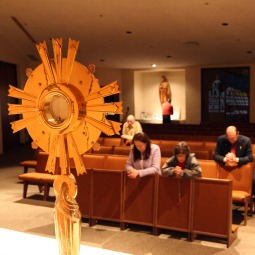
I enjoy attending eucharist adoration.  I started it last year.  Just to be within the silence of the church and to be able to meditate in front of the eucharist is very relaxing and healing.  It is also a grat way to praise the Lord and Jesus for what we have been given. 

I also have a book by Fr. Benedict Groeschel (forget the title) that I bring wth me that has many great adoration prayers. 

Adoration is a great experience for poeple to reflect, meditate and pray to our God.

Post a Comment

By submitting this form, you give The National Catholic Register permission to publish this comment. Comments will be published at our discretion, and may be edited for clarity and length. For best formatting, please limit your response to one paragraph and don't hit "enter" to force line breaks.

Name:

Email:

Write your comment:

Please enter the word you see in the image below:


Notify me of follow-up comments.

About Simcha Fisher

Simcha Fisher
  • Get the RSS feed
Simcha Fisher writes for several publications. She lives in New Hampshire with her husband and nine children. Without supernatural aid, she would hardly be a human being.