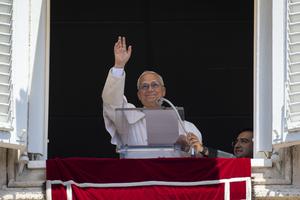
In case you missed it, on May 2 (2011) the Vatican held its first ever bloggers’ convention organized by the Vatican’s Pontifical Councils for Social Communications and for Culture.
From among 750 applications, they invited 150 bloggers (mostly Catholic) to attend in Rome. They had a good mix of personalities and perspectives participating.
I was sad that I wasn’t able to attend, but I am fortunate to know many of those who did. And from what I can gather so far, it was a successful first meeting. It’s also something that both excites me and gives me great confidence that Vatican leadership is on the right track.
Rev. Federico Lombardi, the Vatican’s top spokesperson, “conceded that he himself was not a blogger but that his life has ‘changed’ since he started receiving an ‘informal’ digest of Catholic blogs every morning.”
This is good for the Church. Here are 5 quick takes on the whole thing:
1) The Vatican is listening. Church leadership has an ability greater than ever before to powerfully listen to its people. The social web, including blogs, has been the driving force behind these new means of listening.
2) Church leadership is recognizing that blogs can be an effective representation of public opinion. Social media continues to give us better and better ways of weighing the gravity of each of the various opinions out there via shares, followers, influence, search rankings, etc. that overcome the bureaucratic, idea gate-keepers of the past. No longer do we only hear from those with the podium or the position to weigh in. Anybody can share an idea or opinion and—if it’s good—people will hear about it.
3) Blogs, social media and the web have changed the way culture is defined. It used to be confined and defined by geographical and national borders. Those barriers are becoming less and less important. Now we can form communities and movements around the aspects of culture that are usually far more important: ideas and beliefs. And we can do so without regard for geographical barriers. This means that the Vatican can’t solely rely on the traditional ways of listening to cultural representatives that it has in the past. It’s leadership must be present where these new cultural communities are being formed.
4) The Vatican has been wise not to assert its weight too strongly into the blogosphere and the web. Authority (the practical kind that people are influenced by) on the social web can not be asserted anyway. It must be earned. It must be consented to. The Church has gotten rather good at this in general and it is wise to continue this approach online. Leaders listen first, then lead. This is even more vital online as followers have more power than ever before to connect or disconnect as they please. Church leadership has a great opportunity to listen and then lead in ways that the world desperately needs her to lead. And she’s in a great place to facilitate more of it as she did with this recent bloggers’ convention.
5) I’m interested to see more of the specific action items that are executed as a result of this first Vatican bloggers’ convention. However, I think the most important benefits will come from simply having it in the first place. It does two key things. First, it builds a relationship between the (powerful) blogging community and Vatican leadership. Second, and probably more important, it further connects the Catholic blogging community to each other.
The key for the Vatican is to focus on becoming a facilitator in the Catholic blogging community. It has the organizational leadership to bring the right people together, allow leaders to emerge and then support the right leaders and movements. That is what authority and influence looks like on the social web. I’m excited to see the Vatican become immersed in the process and the adventure. We desperately need them and I look forward to what is next.


Comments
Post a Comment
As always Matt, you give a good run-down of what is going on.
Someone should make a blog about the Vatican blog meeting(s).
Thanks Matt. A great summary - and some good points. I’m looking forward to what happens next and how we can all help.
I watched the video interviews from the conference and was very pleased to see the wide variety of people attending.
I love the points you made. Blogging offers us as Catholics so many benefits we never had before. Namely, the ability to “get out in front of the conversation” rather than simply reacting to it. I was a bit concerned over the requests from certain bloggers to be able to get “documents” quicker which displays a sense of blogging-for-profit in my opinion.
One of the things that really got me thinking was the future of the Church. For the first time we are entering a time when there is a large base of Catholics that do not know the “old ways”. They do not remember a Latin Mass. They are not of the mindset to simply accept. They question, but not in a rebellious manner. They simply want furthering understanding. And they have a willingness to adopt modern things. We still have a large base resisting change and we see that with things like th acceptance and adoption to blogging. So the question becomes, is this the time where foundations are being built and we have to be patient for widespread and “mainstream” adoption within the Church?
I think the Vatican has done a magnificent thing in organizing a Bloggers convention.
I dont think it is that our Church is ‘behind’ because it doesnt jump on a bandwagon immediately. The Church is guided by the Holy Spirit. What may appear to be slow is actually not.
The comment..‘for the first time we are entering… do not know old ways.”
I am not sure what the writer means. I would take it to mean there is not a solid catechetical basis, and probably no reading of Church documents. I dont think blogging can help this, to be frank. I think the parishes or dioceses must start ‘teaching’ again and involve genuine orthodox catholics in the process. The parish in other words, needs to become the centre again… (as it was in the beginning).. or look at the Benedictine model of ‘a city’ - City of God.. with all vocations present.
spiritual and material needs are met. i believe the cornerstone to building up our christian/catholic Faith is right where we are standing, united to the Holy Father and the Magisterium. So blogosphere yes—but only to a certain point..
Like all things Catholic, if the content expressed by a Catholic blog is not consistent with the teaching of The Magisterium of The Catholic Church, the blog is not Catholic to begin with. There is only ONE Word of God, and the line that He drew in the sand did not separate the “liberal” Catholics from the “conservative” Catholics, but rather those who are with Him from those who are against Him. Without the ability to separate the wheat from the chaff, I am afraid what we will end up with is a whole lot of chaff and very little wheat.
thank God for sites like new advent, without which us wierdos out in the middle of nowhere would have no way of finding the good stuff in the blogsphere.
One thing I would like to see is anonymity removed from bloggers who present themselves as priests because they should not be in a position to teach the faith if their real identity is not known. This could have serious implications if someone falsely pretends to be a priest, or even teaches false doctrines to the faithful without the permission or oversight of his Bishop.
The bloggers should submit to the will of the Vatican. What’s this horseshit about about Rome needing to be careful “asserting” itself on the web?
There are faithful Catholics and there are unfaithful Catholics. The faithful will submit to Rome.
Great article Matt. I’m looking forward to what fruits ultimately come out of this and similar meeting.
“It must be earned.”
Foolish. No one “owns” the blogosphere. You make it sound as though, gee, NCR does, since it has the “respect” of it’s readership proven by the number of hits.
I promise you—even if the Vatican may not have a team of full-time bloggers on staff, they have more unique hits per day than any Catholic site. They are linked to more than any other Catholic site and are more relevant than any other Catholic site.
“It must be consented to.”
Really? Sounds rather Cafeteria Catholic, if you ask me. I didn’t kno a catholic post could sound so protestant, as though one needed to “agree” to be saved and accept Jesus as his savior.
Then again, maybe this is what the Vatican has relegated itself too—a bloggery sort of ecumenism, and now it’s sacrificed it’s “authority” for the sake of being “liked” in the blogosphere.
Matthew—I’ve just checked out your bio.
You’re a former electrical engineer who’s now trying to marry their faith with a career in social media.
And now, you’ve just asserted your authority over the Vatican—“Authority on the social web can not be asserted anyway. It must be earned. It must be consented to.”
It’s disgusting.
Do we even know your brand of Catholicism? Or your Catholic background? How is it you think you have more “authority” than the Vatican in the blogosphere?
At the very least, this is conceit and it hurts your credibility, at least with commenter.
ALL Catholic bloggers need to beware. Never put yourself above the Vatican, under any circumstances.. even if you “think” you’ve been around longer than the Vatican in social media.
The Vatican and the Magesterium has been “at it” and has far more credetials than you could possibly imagine.
For shame.
Veronica - I’m not following your logic at all. This post isn’t focusing on who actually has the authority. It is more about how that authority is effectively wielded on one particularly new frontier (new media) in the battle to win hearts and minds. I’m sorry if you misunderstood me. Thanks for your thoughts.
My goodness Veronica, what’s wrong with you? The Vatican is trying to open up its arms to us and you refuse to accept and attack those who don’t have your distorted attitude.
Veronica,
how you reach your conclusions from Matt’s blog is beyone me.
Veeronica,
How are things in right field?
Post a Comment
By submitting this form, you give The National Catholic Register permission to publish this comment. Comments will be published at our discretion, and may be edited for clarity and length. For best formatting, please limit your response to one paragraph and don't hit "enter" to force line breaks.